Alternative Financing Market Size, Share & Industry Analysis, By Model (Peer-to-Peer Lending, Crowdfunding, Invoive Trading, and Others), By Payment Instruments (Credit Transfers, Debit Transfers, Cash, Cheques, Cryptocurrency Wallets, and E-Money), By End User (Individual and Businesses), and Regional Forecast, 2026-2034
 Download Free Sample
KEY MARKET INSIGHTS
 Listen to Audio Version
The global alternative financing market size was valued at USD 505.45 billion in 2025. The market is projected to grow from USD 585.8 billion in 2026 to USD 1,690.66 billion by 2034, exhibiting a CAGR of 14.20% during the forecast period. Asia Pacific dominated the global market with a share of 79.90% in 2025.
Alternative financing is a method of debt security allotted by an organization to investors to raise investment for business requirements such as expansion, operations, or acquisitions. It describes a legal responsibility of the company to repay the primary amount on a certain maturity date. In return, the bondholder receives fixed interest payments, known as coupons. Alternative financings are traded in the secondary market and vary in credit risk, maturity, and yield.
Alternative financing companies, such as CircleUp Network, LendingClub, Kiva, and OnDeck, are leveraging technology to streamline lending processes, enhance data analytics, and reduce costs. The company’s focus on expanding its market reach by diversifying funding options, targeting underserved small businesses and individual borrowers who may lack access to traditional bank loans. Strategic partnerships, such as collaborations with FinTech platforms and institutional investors, help these companies scale while providing broader access to capital.
Alternative financing issuers adopted multiple strategies, such as dealing with refinancing risks and timing, to expand maturity profiles in the market. They may also follow credit rating upgrades to lower borrowing costs and attract institutional investors. Additionally, companies use sustainability or green-linked bonds to support ESG goals and broaden their investor base.
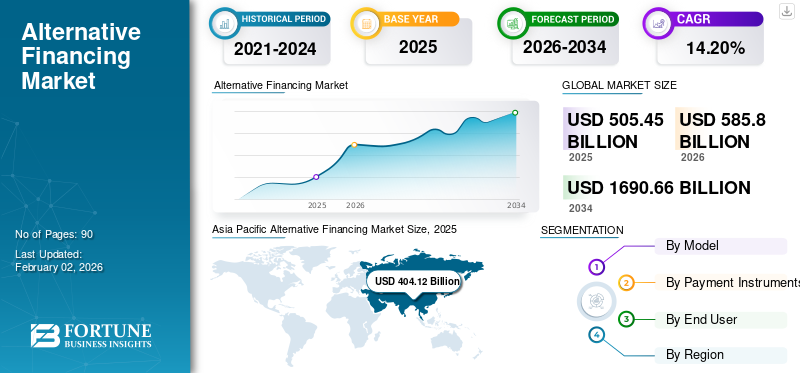
Download Free sample to learn more about this report.
Alternative Financing Market Key Takeaways
 Global Market Size & Forecast
- 2025 Market Size: USD 505.45 billion
- 2026 Market Size: USD 585.80 billion
- 2034 Forecast Market Size: USD 1,690.66 billion
- CAGR: 14.20% from 2026–2034
 Market Share
- Asia Pacific dominated the alternative financing market with a 79.90% share in 2025.
- Peer-to-peer lending is projected to account for 49.86% of the total market share in 2026.
- Credit transfers are expected to represent 40.37% of the market share in 2026.
 Key Regional Highlights
Asia Pacific
Asia Pacific generated USD 404.12 billion in 2025 and is projected to reach USD 474.84 billion in 2026.
North America
North America accounted for USD 53.89 billion in 2025 and is expected to grow to USD 58.90 billion in 2026.
Europe
Europe represented USD 28.28 billion in 2025 and is projected to reach USD 31.21 billion in 2026.
U.S.
The U.S. alternative financing market is projected to reach USD 45.88 billion by 2026.
Japan
The Japan alternative financing market is projected to reach USD 93.29 billion by 2026.
Read More

IMPACT OF GENERATIVE-AI
Rising Adoption of Gen-AI by AI Lending Technology Companies to Help Market Growth
Generative AI transforms the alternative financing market by extracting key data points from bank records, income statements, or loan applications, thereby decreasing decision time and manual efforts. Multiple AI lending technology companies are integrating Gen-AI into their systems to remain competitive. These developments aim to boost decision-making and improve fundraising success. For instance,
- In February 2024, Zest AI launched its new lending intelligence companion called ‘LuLu’. LuLu is a custom-built generative AI tool helping to rapidly capture strategic industry insights, assess portfolio and decisioning performance metrics, and provide speedily access to Zest AI’s product knowledge base.
MARKET DYNAMICS
Market Drivers
Growth of Blockchain and Decentralized Finance (DeFi) to Drive the Alternative Financing Market
The expansion of blockchain and decentralized finance is considerably advancing the global market by increasing accessibility and enhancing efficiency. Blockchain offers an immutable, secure, and transparent ledger that supports all DeFi transactions. This removes the need for integrated mediators (Such as banks) in processing transactions. For instance,
- Cross-chain bridges assisted over USD 1.3 trillion in annual asset movement, reflecting the increasing demand for DeFi and multi-chain ecosystems.
- Gravity Bridge invested over USD 620 million for Ethereum-Cosmos interoperability, driven by rising adoption in DeFi applications.
Market Restraints
Trust and Awareness Gap in Issuers and Companies Can Restrict Market Growth
Many businesses, especially small and medium-sized ones, are not aware of using alternative financing platforms such as crowdfunding, peer-to-peer lending, or DeFi-based funding. It is due to these platforms don’t offer the same level of financial oversight as traditional banks. Banks already have a history of financial activity, but alternative platforms often ask for open data sharing, such as using APIs or giving access to real-time sales and invoicing information. Thus, many companies show concern about losing control of their data or having it used in ways they don’t agree with, especially when working with outside platforms. Therefore, this gap is hampering the alternative financing market growth.
Market Opportunities
Digital Transformation and Fintech Innovation Present Great Opportunities for Market Players in the Future
The growth in APIs, mobile technology, and AI/ML-based models is primarily transforming how credit is delivered and accessed. These advancements are driving a broader digital transformation, simplifying financial services, allowing faster lending processes. Fintech companies are leveraging innovations to provide more inclusive and agile financial solutions. Furthermore, they are faster to adopt regulatory technologies that support compliance with evolving regulations and decreasing operational friction. For instance,
- According to industry analysis, around 90% of FinTech leaders strongly agreed that digital technologies are primarily helping the financial services sector. Such assistance will drive digital transformation and FinTech initiatives, as financial organizations continue innovating to remain competitive.
Thus, by strengthening digital infrastructure, FinTech platforms will accelerate the growth and efficiency of alternative financing models.
Alternative Financing Market Trends
Different Working Models in Developed and Developing Countries are Considered to be a Major Market Trend
The market is experiencing a dynamic transformation, with developed and developing countries evolving along distinctly different trajectories. These differences are driven by several factors, including the maturity of regulatory frameworks, financial infrastructure, rising digital adoption, and the particular financial needs of each region.
As a result, the alternative financing ecosystem has expanded into unique operating models that are explicitly personalized for the institutional landscape and local economic conditions. For instance, in urbanized markets where financial infrastructure is robust and regulatory environments are more established, alternative finance platforms are progressively inviting large institutional investors such as pension funds, hedge funds, and family offices.
SEGMENTATION ANALYSIS
By Model
Peer-to-Peer Lending Segment Dominated due to Increasing Investments and Partnerships Between Financial Institutions
Based on model, the market is divided into peer-to-peer lending, crowdfunding, invoive trading, and others (balance sheet lending).
Peer-to-peer lending is projected to account for 49.86% of the total market share in 2026, owing to increasing investments and partnerships between financial institutions and market players. As the market develops, innovative platforms and new entrants are introducing novel lending models and technologies. This strengthens competition and encourages major players to improve and upgrade their service offerings within the peer-to-peer lending space.
Crowdfunding is anticipated to grow at the highest CAGR during the forecast period. Various crowdfunding platform providers globally are aiming to increase their presence to support startup firms in raising funds from investors. Additionally, government units are increasingly supportive of product promotions related to crowdfunding platforms, thus contributing to the segment’s growth.
By Payment Instruments
Credit transfers Dominated due to their Affordability
Based on payment instruments, the market is fragmented into credit transfers, debit transfers, cash, cheques, cryptocurrency wallets, and e-money.
Credit transfers are expected to represent 40.37% of the market share in 2026, and it is anticipated to grow at the highest CAGR during the forecast period. Credit transfers have lesser transaction fees than wallet-based or card-based payouts, particularly for large-ticket payments. Alternative financing transactions include amounts from hundreds to thousands of dollars, where cost savings are substantial.
The rising adoption of credit card payments across most countries is playing a major role in pushing segmental growth. Widespread credit card penetration, supported by rising consumer spending capacity and improved payment infrastructure, is helping with the most convenient transactions. For instance,
- According to Industry Experts 2024, Credit card usage in India grew by 34% in 2024, compared to 26% in 2023, owing to consumers’ increased spending on their existing credit cards to finance consumption needs.
To know how our report can help streamline your business, Speak to Analyst
By End User
Individual Segment Led due to their High Engagement with Peer-To-Peer Lending Services
Based on end user, the market is bifurcated into individual and businesses.
The individual segment captured the largest market share in 2025 owing to their high engagement with peer-to-peer lending services, reward-based crowdfunding platforms, and micro-investment applications. Additionally, the easy access to funding opportunities through social media promotions and app-based platforms has boosted the individual user dominance in the market.
Businesses are anticipated to hold a 50.52% market share in 2026, owing to growing adoption of alternative financing solutions, including merchant cash advances, invoice factoring, supply chain financing, and equity crowdfunding to secure capital more flexibly and quickly than traditional banks. Specifically, SMEs are adopting these channels to meet funding expansion projects, working capital needs, and to address cash flow gaps.
ALTERNATIVE FINANCING MARKET REGIONAL OUTLOOK
By geography, the market is categorized into North America, Europe, Asia Pacific, South America, and the Middle East & Africa.
Asia Pacific
Asia Pacific Alternative Financing Market Size, 2025 (USD Billion)
To get more information on the regional analysis of this market, Download Free sample
Asia Pacific’s alternative financing market dominated in 2024. It is largely driven by the swift adoption of digital technologies, widespread access to smartphones and the internet, and the presence of a significant number of unbanked and underbanked population seeking easier access to obtain financing. At the same time, emerging markets such as India and South Korea are witnessing an increasing demand for alternative funding solutions, fueled by the growth in small and medium-sized enterprise (SME) activities. The Japan market is projected to reach USD 93.29 billion by 2026, the China market is projected to reach USD 223.47 billion by 2026, and the India market is projected to reach USD 106.73 billion by 2026. Asia Pacific contributed 79.90% to the global market in 2025, with a valuation of USD 404.12 billion, and is projected to reach USD 474.84 billion in 2026.
Download Free sample to learn more about this report.
China accounted for the largest share of the Asia Pacific alternative financing market in 2024, driven by its high population of digitally active consumers, rise in smartphone penetration, and a well-recognized digital payment ecosystem led by platforms such as WeChat Pay and Alipay. However, the country’s revenue contribution has recently declined due to the closure of numerous unlicensed operators following government restrictions.
North America
The North America market holds the second-highest share in 2024, owing to increasing investor interest in alternative assets in the U.S. The addition of blockchain for protected transactions and supportive regulation, such as the U.S. JOBS Act, has further boosted market expansion. Rising contribution from institutional investors and the increasing role of financing models, including invoice factoring and revenue-based financing, are also contributing to the region’s growth. The U.S. market is projected to reach USD 45.88 billion by 2026. In 2025, North America represented USD 53.89 billion, accounting for 10.70% of the worldwide market, and is projected to grow to USD 58.9 billion in 2026.
Europe
Europe will grow at a considerable CAGR owing to the integration of open banking APIs, the expansion of real-time payment systems such as SEPA Instant Credit Transfer, and the rising interest in green and sustainable financing models. Strong activity in Germany, the U.K., France, and the Nordics, driven by both institutional participation and retail investors, continues to emphasize Europe’s importance in the market. The UK market is projected to reach USD 9.01 billion by 2026, while the Germany market is projected to reach USD 6.57 billion by 2026. The Europe market generated USD 28.28 billion in 2025, representing 5.60% of the global market landscape, and is expected to reach USD 31.21 billion in 2026.
Middle East & Africa
The market in the Middle East & Africa is expanding due to the widespread adoption of mobile money platforms, such as M-Pesa is allowing small business financing in underserved MEA’s rural areas. Further, rising SME activity, combined with limited access to traditional banking services, is driving demand for the market. The Middle East & Africa market was valued at USD 14.18 billion in 2025, capturing 2.80% of global revenue, and is estimated to reach USD 15.55 billion in 2026.
Latin America
The South America region captured 1.00% of the global market in 2025, generating USD 4.98 billion in revenue, and is projected to reach USD 5.3 billion in 2026.
South America
The South American market is growing owing to the rising internet and smartphone penetration, rapid expansion of fintech startups, and growing demand for available credit among underbanked populations. Countries such as Argentina, Colombia, and Brazil are witnessing strong adoption of peer-to-peer lending, crowdfunding, and invoice financing as SMEs adopt more flexible funding alternatives to traditional banks.
Competitive Landscape
KEY INDUSTRY PLAYERS
Key Player Focuses on Expansion to Diversify Revenue Streams
Alternative financing players are broadening their service portfolios to offer complete lending and financing solutions across SME, consumer, and institutional segments. Companies are improving compliance measures to align with tightening regulations and build trust with partners and investors. In addition, they are expanding into new markets to diversify revenue streams and capture underserved borrower segments.
Long List of Companies Studied
- CircleUpNetwork, Inc. (U.S.)
- LendingClub (U.S.)
- Kiva (U.S.)
- OnDeck (U.S.)
- UpStart Network, Inc. (U.S.)
- SukFin (U.K.)
- eCapital (U.S.)
- Paro, Inc. (U.S.)
- Tala (U.S.)
- Funding Societies (Singapore)
- Clearbanc (Canada)
- Mintos (Latvia)
- Bitbond (Germany)
- Indifi (India)
- FairMoney (France)
- Funds, Inc. (Japan)
- Ant Group (China)
- Dianrong (China)
- And others
KEY INDUSTRY DEVELOPMENTS
- In July 2025, Charles River Laboratories International, Inc. and BioTech Social Inc. announced a client-centric collaboration to allow Charles River Incubator (CIP) and Accelerator (CAP) Program participants to access the BioTech Funding Portal, which is an investment crowdfunding platform for life science companies.
- In February 2025, the Secretariat of Lingkar Temu Kabupaten Lestari (LTKL) partnered with the Association of Indonesian Regency Governments (Apkasi), aimed at strengthening advocacy for alternative regional financing to support green economy development in LTKL member regencies.
- In May 2025, EIF initiated USD 23.0 million to fuel the expansion of CEE-based innovative SMEs via the Orbit Growth Debt II fund. This would help to provide alternative financing to innovative companies in Central and Eastern Europe.
REPORT COVERAGE
The report provides a detailed analysis of the market and focuses on key aspects such as leading companies, model types, and leading applications of the product. Besides, the report offers insights into the market trends and highlights key industry developments. In addition to the factors above, the report encompasses several factors that contributed to the growth of the market in recent years.
Request for Customization to gain extensive market insights.
REPORT SCOPE & SEGMENTATION
|
ATTRIBUTE |
DETAILS |
|
Study Period |
2021–2034 |
|
Base Year |
2025 |
|
Estimated Year |
2026 |
|
Forecast Period |
2026-2034 |
|
Historical Period |
2021–2024 |
|
Growth Rate |
CAGR of 14.20% from 2026-2034 |
|
Unit |
Value (USD Billion) |
|
Segmentation |
By Model · Peer-to-Peer Lending · Crowdfunding · Invoive Trading
By Payment Instruments · Credit Transfers · Debit Transfers · Cash · Cheques · Cryptocurrency Wallets · E-Money By End User · Individual
By Region · North America (By Model, By Payment Instruments, By End User, and By Country) o U.S. o Canada o Mexico · Europe (By Model, By Payment Instruments, By End User, and By Country) o U.K. o Germany o France o Italy o Spain o Russia o Benelux o Nordics o Rest of Europe · Asia Pacific (By Model, By Payment Instruments, By End User, and By Country) o China o India o Japan o South Korea o ASEAN o Oceania o Rest of Asia Pacific · Middle East & Africa (By Model, By Payment Instruments, By End User, and By Country) o Turkey o Israel o GCC o North Africa o South Africa o Rest of MEA · South America (By Model, By Payment Instruments, By End User, and By Country) o Brazil o Argentina Rest of South America |
|
Companies Profiled in the Report |
• CircleUpNetwork, Inc. (U.S.) • LendingClub (U.S.) • Kiva (U.S.) • OnDeck (U.S.) • UpStart Network, Inc. (U.S.) • SukFin (U.K.) • eCapital (U.S.) • Paro, Inc. (U.S.) • Tala (U.S.) • Funding Societies (Singapore) |
Frequently Asked Questions
The market is projected to reach USD 1,690.66 billion by 2034.
In 2025, the market was valued at USD 505.45 billion.
The market is projected to grow at a CAGR of 14.2% during the forecast period.
By model, peer-to-peer lending led the market.
Growth of Blockchain and Decentralized Finance (DeFi) is a key factor driving market growth.
CircleUpNetwork, Inc., LendingClub, and Kiva are the top players in the market.
Asia Pacific held the highest market share.



- 2021-2034
- 2025
- 2021-2024
- 90
Get 30-60 hrs Free Customization
Expand Regional and Country Coverage, Segments Analysis, Company Profiles, Competitive Benchmarking, and End-user Insights.













-
US +1 833 909 2966 ( Toll Free )
-
Get In Touch With Us