 Download Free Sample



Get a Quote
Receive a tailored pricing based on your needs.
- Choose license type
- Multiple user options
- Custom scope & coverage
- Fast turnaround
"Designing Growth Strategies is in our DNA"
 Listen to Audio Version
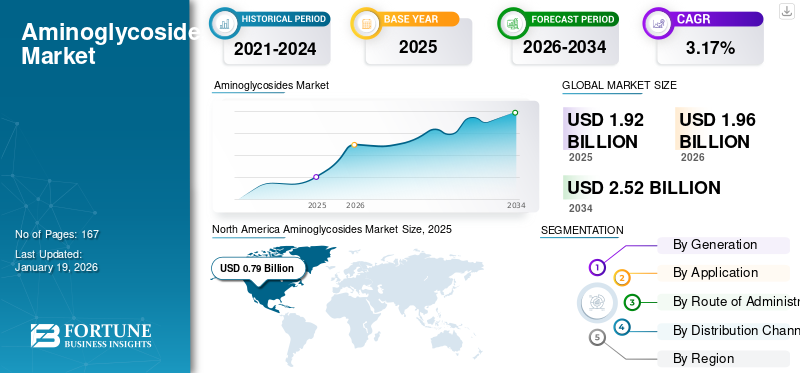
The global aminoglycosides market size was valued at USD 1.92 billion in 2025 and is projected to grow from USD 1.96 billion in 2026 to USD 2.52 billion by 2034, exhibiting a CAGR of 3.17% during the forecast period. North America dominated the aminoglycosides market with a market share of 41.31% in 2025.
Aminoglycosides are a major class of bactericidal antibiotics having strong activity against many bacteria. They are extensively employed in treating complicated urinary tract infections, sepsis, nosocomial pneumonia, and respiratory conditions such as cystic fibrosis. Some of the known aminoglycosides are neomycin, tobramycin, gentamicin, amikacin, paromomycin streptomycin. Aminoglycosides differ from the rest of the antibiotics as they interfere with protein synthesis by binding to the bacterial 30S ribosomal subunit of RNA, causing the misreading of mRNA. This mechanism stops bacterial growth and kills the pathogen actively.
They are rated as better for use in critical care settings due to their ability to work synergistically with β-lactam antibiotics, providing greater and stronger coverage against multidrug-resistant organisms. Advances in technologies, such as inhaled forms and semi-synthetic derivatives, have enhanced their safety and delivery. Additionally, the market is expected to grow due to ongoing research and development.
The market encompasses several major players, with Hikma Pharmaceuticals PLC, Pfizer Inc., and Cipla at the forefront. A broad portfolio, continuous innovative product launches, and strong geographic presence expansion have supported the dominance of these companies in the global market.
Download Free sample to learn more about this report.
 Market Size & Forecast
 Market Share
 Key Regional Highlights
North America
North America generated USD 0.79 billion in 2025 and is projected to reach USD 0.81 billion in 2026, supported by strong R&D activity, strategic collaborations, and new product launches.
Europe
Europe accounted for USD 0.50 billion in 2025 and is expected to reach USD 0.51 billion in 2026, driven by advanced healthcare infrastructure and antimicrobial stewardship initiatives.
Asia Pacific
Asia Pacific captured 17.23% of the global market in 2025 and is projected to grow to USD 0.34 billion in 2026, supported by rising healthcare investments and growing antibiotic demand.
U.S.
The country leads the North American market due to its robust healthcare ecosystem, strong purchasing capacity, and expanding access to innovative aminoglycoside therapies.
Japan
The market is supported by advanced healthcare systems, increasing focus on infection management, and continued adoption of effective antimicrobial treatments.
Read More

Rising Prevalence of Urinary Tract Infections to Augment Demand and Support Market Growth
One of the most common applications of aminoglycosides is for the treatment of urinary tract infections. The rising burden of these infections has resulted in increasing antibiotic prescriptions. These infections are on the rise due to several factors, such as increasing geriatric populations, higher incidence of diabetes and poor hygiene in developing regions, and hospital-acquired UTIs.
In response, key operating companies are streaming their resources toward research and development, along with new product launches, to cater to the need for cost-effective antibiotics for treatment.
Risk Associated with AMR to Hamper Market Growth
The aminoglycosides bactericidal class of antibiotics, pose a severe risk of development of antimicrobial resistance, hampering their effectiveness against bacterial infections. AMR has led to the emergence of aminoglycoside-resistant strains of Escherichia coli, Klebsiella pneumoniae, and Pseudomonas aeruginosa, which are among the most common causes of urinary tract, respiratory, and bloodstream infections.
Peptide-Linked Aminoglycoside Adjuvants for Combating MDR Infections to Create Lucrative Growth Opportunities
To combat the pressing issue of AMR, the development of multidrug-resistant aminoglycoside antibiotics provides a lucrative growth opportunity. Resistance to aminoglycosides is often derived from bacterial enzymes that modify and inactivate the drugs. Thus, the development of peptide-linked aminoglycoside conjugates could overcome this obstacle. This approach provides an adaptable pathway to restore the effectiveness of existing aminoglycosides against multidrug-resistant (MDR) pathogens.
Growing Adoption of Combination Therapy with Aminoglycosides is One of the Significant Market Trends
Aminoglycosides are increasingly being integrated into multidrug combination regimens rather than used as standalone therapies. In complex infections such as NTM lung disease caused by MAC, single-drug approaches have shown limited success. At the same time, combination therapy improves patient outcomes, slows resistance development, and extends the therapeutic life of existing antibiotics. This trend is reshaping the aminoglycoside market by shifting its use away from commodity applications toward specialized, value-driven roles within combination treatment strategies.
Risk of Toxicity Poses a Challenge and Hampers Market Growth
A key challenge facing the aminoglycoside market is the heightened risk of ototoxicity in patients with rare mitochondrial mutations. Despite drug levels remaining within the recommended therapeutic range, patients with mitochondrial mutations may still develop irreversible hearing loss. This creates a layer of clinical uncertainty, as the mutations are uncommon and their real-world impact remains difficult to predict. While genetic testing can help reduce risk, it is not always feasible in urgent care situations and may not be practical for all patient populations.
Download Free sample to learn more about this report.
Growing Occurrence of Bacterial Infections to Boost Third-Generation Segment Growth
On the basis of generation, the market is classified into first generation, second generation, third generation, and others.
The third generation segment is estimated to hold the leading share in the market. The high share is attributed to the third generation due to the increasing incidence of bacterial infections and the promising effectiveness showcased by third-generation aminoglycosides. Additionally, undermining the growing demand, many key operational entities are focusing on strategic collaboration and partnership to expand access to these medications.
Respiratory Tract Infections Segment Dominated due to Rising Emphasis on Research and Development
In terms of application, the market is categorized into urinary tract infections, respiratory tract infections, skin infections, ophthalmic infections, and others.
The respiratory tract infection segment captured the largest aminoglycosides market share in 2024. Aminoglycosides play an important role in the treatment of respiratory tract infections, particularly caused by Pseudomonas aeruginosa, which is a common cause of hospital-acquired infections. These products show effectiveness against these multidrug-resistant bacteria and are used to treat cystic fibrosis. Due to such wide application, many key companies are focusing on research and development of new products to drive segment growth in the forecast period.
New Product Launches Boosted the Topical Segment Growth
Based on route of administration, the market is segmented into oral, parenteral, topical, and others.
The topical segment held the dominant market share in 2024. The topical route of administration provides various benefits such as minimal systemic absorption, rapid effectiveness against infections, and lower dosing requirements. Furthermore, novel product launches are expected to drive growth in the segment.
Retail Pharmacy Segment Led due to Easy Access to Medication
Based on distribution channel, the market is segmented into hospital pharmacy, retail pharmacy, and online pharmacy.
In 2024, the global market was dominated by retail pharmacies in terms of distribution channels. Retail pharmacies provide easy access to medication and retain higher engagement and trust among patients, contributing to growth in the segment. Underlying these benefits, many retail pharmacies are focusing on expanding their distribution network to better serve patient needs.
By geography, the market is categorized into North America, Europe, Asia Pacific, Latin America, and the Middle East & Africa.
North America Aminoglycosides Market Size, 2025 (USD Billion)
To get more information on the regional analysis of this market, Download Free sample
In 2025, North America generated USD 0.79 billion, contributing 41.31% to global market revenue, and is projected to grow to USD 0.81 billion in 2026. The dominance of the region is supported by strategic collaboration among key operational entities, new product launches, and research and development activities.
Furthermore, the U.S. dominated the North America region due to a robust healthcare ecosystem, along with strong purchasing capacity, strategic collaboration among key companies, and reimbursement mechanisms for critical antibiotics in the country.
Other regions, such as Europe and the Asia Pacific, are also anticipated to witness a notable growth in the coming years. During the forecast period, the Europe market accounted for USD 0.5 billion in 2025, representing 26.06% of the global industry, and is expected to reach USD 0.51 billion in 2026. This growth is primarily due to the strong healthcare infrastructure and increasing antimicrobial stewardship, coupled with stringent safety regulations. After Europe, the Asia Pacific recorded a market size of USD 0.33 billion in 2025, capturing 17.23% of the global market share, and is projected to reach USD 0.34 billion in 2026.
The Latin America and Middle East & Africa regions would witness a moderate growth over the forecast period. Asia Pacific recorded a market size of USD 0.33 billion in 2025, capturing 17.23% of the global market share, and is projected to reach USD 0.34 billion in 2026. The Middle East & Africa market generated USD 0.09 billion in 2025, representing 4.88% of the global market landscape, and is expected to reach USD 0.09 billion in 2026.
Industry Participants Focus on Geographic Expansion to Reinforce their Market Presence
The global market shows a semi-concentrated structure with numerous small- to mid-size companies actively operating across the globe. These players focus on product innovation, strategic partnerships, and geographic expansion to strengthen their market presence.
Amneal Pharmaceuticals, Inc., Hikma Pharmaceuticals PLC, and Cipla are some of the key players in the market. They offer a comprehensive range of aminoglycosides globally through a strong distribution network, and strategic collaborations with other operational entities further support their dominance.
Apart from this, other prominent players in the market include Insmed Incorporated, Lupin, Sun Pharmaceutical Industries Ltd, Nordic Group B.V., and others. These companies are undertaking various strategic initiatives, such as investments in R&D and partnerships with pharmaceutical companies to enhance their market presence.
The global aminoglycosides market analysis provides an in-depth study of market size & forecast by all the market segments included in the report. It includes details on the market dynamics and market trends expected to drive the market in the forecast period. It offers information on the technological advancements, new product launches, key industry developments, and details on partnerships, mergers & acquisitions. The market research report also encompasses a detailed competitive landscape with information on the market share and profiles of key operating players.
Request for Customization to gain extensive market insights.
|
ATTRIBUTE |
DETAILS |
|
Study Period |
2021-2034 |
|
Base Year |
2025 |
|
Estimated Year |
2026 |
|
Forecast Period |
2026-2034 |
|
Historical Period |
2021-2024 |
|
Growth Rate |
CAGR of 3.17% from 2026-2034 |
|
Unit |
Value (USD Billion) |
|
Segmentation |
By Generation
|
|
By Application
|
|
|
By Route of Administration
|
|
|
By Distribution Channel
|
|
|
By Geography
|
Fortune Business Insights says that the global market value stood at USD 1.92 billion in 2025 and is projected to reach USD 2.52 billion by 2034.
In 2025, the market value stood at USD 0.79 billion.
The market is expected to exhibit a CAGR of 3.17% during the forecast period (2026-2034).
By generation, the third generation segment led the market.
The key factors driving the market are the rising focus on research and development activities.
Pfizer Inc., Cipla, and Insmed Incorporated are some of the prominent players in the market.
North America dominated the market with a share of 41.31% in 2025.

Get 30-60 hrs Free Customization
Expand Regional and Country Coverage, Segments Analysis, Company Profiles, Competitive Benchmarking, and End-user Insights.













.webp)






Related Reports
Get In Touch With Us
US +1 833 909 2966 ( Toll Free )
Receive a tailored pricing based on your needs.
Discuss your questions with our industry experts.
Have questions? Get quick answers before you purchase.

