Animal Parasiticides Market Size, Share & Industry Analysis, By Product (Ectoparasiticides, Endoparasiticides, and Endectocides), By Animal Type (Companion {Feline, Canine, Avian, and Others}, and Livestock {Poultry, Porcine, Bovine, and Others}), By Route of Administration (Oral, Parenteral, Topical, and Others), By Distribution Channel (Veterinary Hospitals, Veterinary Clinics, Pharmacies & Drug Stores, and Others), and Regional Forecast, 2026-2034
 Download Free Sample
ANIMAL PARASITICIDES MARKET SIZE AND FUTURE OUTLOOK
 Listen to Audio Version
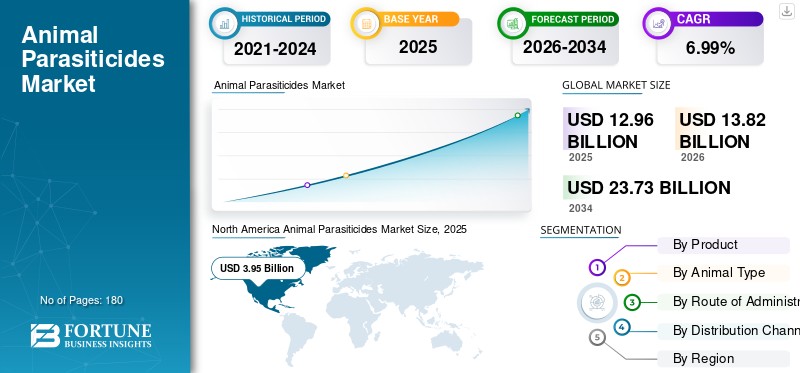
The global animal parasiticides market size was valued at USD 12.96 billion in 2025 and is projected to grow from USD 13.82 billion in 2026 to USD 23.73 billion by 2034, exhibiting a CAGR of 6.99% during the forecast period. North America dominated the global animal parasiticides market with a market share of 30.48% in 2025.
Animal parasiticides are used for the prevention, treatment, and control of parasitic infestations in animals. The parasites such as external ticks, fleas, and mites, as well as internal parasites such as worms and protozoa.
The increasing prevalence of parasitic diseases in companion and livestock animals is driving the demand for effective parasiticides.
- For example, according to data published by HealthforAnimals in the U.S., around 20.7% of dogs sampled tested positive for parasites in dog parks. As parasites lead to irritated skin, hair loss, bites, and other diseases, the adoption of parasiticides drives market growth.
Furthermore, the presence of prominent market players, such as Zoetis Services LLC, Elanco, and Virbac, with robust product offerings and strong research and development initiatives, is expected to propel market growth.
Download Free sample to learn more about this report.
Animal Parasiticides Market KEY TAKEAWAYS
 Market Size & Forecast
- 2025 Market Size: USD 12.96 billion
- 2026 Market Size: USD 13.82 billion
- 2034 Forecast Market Size: USD 23.73 billion
- CAGR: 6.99% from 2026–2034
 Market Share
- North America dominated the animal parasiticides market with a 30.48% share in 2025.
- The pharmacies and drug stores segment held the largest market share of 36.4% in 2025.
- The companion segment dominated the market with a 52.9% share in 2025.
 Key Regional Highlights
North America
North America held the leading position in 2025, valued at USD 3.95 billion, and maintained its dominance in 2026.
Europe
Europe was valued at USD 3.52 billion in 2025 and is projected to grow at a CAGR of 6.24% during the forecast period.
Asia Pacific
Asia Pacific reached USD 3.08 billion in 2025, making it the third-largest regional market globally.
U.S.
U.S. The market was valued at USD 3.73 billion in 2025, supported by strong demand for animal healthcare products.
Japan
Japan Growing focus on companion animal health and preventive veterinary care is supporting market expansion.
Read More

MARKET DYNAMICS
MARKET DRIVERS:
Increasing Demand for Animal Protein to Propel Market Growth
The rising demand for animal protein is expected to increase the adoption of parasiticides for maintaining the health and condition of animals, driving market growth. With increasing demand for animal protein, livestock farmers are focusing on adopting parasite control solutions to ensure the health and productivity of their animals.
- For instance, the United Nations Food and Agriculture Organization (FAO) estimated that between 2010 and 2050, the production of animal proteins is expected to grow by around 1.7% per year. Under this scenario, meat production is projected to rise by nearly 70.0%, aquaculture by 90.0%, and dairy by 55.0%.
These measures reduce economic losses and help maintain disease-free livestock, driving demand for global animal parasiticides.
MARKET RESTRAINTS
Anti-Parasiticides Resistance is a Significant Factor Restraining Market Growth
Anti-parasiticide resistance is restricting the product adoption and market growth. Parasites such as ticks, fleas, and worms develop resistance through genetic adaptations due to the excessive use of parasiticides. Also, resistance complicates disease control efforts, prolonging infections and increasing healthcare burdens. Thus, the growing prevalence of parasitic resistance is hindering the market's expansion.
- For instance, in March 2025, NOAH launched a new campaign, “Use It Right, Treat Them Right,” to support the responsible use of anti-parasitic medicines for pets.
MARKET OPPORTUNITIES
Growth of Companion Animal Sector to Offer Lucrative Growth Opportunity
The rising number of pet ownership and the humanization of pets are two prominent factors bolstering market growth. Rising pet ownership increases the demand for advanced and standard parasiticide products for parasite control. Additionally, the rising prevalence of parasite infections in pet animals and increased awareness about zoonotic diseases transmitted by parasites encourage owners to adopt products for parasite control, thereby boosting market growth during the forecasted timeframe.
- For instance, in March 2024, as per the data published by HealthforAnimals, around 92 million pet dogs and 113 million pet cats are in the European Union, 85 million pet dogs and 65 million pet cats are in the U.S. Thus, with the rising number of parasite infections and the growing pet population to boost the market growth.
ANIMAL PARASITICIDES MARKET TRENDS
Rising Research & Development and Investment to Act as Key Market Trend
The rising cases of parasite resistance in animals shifted the focus of key players to develop and launch novel anti-parasite drugs to combat the growing threat of drug resistance.
Additionally, the increasing number of funding and investment activities is expected to boost market growth and act as a prominent trend in the global animal parasiticides market.
- For instance, in July 2025, ASTRA Therapeutics secured seed funding of USD 8.9 million for the development of drugs targeting eukaryotic pathogens, leveraging its proprietary platform. This drug is designed to be an anti-parasitic agent that helps combat drug resistance and ensures the health and welfare of pets and food animals.
Download Free sample to learn more about this report.
MARKET CHALLENGES
Presence of Counterfeit & Substandard Parasiticides to Hamper Brand Image and Product Adoption
The presence of counterfeit products in the market undermines market trust and product adoption. The similar packaging of products leads to confusion, and genuine brands may be mistaken for counterfeit products, which can be harmful to consumers. This leads to a decline in confidence in genuine products, resulting in lower product adoption and sales. Additionally, the harmful side effects and inefficiency of these products lead to a degradation of consumer trust and challenge the animal parasiticides market growth.
- For instance, in June 2025, the U.K.'s Intellectual Property Office and Veterinary Medicines Directorate issued a warning against toxic insecticide discovered in counterfeit flea treatments that leads to severe poisoning in cat. Such products erode consumer trust and hinder market growth.
SEGMENTATION ANALYSIS
By Product
Increasing Prevalence of Internal Parasites Boosted Endoparasiticides Segment Growth
Based on product, the global market is segmented into ectoparasiticides, endoparasiticides, and endectocides.
The endoparasiticides segment held the highest animal parasiticides market share in 2025, driven by the rising prevalence of internal parasites in animals and increasing product launches for the treatment.
- For instance, in July 2023, Boehringer Ingelheim International GmbH declared the U.S.FDA approval of Parasiticides ‘NexGard Plus’. This drug is a combination type and protects animals against internal and external parasites.
To know how our report can help streamline your business, Speak to Analyst
By Animal Type
Increasing Pet Ownership and Launches Propelled Companion Animal Segment
Based on animal type, the market is divided into livestock and companion.
The companion segment dominated the market with a 52.9% share in 2025. Rising pet ownership and the increasing focus of key players on launching products for pets are expected to boost the segment’s growth in the market.
- For instance, according to data published by World Population Review, the number of dogs in the U.S. was an estimated 90 million in 2025
The livestock segment is expected to grow at a CAGR of 6.05% over the forecast period.
By Route of Administration
Oral Segment Led Market Due to Ease of Administration
Based on route of administration, the market is segmented into parenteral, topical, oral, and others.
The oral segment held the dominating position in 2025. The oral segment held a 28.8% share in 2024. This is attributed to ease of administration and availability. Moreover, top companies emphasize the launch of various new products that cater to the needs of pet owners and livestock breeders.
- For instance, in September 2024, Elanco announced that Zenrelia had been approved by the U.S. Food and Drug Administration (FDA). The ilinocitinib tablets are used to control pruritus associated with allergic dermatitis and to manage atopic dermatitis in dogs.
The parenteral segment is set to flourish with a growth rate of 6.42% over the forecast period.
By Distribution Channel
Easy Availability of Generic Drugs Boosted Pharmacies & Drug Stores Segment
By distribution channel, the global market is segregated into veterinary clinics, pharmacies & drug stores, veterinary hospitals, and others.
Pharmacies and drug stores dominated the market in 2025. The segment held a 36.4% share in 2025. The vast availability of generic drugs and easy accessibility propel the market growth for pharmacies and drug stores. Additionally, a growing focus among key players on launching animal health-focused divisions is expected to boost the segment’s growth in the market.
- For example, in January 2025, Revelation Pharma announced the launch of its new animal-focused division, Revelation Animal Health, designed to meet the unique health needs of animals nationwide.
Additionally, veterinary clinics are projected to grow as a distribution channel at a CAGR of 7.44% during the study period.
Animal Parasiticides Market Regional Outlook
By geography, the market is categorized into Europe, North America, Asia Pacific, Latin America, and the Middle East & Africa.
North America Animal Parasiticides Market Size, 2025 (USD billion)
To get more information on the regional analysis of this market, Download Free sample
North America
North America held the dominant share in 2025, valued at USD 3.95 billion, and also took the leading share in 2026 with USD 4.19 billion. North America’s dominance in the market is driven by rising pet ownership, increasing demand for animal protein. The presence of key market players with advanced product offerings and awareness regarding animal health are factors that are collaboratively boosting the market’s growth in the region.
The U.S. market is valued at USD 3.73 billion in 2025. The U.S. dominated the North America region's market. This is driven by a high dependency on animal protein and the widespread adoption of advanced livestock farming technologies, which also contribute to increased pet ownership rates.
- For instance, according to the American Veterinary Medical Association, in 2025, pet-related expenditures were reported, with dog owners spending an average of USD 598, cat owners spending USD 529, and owners of other types of pets spending USD 552.
Europe
Europe is projected to record a growth rate of 6.24%, the second-highest among all regions, and valued at USD 3.52 billion by 2025. The increasing demand for animal protein, rising parasite infections, and awareness among farmers and pet owners are boosting market growth in the region. Backed by these factors, countries including the U.K. record valuations of USD 1.09 billion, Germany USD 0.49 billion, and France USD 0.58 billion in 2025.
Asia Pacific
The Asia Pacific animal parasiticides market is valued at USD 3.08 billion in 2025, securing the position of the third-largest region in the market. In the region, India and China are both valued at USD 0.45 billion and USD 1.12 billion, respectively, in 2025.
Latin America and Middle East & Africa
Latin America and the Middle East & Africa regions are expected to witness moderate growth in this market in the coming years. The Latin America market is valued at USD 1.34 billion in 2025. The increasing prevalence of parasite infections, combined with a focus on livestock farming, is boosting the region's growth. In the Middle East & Africa, the GCC registers a value of USD 0.55 billion in 2025.
COMPETITIVE LANDSCAPE:
KEY INDUSTRY PLAYERS
Robust Product Offerings & Strategic Activities to Maintain Dominance of Key Players in Market
The global animal parasiticides market exhibits a semi-consolidated structure, characterized by a large number of strong players. Zoetis Services LLC, Merck Animal Health, and Elanco are some of the prominent players in the market. The company's robust product offerings, strong focus on research and development, and strategic initiatives, such as collaborations, have strengthened its market position.
Other prominent players include Ceva, Vetoquinol, and Virbac, each employing diverse strategies to expand their market presence. These strategies involve introducing innovative products and forming strategic partnerships to meet evolving customer needs.
LIST OF KEY ANIMAL PARASITICIDE COMPANIES PROFILED:
- Zoetis Services LLC (U.S.)
- Merck & Co., Inc. (U.S.)
- Elanco (U.S.)
- Boehringer Ingelheim International GmbH (Germany)
- Ceva (France)
- Vetoquinol (France)
- Dechra Pharmaceuticals Limited (U.K.)
- Virbac Corporation (France)
KEY INDUSTRY DEVELOPMENTS:
- August 2025: Merck & Co., Inc. presented the BRAVECTO fluralaner portfolio at the 2025 World Association for the Advancement of Veterinary Parasitology Congress (WAAVP). This portfolio is an advancement in parasite prevention and treatment.
- April 2025: Zoetis Services LLC announced approval of a new label indication for Simparica Trio to prevent flea tapeworm infections in treated dogs. Simparica Trio is the only canine combination that prevents flea and tapeworm infections by killing vector fleas before they can transmit the parasites.
- October 2024: Boehringer Ingelheim International GmbH launched a monthly parasiticide solution for cats in the UAE. The new product offers defense against internal and external parasites.
- July 2021: Vetoquinol launched Imoxi (imidacloprid + moxidectin) topical solution for protection against heartworm, control of fleas, and intestinal parasites in dogs.
- January 2020: Norbrook Inc. launched topical parasiticides for dogs and cats. It is used to treat and prevent fleas, heartworm disease, and ear mites in dogs and cats.
REPORT COVERAGE
The global animal parasiticides market report provides a detailed analysis of the market. It focuses on key aspects, including leading companies, products, animals, route of administration, and distribution channels. Besides this, it offers insights into the market trends, the impact of, and the prevalence of key diseases. In addition to the factors mentioned above, the report encompasses several factors that have contributed to the market's growth over recent years.
Request for Customization to gain extensive market insights.
Report Scope & Segmentation
|
ATTRIBUTE |
DETAILS |
|
Study Period |
2021-2034 |
|
Base Year |
2025 |
|
Forecast Period |
2026-2034 |
|
Historical Period |
2021-2024 |
|
Growth Rate |
CAGR of 6.99% from 2026 to 2034 |
|
Unit |
Value (USD Billion) |
|
Segmentation |
Pruodct, Animal Type, Route of Administration, Distribution Channel, and Region |
|
By Product |
|
|
By Animal Type |
Companion
Livestock
|
|
By Route of Administration |
|
|
By Distribution Channel |
|
|
By Region |
North America (By Product, By Animal Type, By Route of Administration, By Distribution Channel, By Country/ Sub-Region)
Europe (By Product, By Animal Type, By Route of Administration, By Distribution Channel, By Country/ Sub-Region)
Asia Pacific (By Product, By Animal Type, By Route of Administration, By Distribution Channel, By Country/ Sub-Region)
Latin America (By Product, By Animal Type, By Route of Administration, By Distribution Channel, By Country/ Sub-Region)
Middle East & Africa (By Product, By Animal Type, By Route of Administration, By Distribution Channel, By Country/ Sub-Region)
|
Frequently Asked Questions
Fortune Business Insights says that the market is projected to reach USD 23.73 billion by 2034.
In 2025, the market stood at USD 12.96 billion.
By registering a CAGR of 6.99%, the market is expected to exhibit steady growth during the forecast period (2026-2034).
By product, the endoparasiticides segment led the market.
The rising prevalence of key veterinary diseases and the increase in pet ownership are expected to drive market growth.
Zoetis, Elanco, Inc., and Merck Animal Health are the top players in the market.
North America held the largest share of the market.
Increased prevalence of parasitic infections would drive the adoption of animal parasiticides.



- 2021-2034
- 2025
- 2021-2024
- 180
Get 30-60 hrs Free Customization
Expand Regional and Country Coverage, Segments Analysis, Company Profiles, Competitive Benchmarking, and End-user Insights.













.webp)






Related Reports
-
US +1 833 909 2966 ( Toll Free )
-
Get In Touch With Us