Anti-Reflective Coatings Market Size, Share & Industry Analysis, By Technology (Sputtering, Vacuum Deposition, Sol-Gel Coating, Electron Beam Evaporation, and Others), By Material Type (Metal Oxides, Fluorides, Nanostructured Materials, Polymer-Based Coatings, and Others), By Application (Eyewear & Optical Lenses, Electronics & Displays, Solar Panels, Automotive, Aerospace & Defense Optics, and Others), and Regional Forecast, 2026-2034
 Download Free Sample
Anti-Reflective Coatings Market Size and Future Outlook
 Listen to Audio Version
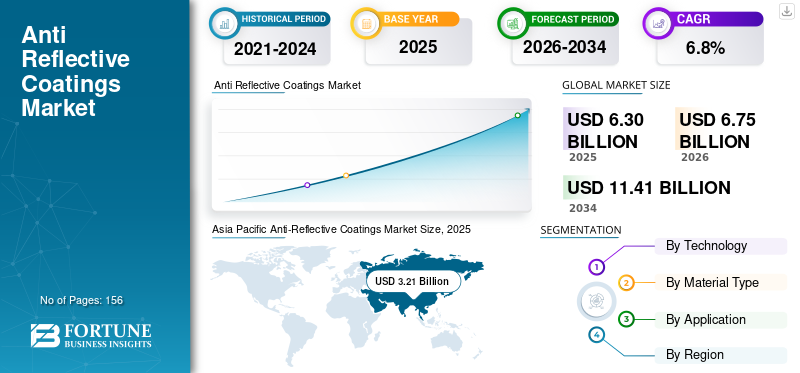
The anti-reflective coatings market size was valued at USD 6.30 billion in 2025. The market is projected to grow from USD 6.75 billion in 2026 to USD 11.41 billion by 2034, exhibiting a CAGR of 6.8% during the forecast period. Asia Pacific dominated the anti reflective coatings market with a market share of 50.95% in 2025.
Anti-reflective coatings are thin layers applied to glass, lenses, screens, and optical components to reduce glare and improve light clarity. They are widely used in eyewear, consumer electronics, solar panels, automotive displays, and architectural glass. Increase in the product demand is mainly linked to the need for better visibility, higher light transmission, improved energy efficiency, and enhanced product performance. Globally, the market is supported by steady growth in electronics, renewable energy, automotive interiors, and optical applications, with demand driven by performance improvement, product upgrades, and replacement needs rather than rapid volume expansion.
The market is led by a group of global optical, glass, and coating manufacturers with strong technical capabilities and established coating technologies. Major players such as ESSILOR OF AMERICA, INC., ZEISS Group, Guardian Industries Holdings Site, HOYA, AGC Glass Europe SA, and specialized regional producers focus on optical clarity, glare reduction, scratch resistance, durability, and consistent product performance. This results in a moderately consolidated market, where demand is steady across eyewear, displays, solar panels, automotive glass, and precision optics, supported by high product-quality requirements and customer reliance on proven coating performance.
Download Free sample to learn more about this report.
ANTI-REFLECTIVE COATINGS MARKET TRENDS
Shift Toward Durable and Multifunctional Coatings Is Reshaping Market
A key trend in the market is the shift from basic glare-reduction coatings to more durable and multifunctional coating solutions. Manufacturers are focusing on coatings that reduce reflection while also offering scratch resistance, smudge resistance, water repellency, and easier cleaning. This is becoming significant in eyewear, displays, optical lenses, solar glass, and automotive glass, where surfaces need to remain clear and durable during regular use. From a business perspective, these advanced coatings help companies improve product quality, support premium positioning, and meet rising customer expectations for longer-lasting performance.
- According to the National Renewable Energy Laboratory (NREL), the longevity of anti-reflective coatings on solar PV modules can range from less than 1 year to over 15 years, highlighting the need for more durable coating solutions.
Download Free sample to learn more about this report.
MARKET DYNAMICS
MARKET DRIVERS
Rising Demand from Solar Panels Drives Market Expansion
The anti-reflective coatings market growth is are primarily driven by growing product demand in solar panel applications, as they reduce light reflection and improve light transmission through the glass surface. Solar modules require higher light absorption to improve energy output and overall efficiency, making anti-reflective-coated glass an important material in photovoltaic systems. This end-use expansion creates a clear demand-side pull for anti-reflective coatings, as higher solar panel production directly translates into increased consumption of coatings used on photovoltaic glass and module surfaces.
- According to the U.S. Energy Information Administration (EIA), generators added a record 30 GW of utility-scale solar capacity to the U.S. grid in 2024, accounting for 61% of total capacity additions that year, supporting higher demand for anti-reflective coatings used on photovoltaic glass and module surfaces.
MARKET RESTRAINTS
High Production Cost and Technical Requirements Limit Wider Adoption
Anti-reflective coating demand is constrained by the high cost and technical complexity of coating application, especially for precision optical surfaces, solar glass, and advanced display panels. These coatings require controlled deposition processes, uniform thickness, strong adhesion, and long-term durability to maintain optical performance under regular use or outdoor exposure. Any inconsistency can affect glare reduction, light transmission, or surface resistance, thus increasing rejection rates and production costs. This limits wider adoption in price-sensitive applications, as manufacturers must balance improved optical performance with coating cost, process efficiency, and final product affordability.
MARKET OPPORTUNITIES
Rising Use of AR/VR Devices and Advanced Optics Creates New Growth Opportunities
The market is expected to benefit from the growing use of AR/VR devices, smart wearables, camera lenses, and advanced optical systems. These applications require clear vision, low glare, and improved light transmission to enhance image quality and user comfort. As manufacturers develop lighter, clearer, and more advanced optical products, the need for high-quality coated lenses and glass surfaces is increasing. This creates a strong market growth opportunity, as wider use of advanced optical devices directly supports higher demand for premium coating solutions.
- According to the U.S. Government Accountability Office (GAO), 16 of 23 U.S. civilian federal agencies plan to expand the use of immersive Technology during FY 2024–2028, supporting demand for advanced optical devices with anti-reflective coatings.
MARKET CHALLENGES
Maintaining Long-Term Coating Performance Remains a Key Market Challenge
The market face a key challenge in maintaining coating performance over a long period, especially in applications exposed to cleaning, scratches, moisture, sunlight, and outdoor conditions. These coatings must continue to reduce glare, improve light transmission, and keep the surface clear during regular use. If the coating wears out or loses effectiveness, it can reduce product performance and affect customer trust. This makes durability, coating uniformity, and quality control significant for manufacturers, particularly in solar glass, eyewear, displays, and precision optical products.
Segmentation Analysis
By Technology
High Precision and Strong Film Control Drive Dominance of Sputtering Technology
Based on technology, the market is segmented into sputtering, vacuum deposition, sol-gel coating, electron beam evaporation, and others.
To know how our report can help streamline your business, Speak to Analyst
The sputtering segment accounted for the largest anti-reflective coatings market share in 2025. It enables highly uniform, durable, and controlled thin-film coatings on glass, lenses, displays, solar panels, and precision optical surfaces. This technology is preferred in applications where coating thickness, optical clarity, adhesion, and long-term surface performance are critical. Its ability to produce high-quality coatings with strong consistency makes it suitable for advanced optical and electronic devices. As demand for clearer, more durable, and high-performance coated surfaces increases, sputtering remains the most widely adopted technology in anti-reflective coating production.
The sol-gel coating segment is expected to grow at a 7.7% CAGR over the forecast period.
By Material Type
Strong Optical Performance Drives Dominance of Metal Oxides in Consumption
Based on material type, the market is segmented into metal oxides, fluorides, nanostructured materials, polymer-based coatings, and others.
To know how our report can help streamline your business, Speak to Analyst
The metal oxides segment accounted for the largest share of the market in 2025. They offer strong optical clarity, good durability, and stable coating performance across glass, lenses, displays, solar panels, and precision optical surfaces. Materials such as silicon oxide, titanium oxide, and aluminum oxide are widely used in thin-film coating systems where light transmission, reflection control, adhesion, and surface protection are important. Their ability to support consistent coating quality and long-term performance makes them highly suitable for both consumer and industrial applications. As demand for clear, durable, and high-performance optical surfaces continues to grow, metal oxides remain the most structurally important material type in the market.
The nanostructured materials segment is expected to grow at a 8.0% CAGR over the forecast period.
By Application
Growing Demand for Vision Clarity and Daily Use of Eyewear & Optical Lenses Leads to Segment’s Dominance
By application, the market is segmented into eyewear & optical lenses, electronics & displays, solar panels, automotive, aerospace & defense optics, and others.
The eyewear & optical lenses segment accounted for the largest market share in 2025. Anti-reflective coatings are widely used to reduce glare, improve light transmission, and enhance visual comfort in prescription glasses, sunglasses, and precision lenses. As consumers increasingly prefer clearer vision, better lens appearance, and reduced eye strain, anti-reflective coatings have become an important value-added feature in optical products. This creates a steady, replacement-driven demand base, as regular eyewear purchases and lens upgrades sustain consistent consumption of anti-reflective coating materials.
The solar panels segment is expected to grow at a 8.4% CAGR over the forecast period.
Anti-Reflective Coatings Market Regional Outlook
By geography, the market is categorized into North America, Europe, Asia Pacific, Latin America, and the Middle East & Africa.
Asia Pacific
Asia Pacific Anti-Reflective Coatings Market Size, 2025 (USD Billion)
To get more information on the regional analysis of this market, Download Free sample
Asia Pacific held the dominant position in 2025, valued at USD 3.21 billion, and is expected to retain its leading role in 2026, reaching USD 3.47 billion. The region’s leadership is driven by its strong electronics manufacturing base, large eyewear production capacity, expanding solar panel industry, and growing use of advanced coated glass and optical components. Robust demand from consumer electronics, optical lenses, photovoltaic modules, automotive displays, and precision optics supports sustained consumption of anti-reflective coatings, particularly in high-volume, performance-focused applications.
China Anti-Reflective Coatings Market
Based on Asia Pacific’s strong contribution and China’s large-scale manufacturing footprint, the China market reached USD 1.57 billion in 2025, accounting for approximately 48.9% of regional revenues. The increase in product demand is supported by large-scale production of eyewear lenses, electronic displays, solar panels, automotive glass, and optical components, along with established glass, electronics, and coatings manufacturing capabilities that support steady anti-reflective coatings consumption across applications.
India Anti-Reflective Coatings Market
The India market in 2025 was at USD 0.55 billion. Growth is supported by rising eyewear consumption, expanding use of electronics and displays, increasing solar panel installations, and gradual improvements in domestic glass, lens, and coating capabilities serving consumer, energy, automotive, and optical applications.
North America
North America remains a significant regional market and reached USD 1.26 billion in 2025. the market growth is supported by the established use of anti-reflective coatings in eyewear, electronic displays, solar panels, automotive glass, and precision optical products. The region benefits from advanced coating capabilities, strong replacement demand, and steady adoption in premium optical applications. However, overall growth remains moderate due to mature end-use industries and slower volume expansion across key sectors.
U.S. Anti-Reflective Coatings Market
The U.S. market in 2025 is estimated at USD 1.09 billion, representing approximately 86.1% of regional revenues. This growth is driven by anti-reflective coatings used in eyewear, optical lenses, electronic displays, solar panels, automotive glass, and aerospace and defense optics, where glare reduction, light transmission, visual clarity, and durable surface performance are important for users.
Europe
Europe is projected to record modest growth over the forecast period and reached USD 1.17 billion by 2025. The region growth is supported by demand for premium eyewear, optical lenses, automotive glass, solar panels, and precision optics. Advanced coating capabilities, strict quality standards, and a sustainability focus support product adoption, while mature end-use industries and high production costs keep overall growth steady but limited across key regional applications sector.
Germany Anti-Reflective Coatings Market
Germany’s market was valued at USD 0.32 billion in 2025, equivalent to around 27.5% of the regional market. Growing product demand is supported by optical manufacturing, automotive glass, solar applications, precision optics, and anti-reflective coatings used in eyewear, displays, and glass.
U.K. Anti-Reflective Coatings Market
The U.K. market in 2025 was at USD 0.20 billion, accounting for roughly 17.2% of global revenues. Consumption is concentrated in eyewear and optical lenses, electronic displays, automotive glass, precision optics, and anti-reflective coated surfaces used in premium visual and performance-focused applications.
Latin America and Middle East & Africa
The Latin America and Middle East & Africa regions are expected to witness moderate growth during the forecast period. The Latin America market reached USD 0.37 billion in 2025, supported by rising demand for eyewear, electronic displays, solar panels, automotive glass, and optical products. In the Middle East & Africa region, demand is driven by solar energy projects, construction glass, premium eyewear, automotive applications, and the gradual adoption of advanced coated surfaces in optical and display products. The Middle East & Africa market was valued at USD 0.30 billion in 2025, supported by improving urban infrastructure and rising consumer demand.
GCC Anti-Reflective Coatings Market
The GCC market accounted for USD 0.18 billion in 2025, representing approximately 59.1% of regional revenues. This growth is supported by solar projects, construction glass, premium eyewear, automotive applications, and the increasing use of coated optical surfaces across infrastructure and consumer applications.
COMPETITIVE LANDSCAPE
Key Industry Players
High Capital Intensity and Strategic Asset Management Shapes Market Competition
The anti-reflective coatings market is relatively consolidated and technology-intensive, as precision coating processes, high-performance requirements, and strict quality standards create significant barriers to entry. These factors limit new participation and concentrate supply among a group of global optical, glass, lens, and specialty coating manufacturers with established thin-film coating expertise.
Leading players such as ESSILOR OF AMERICA, INC., ZEISS Group, Guardian Industries Holdings Site, HOYA, AGC Glass Europe SA, and specialized regional producers, focus primarily on improving coating durability, optical clarity, and process consistency rather than pursuing aggressive volume expansion. Recent activities across these companies highlight a strategic emphasis on premium coating solutions, advanced deposition technologies, scratch resistance, and multifunctional surface performance to support long-term market positioning.
LIST OF KEY ANTI-REFLECTIVE COATINGS COMPANIES PROFILED
- ESSILOR OF AMERICA, INC. (U.S.)
- ZEISS Group (Germany)
- TOPPAN Inc. (Japan)
- Guardian Industries Holdings Site. (U.S.)
- HOYA (Japan)
- Saint-Gobain Glass (France)
- Nippon Electric Glass Co., Ltd. (Japan)
- AGC Glass Europe SA (Belgium)
- Nikon Lenswear. (Japan)
- Dexerials Corporation (Japan)
KEY INDUSTRY DEVELOPMENTS
- November 2021: Dexerials approved an approximately USD 72.85 million capital investment to expand anti-reflection film production, increasing capacity by about 1.5 times after mass production, signalling stronger supply capability for automotive displays and mobile IT products.
REPORT COVERAGE
The anti-reflective coatings market analysis provides an in-depth study of the market size & forecast by all the market segments included in the report. It includes details on market dynamics and trends expected to drive the market during the forecast period. It offers information on technological advancements, new product launches, key industry developments, and partnerships, mergers & acquisitions. The market research report also includes a detailed competitive landscape, including market share and profiles of key players.
Request for Customization to gain extensive market insights.
Report Scope & Segmentation
| ATTRIBUTE | DETAILS |
| Study Period | 2021-2034 |
| Base Year | 2025 |
| Estimated Year | 2026 |
| Forecast Period | 2026-2034 |
| Historical Period | 2021-2024 |
| Growth Rate | CAGR of 6.8% from 2026-2034 |
| Unit | Value (USD Billion) |
| Segmentation | By Technology, Material Type, Application, and Region |
| By Technology |
|
| By Material Type |
|
| By Application |
|
| By Region |
|
Frequently Asked Questions
Fortune Business Insights says that the global market was valued at USD 6.30 billion in 2025 and is projected to reach USD 11.41 billion by 2034.
Recording a CAGR of 6.8%, the market is slated to exhibit steady growth during the forecast period of 2026-2034.
The eyewear & optical lenses application segment led the market.
Asia Pacific held the highest market share in 2025.
Rising use in eyewear, optical lenses, and electronic displays is driving demand for anti-reflective coatings by improving clarity, reducing glare, and enhancing durability.



- 2021-2034
- 2025
- 2021-2024
- 156
Get 30-60 hrs Free Customization
Expand Regional and Country Coverage, Segments Analysis, Company Profiles, Competitive Benchmarking, and End-user Insights.


















Related Reports
-
US +1 833 909 2966 ( Toll Free )
-
Get In Touch With Us