Anti-Satellite (ASAT) Defense Technologies Market Size, Share & Russia Ukraine War Impact Analysis, By Weapon Type (Direct-Ascent ASAT Weapons, Co-orbital / Orbital ASAT Weapons, and Others), By Platform (Satellite-Based Systems, Ground-Based Systems, Airborne Systems, Naval / Sea-Based Systems, and Others), By End User (Defense Ministries / Joint Armed Forces, Dedicated Space Forces / Space Commands, and Others), By Application (Threat Detection and Tracking, Satellite Protection and Survivability, Secure Communications Protection, and Others), and Regional Forecast, 2026-2034
 Download Free Sample
Anti-Satellite (ASAT) Defense Technologies Market Size and Future Outlook
 Listen to Audio Version
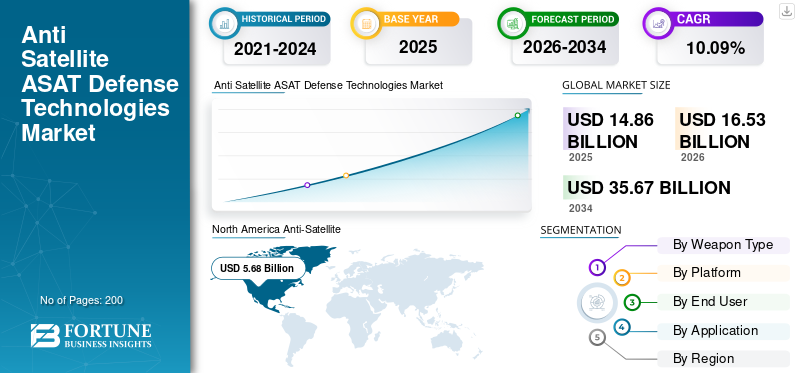
The global Anti-Satellite (ASAT) defense technologies market size was valued at USD 14.86 billion in 2025. The market is projected to grow from USD 16.53 billion in 2026 to USD 35.67 billion by 2034, exhibiting a CAGR of 10.09% during the forecast period. North America dominated the anti satellite asat defense technologies market with a market share of 38.22% in 2025.
Anti‑satellite (ASAT) defense technologies encompass systems and countermeasures designed to protect friendly satellites from physical destruction, electronic disruption, or cyberattacks, including kinetic interceptors, directed‑energy weapons, electronic‑warfare jammers, cyber defenses, and space‑surveillance networks which track and identify threats. These technologies are deployed by major space militaries to safeguard intelligence, navigation, and communications satellites, deter adversary ASAT use, and maintain wartime command and control. Growth is driven by rising dependence on space assets, evolving kinetic and non‑kinetic ASAT threats, and increased defense spending on space‑domain awareness and resilient satellite architectures.
Leading players include U.S. firms Lockheed Martin and Northrop Grumman, which develop missile defense derived ASAT‑relevant interceptors and directed‑energy prototypes. Raytheon, which advances in electronic‑warfare and space surveillance systems. Also, European and Asian aerospace‑defense groups: Airbus Defence and Space, Thales, BAE Systems, and Israel Aerospace Industries, which are building ground‑based radar and EW suites, satellite hardening solutions, and testing infrastructure for space domain protection.
Download Free sample to learn more about this report.
Anti Satellite ASAT Defense Technologies Market Takeaways
 Global Market Size & Forecast
- 2025 Market Size: USD 14.86 billion
- 2026 Market Size: USD 16.53 billion
- 2034 Forecast Market Size: USD 35.67 billion
- CAGR: 10.09% from 2026–2034
 Market Share
- North America dominated the anti-satellite (ASAT) defense technologies market with a 38.22% share in 2025.
- The co-orbital/orbital ASAT weapons segment is projected to grow at a 10.69% CAGR during the forecast period.
- The satellite-based systems segment is expected to expand at a 10.65% CAGR during the forecast period.
 Key Regional Highlights
North America
North America maintained its leading position, with the market growing from USD 4.84 billion in 2024 to USD 5.68 billion in 2025.
Europe
Europe is projected to grow at a 10.14% CAGR, reaching USD 3.83 billion by 2026.
Asia Pacific
Asia Pacific is expected to reach USD 3.67 billion by 2026, making it the third-largest and fastest-growing regional market.
U.S.
The market is projected to reach approximately USD 3.82 billion by 2026, growing at a 10.34% CAGR during the forecast period.
Japan
The market is estimated to reach USD 0.81 billion by 2026, expanding at a 10.57% CAGR during the forecast period.
Read More

ANTI-SATELLITE (ASAT) DEFENSE TECHNOLOGIES MARKET TRENDS
Integration Of Cyber‑Countermeasures Is a Market Trend
Integration of cyber‑countermeasures has become a leading trend in market, as nations prioritize reversible, non‑kinetic attacks that disable or disrupt satellite functions without generating orbital debris. Cyber tools now target ground stations, command and control links, and onboard software to degrade or hijack satellite services, posing persistent threats for governments and militaries. Furthermore, recent assessments highlight rapid growth in cyber‑enabled counterspace operations from China, Russia, and others, driving investment in space‑cyber fusion, AI‑driven anomaly detection, and resilient encrypted architectures.
Russia-Ukraine War Impact
The Russia–Ukraine war has accelerated demand for ASAT linked space‑defense systems, especially for resilient SATCOM, electronic warfare, and cyber‑protection for satellites used in battlefield ISR and command. It has pushed NATO and U.S. allies to prioritize space‑domain awareness and jam‑resistant constellations, strengthening procurement and R&D in ASAT defense technologies.
Middle East War Impact
Ongoing conflicts in the Middle East have increased reliance on military grade satellites for ISR, missile‑warning, and secure communications, raising the perceived need for ASAT defense capabilities such as EW‑hardened links and cyber resilient space systems. Regional powers and their partners are investing in surveillance and space‑surveillance‑linked programmes that integrate into ASAT defense and counterspace architectures.
MARKET DYNAMICS
MARKET DRIVERS
Download Free sample to learn more about this report.
Rise In Space Militarization Is Anticipated To Drive Market Growth
Space militarization is expected to drive the Anti-Satellite (ASAT) defense technologies market growth, as major powers treat space as a contested warfighting domain and expand investment in counterspace and space control systems. Governments are increasing defense budgets for space‑based surveillance, early warning, missile defense linked sensors, and anti-Satellite (ASAT) capabilities, viewing secure access to space as essential to national security and modern military operations. Geopolitical competition between the U.S., China, Russia, and other countries is accelerating the deployment of orbital assets, hardened and redundant satellite constellations, and non‑kinetic ASAT tools such as directed energy and cyber countermeasures.
MARKET RESTRAINTS
Risk Of Orbital Debris to Act as a Market Growth Restraint
Risk of orbital debris acts as a significant market restraint, especially kinetic systems that destroy satellites in orbit. Each destructive ASAT test can produce thousands of debris fragments into low earth orbit, increasing the probability of cascading collisions and raising insurance, shielding, and maneuver‑fuel costs for operators. International concern over the Kessler syndrome like scenario, where debris driven collisions render some orbits unusable, has stimulated for halts on kinetic ASAT testing and tighter norms on space sustainability related behavior.
MARKET OPPORTUNITIES
AI‑Driven Anomaly Detection In ASAT Create Market Opportunities
AI‑driven anomaly detection in ASAT and space defense systems is opening new market growth opportunities by enabling real-time identification of adversarial behavior, intrusion attempts, and system faults on orbit. Machine learning models can shift through massive telemetry and tracking datasets to distinguish anomalies from suspicious maneuvers, jamming, spoofing, or cyber‑intrusions targeting satellites and ground infrastructure. This capability supports autonomous threat warning, predictive collision avoidance, and cognitive electronic warfare responses, reducing reliance on ground operators and shrinking decision loops in contested space environments.
MARKET CHALLENGES
Limited Onboard Processing Power Present a Major Challenge to Market Growth
Limited onboard processing power presents a major market challenge as most AI‑driven ASAT and space defense functions such as real time anomaly detection, electronic‑warfare classification, and cyber intrusion monitoring require more compute capacity than current radiation hardened satellite processors. Space qualified chips are constrained by power, thermal limits, and their radiation tolerance, restricting model complexity, inference speed, and ability to run advanced neural networks directly on orbit.
Segmentation Analysis
By Weapon Type
With Zero Hazardous Space Debris, Electronic Warfare (EW) / Signal Interdiction Weapons is the Most Preferred Weapon Type
Based on the weapon type, the market is segmented into direct-ascent ASAT weapons, co-orbital / orbital ASAT weapons, directed-energy ASAT weapons, Electronic Warfare (EW) / signal interdiction weapons, and cyber counterspace weapons.
Electronic Warfare (EW) / signal interdiction weapons segment is anticipated to account for the largest anti-satellite (ASAT) defense technologies market share. The segmental growth is on the account of EW providing high operational flexibility, enabling accurate, reversible, and non-kinetic disabling of adversary space assets without producing hazardous space debris.
The co-orbital / Orbital ASAT weapons segment is anticipated to rise with a CAGR of 10.69% over the forecast period.
By Platform
Less Expensive Maintenance and Upgradation to Boost Ground-Based Systems Segment Growth
Based on platform, the market is segmented into satellite-based systems, ground-based systems, airborne systems, naval / sea-based systems, and mobile / transportable systems.
In 2025, ground-based systems segment dominated the global market. Compared to deploying, launching, and maintaining weapons in orbit, ground launched missiles and satellites are substantially less expensive to build, maintain, and upgrade and are proven to be cost effective for the agencies.
The satellite-based systems segment is projected to grow at a CAGR of 10.65% over the forecast period.
By End User
Rise in Geopolitical Tensions To Sustain the Dominance of Defense Ministries / Joint Armed Forces Segment
Based on the end user, the market is segmented into defense ministries / joint armed forces, dedicated space forces / space commands, intelligence & reconnaissance agencies, and missile defense / strategic forces organizations.
Defense ministries / joint armed forces segment is anticipated to witness a dominating market share over the forecast period. Governments are investing heavily in ASAT to safeguard their own orbital infrastructure and acquire the ability to monitor the communication systems due to growing geopolitical tensions.
The dedicated space forces / space commands segment is projected to grow at a CAGR of 10.52% over the forecast period.
To know how our report can help streamline your business, Speak to Analyst
By Application
Rise in AI-Powered Space Situational Awareness (SSA) Pushed the Leadership of Threat Detection and Tracking Segment
Based on application, the market is segmented into threat detection and tracking, satellite protection and survivability, secure communications protection, mission assurance and continuity, space asset recovery / reconstitution, and collision avoidance and space traffic management support.
Threat detection and tracking segment dominated the segment as AI-powered Space Situational Awareness (SSA) offer real-time monitoring and proactive defense against new orbital threats.
In addition, satellite protection and survivability segment is projected to grow at a CAGR of 10.59% during the forecast period.
Anti-Satellite (ASAT) Defense Technologies Market Regional Outlook
By geography, the market is categorized into Europe, North America, Asia Pacific, and Rest of the World.
North America
North America Anti-Satellite (ASAT) Defense Technologies Market Size, 2025 (USD Billion)
To get more information on the regional analysis of this market, Download Free sample
North America held the dominant share in 2024, valuing at USD 4.84 billion, and also maintained the leading share in 2025, with USD 5.68 billion. North America, led by the U.S. Space Force, dominates ASAT defense through its space domain awareness and space surveillance network, along with investments in low‑earth‑orbit sensors, missile warning satellites, and AI‑driven tracking.
U.S Anti-Satellite (ASAT) Defense Technologies Market
Based on North America’s strong contribution and the U.S. dominance within the region, the U.S. market can be analytically approximated to be around USD 3.82 billion in 2026, accounting for roughly 10.34% CAGR. The U.S. is at the forefront of ASAT defense, operating with the most advanced space‑surveillance and missile‑warning architecture, including DSP and SBIRS satellites and a growing LEO‑based tracking layer.
Europe
Europe is projected to record a steady growth rate of 10.14% during the forecast period, which is the second highest among all regions, and reach a valuation of USD 3.83 billion by 2026. Europe’s ASAT‑relevant capabilities centralizes on ESA’s Space Safety Programme, which funds asteroid‑monitoring, debris‑tracking, and space‑surveillance services through a network of sensors.
U.K Anti-Satellite (ASAT) Defense Technologies Market
The U.K. market in 2026 is estimated to be at around USD 1.22 billion, representing roughly 10.53% CAGR during the study period. The U.K. is building a dedicated space domain with the National Space Operations Centre, Protected Military SATCOM programmes, and the Minerva‑class imagery satellites, alongside the Deep Space Advanced Radar Capability.
Germany Anti-Satellite (ASAT) Defense Technologies Market
Germany’s market is projected to reach approximately USD 1.10 billion in 2026. Germany contributes to ASAT‑related defense through participation in NATO and EU‑level space surveillance efforts, including radar and optical sensors linked into the European SSA network.
Asia Pacific
Asia Pacific region is estimated to reach USD 3.67 billion in 2026 and secure the position of the third-largest region in the market and fastest growing during the forecast period. The region is witnessing rapid growth in ASAT and counterspace investment, driven by regional security competition and dependency on satellite‑enabled C4ISR.
Japan Anti-Satellite (ASAT) Defense Technologies Market
The Japan market in 2026 is estimated at around USD 0.81 billion, accounting for roughly 10.57% of CAGR during the forecast period. Japan is advancing ASAT‑oriented defense with the Japan Space Operations Group and the Space Operations Squadron, managing surveillance of satellites and debris.
China Anti-Satellite (ASAT) Defense Technologies Market
China’s market is projected to be one of the largest in Asia Pacific, with 2026 revenues estimated at around USD 1.13 billion. China has one of the most active counterspace programmes, operating with a dense network of ground‑based radars, optical sensors, and electronic‑warfare stations, co‑orbital inspection, and jamming satellites under the PLA Strategic Support Force.
India Anti-Satellite (ASAT) Defense Technologies Market
The India market in 2026 is estimated at around USD 1.02 billion. India is expanding its ASAT and space‑defense sector through the Defence Space Agency and DRDO‑led programmes, including ground‑based ASAT interceptors, EW jammers, and satellite‑hardening measures.
Rest of the World
The rest of the world include Middle East and Africa and Latin America. Latin America, the Middle East, and Africa are in early but growing phases of ASAT‑relevant defense, with select states acquiring ground‑based radars, satellite‑monitoring services, and cyber defense tools from U.S. and European vendors. The Middle East & Africa and Latin America market is set to reach a valuation of USD 1.67 billion and USD 1.04 billion, respectively, in 2026.
COMPETITIVE LANDSCAPE
Key Industry Players
Strategic Partnerships Fuel Anti-Satellite (ASAT) Defense Technologies Market Expansion
The competitive landscape in Anti‑Satellite (ASAT) Defense Technologies is moderately consolidated, with a mix of specialized aerospace‑defense and dual‑use technology providers shaping the market. Key players in the Anti‑Satellite (ASAT) Defense Technologies market include Lockheed Martin Corporation, Northrop Grumman Corporation, Raytheon Technologies Corporation, The Boeing Company, Airbus Defence and Space, and among others.
Strategic partnerships and technology transfers are central to market expansion, large aerospace and defense OEMs collaborate with space‑surveillance and AI‑driven SSA firms to integrate advanced sensors and data‑fusion engines into ASAT and counter‑ASAT platforms, while dual‑use industrial‑sensing and robotics suppliers embed their AI‑enabled vision and localization systems into autonomous ground‑based and airborne ISR assets.
LIST OF KEY ANTI-SATELLITE (ASAT) DEFENSE TECHNOLOGIES COMPANIES PROFILED
- Lockheed Martin Corporation (U.S.)
- Northrop Grumman Corporation (U.S.)
- Raytheon Technologies Corporation (U.S.)
- The Boeing Company (U.S.)
- Airbus Defence and Space (Netherlands)
- Thales Group (France)
- BAE Systems plc (U.K.)
- L3Harris Technologies (U.S.)
- Rafael Advanced Defense Systems Ltd. (Israel)
- Saab AB (Sweden)
KEY INDUSTRY DEVELOPMENTS
- April 2026: For the Next-Gen OPIR GEO missile warning satellite program, Lockheed Martin Space was awarded a USD 68 million contract amendment, bringing the total to USD 8.2 billion. Funded by research and development money from the fiscal year 2026, work will be done in Boulder, Colorado, and completion is anticipated by August 2028.
- January 2026: The U.S. Army has awarded Raytheon a USD 1.03 billion contract modification to support the Lower Tier Air and Missile Defense Sensor, or LTAMDS, in its second year of manufacturing.
- September 2025: The U.S. Army granted Raytheon, a USD 1.7 billion contract to provide the Lower Tier Air and Missile Defense Sensor, or LTAMDS. Nine radars in total are included in the contract for Poland and the U.S. Army.
- June 2025:S. Space Systems Command has given BAE Systems a USD 1.2 billion contract to supply missile monitoring satellite capabilities to the U.S. Space Force. Under the terms of the deal, BAE Systems will develop and construct ten spacecraft as the prime contractor for the Resilient Missile Warning & Tracking (RMWT) - Medium Earth Orbit (MEO) Epoch 2 program.
- May 2024: A cooperative agreement was formed by the U.S. and Japan to jointly develop a hypersonic missile defense capability intended to eliminate hypersonic threats during the glide phase of flight.
REPORT COVERAGE
The global Anti-Satellite (ASAT) defense technologies industry analysis includes a comprehensive study of the market size & forecast by all the market segments included in the report. It includes details on the market dynamics and market trends expected to drive the market over the forecast period. It provides information on key aspects, including an overview of technological advancements the regulatory environment, Porter’s five forces analysis, company profiles and regional analysis. Additionally, it details partnerships, mergers & acquisitions, as well as key aviation industry developments and prevalence by key regions. The global market report also provides a depth competitive landscape with information on the market share and profiles of key operating players.
Request for Customization to gain extensive market insights.
Report Scope & Segmentation
| ATTRIBUTE | DETAILS |
| Study Period | 2021-2034 |
| Base Year | 2025 |
| Estimated Year | 2026 |
| Forecast Period | 2026-2034 |
| Historical Period | 2021-2024 |
| Growth Rate | CAGR of 10.09% from 2026 to 2034 |
| Unit | Value (USD Billion) |
| Segmentation | By Weapon Type, Platform, End User, Application, and Region |
| By Weapon Type |
|
| By Platform |
|
| By End User |
|
| By Application |
|
| By Region |
|
Frequently Asked Questions
According to Fortune Business Insights, the global market value stood at USD 14.86 billion in 2025 and is projected to reach USD 35.67 billion by 2034.
In 2025, the market value stood at USD 5.68 billion.
The market is expected to exhibit a CAGR of 10.09% during the forecast period of 2026-2034.
By weapon type, the Electronic Warfare (EW) / signal interdiction weapons segment is expected to dominate the market.
Rise in space militarization is anticipated to Drive Market Growth
Lockheed Martin Corporation, Northrop Grumman Corporation, Raytheon Technologies Corporation, The Boeing Company, and Airbus Defence and Space, are few key players in the global market.
North America dominated the market in 2025



- 2021-2034
- 2025
- 2021-2024
- 200
Get 30-60 hrs Free Customization
Expand Regional and Country Coverage, Segments Analysis, Company Profiles, Competitive Benchmarking, and End-user Insights.




















Related Reports
-
US +1 833 909 2966 ( Toll Free )
-
Get In Touch With Us