Antibiotic Infusion Therapy Market Size, Share & Industry Analysis, By Product (Drugs, Devices, and Services), By Antibiotics Class (Cephalosporins, Carbapenems, Glycopeptides, Aminoglycosides, Oxazolidinones & Lipopeptides, and Others), By Indication (Bloodstream Infections & Sepsis, Respiratory Tract Infections, Skin & Soft Tissue Infections, Urinary Tract & Intra-abdominal Infections, Bone & Joint Infections, and Others) By Age Group (Adults and Pediatric), By Setting (Hospitals, Outpatient Infusion Centers, Home Infusion, and Others), and Regional Forecast, 2026-2034
 Download Free Sample
Antibiotic Infusion Therapy Market Size and Future Outlook
 Listen to Audio Version
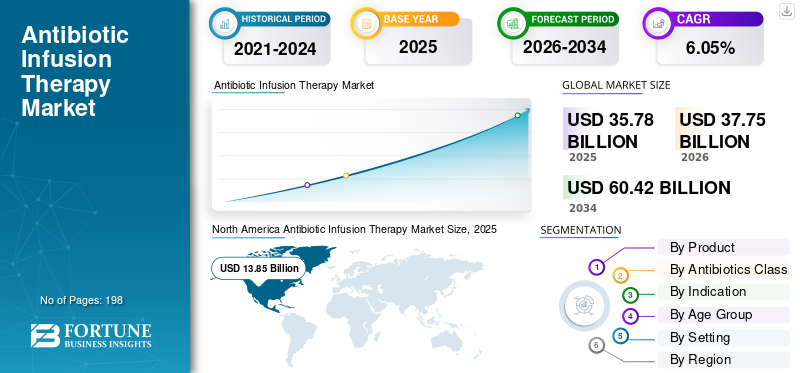
The global antibiotic infusion therapy market size was valued at USD 35.78 billion in 2025. The market is projected to grow from USD 37.75 billion in 2026 to USD 60.42 billion by 2034, exhibiting a CAGR of 6.05% during the forecast period. North America dominated the antibiotic infusion therapy market with a market share of 38.71% in 2025.
The global antibiotic infusion therapy market comprises intravenous antibiotic medications, infusion equipment, and associated administration services utilized for managing moderate to severe bacterial infections in hospitals, outpatient infusion clinics, home infusion environments, and various care facilities. The market is expanding due to the increasing demand for quick and supervised IV antibiotic therapy for serious infections. The therapy demand is rising due to antimicrobial resistance, infections acquired in hospitals, aging populations, and complications from chronic diseases, all of which heighten the need for long-course and broad-spectrum injectable antibiotic treatments. The market is bolstered by the transition from extended hospitalizations to outpatient and home infusion strategies, allowing patients to continue IV antibiotic therapy with pharmacy compounding, nursing assistance, vascular access management, and remote monitoring.
Key players operating in the global market include Pfizer Inc., Baxter, B. Brain SE, Option Care Health, Inc., and ICU Medical Inc. These firms are focusing on advanced infusion devices & consumables, expansion of home or alternative site infusion, and regulatory approvals to maintain their market positions.
Download Free sample to learn more about this report.
Antibiotic Infusion Therapy Market Takeaways
 Global Market Size & Forecast
- 2025 Market Size: USD 35.78 billion
- 2026 Market Size: USD 37.75 billion
- 2034 Forecast Market Size: USD 60.42 billion
- CAGR: 6.05% from 2026–2034
 Market Share
- North America dominated the antibiotic infusion therapy market with a market share of 38.71% in 2025.
- The drugs segment led the global antibiotic infusion therapy market share in 2025.
- The cephalosporins segment captured the leading position in the global market in 2025 and is set to hold 28.9% share in 2026.
 Key Regional Highlights
North America
North America accounted for the largest market share and was valued at USD 13.12 billion in 2024. In 2025, the region maintained its dominance, with USD 13.85 billion.
Europe
Europe is projected to expand at a 4.65% CAGR during the forecast period, driven by continued demand for hospital-based infection management.
Asia Pacific
Asia Pacific is expected to reach a market value of USD 9.43 billion in 2026, reflecting increasing healthcare investments and infection treatment demand.
U.S.
The U.S. market is projected to reach approximately USD 13.26 billion in 2026, accounting for about 35.1% of global revenues.
Japan
Japan's antibiotic infusion therapy market is estimated at around USD 1.71 billion in 2026, representing roughly 4.5% of global revenues.
Read More

ANTIBIOTIC INFUSION THERAPY MARKET TRENDS
Growth in Home-based Antibiotic Infusion Programs is a Significant Trend
The growing demand for home infusion therapy programs is emerging as a significant trend in the antibiotic infusion therapy sector as hospitals aim to minimize inpatient stays and transition clinically stable patients to more affordable care environments. Home infusion enables patients needing extended IV antibiotics for infections such as osteomyelitis, complex skin infections, pneumonia, and post-surgical infections to maintain treatment outside the hospital with assistance from nursing, pharmacy, monitoring, and vascular access. This trend is further backed by the increasing use of OPAT models, which allow IV antimicrobials to be administered at home, infusion centers, or skilled nursing facilities instead of confining patients to the hospital solely to finish antibiotic treatment.
IDSA observes that home-based OPAT includes administration by the patient, caregiver, or home health nurse, and that in the U.S., most patients seldom stay hospitalized to finish parenteral antimicrobial therapy. CMS acknowledges that home infusion therapy encompasses medications, pumps, tubing/catheters, nursing services, training, education, remote monitoring, and additional monitoring services, thereby facilitating formal reimbursement and service advancement. These factors are supporting the overall global antibiotic infusion therapy market growth.
- For instance, in CMS’s Home Infusion Therapy Services monitoring update, modified in April 2026, which highlights ongoing federal monitoring of home infusion service visits and supplier organizations, showing that home infusion remains an active and structured care model.
MARKET DYNAMICS
MARKET DRIVERS
Download Free sample to learn more about this report.
Increasing Prevalence of Severe Bacterial Infections is Driving Market Growth
The rising occurrence of severe bacterial infections significantly fuels the market, as critical infections frequently necessitate swift intravenous antibiotic delivery rather than oral medication. Conditions such as bloodstream infections, sepsis, pneumonia acquired in hospitals, complicated urinary tract infections, intra-abdominal infections, and wound infections typically require broad-spectrum injectable antibiotics, infusion devices, and monitored delivery. The rising challenge of antimicrobial resistance is amplifying the demand for more potent IV treatments such as carbapenems, glycopeptides, beta-lactam/beta-lactamase inhibitor combinations, oxazolidinones, and lipopeptides. As infections grow more challenging to manage, patients might need extended treatment durations, more expensive antibiotics, and infusion assistance after discharge via outpatient or home infusion environments. This actively meets market needs for medications, equipment, and services. All these factors cumulatively drive the overall market growth.
- For instance, in September 2025, the CDC reported that U.S. infections caused by NDM-producing carbapenem-resistant Enterobacterales increased by more than 460% from 2019 to 2023; these infections can cause pneumonia, bloodstream infections, UTIs, and wound infections and are difficult to treat, often requiring limited IV antibiotic options.
MARKET RESTRAINTS
High Treatment and Monitoring Costs to Limit Market Growth
Significant treatment and monitoring expenses serve as a limitation for the market, as IV antibiotic treatment encompasses more than just the cost of the medication. Patients frequently require infusion pumps, tubing, catheters, dressing replacements, nursing visits, pharmacy preparations, delivery services, line-care assistance, laboratory supervision, and clinician follow-ups, which elevates the overall cost of each treatment episode. These expenses are particularly difficult for prolonged infections such as osteomyelitis, prosthetic joint infections, complicated skin infections, and bloodstream infections, where treatment can last for weeks. Substantial costs may postpone discharge planning, hinder acceptance in cost-sensitive markets, and limit access to home or outpatient infusion services where reimbursement is poor. The financial strain grows when patients need monitoring of therapeutic drugs or management of complications related to catheters.
- For instance, NHIA indicates that the rollout of the Medicare Part B home infusion benefit by CMS has resulted in restricted access and significant access challenges for Medicare beneficiaries, contrary to congressional intent for a thorough home infusion benefit. This restricts uptake among qualified patients and causes financial unpredictability for providers.
MARKET OPPORTUNITIES
Rising Adoption of Outpatient Infusion Services to Offer Market Growth Opportunities
Increasing use of outpatient infusion services is generating a significant market opportunity as healthcare systems transfer stable patients from expensive inpatient care while continuing supervised IV antibiotic therapy. Outpatient infusion centers assist patients requiring parenteral antibiotics for infections such as osteomyelitis, complex skin infections, urinary/intra-abdominal infections, and post-surgical infections without the need for ongoing hospitalization. This model aids hospitals in decreasing bed occupancy, lowering length of stay, and handling infection care more effectively, while creating a need for IV antibiotics, infusion pumps, catheters, IV sets, pharmacy preparation, and nursing administration. It is particularly beneficial for planned antibiotic administration and patients requiring professional oversight, although it may not be appropriate for complete home infusion. All these factors would drive the market growth in the coming years.
- For instance, in August 2023, a systematic review published in Antibiotics evaluated the feasibility, effectiveness, and safety of elastomeric pumps for antibiotic delivery in adult patients. The review highlighted that elastomeric pumps can support continuous or prolonged antibiotic infusion without requiring electronic pump infrastructure, making them relevant for OPAT, outpatient infusion, and step-down care models.
MARKET CHALLENGES
Risk of Catheter-Related Complications to Pose a Prominent Challenge to Market Growth
Risk of catheter-related complications is a key market challenge as antibiotic infusion therapy often requires peripheral IV lines, PICC lines, midline catheters, or central venous catheters for repeated or long-duration dosing. These access devices can lead to bloodstream infections, thrombosis, occlusion, phlebitis, line displacement, and the need for catheter replacement, which increases treatment cost and clinical monitoring requirements. The risk becomes more important in long-course therapies such as osteomyelitis, prosthetic joint infections, complicated skin infections, and post-discharge IV antibiotic treatment. Catheter complications can interrupt therapy, force patients back into hospitals, reduce suitability for home or outpatient infusion, and increase payer/provider concerns around safety. This creates a challenge for service providers as they must invest in trained nursing staff, sterile line-care protocols, patient education, and regular monitoring.
- For instance, a June 2025 Cornell University study on dynamic prediction of central line-associated bloodstream infection analyzed 30,862 catheter episodes and focused on predicting 7-day CLABSI risk, highlighting that catheter-related infections remain a clinically important risk requiring monitoring and prevention.
Segmentation Analysis
By Product
Drugs Segment Dominated Due to Core Use of IV Antibiotics in Severe Bacterial Infection Treatment
In terms of product, the market is divided into drugs, devices, and services.
The drugs segment led the global antibiotic infusion therapy market share in 2025, owing to IV/injectable antibiotics forming the core treatment component for severe bacterial infections. Additionally, drugs account for the largest direct revenue share as every infusion episode requires an antibiotic product, while device and service intensity vary by setting. The segment is also supported by rising antimicrobial resistance, which is increasing the need for broad-spectrum and higher-value injectable antibiotics. Although many IV antibiotics are generic, the high treatment volume across inpatient and post-acute care settings continues to make drugs the leading revenue contributor in the market.
- For instance, in February 2025, the U.S. FDA approved Emblaveo (aztreonam and avibactam), co-developed by Pfizer and AbbVie, for adults with complicated intra-abdominal infections who have limited or no alternative treatment options. The product is administered intravenously and highlights the continued demand for advanced injectable antibiotics targeting serious, resistant gram-negative infections.
The services segment is anticipated to rise with a CAGR of 6.69% over the forecast period.
To know how our report can help streamline your business, Speak to Analyst
By Antibiotics Class
Cephalosporins Segment Captured Leading Position Due to Broad Clinical Use across Severe Bacterial Infections
Based on the antibiotics class, the market is segmented into cephalosporins, carbapenems, glycopeptides, penicillins & beta-lactam/beta-lactamase inhibitor combinations, aminoglycosides, oxazolidinones & lipopeptides, and others.
The cephalosporins segment captured the leading position in the global market in 2025. This is due to the fact that this class is widely used across hospitals and outpatient settings for various types of infections, including intra-abdominal infections and surgical infection management. Moreover, cephalosporins have strong adoption as they offer broad antibacterial coverage, multiple injectable options, established clinical familiarity, and availability across both branded and generic forms. Their use is also supported by once-daily or convenient dosing options for some products, making them suitable for inpatient treatment as well as outpatient or home infusion continuation. Furthermore, the segment is set to hold 28.9% share in 2026.
- For instance, in April 2024, the U.S. FDA approved Zevtera (ceftobiprole medocaril sodium for injection), a cephalosporin antibiotic, for adults with Staphylococcus aureus bloodstream infections, including right-sided infective endocarditis, adults with acute bacterial skin and skin structure infections, and adult and pediatric patients with community-acquired bacterial pneumonia.
The oxazolidinones & lipopeptides segment is anticipated to rise with a CAGR of 9.90% over the forecast period.
By Indication
Urgent Need for Rapid IV Antibiotic Treatment Supported Leadership of Bloodstream Infections & Sepsis Segment
In terms of indication, the market is segmented into bloodstream infections & sepsis, respiratory tract infections, skin & soft tissue infections, urinary tract & intra-abdominal infections, bone & joint infections, and others.
The bloodstream infections & sepsis segment dominated the market share in 2025, as these conditions are life-threatening and require immediate intravenous antibiotic treatment, often in emergency, ICU, or inpatient hospital settings. The segment also gained strong market share during and after COVID-19 due to higher ICU admissions, secondary infections, and hospital-acquired bloodstream infection risk. Continued antimicrobial resistance and aging-related infection vulnerability further support the segment’s leading position in the market. Furthermore, the segment is set to hold 35.5% share in 2026.
- For instance, in January 2024, NICE updated its sepsis guidance and emphasized that people who are severely ill with suspected sepsis should receive antibiotics promptly to reduce the risk of death. The update highlighted the use of the National Early Warning Score in acute hospital and ambulance settings and reinforced that rapid antibiotic treatment remains central for high-risk sepsis cases.
The bone & joint infections segment is anticipated to rise with a CAGR of 7.03% over the forecast period.
By Age Group
Adults Segment Dominated Due to Higher Burden of Severe and Complicated Bacterial Infections
On the basis of age group, the market is segmented into adults and pediatric.
In 2025, the market share was primarily led by the adults segment. This is owing to the higher risk of severe bacterial infections among this age group, especially in older adults. Moreover, adults also have higher rates of comorbidities such as diabetes, chronic kidney disease, cancer, cardiovascular disease, and immunosuppression, which increase hospitalization risk and the need for IV antibiotic treatment. The segment is also supported by the growing elderly population and higher use of home infusion or outpatient infusion for long-duration antibiotic therapy.
- For instance, in October 2024, the CDC accepted ACIP’s recommendation to lower the routine pneumococcal vaccination age from 65 to 50 years for adults, stating that vaccination at this age can help protect more adults against pneumococcal disease ahead of the respiratory season. This update reflects the growing clinical focus on adult bacterial infection prevention and the higher infection risk among aging adults, which also supports the larger adult treatment pool for severe infections requiring IV antibiotic therapy.
The pediatric segment is anticipated to rise with a CAGR of 4.31% over the forecast period.
By Setting
Hospitals Led Demand Due to High Volume of Severe Infection Treatment and Inpatient IV Antibiotic Use
Based on setting, the market is segmented into hospitals, outpatient infusion centers, home infusion, and others.
The hospitals segment accounted for the dominant market share in 2025, as most severe bacterial infections are first diagnosed and treated in inpatient or emergency care settings. Hospitals also account for higher use of broad-spectrum injectable antibiotics such as cephalosporins, carbapenems, and others, especially in ICU and post-surgical infection cases. Moreover, the segment is further supported by rising hospital-onset resistant infections, catheter-associated infections, ventilator-associated pneumonia, and sepsis cases that require structured inpatient antibiotic protocols. Furthermore, the segment is set to hold 60.4% share in 2026.
- For instance, in October 2025, the WHO reported a sharp global rise in antibiotic-resistant infections in hospitals, stating that one in six laboratory-confirmed bacterial infections in 2023 were resistant to antibiotic treatments. The report highlighted serious gram-negative infections such as E. coli and Klebsiella pneumoniae, which can lead to sepsis, organ failure, and death, reinforcing the continued need for hospital-based IV antibiotic therapy.
The home infusion segment is projected to witness a CAGR of 8.21% during the forecast period.
Antibiotic Infusion Therapy Market Regional Outlook
By geography, the market is divided into Latin America, Asia Pacific, Europe, North America, and the Middle East & Africa.
North America
North America Antibiotic Infusion Therapy Market Size, 2025 (USD Billion)
To get more information on the regional analysis of this market, Download Free sample
North America accounted for the largest market share and was valued at USD 13.12 billion in 2024. In 2025, the region maintained its dominance, with USD 13.85 billion. The high burden of sepsis, bloodstream infections, hospital-acquired infections, complicated UTIs, pneumonia, and resistant bacterial infections supports market growth in North America. The region also has strong adoption of IV antibiotics, advanced hospital infrastructure, and high use of broad-spectrum injectable therapies, which further support the regional market growth.
U.S. Antibiotic Infusion Therapy Market
The U.S. market led the North American region and is projected to be approximately USD 13.26 billion in 2026, representing about 35.1% of global revenues.
Europe
The market in Europe is set to grow at a CAGR of 4.65% during the forecast period. The growth in Europe is fueled by developed hospital facilities, elevated diagnosis rates of serious bacterial infections, and the common use of IV antibiotics for sepsis, pneumonia, intra-abdominal infections, bone and joint infections, and post-operative infections. The area is experiencing a slow growth in outpatient parenteral antibiotic therapy and home-based infusion methods, particularly as healthcare systems aim to cut inpatient expenses and enhance bed usage.
U.K. Antibiotic Infusion Therapy Market
The U.K. market in 2026 is estimated at around USD 1.71 billion, representing roughly 4.5% of global revenues.
Germany Antibiotic Infusion Therapy Market
Germany's market size is projected to reach approximately USD 1.94 billion in 2026, equivalent to around 5.1% of global sales.
Asia Pacific
The Asia Pacific market size is expected to reach a valuation of USD 9.43 billion in 2026. Asia Pacific is expected to be the fastest-growing region due to its large patient pool, high infectious disease burden, rising hospitalization rates, and expanding access to tertiary care. The region also benefits from rising healthcare spending, growing private hospital networks, and increasing elderly and diabetic populations.
Japan Antibiotic Infusion Therapy Market
The Japanese market in 2026 is estimated at around USD 1.71 billion, accounting for roughly 4.5% of global revenues.
China Antibiotic Infusion Therapy Market
China’s market is projected to reach revenues of around USD 3.04 billion in 2026, representing roughly 8.0% of global sales.
India Antibiotic Infusion Therapy Market
The Indian market in 2026 is estimated at around USD 1.46 billion, accounting for roughly 3.9% of global revenues.
Latin America and Middle East & Africa
The growth in the Latin America and Middle East & Africa regions is anticipated to be slower over the forecast period. Market growth in both regions is driven by increasing hospital access, rising burden of severe bacterial infections, and growing use of IV antibiotics for pneumonia, complicated UTIs, intra-abdominal infections, sepsis, and skin infections. The Latin America market in 2026 is estimated at around USD 2.50 billion.
In the Middle East & Africa region, the GCC market is projected to reach approximately USD 0.76 billion in 2026, representing about 2.0% of global revenues.
COMPETITIVE LANDSCAPE
Key Industry Players
Broad Drug, Device, and Service Portfolios to Support Players’ Market Positions
The global antibiotic infusion therapy market reflects a moderately consolidated competitive landscape, with major companies such as Pfizer Inc., Baxter, B. Brain SE, Option Care Health, Inc., and ICU Medical Inc. representing a significant portion of the global market. The competitive position of these players is supported by their strong presence across sterile injectable antibiotics, premixed IV antibiotics, infusion pumps, elastomeric pumps, IV sets, catheters, vascular access devices, and home or alternate-site infusion services. Service providers are strengthening their position through home infusion networks, nursing support, pharmacy compounding, monitoring, and post-discharge care coordination.
- For instance, in May 2025, Baxter showcased its expanded infusion therapy and medication delivery portfolio at ISMP 2025, including technologies designed to support safer medication preparation and IV administration workflows.
Other significant participants include KabaFusion, Soleo Health, Terumo Corporation, BD, Sandoz Inc., and others. These firms are anticipated to focus on product improvement and expansion of service offerings, and innovative drug development to strengthen their market positions throughout the forecast period.
LIST OF KEY ANTIBIOTIC INFUSION THERAPY COMPANIES PROFILED
- Pfizer Inc. (U.S.)
- Fresenius Kabi AG (Germany)
- Sandoz Inc. (Switzerland)
- Baxter (U.S.)
- Braun SE (Germany)
- BD (U.S.)
- ICU Medical, Inc. (U.S.)
- Terumo Corporation (Japan)
- Option Care Health, Inc. (U.S.)
- KabaFusion (U.S.)
- Soleo Health (U.S.)
KEY INDUSTRY DEVELOPMENTS
- June 2026: Wockhardt received U.S. FDA approval for ZAYNICH (cefepime and zidebactam), a novel intravenous antibiotic for complicated urinary tract infections, including pyelonephritis, caused by susceptible gram-negative pathogens.
- April 2026: Braun invested around USD 67.72 million to expand its Melsungen facility, increasing production and logistics space for products including infusion pumps used for precise medication dosing.
- October 2025: Braun opened a new automated production facility in Melsungen for medical disposable products for infusion therapy, including Combi-Stopper products designed to improve infusion safety and reduce contamination and needlestick risks.
- March 2025: Baxter Healthcare and the Australian government committed around USD 40 million to expand local IV saline fluid production in Western Sydney, targeting at least 80 million units annually by 2027.
- February 2024: The U.S. FDA approved EXBLIFEP (cefepime and enmetazobactam), administered as an IV infusion every eight hours, for adults with complicated urinary tract infections, including pyelonephritis.
REPORT COVERAGE
The global antibiotic infusion therapy market analysis includes a thorough evaluation of the market size and forecasts for every segment highlighted in the report. It offers insights into the market dynamics and trends expected to drive the market throughout the forecast period. It provides an understanding of essential factors, including product innovations, the regulatory environment, and the launch of new products. Additionally, it details partnerships, mergers & acquisitions, as well as key developments in the industry within the market. The global market forecast report also provides an in-depth competitive landscape, including information on market share and profiles of key active players.
Request for Customization to gain extensive market insights.
Report Scope & Segmentation
| ATTRIBUTE | DETAILS |
| Study Period | 2021-2034 |
| Base Year | 2025 |
| Estimated Year | 2026 |
| Forecast Period | 2026-2034 |
| Historical Period | 2021-2024 |
| Growth Rate | CAGR of 6.05% from 2026 to 2034 |
| Unit | Value (USD Billion) |
| Segmentation | By Product, Antibiotics Class, Indication, Age Group, Setting, and Region |
| By Product |
|
| By Antibiotics Class |
|
| By Indication |
|
| By Age Group |
|
| By Setting |
|
| By Region |
|
Frequently Asked Questions
According to Fortune Business Insights, the global market value stood at USD 35.78 billion in 2025 and is projected to reach USD 60.42 billion by 2034.
In 2025, the market value in North America stood at USD 13.85 billion.
The market is expected to exhibit a CAGR of 6.05% during the forecast period of 2026-2034.
By product, the drugs segment led the market.
The increasing prevalence of severe bacterial infections is driving market growth.
Pfizer Inc., Baxter, B. Brain SE, Option Care Health, Inc., and ICU Medical Inc. are some of the prominent players in the global market.
North America dominated the market in 2025.



- 2021-2034
- 2025
- 2021-2024
- 198
Get 30-60 hrs Free Customization
Expand Regional and Country Coverage, Segments Analysis, Company Profiles, Competitive Benchmarking, and End-user Insights.













.webp)






-
US +1 833 909 2966 ( Toll Free )
-
Get In Touch With Us