Artificial General Intelligence Market Size, Share & Industry Analysis, By Deployment (Cloud, On-premise, and Edge/Embedded), By Type (Functional AGI, Cognitive AGI, Self-learning AGI, and Philosophical AGI), By Application (Autonomous Robotics/Humanoid AI, Coding intelligence, Navigation Exploration and Autonomous Systems, Customer service, and Others), By End-User (Healthcare & Life Sciences, BFSI, Manufacturing, Automotive, IT & Telecom, Government & Defense, Retail & E-commerce, Education, and Others) and Regional Forecast, 2026–2034
 Download Free Sample
KEY MARKET INSIGHTS
 Listen to Audio Version
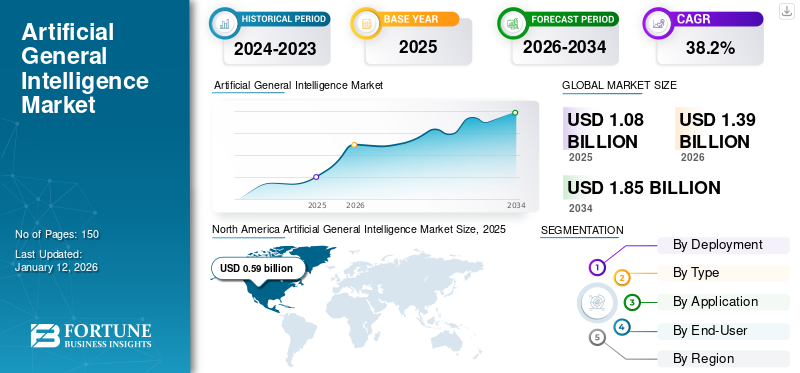
The global artificial general intelligence market size was valued at USD 1.08 billion in 2025 and is projected to grow from USD 1.39 billion in 2026 to USD 1.85 billion by 2034, exhibiting a CAGR of 38.2% during the forecast period. North America dominated the artificial general intelligence market with a market share of 1.6% in 2025.
Artificial General Intelligence (AGI) is a kind of AI that has the competency to capture, learn, and implement intelligence over a wide range of tasks, at a level comparable to human cognitive capabilities. AGI is intended to perform any intellectual operations that a human is capable of, including reasoning, decision-making, problem-solving, and understanding complex concepts in diverse domains.
Major players operating in the artificial general intelligence market, including IBM Corporation, Alphabet Inc., Microsoft Corporation, NVIDIA Corporation, Meta, and OpenAI. These companies are investing in research and development for new innovations across the market.
For enterprises, the advancement in generative AI signifies a substantial development. As organizations deploy more advanced AI solutions to enhance operational innovation and improve efficiency, they are instantaneously laying the foundation for future innovations, leading to AGI.
Download Free sample to learn more about this report.
Artificial General Intelligence Market KEY TAKEAWAYS
 Global Market Size & Forecast
- 2025 Market Size: USD 1.08 billion
- 2026 Market Size: USD 1.39 billion
- 2034 Forecast Market Size: USD 1.85 billion
- CAGR: 38.2% from 2026–2034
 Market Share
- North America dominated the artificial general intelligence market in 2025.
- The cloud deployment segment is expected to account for the largest market share during the forecast period.
- The self-learning AGI segment is projected to hold a 37.41% share in 2026.
 Key Regional Highlights
Asia Pacific
Asia Pacific accounted for USD 0.33 billion in 2025, driven by strong government investments and national AI strategies.
North America
North America accounted for USD 0.59 billion in 2025, supported by robust AI funding, advanced infrastructure, and leading technology companies.
Europe
Europe reached USD 0.44 billion in 2025, driven by collaborative AI research and strong public-private partnerships.
U.S.
The U.S. market is projected to reach USD 0.13 billion by 2026, fueled by national AI initiatives and significant investments in AGI development.
Japan
The Japan market is projected to reach USD 0.13 billion by 2026, supported by government-backed AI programs and growing research investments.
Read More

MARKET DYNAMICS
Market Drivers
Availability of Big Data and Enhanced Computational Power is a Key Market Driver
The usage of big data has become crucial for enterprises to comprehend customers effectively. The virtual volumes of big data streaming through any firm’s system offer numerous possibilities for a substantial boost in profits, better customer satisfaction, and outdo the competition. For instance,
- As per industry experts, in 2024, the worldwide volume of data generated, copied, consumed, and captured was around 149 zettabytes. The worldwide volume of data is projected to surge further to 181 zettabytes by the end of 2025. The rising usage of IoT devices, cloud-based storage, and real-time data processing drives this growth.
Also, different tech companies such as Amazon, Microsoft, and Google have heavily invested in cloud computing infrastructure, making it easier to scale AI powered models. For instance, Microsoft's Azure and Google Cloud have been instrumental in supporting the computational needs of AI models.
The ability of AGI models to understand, reason, and generate human-like outputs relies on access to vast amounts of data. In the current digital era, the volume of data generated daily is staggering, and this trend is growing. AGI systems need diverse structured and unstructured datasets to simulate human cognition. This includes text, images, audio, and video data, which are integral for the models to learn and understand the issues of the real world.
A significant portion of this data comes from the digital transformation of industries, where businesses generate information from customer interactions, IoT devices, e-commerce, and sensor-based devices. Companies such as Google and Facebook process data from billions of users, providing an immense volume of training material for AGI models. Such factors contribute to the artificial general intelligence market growth.
Market Restraints
Lack of Standardization Limits the Progress of AGI-based Solutions in Market
The AGI field lacks universal standards for model development, training methodologies, and performance metrics. This lack of standardization can lead to fragmentation in the market, making it difficult for businesses and developers to integrate AGI technologies across various platforms and industries. The absence of a cohesive framework can also slow innovation and increase development and deployment costs, limiting the widespread adoption of AGI systems.
While present AI excels at particular tasks, AGI needs the capability to simplify knowledge, familiarize to new situations, and show human-level cognitive capabilities, which are not yet attainable. This lack of standardization in methodologies for accomplishing AGI, along with the complexity of human the brain, showcases a foremost hindrance to its development. Thus, a lack of standardization due to the complexity of human-level capabilities can hamper market development.
Artificial General Intelligence Market Trends
Advancements in AGI Systems is Revolutionizing Creativity in Art, Music, Literature, and Design
The growing capabilities of Artificial General Intelligence (AGI) is significantly impacting the creative industries, including art, music, literature, and design. AGI systems are designed to understand and replicate human creativity by learning from existing works across such fields. By analyzing large datasets of creative content, AGI can generate original art, music, and literature that reflect human-like creativity, enabling new forms of artistic expression and innovation.
One of the key benefits offered by AGI is its ability to assist human creators in the process of innovation. AGI can provide recommendations, suggest alternative directions, or even complete unfinished work, thus enhancing the creative process.
For instance, in the fashion industry, AGI systems can analyze past trends and predict future styles, offering designers tools to create innovative collections that resonate with audiences while maintaining creativity and uniqueness.
Market Opportunities
Usage of AGI-driven Capabilities in Robotics Creates Lucrative Market Opportunities
AGI can be essential used in automating manufacturing, logistics, and the automotive industries. Autonomous systems, powered by AGI, are more capable of adapting to complex and dynamic environments. Companies including Tesla plan to integrate AGI capabilities with their autopilot systems to enhance vehicle automation, while Boston Dynamics is developing robots capable of performing complex tasks. AGI’s ability to enable robots to perform multi-step, complex tasks have unlocked new applications in logistics, healthcare, and construction industries.
- For example, Boston Dynamics' Spot robot, which uses AI capabilities for navigation, obstacle avoidance, and task execution, has been employed in various applications such as industrial inspections and construction site management.
AGI-powered robots can transform healthcare by assisting in surgeries, patient care, and rehabilitation. Integrating AGI into surgical robots allows for more precise and adaptable procedures, reducing human error and improving patient outcomes.
AGI-powered robots can transform healthcare by assisting in surgeries, patient care, and rehabilitation. Integrating AGI into surgical robots also enables more precise and adaptable procedures, reducing human error and improving patient outcomes. Thus, these benefits of AGI-based capabilities create numerous market opportunities for key players.
SEGMENTATION ANALYSIS
By Deployment
Enhanced Benefits of Cloud Deployment Augments the Segment Growth
Based on the deployment, the market is categorized into cloud, on-premise, and edge/embedded.
Cloud Deployment holds the highest market and is anticipated to grow with the highest CAGR during the forecast period (2025-32). Cloud deployment allows AGI developers to access high-performance computing resources on a pay-as-you-go basis, reducing the need for expensive infrastructure investments. This is particularly advantageous for AGI startups or research labs that cannot afford to purchase and maintain their own supercomputers. Microsoft Azure offers an extensive suite of machine learning as well as deep learning tools and services that enable users to deploy AI models without demanding dedicated hardware infrastructure. This lowers the cost barrier for businesses looking to adopt AGI.
Edge/embedded segment is projected to grow significantly during the studied period. Edge AI, or edge artificial intelligence, refers to the use of artificial intelligence algorithms on edge devices, including gateways, sensors, and other IoT devices, to run data locally instead of depending on cloud-driven servers. It offers various benefits such as reduced latency, enhanced privacy, and the capability to function in detached environments.
By Type
Increasing Self-learning Applications of AGI Fueled the Segment Expansion
Various types of artificial general intelligence include Functional AGI, Cognitive AGI, Self-learning AGI, and Philosophical AGI.
The Self-learning AG segment led the market accounting for 37.41% market share in 2026 and is projected to grow with the highest CAGR during the studied period. Self-learning AGI is a system that constantly improves itself, irrespective of any human intervention. As a substitute for depending on predefined datasets, it experiments, discovers new knowledge, and refines its algorithms to become more effective over time. This type of AGI could conduct scientific research self-sufficiently, generate new theories, or even alter its own architecture to improve capabilities. This is important in healthcare, autonomous vehicles, and finance, where decisions must adhere to ethical standards without explicit programming for every scenario. For instance,
- Waymo's self-driving cars are using self-learning algorithms to make decisions based on real-time data. These cars constantly improve their decision-making abilities, learning to handle complex ethical situations such as pedestrian safety.
Cognitive AGI is predicted to expand significantly during the forecast period, owing to several capabilities such as imitating human-like reasoning, abstract thinking, common sense, and contextual understanding. An AI developed on this definition can hold expressive conversations, interpret humor, and solve problems similar to a human brain logic.
By Application
Enhanced Capabilities of AGI across Autonomous Robotics/Humanoid Contributed to the Segment Expansion
Different applications of artificial general intelligence include autonomous robotics / humanoid AI, coding intelligence, navigation exploration and autonomous systems, customer service, and others.
The Autonomous Robotics/Humanoid AI segment dominated the market accounting for 2.37% market share in 2026. AGI-powered humanoid robots are capable of improving human-robot interaction through advanced speech recognition, emotional understanding, and contextual awareness. These robots can adapt to human needs and preferences in real-time, making them more effective collaborators in different environments. For instance,
- SoftBank's Pepper Robot is a humanoid robot designed for customer service and retail environments. It can recognize human emotions and interact with customers based on their needs, showcasing the power of AGI in enhancing human-robot collaboration.
Navigation, exploration and autonomous systems are estimated to grow with the highest CAGR during the forecast period. AGI can analyze real-time data from LiDAR, cameras, and other sensors to recognize objects, measure risks and anticipate environmental changes such as unexpected weather events or unforeseen obstacles. Discovery and analysis of risks and changes can help in delivering enhanced customer experience within navigation and autonomous systems.
By End-User
Download Free sample to learn more about this report.
Transformation of Financial Services through AGI, Propelled the Segment Expansion
By end-user, the market is categorized into healthcare & life sciences, BFSI, manufacturing, automotive, IT & telecom, government & defense, retail & e-commerce, education, and others.
The BFSI segment is expected to lead the market, contributing 21.58% globally in 2026 and is estimated to progress with the highest CAGR during the forecast period. AGI can transform financial analysis by going beyond regular methods. AGI can analyze huge data sets, such as financial news, social media sentiment, and even satellite imagery, to recognize multifaceted market trends and potential disturbances that might go unseen by human analysts. Major startups and financial organizations are already planning and leveraging limited forms of such technologies. For instance,
- HSBC’s AI-powered chatbot: HSBC has implemented AI chatbots in their customer service operations, allowing them to interact with the bank in real-time, resolve issues, and get personalized recommendations.
Healthcare is predicted to grow substantially over the studied period. The vast volume of medical data generated presently remains mainly untapped. AGI can analyze patient records, medical images, and genetic data to recognize refined patterns that might slip human attention.
ARTIFICIAL GENERAL INTELLIGENCE MARKET REGIONAL OUTLOOK
Geographically, the market is divided into North America, Europe, Asia Pacific, South America and Middle East & Africa.
North America
North America Artificial General Intelligence Market Size, 2025 (USD billion)
To get more information on the regional analysis of this market, Download Free sample
The North America region captured 1.60% of the global market in 2025, generating USD 0.59 billion in revenue, and is projected to reach USD 0.81 billion in 2026. North America dominated the market with the highest artificial general intelligence market share for the year 2024. It is also anticipated to progress with a leading growth rate during the studied period. North America has a well-established venture capital ecosystem, providing significant funding for AGI startups and research initiatives. This robust funding environment enables rapid scaling of AGI technologies and creating innovative applications across numerous industries. Tech giants such as Microsoft, Google, Amazon, and Facebook (Meta) have invested heavily in AGI research and development. The U.S. market is projected to reach USD 0.13 billion by 2026.
Governments in North America, especially in the U.S. and Canada, have recognized the importance of AI and AGI and are heavily investing in AI research and development through national strategies and initiatives. For instance,
- The U.S. National Artificial Intelligence Initiative Act and Canada’s Pan-Canadian Artificial Intelligence Strategy both aim to enhance the region’s global leadership in AI, including AGI. These initiatives focus on funding, policy development, and AI talent development.
South America
South America is projected to grow considerably during the forecast period. Various South American countries are formulating national AI approaches to promote the development of AI and AGI-based technologies. Governments are increasingly advancing AI research, building infrastructure, and supporting startups that develop AGI technologies to modernize industries and improve public services.
Europe
Europe maintained a strong presence in the global market, reaching USD 0.44 billion in 2025, accounting for 31.00% share, and is expected to reach USD 0.57 billion in 2026. Collaborative efforts between tech firms, research labs, and academic institutions are driving the progress of AGI technologies in Europe. These collaborations often combine academic knowledge with real-world applications to accelerate AGI development. The UK market is projected to reach USD 0.13 billion by 2026, while the Germany market is projected to reach USD 0.04 billion by 2026. For instance,
- The AI4EU initiative: a collaboration of European Union research organizations and technology companies, aims to create a common European AI platform, including AGI, by linking research, industries, and public administrations across Europe.
Middle East & Africa
Middle East & Africa recorded a market size of USD 0.01 billion in 2025, capturing 1.00% of the global market share, and is projected to reach USD 0.01 billion in 2026. The artificial general intelligence (AGI) market in the Middle East & Africa is under development for numerous reasons including limited infrastructure, relatively early-stage adoption, lack of skilled talent, and regulatory hurdles. At the same time, the region is developing strategies for AI adoption and the development of AGI. Countries in the Middle East & Africa region are investing heavily in building data centers and AI infrastructure to support the deployment and scaling of AGI technologies. These investments are essential for handling large datasets and running AI models that power AGI systems.
Latin America
The Latin America market generated USD 0.02 billion in 2025, representing 1.90% of the global market landscape, and is expected to reach USD 0.02 billion in 2026.
Asia Pacific
In 2025, Asia Pacific generated USD 0.33 billion, contributing 24.50% to global market revenue, and is projected to grow to USD 0.42 billion in 2026. Governments across Asia Pacific are investing heavily in AGI research. China, Japan, and South Korea have developed national AI strategies, including funding for AGI research and the development of AI infrastructure. The Japan market is projected to reach USD 0.13 billion by 2026, the China market is projected to reach USD 0.07 billion by 2026, and the India market is projected to reach USD 0.68 billion by 2026. For instance,
- In 2024, China unveiled its AI Development Plan, which focuses on becoming the global leader in AGI by 2030. This plan includes substantial funding for AI research, talent development, and infrastructure building.
COMPETITIVE LANDSCAPE
Key Industry Players
Key Market Players Focus on Presenting New Product Offering to Expand their Business Presence
Key players in the market, such as OpenAI, DeepMind, Meta, NVIDIA Corporation, Numenta, and Microsoft, among other players, are working on research and development for progress in artificial general intelligence technology. These players use advanced technological extensions to resolve changing consumer requirements and attain a competitive edge. They are collaborating with research labs, educational institutions, and other organizations.
Key Industry Players
OpenAI, Microsoft, Google DeepMind, Numenta, IBM, and Meta, among other players, are the largest players in the market.
Long List of Companies Studied
- IBM Corporation (U.S.)
- Alphabet Inc. (U.S.)
- Microsoft Corporation (U.S.)
- NVIDIA Corporation (U.S.)
- Meta (U.S.)
- OpenAI (U.S.)
- Anthropic PBC (U.S.)
- Numenta (U.S.)
- Hanson Robotics Ltd. (Hong Kong)
- SingularityNET (Netherlands)
- SAP SE (Germany)
- xAI (U.S.)
- Glean (U.S.)
- DataRobot, Inc. (U.S.)
- InWorld AI (U.S.)
- Aleph Alpha (Germany)
- Markovate (U.S.)
- Zhipu AI (China)
- …many more
KEY INDUSTRY DEVELOPMENTS
- July 2025: NVIDIA, in collaboration with Intel, appointed new officials associated with AI. Both companies expressed their intent to advance the frontiers of Artificial General Intelligence (AGI) and superintelligence.
- July 2025: Meta announced the foundation of Meta Superintelligence Labs (MSL), a dedicated subsidiary focused on advancing AGI research. The lab is directed by Alexandr Wang, previous CEO of Scale AI, and Nat Friedman, previous CEO of GitHub.
- April 2025: Google’s DeepMind released a paper on responsible artificial general intelligence (AGI). The new paper, titled “An Approach to Technical AGI Safety and Security,” is a preliminary point for essential discussions with the broader industry about monitoring of AGI progress.
- April 2025: OpenAI raised USD 40 billion at a USD 300 billion post-money valuation, marking the largest private technology deal on record. The financing round was led by SoftBank, with participation from Microsoft, Coatue, Altimeter, and Thrive.
- August 2024: Anthropic and OpenAI announced a partnership with the U.S. government for innovative AI driven research. The partnerships allow Anthropic and OpenAI to work closely with the U.S. Artificial Intelligence Safety Institute, focusing on the valuation of AI proficiencies and the discovery of potential safety risks.
INVESTMENT ANALYSIS AND OPPORTUNITIES
Market players are continuously working on research and development for the progress and extension of artificial general intelligence-based technologies. The market players are also collaborating with various research labs, institutions, and start-ups to accelerate the development of AGI-based solutions. There has been a significant increase in venture capital and corporate funding for AI and AGI startups. Additionally, various initiatives and funding by different governments can contribute to market expansion.
REPORT COVERAGE
The report provides a detailed market analysis and focuses on key aspects such as leading companies, product/service types, and leading applications of the solution and services. Besides, the report offers insights into the market trends and highlights key industry developments. In addition to the factors above, the report encompasses several factors that contributed to the market's growth in recent years.
Request for Customization to gain extensive market insights.
REPORT SCOPE & SEGMENTATION
|
ATTRIBUTE |
DETAILS |
|
Study Period |
2021-2034 |
|
Base Year |
2025 |
|
Estimated Year |
2026 |
|
Forecast Period |
2026-2034 |
|
Growth Rate |
CAGR of 38.2% from 2026 to 2034 |
|
Unit |
Value (USD billion) |
|
Segmentation |
By Deployment
By Type
By Application
By End-user
By Region
|
|
Companies Profiled in the Report |
|
Frequently Asked Questions
The market is projected to reach USD 1.85 billion by 2034.
In 2025, the market was valued at USD 1.08 billion.
The market is projected to grow at a CAGR of 38.2% during the forecast period.
BFSI is expected to lead the market with the highest CAGR.
Availability of big data and enhanced computational power to be a key driving factor for the market.
OpenAI, Microsoft, Google DeepMind, Numenta, IBM, and Meta, among others are the top players in the market.
North America is expected to hold the highest market share.
By application, navigation, exploration and autonomous systems are expected to grow with the highest CAGR during the forecast period.



- 2021-2034
- 2025
- 2021-2024
- 150
Get 30-60 hrs Free Customization
Expand Regional and Country Coverage, Segments Analysis, Company Profiles, Competitive Benchmarking, and End-user Insights.




















Related Reports
-
US +1 833 909 2966 ( Toll Free )
-
Get In Touch With Us