Assembly Line Solutions Market Size, Share & Industry Analysis, By Component (Hardware, Software, and Services), By Solution Type (Semi-automated, Fully automated, and Manual) By Application (General Assembly & Sub-Assembly, Material Handling & Feeding, Testing & Inspection, End-of-Line Packaging & Marking, and Others), By End-User (Automotive, Electronics & Semiconductors, Industrial Machinery, Medical Devices, Consumer Goods & Appliances, and Others), and Regional Forecast, 2026 – 2034
 Download Free Sample
Assembly Line Solutions Market Size and Future Outlook
 Listen to Audio Version
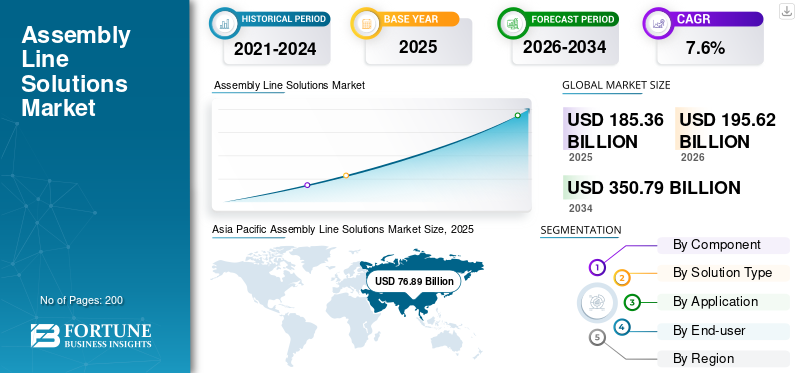
The global assembly line solutions market size was valued at USD 185.36 billion in 2025. The market is projected to grow from USD 195.62 billion in 2026 to USD 350.79 billion by 2034, exhibiting a CAGR of 7.6% during the forecast period. Asia Pacific dominated the assembly line solutions market with a market share of 41.48% in 2025.
Assembly line solutions are comprehensive production line systems which help in assembling products in a sequential method by either manual, semi-automated, or completely automated processes. They consist of workstations, conveyors, fixtures, jigs, tooling, part feeders, robots, cobots, PLCs, sensors, testing and inspection systems, MES/SCADA integration, line monitoring software, packaging systems, installation, commissioning, maintenance, and retrofit services. Assembly line solutions find application in general assembly and joining, material handling and feeding, testing and inspection, end-of-line packaging and marking, and custom manufacturing operations. Some of the key end-users of these solutions are automotive & electric vehicles, electronics & semiconductors, industrial machinery, medical devices, consumer goods & appliances, food & beverages, aerospace & defense, packaging, energy & power industries, etc.
Increased investments in EV battery packs, power electronics, automobiles, consumer electronics, semiconductors, and industrial machinery are increasingly fueling the need for innovative assembly line solutions. Such businesses require fast, accurate, and efficient assembly processes that cannot be effectively achieved through manual assembly processes. With rising production volumes and complexities in design, manufacturers are making increased investments in assembly line solutions that will help automate essential assembly line processes such as parts handling, joining, fastening, welding, inspection, testing, packaging, and tracking. This has contributed to an increased need for conveyor systems, robotics, automated control systems, programmable logic controllers, machine vision systems, testing systems, and MES integration. In addition to this, key players are providing automation technology and assembly solutions including Siemens AG, ABB Ltd., FANUC Corporation, Rockwell Automation, Bosch Rexroth, ATS Corporation, JR Automation, KUKA AG, Mitsubishi Electric Corporation, Yaskawa Electric Corporation, and Omron Corporation will fuel growth in the market. These companies provide solutions ranging from robotics, PLCs, motion control, conveyor systems, assembly systems, machine vision, MES & SCADA, and custom manufacturing automation solutions to facilitate development of fast and digitally integrated assembly lines.
Download Free sample to learn more about this report.
ASSEMBLY LINE SOLUTIONS MARKET TRENDS
Rising Adoption of Automation Across Manufacturing Industries Is Creating Significant Market Opportunities
The demand for assembly line solutions is being fueled by the adoption of automation technology by the manufacturing industry as more manufacturers are embracing automation trends whereby the production line that was previously manual shifts to a semi-automated and automated production line. The adoption of conveyors, robotic arms, cobots, automated systems, PLCs, sensors, vision inspections systems, testing modules, and monitoring through MES/SCADA are some of the ways that manufacturers have adopted automation trends to ensure fast production, accurate production, and better control over the process. This trend can be seen in numerous industries as there is a need for high production volumes, quality products, reduced cycle time, and fewer errors in the production of the products.
- For Instance, in April 2026, Path Robotics introduced Rove – a welding robot that utilizes physical AI to move around for welding automation applications in large-format, high-variety production settings like ship-building, heavy industry, and construction.
- For Instance, April 2025, FANUC America showcased its latest industrial and collaborative robotics automation solutions at Automate 2025, aimed at improving manufacturing efficiency and supporting advanced factory automation applications
MARKET DYNAMICS
MARKET DRIVERS
Download Free sample to learn more about this report.
Growing Demand for Quality Control, Traceability, and Compliance Drive Market Growth
The market is witnessing significant momentum owing to the increasing requirement of quality control, production tracing, and compliance within the manufacturing sectors. Industries such as medical devices, electronics, automotive, aerospace, food & beverages, and industrial equipment work within stringent quality standards where even minute defects in the products may lead to recalls, risks, and compliance issues. To address these challenges, there is an increasing adoption of automated test equipment, vision inspection cameras, leak detection units, torque measurement systems, barcode & RFID tracking systems, serialization systems, and MES-based quality documentation within the assembly lines. These systems enable to track all the stages of production, component verification, defect detection, and digital documentation of batches, personnel, machines, and inspections. Traceability within automotive and aerospace industries helps in validation of critical safety components, while within medical devices and food & beverages industries, traceability enables compliance with hygiene and sterilization regulations. In the electronics industry, inspection and testing systems are deployed to reduce defects in PCB, sensors, and precision components.
MARKET RESTRAINTS
High Initial Investment and Integration Cost is Limiting Market Adoption
High initial costs associated with designing, setting up, and installing automated or semi-automated manufacturing assembly line are a major challenge faced by the market. An assembly line involves the use of conveyors, stations, fixtures, jigs, tooling, automated feeders, robotic cells, PLCs, sensors, drives, machine vision system, testing and inspection stations, safety systems, software solutions, setup, and installation, as well as training of the operators. Apart from equipment cost, manufacturers incur additional costs such as plant layout modification, system engineering, programming, software integration, validation, and maintenance planning. Therefore, adoption of such solutions poses challenges for smaller manufacturers and even some midsize manufacturers, especially those with budget constraints or lower production volumes. Additional complexity and costs may arise when integrating the solution with existing equipment, which may necessitate customization and modifications on both hardware and software side, as well as stopping production during the installation process. As a result, manufacturers tend to favor partial automation and gradual automation or use semi-automated lines over automated assembly lines.
MARKET OPPORTUNITIES
Adoption of Smart Manufacturing and Industry 4.0- Based Production Systems to Create Market Opportunities
The growing trend toward the adoption of smart manufacturing and Industry 4.0-based production systems to create market opportunities. Smart manufacturing allows for the collection of live data on the performance of assembly lines from sensors, programmable logic controllers, vision systems, test equipment, and connected workstations. In turn, this helps the manufacturer to monitor performance closely, production status, locate any bottlenecks, and make informed decisions. The integration of MES, SCADA, digital work instructions, traceability software, and predictive maintenance tools can help the manufacturer transform their conventional assembly lines into smart production lines with improved visibility, flexibility, and control. This results in increased interest in assembly line solutions that are not only automated but also digitalized, modular, data-driven, and integrable with factory-wide systems.
With the rise in investments in smart factories, digital transformation, and connected production networks, there is an increasing need for sophisticated assembly line solutions capable of ensuring real-time production monitoring, remote diagnostics, quality analysis, production traceability, and continuous process optimization. According to the findings of Rockwell Automation's 2026 State of Smart Manufacturing report, 59% of all manufacturers employ smart manufacturing technologies in production processes, while only 18% continue being in the pilot stage.
- For Instance, in March 2026, Siemens invested more than USD 230 million into smart factory, an artificial intelligence-powered and digitalized production facility high-tech electronic products in Amberg, Germany
MARKET CHALLENGES
Cybersecurity and Data Connectivity Concern is Challenging Market Growth
With the rise of data security and connectivity, there is an increasing concern about the same in the market. While the connectivity in the assembly lines brings more visibility and traceability in the processes, it also poses more vulnerabilities in terms of potential cyber threats such as unauthorized access, data theft, malware, production disruption, and manipulation of machine control. Cyberattack on the connected assembly lines may lead to disruption of production, product quality, damage to machinery or any confidential data related to product design, processes, batches, and customers. In addition to this, there will be various operational issues in case of integration of the legacy machinery with the advanced digitalized systems in the form of poor network connectivity, protocol compatibility, data governance, and lack of OT security knowledge. Therefore, manufacturers would need to spend money on the OT security in the form of secure industrial networking, access controls, firewalls, data encryption, backup systems, OT monitoring, and cyber security training.
Segmentation Analysis
By Component
Hardware Segment Leads Market as it Forms Core Physical Infrastructure of Any Production Lines
By component, the market is segmented into hardware, software, and services.
Hardware segment dominates assembly line solutions market share accounting for 46.1% in 2026, as it forms the core physical infrastructure of any production line. Hardware represents equipment and automation systems required to build and operate production lines. Manufacturers investing in new assembly lines or upgrading existing manual and semi-automated lines require substantial spending on conveyors, workstations, robotic cells, feeders, tooling, sensors, controls, testing equipment, and end-of-line systems. Increasing adoption of modular assembly lines, robotic cells, automated material handling, machine vision, and quality testing equipment is also strengthening hardware demand. As a result, hardware remains the leading component segment, while software and services grow alongside it through MES/SCADA integration, monitoring, analytics, installation, commissioning, maintenance, and retrofit support.
- For Instance, In April 2026, ABB Robotics launched its new PoWa high-speed collaborative robotics family, designed to bridge the gap between traditional cobots and industrial robots. The new cobots offer payload capacities of 7–30 kg and speeds up to 5.8 m/s, supporting assembly, machine tending, palletizing, screwdriving, and welding applications where manufacturers need faster, flexible automation without large fixed production systems.
The software segment is expected to grow at 7.4% CAGR from 2026-2034. Modern assembly lines require real-time insight into production performance, machine performance, availability, quality performance, material flow, and operator performance. For this reason, manufacturers have started implementing MES solutions, SCADA systems, traceability solutions, production dashboards, quality solutions, and remote monitoring systems for improved decision making and line efficiency. The growth of the market segment can also be attributed to the increasing popularity of Industry 4.0, smart manufacturing, digital twins, predictive maintenance, and advanced production analytics with artificial intelligence. With software solutions, manufacturers can detect bottlenecks, minimize unexpected downtime, detect defects, manage compliance requirements, implement efficient changeovers, and connect assembly lines with corporate systems.
By Solution Type
Improved Quality Control Led to Dominance of Semi-Automated Segment
By solution type, the market is segmented into semi-automated, fully automated, and manual.
Semi-automated segment held the largest market share in 2025 accounting for 48.7% and is expected to grow at fastest CAGR during the forecast period. Semi-automated lines have become very popular in those industries where manufacturers aim to increase productivity and improved quality control yet do not want to lose the flexibility associated with human operations related to inspection, loading, adjusting, handling parts, and custom assembly. This allows manufacturers to increase their manufacturing efficiency without fully automating their operations which in turn is cost-effective with faster cycle time, fewer mistakes, consistency, increased safety of operators, and less labor-intensity.
Fully automated segment is projected to register a CAGR of 7.2% during the forecast period. Full automated assembly line solutions are equipped with integrated machines, conveyors, robotic systems, automated feeders, PLC, sensors, vision inspection systems, testing system modules, MES/SCADA interface, and EOL automation, which can complete most of the assembly processes without much human involvement. The major benefit of fully automated assembly lines is the capability of delivering consistent and mass production without relying heavily on human labor. These lines are widely employed in EV battery packs, automobile parts, electronics, semiconductor products, medical products, aerospace parts, industrial equipment, and consumer goods manufacturing. Increased investments in smart factory, Industry 4.0, robotics, machine vision, and production monitoring are driving the adoption of fully automated assembly line solutions.
By Application
General Assembly & Sub-Assembly Segment Led Market Owing to Its Excellent Mechanical Properties
By application, the market is segmented into general assembly & sub-assembly, material handling & feeding, testing & inspection, end-of-line packaging & marking, and others.
General assembly & sub-assembly dominated the application segment in 2025 and is projected to grow at fastest CAGR from 2026-2034. General assembly & sub-assembly covers the processes of component positioning, component mounting, fastening, screw driving, press fitting, welding, bonding, sealing, joining, module assembly, and build-up of a finished good. Growing complexity of production, decreasing product life cycles, multi-product production, and the need for quicker and more reliable performance of tasks will drive even greater adoption of automated and semi-automated assembly systems.
The material handling & feeding segment is expected to grow at CAGR of 7.6% over the forecast period. The growth of this segment is mainly attributed to increasingly adoption by companies that are aiming to minimize manual handling, increase line speeds, reduce operator fatigue, and deliver the parts to their appropriate stations in an accurate way. The use of automation technology in handling and feeding improves precision during assembly, reduces error during placement of parts, reduces downtime, and enhances volume production through efficient material flow. Growing application of flexible manufacturing systems, multi-product assembly lines, lean manufacturing, and smart factory environments is creating more demand for material handling and feeding technology.
By End-User
To know how our report can help streamline your business, Speak to Analyst
Automotive Segment Led Market Owing to Its Growing Demand for Specialized Assembly Lines
By end-user, the market is segmented into automotive, electronics & semiconductors, industrial machinery, medical devices, consumer goods & appliances, and others.
The automotive segment is the leading end-user industry within the market due to its high dependence on structured, large-scale, and multi-level assembly processes. Automotive manufacturers use specialized assembly lines for body parts assembly, chassis assembly, interior assembly, powertrain assembly, electronic components assembly, braking systems assembly, lighting system assembly, seat assembly, wiring assembly, EV battery modules assembly, battery pack assembly, e-motor assembly, and vehicle assembly. Additional growth drivers for the segment include the transition toward electric vehicles, resulting in the emergence of demand for battery module assembly, battery pack assembly, power electronics assembly, thermal management assembly, and e-drive assembly. Global EV sales have skyrocketed to new highs, with over 22 million units produced in 2025 and electric models representing 25% of all new cars sold globally, as per International Energy Association.
The electronics & semiconductors segment is expected to grow at 7.8% CAGR from 2026-2034, owing to growing need for fast, accurate, and clean assembly process. This industry is largely driven by the increasing demand for smartphones, consumer electronics, automotive electronics, industrial electronics, data center equipment, IoT products, power modules, semiconductors, etc. With the increase in complexity and miniaturization of the electronic products, automated feeder systems, precision handling system, machine vision systems, assembly systems suitable for clean rooms, electrical testing, functional testing, and traceability with MES systems have been increasingly adopted by manufacturers of electronics and semiconductors.
Assembly Line Solutions Market Regional Outlook
By geography, the market is categorized into Europe, North America, Asia Pacific, South America, and the Middle East & Africa.
North America
Asia Pacific Assembly Line Solutions Market Size, 2025 (USD Billion)
To get more information on the regional analysis of this market, Download Free sample
North America’s market is expanding owing to rising demand for semi-automation and full automation in the region is driving the installation of assembly lines in terms of increased production efficiency, quality assurance, labor savings, and factory of the future concepts. Increasing developments in EV manufacturing plants, battery plants, semiconductors, aerospace components, and medical devices production facilities are resulting in the growth of demands for conveyors, robotics solutions, automated feeding, testing solutions, inspection modules, MES/SCADA, and digital traceability solutions. Reshoring and nearshoring trends are also contributing to the growth of the North American market, as companies opt for the automation and digitization of the manufacturing process. For instance, Hyundai Motor Group aims to Metaplant America project with investments totaling USD 12.6 billion that will produce up to 500,000 electric and hybrid cars annually.
U.S. Assembly Line Solutions Market
The U.S. market occupies the largest share in North America due to the robust manufacturing presence of the U.S. in automotive and EV, aerospace, electronics, semiconductors, medical devices, industrial machinery, packaging, and advanced manufacturing sectors. Manufacturing in the U.S. is a key market for the automation of production lines, where manufacturing was valued at USD 2.4 trillion in 2023 representing 10.2% of GDP and 2.7% growth in real manufacturing output between 2023 and 2024. This leads to a huge demand for conveyors, automated feeders, assembly workstations, robotic cells, testing systems, inspection modules, MES/SCADA integration, and digital traceability solutions.
In addition, the market will be fueled through major investments made by companies in manufacturing electric vehicles, batteries, and expanding semiconductor capacities. Key companies invested USD 208.8 billion in EV and battery manufacturing projects in the U.S. in October 2024. These investments drive the demand for battery module assembly, battery pack assembly, power electronics assembly, end-of-line testing, and automated material handling systems.
Europe
Europe is among the key regions for market owing to the presence of a developed automotive, machinery, electronics, aerospace, medical device, industrial equipment, and packaging manufacturing industry ecosystem within Europe. Germany, France, Italy, the U.K., Spain, and Nordic nations have been the key players, which have been driven by high industry 4.0, smart factories, robotics, digital twin, machine vision, and energy-efficient manufacturing system adoption. The region has seen increasing demand for EV battery assembly, e-drive production line, power electronics assembly, automated inspection, and digitally connected final assembly systems. In September 2025, Toyota announced an investment of USD 800 million to expand its Czech Republic facility and set up a new production line for manufacturing its first battery electric vehicle from Europe. The investment is helping drive Europe toward EV-oriented manufacturing and has been increasing demand for connected assembly line solutions, automated logistics, quality monitoring, and smart production systems in Europe.
U.K. Assembly Line Solutions Market
The U.K. market is estimated at around USD 9.3 billion in 2026, representing roughly 4.77% of global sales.
Germany Assembly Line Solutions Market
Germany’s market is projected to reach approximately USD 14 billion in 2026, equivalent to 7% of the global market
Asia Pacific
Asia Pacific remains the dominating market during the forecast period and is expected to generate a revenue of USD 81.55 billion in 2026 globally. The growth is attributed to the presence of extensive manufacturing operations in China, Japan, India, South Korea, and Southeast Asia. There is a high presence of electronics manufacturing, automotive and electric vehicle manufacturing, semiconductor assembly and battery manufacturing, consumer goods, industrial machinery, and export-based manufacturing in the region. China leads as the major player in the region owing to its EVs and electronics manufacturing ecosystem, with 16.626 million new energy vehicles manufactured in 2025 and NEV sales totaling 16.49 million units, indicating the demand for automated batteries, power electronics, and vehicle assembly lines. This is expected to grow the demand for the market
China Assembly Line Solutions Market
China’s market is projected to remain the dominant in the Asia Pacific region, with 2026 revenues estimated at around USD 33.4 billion, representing roughly 17.09% of global sales.
India Assembly Line Solutions Market
The market is estimated at around USD 8.6 billion in 2026, accounting for roughly 4.41% of global sales.
Japan Assembly Line Solutions Market
The Japanese market is estimated at around USD 16.7 billion in 2026, accounting for 8.54% of global sales.
Middle East & Africa
The market for assembly line production in the Middle East & Africa is growing steadily owing to industrial diversification, manufacturing localization, food processing, packaging, automotive parts, electrical machinery, pharmaceuticals, and production of consumer goods. The GCC region is developing non-oil industries, industrial cities, smart factories, and localized production according to their diversification programs. During June 2025, Saudi Arabia has provided 83 new licenses for industrial activities along with the opening of 58 factories with investments amounting to about USD 0.75 billion, showing the growth of industrial activities and demands for advanced production technologies in the future. The South African contribution includes the automobile assembly industry, industrial machinery, food processing, and packaging industries. With the growth in industrial capacity, there will be more demands for semi-automated assembly lines, conveyors, packaging automation, inspection, testing machines, and smart monitoring solutions.
GCC Assembly Line Solutions Market
The GCC market is projected to reach around USD 2.4 billion in 2026, representing 1.24% of the global sales.
South America
South America is an emerging market for assembly line solutions as it is backed by the rising manufacturing operations in the automobile, food & beverages, packaging, consumer goods, machinery, home appliances, and electrical industries. Brazil leads owing to its automotive manufacturing, machinery manufacturing, food processing, and factory automation. The production of vehicles in Brazil rose by 3.5% in 2025; this marks the best performance of the industry since 2019, and this is what drives demand for automatic assembly, components handling, inspection, and end-of-line assembly. There is demand for assembly line solutions in Argentina, Chile, and Colombia through their automobile components, packaging, mining machinery, food processing, and industrial equipment manufacturing.
Brazil Assembly Line Solutions Market
The Brazil market is projected to reach around USD 3.3 billion in 2026, representing roughly 1.7% of the global sales.
COMPETITIVE LANDSCAPE
Key Industry Players
Competitive Advantage Driven by Advanced Technologies, Automation, and Application Expertise
The assembly line solutions market is moderately fragmented with competition fueled by expertise in assembly line automation, robotics, PLC & motion control, material handling, testing and inspection, MES/SCADA integration, machine vision, traceability, installation, commissioning, and lifetime services. Leading players such as Siemens AG, ABB Ltd., FANUC Corporation, Rockwell Automation, Bosch Rexroth, ATS Corporation, JR Automation, KUKA AG, Mitsubishi Electric Corporation, Yaskawa Electric Corporation, and Omron Corporation have enhanced their competitive positions through comprehensive automation portfolio, wide-ranging service network across geographies, and domain knowledge.
These companies are working in partnership with automotive OEMs, EV & battery manufacturers, electronics & semiconductor companies, medical device makers, industrial machinery manufacturers, and packaging companies for the implementation of new lines, factories modernization, and automation retrofits. The competitive positioning of firms is being determined more by intelligent assembly line solutions that include robotics, cobots, PLCs, sensors, machine vision, testing modules, digital twins, MES integration, remote monitoring, predictive maintenance, and real-time production monitoring.
LIST OF KEY ASSEMBLY LINE SOLUTIONS COMPANIES PROFILED IN REPORT
- Siemens AG (Germany)
- ABB Ltd. (Switzerland)
- FANUC Corporation (Japan)
- Rockwell Automation, Inc. (U.S.)
- Bosch Rexroth AG (Germany)
- ATS Corporation (Canada)
- JR Automation (U.S.)
- KUKA AG (Germany)
- Mitsubishi Electric Corporation (Japan)
- Yaskawa Electric Corporation (Japan)
- Omron Corporation (Japan)
KEY INDUSTRY DEVELOPMENTS
- March 2026: FANUC announced a USD 90 million investment through FANUC America to build a new factory and distribution center in the U.S. The facility will add production-ready capacity for robot manufacturing and strengthen FANUC’s local automation supply capabilities.
- September 2025: JR Automation announced plans for a new USD 72.8 million global headquarters in Zeeland, Michigan. The 286,000 sq. ft. facility will include customer automation demonstration, assembly, and office space, supporting its automation solution development capabilities.
- August 2025: Comwin Group introduced a modular battery pack assembly line for the manufacture of energy storage batteries. The assembly line relies on automation, modular design, online quality checks, and data analysis through a data platform, increasing capacity from 10,000 to 50,000 packs per annum.
- May 2025: Comau completed the installation of an integrated automated assembly line for the manufacture of Li Auto's next-generation EV range extender. This involved concept design, system simulation, assembly, commissioning, SmartCell technology, vision systems, and quality control, allowing for a production capacity of up to 400,000 units annually.
REPORT COVERAGE
The global assembly line solutions market analysis includes a comprehensive study of the market size & forecast by all the market segments included in the report. It includes details on the market dynamics and market trends expected to drive the market over the forecast period. It provides information on key aspects, including an overview of technological advancements, the regulatory environment, and product launches. Additionally, it details partnerships, mergers & acquisitions, and key Industry developments and prevalence by key regions. The global market research report also provides a depth competitive landscape with information on the market share and profiles of key operating players.
Request for Customization to gain extensive market insights.
Report Scope & Segmentation
| ATTRIBUTE | DETAILS |
| Study Period | 2021-2034 |
| Base Year | 2025 |
| Estimated Year | 2026 |
| Forecast Period | 2026-2034 |
| Historical Period | 2021-2024 |
| Growth Rate | CAGR of 7.6% from 2026-2034 |
| Unit | Value (USD Billion) |
| Segmentation | By Component, Solution Type, Application, End-User, and Region |
| By Component |
|
| By Solution Type |
|
| By Application |
|
| By End-user |
|
| By Region |
|
Frequently Asked Questions
According to Fortune Business Insights, the global market value is expected to stand at USD 195.62 billion in 2026 and is projected to reach USD 350.79 billion by 2034.
In 2025, the Asia Pacific’s market value stood at USD 76.89 billion.
The market is expected to exhibit a CAGR of 7.6% during the forecast period.
By end-user, automotive segment leads the market.
Growth in automotive & EV, electronic products, semiconductor, medical devices, industrial machinery, and consumer goods production has led to a rising demand for high speed and quality assembly line systems.
Siemens AG, ABB Ltd., FANUC Corporation, and KUKA AG are the top players in the market.
Asia Pacific held the largest market share in 2025.


- 2021-2034
- 2025
- 2021-2024
- 200
Get 30-60 hrs Free Customization
Expand Regional and Country Coverage, Segments Analysis, Company Profiles, Competitive Benchmarking, and End-user Insights.















-
US +1 833 909 2966 ( Toll Free )
-
Get In Touch With Us