Car Air Purifier Market Size, Share & Industry Analysis, By Technology Type (HEPA, Activated Carbon, Ionic Filter), By Sales Channel (OEM, Aftermarket), By Vehicle Type (Economical, Medium-Priced, Luxury), and Regional Forecast, 2026-2034
 Download Free Sample
(Offer valid till 30th Sep 2026)

KEY MARKET INSIGHTS
 Listen to Audio Version
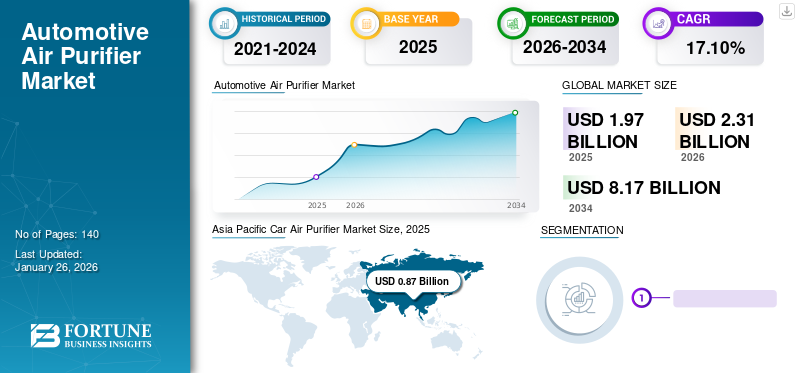
The global car air purifier market size was valued at USD 1.97 billion in 2025 and is projected to grow from USD 2.31 billion in 2026 to USD 8.17 billion by 2034, exhibiting a CAGR of 17.10% during the forecast period. Asia Pacific dominated the global market with a share of 44.24% in 2025.
The global car air purifier market is experiencing significant growth due to increasing concerns about air quality and the rising awareness of the importance of clean air within vehicles. Car air purifiers are devices designed to remove pollutants, allergens, and odors from the air inside vehicles, providing occupants with a healthier and more comfortable driving experience. Factors such as urbanization, traffic congestion, and the growing prevalence of respiratory diseases have propelled the demand for car air purifiers worldwide. As a result, the market is expected to continue its growth trajectory in the coming years, driven by increasing consumer awareness, technological advancements, and the growing emphasis on health and wellness in the automotive sector.
Download Free sample to learn more about this report.
CAR AIR PURIFIER MARKET KEY TAKEAWAYS
 Global Market Size & Forecast
- 2025 Market Size: USD 1.97 billion
- 2026 Market Size: USD 2.31 billion
- 2034 Forecast Market Size: USD 8.17 billion
- CAGR: 17.10% from 2026–2034
 Market Share
- Asia Pacific dominated the global market with a share of 44.24% in 2025.
- he HEPA segment is projected to dominate the market with a share of 60.26% in 2026.
- The aftermarket segment will account for 90.61% market share in 2026.
 Key Regional Highlights
North America
North America reached USD 0.43 Billion in 2025, accounting for 21.86% of the global market.
Europe
Europe generated USD 0.51 Billion in 2025, representing 25.70% of the global market.
Asia Pacific
Asia Pacific dominated the market with USD 0.87 Billion in 2025, accounting for 44.24% of the global industry.
U.S.
The U.S. market is projected to reach USD 0.42 Billion by 2026.
Japan
The Japan market is projected to reach USD 0.16 Billion by 2026.
Read More

Car Air Purifier Market Trends
Increasing Focus on Implementing Advanced Comfort and Safety Features to Set a Positive Trend for Market Growth
Automobile manufacturers are increasingly investing in designing and developing comfort and safety features, which is also a development trend in the automobile industry. Currently, most of the vehicles in the market are not equipped with air purifier systems. Therefore, this market will grow proportionally with the growth of the automobile market. Ultra-low Penetration Air (ULPA) filters can remove at least 99.99% of dust, pollen, bacteria, and airborne particles with a minimum particle penetration size of 100 nanometres (0.1 µm) from the air. Moreover, a ULPA filter can remove oil smoke, tobacco smoke, rosin smoke, smog, and insecticide dust to a large extent. Both HEPA and ULPA filters have similar designs, consisting of an enormous web of randomly arranged fibers. When air passes through this dense mesh, the solid particles stay back with the fibers and thus are eliminated from the air. Thus, the development of ULPA filters will set a positive trend for market growth.
Download Free sample to learn more about this report.
Car Air Purifier Market Growth Factors
Rise in Air Pollution in Developed & Developing Countries to Drive Market Growth
The rise in air pollution levels in both developed and developing countries is a significant driver of growth in the global car air purifier market. The emission of pollutants such as particulate matter, nitrogen dioxide, and volatile organic compounds (VOCs) into the atmosphere continues to expand with increasing urbanization and industrialization. These pollutants pose serious health risks to individuals and degrade the air quality inside vehicles, especially in densely populated urban areas with heavy traffic congestion.
As a result, the air quality index is deteriorating, producing health problems in many countries. Every year, 2.4 million people die as a result of air pollution, according to the World Health Organization (WHO). For example, cities in India and China frequently experience severe air pollution episodes, leading to respiratory illnesses, cardiovascular diseases, and other health issues among their populations. In developed countries, although air quality standards are generally higher, urban areas still grapple with pollution from vehicle emissions, industrial activities, and other sources. Major cities such as Los Angeles, London, and Tokyo often exceed air quality guidelines, prompting concerns about public health and environmental sustainability.
The increasing awareness of the detrimental effects of air pollution on health and well-being has prompted individuals to seek ways to protect themselves, including investing in car air purifiers. These devices are designed to filter out harmful pollutants and allergens from the air inside vehicles, providing occupants with cleaner and healthier air to breathe while commuting or traveling.
Additionally, government regulations and initiatives aimed at curbing air pollution are driving market growth by incentivizing the adoption of cleaner technologies, including air purification systems for vehicles. For example, some cities offer subsidies or tax incentives for the purchase of electric vehicles or vehicles equipped with advanced air filtration systems. Overall, the growing concerns about air pollution and its impact on public health are fueling the demand for car air purifiers globally. As urbanization and industrial activities continue to increase, the need for effective air purification solutions in vehicles is expected to grow, driving the expansion of the car air purifier market.
RESTRAINING FACTORS
High Cost of Air Purification Systems is Limiting Market Growth
A major factor hindering the growth of this market is the high cost limiting product consumption. Though cost is not a restraining factor in the luxury car market segment, it substantially affects the economical and medium-priced car market segments. However, the cost of car air purifiers is expected to decrease in the coming years due to the higher adoption rate by vehicle manufacturers, with the number of suppliers for automakers rising in the recent past. In addition, fluctuations in automobile sales will always have an impact on its growth, which is another key restraint for market growth. This air purifier uses reusable containers or filters to collect impurities and will need to wipe them out on a regular basis. For instance, the U.S. Environmental Protection Agency (EPA) issued an advisory that air purifier filters should be replaced every three-six months or so.
Many car air purifiers employ disposable or replaceable filters, which means they will have to spend between USD 30 to USD 50 on new filters every year. Thus, replacement & maintenance cost is limiting the growth of the market.
Car Air Purifier Market Segmentation Analysis
By Technology Type Analysis
HEPA Segment Dominates Market Owing to Improved Filtering Quality, Reliability, and Cost Effectiveness
By technology type, the market is segmented into HEPA, activated carbon, and ionic filter. The HEPA segment currently holds the largest share in the market. The HEPA segment is projected to dominate the market with a share of 60.26% in 2026. It is anticipated to be the largest segment of the market during the forecast period. HEPA filters are made of very fine mesh with less than 1 micron (a micron is 0.00004 in, 0.001 mm) thickness. The superior quality and reliability of HEPA filters in removing airborne particles are projected to drive product adoption of car air purifiers. Moreover, these filters are more cost-effective compared to other filters, thereby fueling the market growth. The ionic filter segment will have a steady growth. The ionizer purifier shoots out negative ions into the air. These negative ions in the air cause the particles to stick to the surface of the plate. The limitation of ionic filters is that they fail to effectively clean the air of gas, smoke, and odors.
The activated carbon segment will exhibit the highest CAGR during the forecast period since activated carbon is more efficient than HEPA systems in automobiles in removing cabin air pollution. Activated carbon, the universal adsorbent, has a capacity for virtually all vapor contaminants and will adsorb and retain a wide variety of chemicals simultaneously. However, HEPA is more cost-effective than activated carbon and ionic filters; hence, it acquires a significant portion of the vehicle air purifier market share.
To know how our report can help streamline your business, Speak to Analyst
By Vehicle Type Analysis
Luxury Car Segment to Grow at the Highest CAGR Due to Significant Growth of Luxury Offerings in Vehicles and Shifting Consumer Preferences
By vehicle type, the market is segmented into economical, medium-priced, and luxury. The luxury segment is estimated to grow substantially with the highest CAGR during the projected time period. Numerous luxury offerings in vehicles, increasing disposable incomes of consumers, and shifting consumer preferences related to car features have been propelling the demand for luxury cars worldwide. However, an increase in custom duty is expected to hamper the luxury car market growth. Attributed to increasing demand for comfort & convenience features in vehicles, the medium-priced car segment is anticipated to be the fastest-growing segment in the global market. The economical segment is anticipated to hold the largest share globally in terms of volume and value. The economical segment is expected to lead the market, contributing 64.16% globally in 2026. The growing population, increased urbanization, and development in the economic conditions of several countries have actively encouraged consumers to own technologically advanced cars, which propelled the growth of the market in this segment.
By Sales Channels Analysis
Aftermarket Segment Dominated Global Market Due to Wide Presence of Distributors and Retailers
By sales channel, the market is segmented into OEM and aftermarket. The aftermarket segment currently holds the largest car air purifier market share. The aftermarket segment will account for 90.61% market share in 2026. However, the OEM segment for air purifiers is estimated to be the fastest growing during the forecast period. Aftermarket business dominates the market due to the wide presence of distributors, retailers, and offline & online footprints across the world. The domestic players are also involved in the competition with new technology development to remain in the market and also to gain more profit margin. Players, such as Shenzhen Vamia Environmental Protection Co., Ltd., Jinpus, GermGuardian, Levoit, Soto, Mahle, Aokestone, and many others, offer their products in the aftermarket.
An increase in vehicle sales that have OEM fitted air purifiers is expected to create an opportunity for the OEM business in the coming years. Many players have already started adopting the trend of safety features equipped in a car, including air purifiers, owing to government mandates in some regions, considering environmental benefits and demand from consumers.
Furthermore, the adoption of advancements in car air purifiers from OEMs will eventually offer lucrative growth potential for the expansion of OEM-equipped car air purifiers in the forecast period.
REGIONAL INSIGHTS
Asia Pacific Car Air Purifier Market Size, 2025 (USD Billion)
To get more information on the regional analysis of this market, Download Free sample
Asia Pacific
The Asia Pacific market accounted for USD 0.87 billion in 2025, representing 44.24% of the global industry, and is expected to reach USD 1.03 billion in 2026. It is expected to show dominance with the highest CAGR during the forecast period. China and India together accounts for more than 38% of the global population, which is a strong factor contributing to the growth of this region. Along with that, various favorable government initiatives implemented for the resurrection of the automobile industry in these regions are expected to propel the market growth. Moreover, high urbanization and smart cities are expected to accelerate market development. The Japan market is projected to reach USD 0.16 billion by 2026, the China market is projected to reach USD 0.66 billion by 2026, and the India market is projected to reach USD 0.14 billion by 2026.
Europe
In 2025, Europe generated USD 0.51 billion, contributing 25.70% to global market revenue, and is projected to grow to USD 0.59 billion in 2026. Europe holds the second-largest position in the market, of which Germany ranks first in this regional market as major auto manufacturers are located here. Furthermore, increased production of vehicles and the adoption of advanced technologies will enhance the market growth in this region. The UK market is projected to reach USD 0.09 billion by 2026, while the Germany market is projected to reach USD 0.15 billion by 2026.
North America
North America maintained a strong presence in the global market, reaching USD 0.43 billion in 2025, accounting for 21.86% share, and is expected to reach USD 0.51 billion in 2026. North America is anticipated to hold the third position in the global market. This can be attributed to the growing consumer demand for safety, and comfort features complemented with the increased sales of vehicles. The technologically developed infrastructure and technology giants also contribute significantly to the growth of the market in this region. The US market is projected to reach USD 0.42 billion by 2026.
Rest of the World
Rest of the World accounted for USD 0.16 billion in 2025, representing 8.20% of the global market share, and is projected to reach USD 0.19 billion in 2026. The rest of the world consists of Latin America, the Middle Eastern, and Africa. The Middle East is anticipated to be the major contributor to the growth of the global market. This can be attributed to government initiatives, which attracted opportunities in the automotive industry in the region along with the early adoption of advanced technologies.
List of Key Companies in Car Air Purifier Market
Volvo’s Announcement of the First System to Assess PM 2.5 Air Quality Inside a Vehicle Cabin to Brighten its Market Prospects
Volvo Cars is a Swedish luxury automobile company headquartered in Gothenburg, Sweden. In September 2020, Volvo's Advanced Air Cleaner system included a sensor that can measure levels of PM2.5. These particulates in a vehicle's cabin can cause various respiratory ailments. According to Volvo, it is the world’s first air purifier for production of cars. In China, drivers can compare air quality inside the vehicle to the outside environment as PM 2.5 measurements are regularly taken due to rampant air pollution. Drivers in some of the regions can also use the Volvo On Call smartphone app to initiate cleanings of the cabin air filter and monitor PM2.5 levels. According to Volvo, the ‘advanced air cleaner’ can clean out particulate matter and remove up to 95% of all PM2.5 particles using a synthetic fiber-based filter and ionization in the vehicle cabin.
LIST OF KEY COMPANIES PROFILED:
- Honeywell International (U.S.)
- Sharp Electronics Corporation (Japan)
- Panasonic Corporation (Japan)
- Eureka Forbes (India)
- Shenzhen Agcen Environmental Protection Tech Co (China)
- Koninklijke Philips NV (Netherlands)
- Airbus Electronic Technology Co Ltd (France)
- BlueAir (Romania)
- 3M (U.S.)
- Denso Corporation (Japan)
KEY INDUSTRY DEVELOPMENTS:
- January 2024: Researchers at the University of Bath developed a new air purifier design, utilizing FOAM3R filter technology that offers virus-stopping performance and boasts a zero harmful waste feature. The FOAM3R technology, patented by the University, serves as a highly adaptable disruptor for microbial, CO2, and volatile organic compound (VOC) odor removal.
- January 2023: Panasonic Automotive Systems Company of America, a tier one automotive supplier, announced the launch of its nanoe™ X portable in-vehicle air cleaner that provides and protects cabin air purity in North America. This air purifier reduces odors and helps inhibit viruses, bacteria, mold, and allergens, both air-borne and on surfaces.
- June 2022: Hyundai announced the launch of its Venue facelift SUV. Only the top variant will get an air purifier in the vehicle cabin. This hints at the slowly growing adoption of air purifiers in the Indian market.
- June 2022: The 2022 Perodua Myvi facelift was relaunched as the Daihatsu Sirion in Indonesia. The new Sirion comes with a standard 4.2-inch multi-info instrument cluster display, a reverse camera, front parking sensors, and an air purifier system.
- June 2021: BlueAir launched the products Cabin P1 and P2i in-car air purifiers. BlueAir claimed that its air purifiers have been tested to remove more than 99% of fine particles and motor vehicle exhaust emissions and also have been tested to meet or exceed global standards.
REPORT COVERAGE
The market research report provides a detailed analysis of the market and focuses on crucial aspects such as leading companies, product types, and leading product applications. In addition, the report offers insights into the car air purifier market trends and highlights vital industry developments. Further, the report encompasses several factors contributing to the market growth in recent years.
Request for Customization to gain extensive market insights.
Report Scope & Segmentation
|
ATTRIBUTE |
DETAILS |
|
Study Period |
2021-2034 |
|
Base Year |
2025 |
|
Estimated Year |
2026 |
|
Forecast Period |
2026-2034 |
|
Historical Period |
2021-2024 |
|
Growth Rate |
CAGR of 17.10% from 2026 to 2034 |
|
Unit |
Value (USD Billion) |
|
Segmentation |
By Technology Type
|
|
By Vehicle Type
|
|
|
By Sales Channel
|
|
|
By Geography
|
Frequently Asked Questions
Fortune Business Insights says that the global market size was USD 1.97 billion in 2025 and is projected to reach USD 8.17 billion by 2034.
In 2025, the market value in Asia Pacific stood at USD 0.87 billion.
The market is projected to grow at a CAGR of 17.10% and exhibit steady growth during the forecast period (2026-2034).
The economical segment is expected to be the leading segment in this market during the forecast period.
Increasing urbanization, consumers spending capacity, growing environmental concerns about the pollution caused by vehicles along with stringent emission standards are factors that will propel the growth of the market.
Honeywell International is the leading market player.
Asia Pacific dominated the market share in 2025.



- 2021-2034
- 2025
- 2021-2024
- 140
-
(Offer valid till 30th Sep 2026)
Get 30-60 hrs Free Customization
Expand Regional and Country Coverage, Segments Analysis, Company Profiles, Competitive Benchmarking, and End-user Insights.




















Related Reports
-
US +1 833 909 2966 ( Toll Free )
-
Get In Touch With Us