Car Audio Market Size, Share & Industry Analysis, By Component Type (Head Unit, Amplifier, and Speaker), By Technology (Non-Voice Recognized Audio System and Voice Recognized Audio System), and Regional Forecast, 2026-2034
 Download Free Sample
(Offer valid till 15th Oct 2026)

Car Audio Market Size and Future Outlook
 Listen to Audio Version
The global car audio market size was valued at USD 11.10 Billion in 2025 and the market is projected to grow from USD 11.87 Billion in 2026 to USD 20.72 Billion by 2034, exhibiting a CAGR of 7.21% during the forecast period. Asia Pacific dominated the global market with a share of 54.21% in 2025.
Car audio refers to the system of equipment installed in a vehicle to play music, radio, and other audio media. It typically includes speakers, amplifiers, head units (stereos), and subwoofers. Modern car audio systems offer various features such as Bluetooth connectivity, touchscreen displays, and compatibility with smartphones for streaming music.
The trend towards advanced infotainment systems with features such as voice control, Bluetooth, and wireless connectivity boosts the market demand. However, health and safety issues concerning prolonged use of audio devices restrain market development. Increasing demand for enhanced in-car entertainment experiences, technological advancements, and the rise of electric vehicles drive the market growth over the forecasted period. The Bose Corporation, JVC Kenwood Corporation, and Harman International are the leading players in the market.
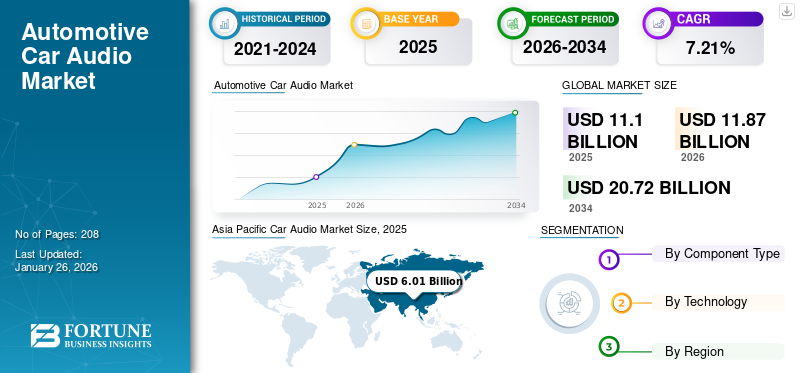
Download Free sample to learn more about this report.
CAR AUDIO MARKET KEY TAKEAWAYS
 Market Size & Forecast
- 2025 Market Size: USD 11.10 Billion
- 2026 Market Size: USD 11.87 Billion
- 2034 Forecast Market Size: USD 20.72 Billion
- CAGR: 7.21% from 2026–2034
 Market Share
- Asia Pacific dominated the car audio market with a 54.21% share in 2025.
- The speaker segment is projected to account for 44.48% of the market in 2026.
- The voice recognized audio system segment is expected to hold 60.0% of the market in 2025.
 Key Regional Highlights
Asia Pacific
Asia Pacific reached USD 6.01 billion in 2025, accounting for 54.21% of global market revenue.
Europe
Europe was valued at USD 3.26 billion in 2025, representing 29.42% of the global market.
North America
North America reached USD 0.85 billion in 2025, contributing 7.69% of global revenue.
U.S.
The market is projected to reach USD 0.70 billion by 2026.
Japan
The market is projected to reach USD 0.74 billion by 2026.
Read More

Market Dynamics
Market Drivers
Driving Habits to Fuel Market Demand
As commuting times increase, drivers are spending more time in their cars, driving the demand for high-quality car audio systems. According to the American Driving Survey by the AAA Foundation for Traffic Safety, drivers reported spending an average of 60.7 minutes per day driving in 2023, which is nearly the same as the 60.2 minutes per day reported in 2022. In 2023, drivers aged 35–49 spent the most time on the road, averaging 72.4 minutes per day, more than any other age group. While this represents a decrease from the previous year, the change was not statistically significant. Additionally, the time spent driving decreased for individuals aged 20–24 and 50–64, while it increased for other age groups compared to 2022.
Longer drives are making in-car entertainment, such as music streaming and podcasts, more important. Multitasking habits, such as using cars as mobile offices, are fueling the need for voice-controlled and hands-free audio systems, promoting safety and convenience. Upgrading factory-installed audio systems to aftermarket solutions is also driving demand as consumers seek better sound quality and advanced connectivity features. Overall, the trend toward enhanced driving experiences and safety technologies is boosting the car audio market.
Market Restraint
Health and Safety Issues Concerning Prolonged Use of Audio Devices can Restrain Market Growth
The prolonged use of car audio systems at high volumes can cause hearing damage, leading to Noise-Induced Hearing Loss (NIHL) and ear fatigue, which may deter consumers from using high-power systems. Awareness of hearing risks may shift preferences toward quieter audio systems. Additionally, car audio systems can distract drivers, increasing accident risks by diverting attention or requiring physical interaction.
Despite hands-free features, modern systems can still contribute to distractions. Health concerns about EMF exposure are also being investigated, though there’s no conclusive evidence. Furthermore, noise ordinances in some regions may lead manufacturers to produce quieter systems, affecting market demand for high-performance car audio products. According to the Cleveland Codified Ordinances Part Six (6), no individual shall play a radio or audio system in a vehicle at a volume that disrupts the peace, comfort, or rest of others or at a level that is clearly audible to people outside the vehicle.
Market Opportunities
Increased Focus on Vehicle Interior Provides Market Opportunity
As the automotive industry shifts toward luxury and premium features, the in-car experience has evolved beyond simple transportation, with consumers seeking comfort, convenience, and entertainment. Audio systems play a crucial role in this transformation. High-end automakers are increasingly integrating top-tier audio systems, collaborating with renowned brands such as Bose and Harman Kardon. The focus on vehicle interiors has also driven the adoption of advanced sound technologies, such as Active Noise Cancellation (ANC), and multi-dimensional sound systems, such as 360-degree audio, enhancing the auditory experience. Luxury vehicles prioritize cabin tranquility and immersive sound, further expanding the demand for sophisticated, customizable audio systems.
For instance, in June 2023, the Aston Martin DB12 ‘Super Tourer’ made its debut in Australia. This model featured a 15-speaker surround system powered by a 15-channel amplifier with an output of 1170W, including 5x 25mm Nautilus Aluminium Double Dome tweeters, 5x 100mm Continuum midrange speakers, 2x 40mm Headline speakers, 2x 170mm woofers, and a 200mm subwoofer. It offers sound modes such as Studio and Stage, along with advanced sound processing technologies such as QuantumLogic Surround, Dirac Unison, and Vehicle Noise Compensation Technology. The vehicle is equipped with an 1170W amplifier and Bowers & Wilkins 15-speaker surround system, providing an authentic, pristine, and accurate sound experience.
Market Challenges
Technological Challenges in Wireless Hi-Fi Systems May Restrain Market Growth
Wireless Hi-Fi systems face several technological challenges that may limit market car audio market growth. While they offer convenience, maintaining sound quality over wireless connections can lead to compression, which affects audio fidelity, particularly in high-resolution tracks. Latency, or delays between audio and video, is another issue, especially in car audio systems where synchronization is key. Wireless signals in cars are also prone to interference from electronic systems and metal frames, causing distortion or connection drops. Additionally, wireless systems consume more power than wired ones, draining vehicle batteries, particularly in electric or hybrid cars. The heat generated by continuous signal processing further complicates design and performance. These challenges must be addressed to meet consumer expectations for high-quality, reliable wireless audio systems.
Car Audio Market Trends
Download Free sample to learn more about this report.
Integration of Wireless Connectivity Boosts Market Development
Wireless connectivity through Bluetooth, Wi-Fi, Apple CarPlay, and Android Auto enhances car audio systems by allowing seamless integration with personal devices, eliminating tangled cables. This technology enables the streaming of music, calls, and media directly from smartphones. Advanced features, such as voice control via virtual assistants (Alexa, Google Assistant, Siri), further improve user experience. Additionally, advancements in Bluetooth and Wi-Fi offer better sound quality and reduced latency, while high-resolution audio protocols (aptX, LDAC) provide a premium listening experience.
In January 2024, JBL introduced the JBL Legend 700, a 7-inch Double-Din car stereo offering a comprehensive in-car entertainment solution, combining cutting-edge technology with premium sound performance. The JBL Legend 700 is designed to enhance the in-vehicle audio experience with a sleek 7-inch touchscreen interface that provides a modern, user-friendly platform. Featuring Apple CarPlay and Android Auto, the device ensures seamless, hands-free connectivity with smartphones, promoting safer and more convenient operation while driving. In addition, the JBL Legend 700 supports Bluetooth streaming, allowing for hands-free calling and effortless music streaming.
Segmentation Analysis
By Component Type
Demand for High-Quality Speakers to Foster Market Growth for Speakers
On the basis of component type, the market is segmented into head unit, amplifier, and speaker.
The speaker segment is projected to dominate the market with a market share of 44.48% in 2026. The segment is also estimated to develop at the fastest-growing CAGR during the forecasted period. As consumers seek enhanced in-car entertainment experiences, demand for high-quality speakers, including woofers, tweeters, and subwoofers, has risen. High-fidelity audio with clear bass, treble, and mid-range sounds is a key driver for the growth of the segmental market over the forecast period.
The head unit segment held the second-largest market share of 34% in 2024. Car buyers today are looking for multifunctional entertainment systems that go beyond traditional audio. In-car infotainment systems, which combine audio, video, navigation, climate control, and connectivity, are growing in popularity. The head unit serves as the central hub for controlling all of these functions, making it an integral component of modern vehicles. Consumers expect systems that can handle multiple applications seamlessly, from real-time traffic updates to social media integration, voice assistants (like Amazon Alexa or Google Assistant), and advanced navigation tools.
In August 2024, Aerpro launched the AMUTO53 voice head unit, compatible with the 200 series VX and Sahara Landcruisers. It features a 10-inch HD touchscreen with a resolution of 1280 x 720, providing sharp visuals and smooth touch controls for easy access to music, apps, and settings. The system supports Apple CarPlay, along with Android Auto, for seamless smartphone integration, as well as DAB+ digital radio, Bluetooth, and various media formats to enhance your driving audio experience. The AMUTO53 significantly improves audio quality, offering a 16-band graphic EQ with Q factor adjustment and ten presets for customization, as well as time alignment and subwoofer control to enhance listening.
To know how our report can help streamline your business, Speak to Analyst
By Technology
Improvements in Speech Recognition and Artificial Intelligence (AI) Propels Voice Recognized Audio System Segment Market
The market by technology is segregated into categories, including voice recognized audio system and non-voice recognized audio system.
The voice recognized audio system segment is expected to hold the market with a share of 62.16% in 2026 and projected to develop at the fastest-growing CAGR of 11.0% over the forecast period and is expected to capture a share of 60% in 2025. The segment held the largest share of the market in 2024. Continuous improvements in speech recognition and Artificial Intelligence (AI) have enabled more accurate and responsive voice-controlled audio systems. Advanced algorithms now allow systems to better understand commands even in noisy environments, improving the user experience. As voice recognition technology becomes more refined, consumers expect more intuitive and reliable interaction with their car’s audio system, which further fuels the market demand of the segment.
In January 2025, SoundHound AI, Inc., a global leader in voice artificial intelligence, introduced the first-ever in-vehicle voice commerce platform at CES 2025. This platform enables drivers and passengers to place takeout orders directly through the car's infotainment system. It promises to revolutionize the use of voice assistants for food orders, allowing consumers to bypass drive-thru lines and coordinate food pickups based on GPS navigation.
The non-voice recognized audio system segment held the second-largest market share in 2024, and is predicted to grow at the CAGR of -0.40% during the forecast period (2025-2032). Modern vehicles place a high emphasis on driver safety, and voice-controlled systems play a crucial role in reducing distractions. Non-voice recognized systems require manual interaction, which can divert attention from the road and increase the risk of accidents. As a result, automakers are moving away from non-voice systems in favor of more driver-friendly, hands-free solutions.
Car Audio Market Regional Outlook
By region, the market is studied across North America, Europe, Asia Pacific, and the Rest of the World.
Asia Pacific
Asia Pacific Car Audio Market Size, 2025 (USD Billion)
To get more information on the regional analysis of this market, Download Free sample
The Asia Pacific market accounted for USD 6.01 billion in 2025, representing 54.21% of the global industry, and is expected to reach USD 6.47 billion in 2026. Asia Pacific is one of the principal markets for automobile production and sales, especially in countries such as China, Japan, India, and South Korea. The increase in vehicle production and sales naturally boosts the demand for car audio systems. China market is anticipated to grow with a valuation of USD 2776.7 million in 2025. As more cars are sold, the need for integrated audio solutions, ranging from basic systems to premium and high-end sound setups, grows. The Japan market will value at USD 0.74 billion by 2026, and the China market will value at USD 2.99 billion by 2026.
In April 2024, Mahindra & Mahindra launched the facelifted compact SUV, now called the Mahindra XUV 3XO. The XUV 3XO features a cabin similar to the XUV400 EV, with enhanced safety and comfort. The top AX7L Pro trim includes a 10.25-inch infotainment screen, a panoramic sunroof, dual-zone climate control, a seven-speaker Harman Kardon audio system, 380W amplifier, the Adrenox Connect suite, wireless Android Auto and Apple CarPlay, a 65W Type C charging port, wireless charging, rear AC vents, and a rear Type-C charger.
North America
North America maintained a strong presence in the global market, reaching USD 0.85 billion in 2025, accounting for 7.69% share, and is expected to reach USD 0.9 billion in 2026. The growing demand for advanced infotainment systems that integrate multimedia, navigation, and audio technologies is fueling the market in North America. The integration of voice-activated controls, touchscreen interfaces, Bluetooth connectivity, and smartphone integration (e.g., Apple CarPlay, Android Auto) has become a must-have feature, pushing the adoption of high-tech audio systems in vehicles in the region. The U.S. car audio market was USD 635.5 million in 2024 and is projected to reach USD 973.3 million by 2032, at a CAGR of 5.6% over the forecast period. The country held the largest market share of 78.4% in 2024.
The U.S. market benefits from continuous innovation in infotainment systems, surround sound technologies, and connectivity features, including integration with smartphones and voice-controlled systems, enhancing the overall audio experience for consumers. In January 2025, At CES 2025, Dolby Laboratories showcased its latest automotive innovations, highlighting collaborations with top manufacturers and an expanding catalog of entertainment content. Dolby's Atmos technology has more than doubled its automotive partnerships, supporting 20+ companies, including Cadillac, Mercedes-Benz, and Sony Honda Mobility. Additionally, Dolby is partnering with suppliers such as Analog Devices, MediaTek, and Texas Instruments to bring immersive audio to more vehicles, including aftermarket solutions. The U.S. market is projected to value at USD 0.7 billion by 2026.
Europe
In 2025, Europe generated USD 3.26 billion, contributing 29.42% to global market revenue, and is projected to grow to USD 3.49 billion in 2026. European consumers, especially in markets such as Germany, France, and the U.K., have a high demand for premium in-car audio experiences. The U.K. market is expanding and is expected to be valued at USD 391.3 million in 2025. The growing affluence of consumers and their increasing focus on high-quality in-car entertainment systems are key drivers for the development of the market in the region. Many automakers in Europe offer premium sound systems (e.g., Bose, Harman Kardon, Bang & Olufsen) as standard or optional upgrades in higher-end vehicle models, which fuels the market demand over the forecasted period. The UK market will value at USD 0.42 billion by 2026, while the Germany market will value at USD 0.73 billion by 2026.
Rest of the World
The Rest of the World comprises regions such as the Middle East & Africa and South America. Rest of the World accounted for USD 0.96 billion in 2025, representing 8.68% of the global market share, and is projected to reach USD 1.01 billion in 2026. The growing demand for automobiles in emergent markets is a significant driver of the rest of the world market. With rising vehicle sales in Brazil, South Africa, and the Middle East, there is a concurrent demand for integrated and aftermarket car audio systems. As more vehicles are sold, the demand for both basic and advanced audio systems grows in tandem in the region.
Competitive Landscape
Key Market Players
Prominent Market Players are Focusing on Providing Advanced Systems
The global car audio market is highly competitive, with major players continuously innovating to capture market position. Key players include Bose Corporation, Pioneer Corporation, JVC Kenwood Corporation, Harman International, and Alpine Electronics, among others, which dominate with advanced audio systems featuring high-quality sound, connectivity, and integration with modern car technologies.
The increasing trend of Electric Vehicles (EVs) has shifted focus toward advanced infotainment systems, with features such as voice assistants, wireless connectivity, and integration with autonomous driving technologies. Regional differences also influence market competition. For example, North America and Europe see high demand for premium systems, while emerging markets in Asia Pacific are witnessing growth driven by budget-friendly yet feature-rich car audio solutions.
Bose Corporation is leading the market due to its premium sound quality, brand recognition, and strong partnerships with automotive manufacturers such as General Motors and Audi, among others. Bose's proprietary technologies, such as Active Noise Cancelling (ANC) and high-performance speaker systems, make it a preferred choice for luxury vehicles and high-end audio systems.
List of Key Car Audio Companies Profiled:
- Alpine Electronics Inc. (Japan)
- Harman International (U.S.)
- Sony Corporation (Japan)
- Bose Corporation (U.S.)
- Pioneer Corporation (Japan)
- Blaupunkt GmbH (Germany)
- Panasonic Corporation (Japan)
- JL Audio (U.S.)
- JVC Kenwood Corporation (Japan)
- Clarion Co., Ltd. (Japan)
Key Industry Developments
- In March 2025, Pioneer Corporation signed an agreement with LEXUS for its Premium Sound System to be factory-installed in the 2024 LEXUS GX SUVs launched in Japan. The company also received a Special Chief Engineer (CE) Award from Toyota for designing a technologically advanced sound system for the GX. The system, leveraging Pioneer’s TAD technology, features a compact subwoofer delivering powerful bass while fitting into tight vehicle spaces. This marks Pioneer’s fourth Toyota award, following the 2019 Special CE Award for the LEXUS ES project.
- In December 2024, KENWOOD, JVC, and iDatalink Maestro teased a new product category described as “the future of car audio.” Set to launch at KnowledgeFest in January 2025, the innovative solution promises better-than-OEM performance, lower hardware costs, and broader vehicle compatibility. Developed over several years, the products incorporate new iDatalink Maestro technology. The full release will occur during a joint training session on January 31, 2025, followed by separate sessions for JVC and KENWOOD with industry experts.
- In November 2024, Bose Corporation acquired McIntosh Group, the parent company of luxury audio brands McIntosh and Sonus Faber, expanding its portfolio of high-performance audio products. This acquisition combines over 175 years of technical expertise, craftsmanship, and a shared commitment to premium audio experiences.
- In October 2024, At the 2023 SEMA Show, BLAUPUNKT unveiled its 2023/2024 Car Audio lineup. Showcased at Booth #10947, the lineup featured innovative sound solutions, seamless connectivity, timeless design, and user-friendly interfaces. Products included speakers, subwoofers, amplifiers, head units, and marine audio, all engineered for superior sound quality. BLAUPUNKT emphasized advanced technology, effortless device pairing, and exceptional customer support at the event.
- In October 2024, Garmin launched the JL Audio SlamPak Audio System for Polaris SxS vehicles, including RZR Pro XP, Pro R, and Turbo R models. The customizable system features MediaMaster 55 or Ride Command as the source, paired with M3 or M6 speakers. The kit includes 6.5-inch marine-grade front speakers, component tweeters, rear speakers with custom enclosures, a 10-inch TW3 subwoofer, and RGB LED lighting options. Weatherproof amplifiers power the system with plug-and-play installation for an enhanced off-road audio experience.
Investment Analysis and Opportunities
Enhanced In-car Entertainment Demand and Technological Advancements Foster Market Opportunity
The global market presents significant investment opportunities driven by technological advancement and increasing consumer demand for enhanced in-car entertainment experiences. Key drivers include the rise of Electric Vehicles (EVs) with advanced infotainment systems, integration of AI and voice recognition, and growing trend of connected cars. As consumers demand superior sound quality and seamless connectivity, investments are directed toward the research and development of high-performance audio systems, smart speakers, and multimedia platforms. Emerging markets offer growth potential due to rising disposable incomes and expanding automotive industries. Investors are particularly interested in partnerships with car manufacturers, tech companies, and audio equipment suppliers to capitalize on these trends, with a forecasted market expansion over the period.
Report Coverage
The global car audio market report analyzes the market in-depth. It highlights crucial aspects such as prominent companies, market segmentation, competitive landscape, component type, and technology. Besides this, the market research report provides insights into the car audio market trends and highlights significant industry developments. In addition to the aspects mentioned earlier, it encompasses several factors contributing to the market growth over recent years.
Request for Customization to gain extensive market insights.
Report Scope & Segmentation
|
ATTRIBUTE |
DETAILS |
|
Study Period |
2021-2034 |
|
Base Year |
2025 |
|
Forecast Period |
2026-2034 |
|
Historical Period |
2021-2024 |
|
Growth Rate |
CAGR of 7.21% from 2026 to 2034 |
|
Unit |
Value (USD Million) |
|
Segmentation |
By Component Type
By Technology
By Region
|
Frequently Asked Questions
Fortune Business Insights says that the market size was USD 11.10 Billion in 2025 and is anticipated to record a valuation of USD 20.72 Billion by 2034.
The market will exhibit a CAGR of 7.21% over the forecast period.
In 2025, the voice recognized audio system segment led the market, holding the largest share.
Driving habits to surge the demand for the product in the market.
Key players, including Bose Corporation, Pioneer Corporation, JVC Kenwood Corporation, Harman International, and Alpine Electronics, among others, dominate the car audio market in 2025.
In 2025, the Asia Pacific region led the global market.



- 2021-2034
- 2025
- 2021-2024
- 208
-
(Offer valid till 15th Oct 2026)
Get 30-60 hrs Free Customization
Expand Regional and Country Coverage, Segments Analysis, Company Profiles, Competitive Benchmarking, and End-user Insights.




















Related Reports
-
US +1 833 909 2966 ( Toll Free )
-
Get In Touch With Us