Automotive Dyno Market Size, Share & Industry Analysis, By Vehicle Type (Hatchback/Sedan, SUV, LCV and HCV), By Dyno Type (Engine, Chassis, Powertrain and Electric Motor & e-axle), By Propulsion (ICE and Electric), By Component (Hardware and Software), and Regional Forecasts, 2026-2034
 Download Free Sample
(Offer valid till 15th Oct 2026)

KEY MARKET INSIGHTS
 Listen to Audio Version
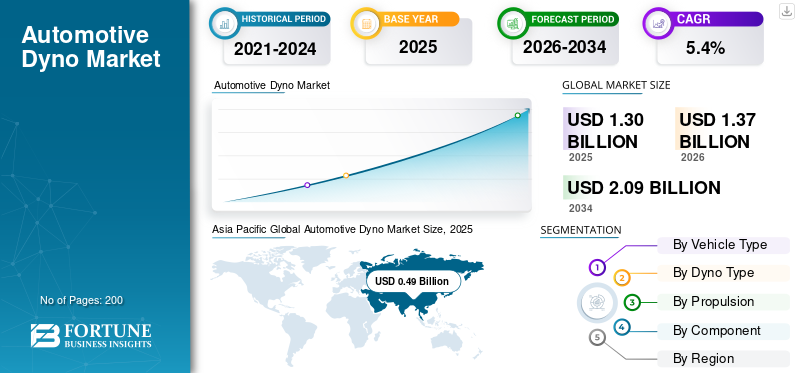
The global automotive dyno market size was valued at USD 1.30 billion in 2025. The market is projected to grow from USD 1.37 billion in 2026 to USD 2.09 billion by 2034, exhibiting a CAGR of 5.4% during the forecast period. Asia Pacific dominated the global market with a market share of 37.69% in 2025.
The global automotive dyno market represents the ecosystem of advanced testing equipment used to evaluate vehicle and powertrain performance under simulated real world driving conditions. Automotive dynamometers are essential tools for measuring torque, power output, speed, efficiency, and compliance with regulatory standards. These systems include engine dynamometers and chassis dynamometers, which are widely used by automotive manufacturers, Tier-1 suppliers, and certified testing laboratories for vehicle testing and validation.
The automotive dyno market is closely linked to the rising complexity of modern vehicles and the growing demand for high performance vehicles. Automakers increasingly rely on dyno systems to validate engines, transmissions, hybrid systems, and vehicles EVs, ensuring safety, durability, and regulatory compliance. The expanding focus on emissions testing and fuel-efficiency standards further strengthens the importance of dynos across global markets.
During the forecast period, the market is expected to evolve as electrification, digitalization, and automation reshape testing requirements. The transition toward electric vehicle EV platforms is driving demand for electric motor and e-axle testing solutions, while legacy internal combustion platforms continue to require extensive validation. Advanced dyno systems now integrate software-based analytics, automation, and data acquisition tools to improve testing capabilities and reduce development cycles.
Key players in the global automotive dyno market such as AVL List GmbH, HORIBA Ltd., Mustang Advanced Engineering and Dynojet Research are actively strengthening their positions by investing in advanced testing technologies, automation, and software-driven validation platforms. Leading suppliers are developing flexible dyno systems capable of supporting both internal combustion and electric vehicle EV architectures, enabling faster and more accurate vehicle testing.
Download Free sample to learn more about this report.
AUTOMOTIVE DYNO MARKET KEY TAKEAWAYS
 Market Size & Forecast
- 2025 Market Size: USD 1.30 Billion
- 2026 Market Size: USD 1.37 Billion
- 2034 Forecast Market Size: USD 2.09 Billion
- CAGR: 5.4% from 2026–2034
 Market Share
- Asia Pacific dominated the automotive dyno market with a 37.69% share in 2025.
- SUVs represent the leading vehicle type segment and are projected to grow at a CAGR of 6.9%.
- Engine dynamometers dominate the market due to their widespread use in ICE development and validation.
 Key Regional Highlights
Asia Pacific
Asia Pacific generated USD 0.49 billion in 2025 and remains the leading regional market for automotive dyno systems.
Europe
Europe is projected to reach USD 0.41 billion in 2026, supported by stringent emissions regulations and electrification initiatives.
North America
North America accounted for USD 0.31 billion in 2025, driven by strong automotive R&D and advanced testing requirements.
U.S.
The automotive dyno market was valued at approximately USD 0.24 billion in 2025, representing around 17.8% of global revenue.
Japan
The market is supported by extensive vehicle production and continued investments in advanced testing infrastructure for ICE and electric vehicles.
Read More

AUTOMOTIVE DYNO MARKET TRENDS
Integration of Automation and Digital Testing Platforms
Automation and digitalization are reshaping automotive dyno market trends. Modern dynos increasingly integrate software-driven control, automated test cycles, and advanced analytics. These capabilities improve efficiency, reduce human error, and enhance testing capabilities, supporting higher throughput and consistent results.
- For instance, Automotive testing suppliers are increasingly offering integrated software platforms for automated dyno testing and data analysis.
MARKET DYNAMICS
MARKET DRIVERS
Rising Demand for Advanced Vehicle and Emissions Validation Drives Industry Growth
The increasing complexity of modern vehicles and stricter regulatory norms are driving sustained demand for automotive dyno systems. Automakers must perform extensive emissions testing and performance validation to meet compliance requirements while maintaining efficiency and reliability. Advanced dynos enable precise measurement under controlled conditions, directly supporting market growth by improving development accuracy and reducing time-to-market.
- For instance, the U.S. Environmental Protection Agency continues to tighten vehicle emissions standards, increasing the need for advanced testing and validation infrastructure.
MARKET RESTRAINTS
High Capital Investment and Operational Complexity
Automotive dyno systems require significant upfront investment and skilled technical expertise, which can limit adoption among smaller testing facilities. High installation costs, calibration requirements, and specialized infrastructure increase financial risk. These factors can slow deployment rates, particularly in cost-sensitive markets, negatively influencing overall market growth.
MARKET OPPORTUNITIES
Expansion of Electric Vehicles to Fuel Industry Development
The global shift toward vehicles EVs presents a strong opportunity for the automotive dyno market. Electrified powertrains require new testing methodologies, creating demand for advanced motor and system-level dynos. Manufacturers that develop flexible, EV-ready solutions can capture significant share during the forecast period.
- For instance, the International Energy Agency highlights accelerating EV adoption, increasing demand for specialized testing and validation technologies.
MARKET CHALLENGES
Rapid Technology Shifts Across Powertrain Architectures Hinder Market Growth
Frequent changes in vehicle technologies create challenges for dyno manufacturers. Supporting both ICE and electric platforms requires continuous system upgrades and R&D investment. Failure to adapt quickly can limit supplier relevance, negatively affecting long-term market growth.
- For instance, Automotive OEMs continue to diversify powertrain strategies, increasing complexity for testing solution providers.
Download Free sample to learn more about this report.
Segmentation Analysis
By Vehicle Type
SUVs Segment Dominate Driven by Rising Global SUV Production
On the basis of vehicle type, the market is divided into Hatchback/Sedan, SUV, LCV and HCV. SUVs dominate the automotive dyno market due to higher power, weight, and emissions requirements. These vehicles require extensive validation across multiple driving conditions, increasing dyno utilization. Rising global SUV production directly supports sustained testing demand.
- For instance, global SUV production continues to rise, increasing testing requirements for performance and compliance.
To know how our report can help streamline your business, Speak to Analyst
The SUVs segment is expected to grow at a CAGR of 6.9% over the forecast period.
By Dyno Type
Engine Dynamometers Segment Lead Due to Widespread Use Across ICE Development
On the basis of dyno type, the market is segmented into engine, chassis, powertrain and electric motor & e-axle. Engine dynamometers dominate due to widespread use across ICE development, durability testing, and regulatory validation. Their ability to isolate and precisely measure engine performance makes them indispensable.
- For instance, in June 2024, Honda Motor Co. stated semi-digital instrument clusters remain common across mass-market models, offering digital information while retaining familiar analog elements.
Electric motor & e-axle is expected to grow at a CAGR of 11.3% over the forecast period.
By Propulsion
Continuous Efficiency Improvements Boosts ICE Segment Development
On the basis of propulsion, the market is segmented into ICE and Electric. Despite EV growth, ICE vehicles dominate the market, sustaining dyno demand. Continuous efficiency improvements and emissions compliance keep ICE testing relevant.
- For instance, in August 2023, Toyota stated internal combustion vehicles continue high global production volumes, sustaining demand for digital clusters across mainstream models.
The electric segment is expected to grow at a CAGR of 8.5% over the forecast period.
By Component
Hardware Segment Dominates Due to High-Value Mechanical Systems
On the basis of component, the market is segmented into hardware and software. Dyno hardware dominates due to high-value mechanical systems, load units, and control assemblies. Software complements hardware but remains secondary in overall value contribution.
- For instance, in March 2024, Bosch Mobility stated digital instrument clusters are primarily supplied through OEM integration to ensure system compatibility and functional safety.
The software segment is expected to grow at a CAGR of 7.4% over the forecast period.
Automotive Dyno Market Regional Outlook
By geography, the global automotive dyno market is categorized into North America, Europe, Asia Pacific, and Rest of the World.
Asia Pacific Global Automotive Dyno Market Size, 2025 (USD Billion)
To get more information on the regional analysis of this market, Download Free sample
Asia Pacific held the dominant share in 2025, valued at USD 0.49 billion, and also maintained its leading share in 2024, with USD 0.52 billion. The region dominates the global automotive dyno market due to its large vehicle production base, strong presence of automotive manufacturers, and rapid adoption of electric vehicle EV technologies. Countries such as China, Japan, South Korea, and India continue to invest in advanced vehicle testing infrastructure to support both ICE and electric platforms.
- For instance, in 2024, IBEF reported Asia Pacific leads global vehicle production, supporting large-scale adoption of digital instrument clusters across mass-market and premium vehicles.
China Automotive Dyno Market
China’s automotive dyno market is projected to be one of the largest worldwide, with 2025 revenues estimated at around USD 0.23 billion, representing roughly 18.2% of global market.
India Automotive Dyno Market
India’s automotive dyno market in 2025 is estimated at around USD 0.07 billion, accounting for roughly 5.3% of global automotive dyno revenues.
Europe is projected to record a growth rate of 5.3% in the coming years, which is the second-highest among all regions, and reach a valuation of USD 0.41 billion by 2026. Europe’s automotive dyno market benefits from strict regulatory standards, high engineering intensity, and a strong focus on powertrain efficiency. Countries such as Germany and France continue to invest in advanced vehicle testing systems to support emissions compliance and electrification, sustaining stable market expansion during the forecast period.
Germany Automotive Dyno Market
Germany automotive dyno market in 2025 is estimated at around USD 0.11 billion, accounting for roughly 8.4% of global automotive dyno revenues.
U.K. Automotive Dyno Market
U.K. automotive dyno market in 2025 is estimated at around USD 0.07 billion, accounting for roughly 5.4% of global automotive dyno revenues.
North America is estimated to reach USD 0.31 billion in 2025 and secure the position of the third-largest region in the market. The North America automotive dyno market is driven by strong R&D investments, stringent emissions regulations, and high demand for advanced testing capabilities. The U.S. remains a key contributor, supported by continuous innovation in performance testing and compliance validation. Growing adoption of electrified powertrains further supports steady market growth across the region.
U.S. Automotive Dyno Market
Based on North America’s strong contribution and the U.S. dominance within the region, the U.S. market can be analytically approximated at around USD 0.24 billion, representing roughly 17.8% of global automotive dyno market.
The Rest of the World, including Latin America, is witnessing gradual growth in the automotive dyno market. Expansion is supported by increasing vehicle assembly activities and improving regulatory frameworks. However, lower testing infrastructure maturity compared to developed regions limits rapid adoption, resulting in moderate but steady market growth.
COMPETITIVE LANDSCAPE
Key Industry Players
Industry Participants Focus on Innovation to Support Conventional And Electrified Powertrains
The competitive landscape of the global automotive dyno market is characterized by a mix of established testing solution providers and specialized manufacturers focusing on advanced vehicle testing technologies. Leading companies compete on system accuracy, automation, digital integration, and the ability to support both conventional and electrified powertrains. Product differentiation increasingly centers on modular designs, scalable software platforms, and enhanced data analytics capabilities.
Key players pursue competitive advantage through continuous product innovation, strategic partnerships with automotive manufacturers, and expansion of global service networks. Many companies are investing in dyno systems that can replicate simulated real world driving conditions, enabling more precise validation of performance and emissions. Integration of digital twins, cloud-based monitoring, and automated test cycles has become a defining feature of the key market participants.
Another important strategy involves expanding offerings for electric vehicle EV testing, including motor, inverter, and battery-related validation. Companies are also strengthening aftermarket and motorsports applications to diversify revenue streams. Geographic expansion into emerging automotive hubs in Asia and Latin America further supports long-term competitiveness.
- For instance, AVL introduced advanced vehicle testing systems supporting electrified powertrains and automated validation workflows to address evolving OEM testing requirements.
LIST OF KEY Automotive Dyno Market COMPANIES PROFILED
- AVL List GmbH (Austria)
- HORIBA Ltd. (Japan)
- Mustang Advanced Engineering (U.S.)
- Dynojet Research (U.S.)
- SuperFlow Technologies (U.S.)
- SAKOR Technologies (U.S.)
- Rototest (Sweden)
- Meidensha Corporation (Japan)
- Froude Hofmann (U.K.)
- Power Test Inc. (U.S.)
KEY INDUSTRY DEVELOPMENTS
- October 2025: SuperFlow launched the Stuska TrackPack Universal Test Stand, offering a configurable engine test stand solution designed to standardize dyno setups across multiple engine configurations.
- August 2025: Mustang Advanced Engineering announced the availability of an ADAS testing system designed for installation in existing service and inspection lanes, broadening access to advanced vehicle testing capabilities.
- May 2025: Power Test announced a major capital investment to upgrade and expand its Sussex, Wisconsin manufacturing facility, aimed at improving production efficiency and delivery timelines for testing equipment.
- May 2025: AVL highlighted its involvement at the MUBIL Lab Experience 2025, showcasing testing infrastructure supporting sustainable mobility programs, including electrified and alternative powertrain validation.
- April 2025: MAHA and dSPACE announced a collaboration to jointly develop and market automated test benches for vehicle inspection and functional testing, supporting the evaluation of increasingly automated vehicles.
REPORT COVERAGE
The global automotive dyno market analysis provides an in-depth study of market size & forecast by all the market segments included in the report. It includes details on the market dynamics and market trends expected to drive the market in the forecast period. It offers information on the technological advancements, new product launches, key industry developments, and details on partnerships, mergers & acquisitions. The research report also encompasses detailed competitive landscape with information on the market share and profiles of key operating players.
Request for Customization to gain extensive market insights.
Report Scope & Segmentation
|
ATTRIBUTE |
DETAILS |
|
Study Period |
2021-2034 |
|
Base Year |
2025 |
|
Estimated Year |
2026 |
|
Forecast Period |
2026-2034 |
|
Historical Period |
2021-2024 |
|
Growth Rate |
CAGR of 5.4% from 2026-2034 |
|
Unit |
Value (USD Billion) |
|
Segmentation |
By Vehicle Type, Dyno Type, Propulsion, Component, and Region |
|
By Vehicle Type |
· Hatchback/Sedan · SUV · LCV · HCV |
|
By Dyno Type |
· Engine · Chassis · Powertrain · Electric motor & e-axle |
|
By Propulsion |
· ICE · Electric |
|
By Component |
· Hardware · Software |
|
By Geography |
· North America (By Vehicle Type, Dyno Type, Propulsion, Component and Country) o U.S. (By Vehicle Type) o Canada (By Vehicle Type) o Mexico (By Vehicle Type) · Europe (By Vehicle Type, Dyno Type, Propulsion, Component and Country) o Germany (By Vehicle Type) o U.K. (By Vehicle Type) o France (By Vehicle Type) o Rest of Europe (By Vehicle Type) · Asia Pacific (By Vehicle Type, Dyno Type, Propulsion, Component and Country) o China (By Vehicle Type) o India (By Vehicle Type) o Japan (By Vehicle Type) o South Korea (By Vehicle Type) o Rest of Asia Pacific (By Vehicle Type) · Rest of the World (By Vehicle Type, Dyno Type, Propulsion, Component and Country) |
Frequently Asked Questions
Fortune Business Insights says that the global market value stood at USD 1.30 billion in 2025 and is projected to reach USD 2.09 billion by 2034.
In 2025, the market value stood at USD 0.49 billion.
The market is expected to exhibit a CAGR of 5.4% during the forecast period (2026-2034).
SUV segment led the market by vehicle type.
Rising demand for advanced vehicle and emissions validation is the key factor driving market growth.
Mustang, SuperFlow, Rototest and Dynojet are some of the top players in the market.
Asia Pacific dominated the market in 2025.



- 2021-2034
- 2025
- 2021-2024
- 200
-
(Offer valid till 15th Oct 2026)
Get 30-60 hrs Free Customization
Expand Regional and Country Coverage, Segments Analysis, Company Profiles, Competitive Benchmarking, and End-user Insights.




















-
US +1 833 909 2966 ( Toll Free )
-
Get In Touch With Us