Automotive Immobilizer Market Size, Share & Industry Analysis, By Technology Type (Transponder-Based Immobilizer, RFID-Based Immobilizer, Smart Key/Passive Keyless Entry Immobilizer, Biometric Immobilizer), By Vehicle Type (Hatchback/Sedan, SUVs, LCVs, HCVs), By Distribution Network (OEM and Aftermarket), By Component (Immobilizer Control Unit, Transponder Key/Key Fob, Antenna Coil/Receiver Ring, ECU Interface Module), By Propulsion Type (Internal Combustion Engine Vehicles, Hybrid Electric Vehicles, and Battery Electric Vehicles), and Regional Forecast, 2026-2034
 Download Free Sample
(Offer valid till 31st Oct 2026)

Automotive Immobilizer Market Size and Future Outlook
 Listen to Audio Version
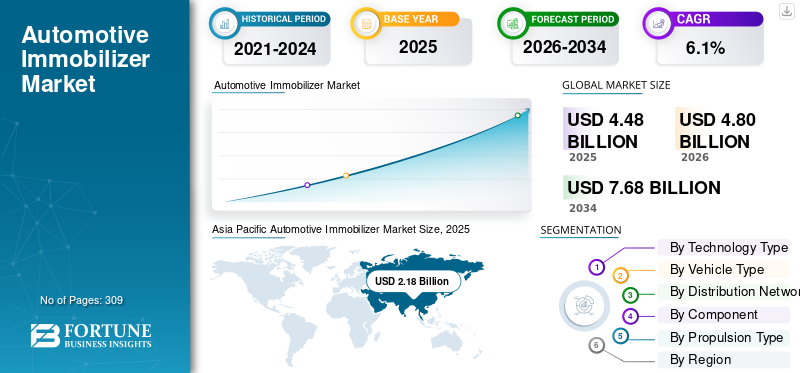
The global automotive immobilizer market size was valued at USD 4.48 billion in 2025. The market is projected to grow from USD 4.80 billion in 2026 to USD 7.68 billion by 2034, exhibiting a CAGR of 6.1% over the forecast period. Asia Pacific dominated the automotive immobilizer market with a market share of 48.66% in 2025.
An automotive immobilizer is an electronic anti-theft system that prevents a vehicle from starting unless the correct authorized key, transponder, smart key, or digital credential is detected. It works by turning off critical engine or powertrain functions through the ECU, ignition, fuel, or start authorization system, reducing unauthorized vehicle use and theft risk. The market growth is driven by rising vehicle theft concerns, regulations mandating the inclusion of anti-theft devices, and the growing OEM adoption of electronic security systems. The increasing use of smart keys, passive entry, push-button start, connected vehicles, and electric vehicles is strengthening the demand for advanced immobilizers integrated with ECUs, digital access systems, telematics, and cybersecurity-enabled authentication.
Major players include Huf Hulsbeck & Furst, Continental, Bosch, DENSO, HELLA, and Valeo. Companies are shifting from basic transponder immobilizers toward smart keys, passive entry, digital keys, UWB/NFC access, secure semiconductors, and software-defined vehicle authorization systems to improve theft protection and user convenience.
Download Free sample to learn more about this report.
Automotive Immobilizer Market Key Takeaways
 Global Market Size & Forecast
- 2025 Market Size: USD 4.48 billion
- 2026 Market Size: USD 4.80 billion
- 2034 Forecast Market Size: USD 7.68 billion
- CAGR: 6.1% from 2026–2034
 Market Share
- Asia Pacific dominated the automotive immobilizer market with a market share of 48.66% in 2025.
- The HCVs segment is projected to grow at a CAGR of 6.5% over the forecast period.
- The immobilizer control unit segment is projected to grow at a CAGR of 7.8% over the forecast period.
 Key Regional Highlights
Asia Pacific
The region led the global market with a value of 48.66% share in 2025, driven by strong vehicle production, rising smart key adoption, and increasing OEM installation across passenger and commercial vehicles.
North America
The regional market is supported by high OEM fitment, growing connected vehicle adoption, strong fleet security demand, and increasing replacement smart key requirements.
Europe
Stable growth is driven by mature anti-theft regulations, widespread factory-fitted immobilizers, premium vehicle production, and increasing adoption of digital vehicle access technologies.
U.S.
The market is expected to reach USD 0.87 billion in 2026, supported by a large vehicle parc, high SUV and pickup ownership, strong OEM penetration, and rising adoption of connected vehicle security systems.
Japan
The market is projected to reach USD 0.32 billion in 2026, supported by mature OEM immobilizer adoption, advanced automotive electronics capabilities, and growing demand for smart key and hybrid vehicle security systems.
Read More

AUTOMOTIVE IMMOBILIZER MARKET TRENDS
Lifecycle Cybersecurity Engineering is emerging as a Major Trend in Immobilizer Development
Lifecycle cybersecurity engineering is becoming a central trend in the market. Earlier immobilizer systems were often evaluated mainly on their ability to prevent unauthorized engine start at the point of sale.
The security requirement extends across the entire vehicle lifecycle, including design, supplier sourcing, software development, production, dealership programming, vehicle operation, maintenance, updates, and end-of-life handling. This is changing how OEMs and suppliers design immobilizers given that the system must remain secure not only when the vehicle is new, but also after years of software updates, key replacements, ownership transfers, and service interventions.
Suppliers must provide threat analysis, risk assessment, secure coding practices, vulnerability management, production controls, and maintenance support. Immobilizers must also be designed to withstand unauthorized diagnostic access, credential manipulation, firmware tampering, and insecure software updates. This trend supports the transition from hardware-only immobilizer supply to system-level security engineering.
MARKET DYNAMICS
MARKET DRIVERS
Download Free sample to learn more about this report.
Regulatory Standardization of Anti-Theft Technologies and Unauthorized-Use Prevention Systems to Drive Market Growth
One of the strongest factors driving the global automotive immobilizer market growth is the increasing standardization of vehicle anti-theft devices and unauthorized-use prevention requirements across major automotive markets. Immobilizers are no longer treated only as optional security accessories. They are increasingly being embedded into vehicle type approval, insurance evaluation, and compliance frameworks. This regulatory direction directly supports their demand given that automakers must ensure that vehicles cannot be started, moved, or operated by unauthorized users without validated key authentication or electronic access approval.
The UN Regulation No. 116 identifies immobilizers as a recognized technical category and provides approval symbols for vehicles equipped with immobilizer-related systems. This gives OEMs, suppliers, and approval authorities a common framework for designing, testing, and certifying the vehicle security system market. Such regulatory harmonization is important for global platforms as automakers often use common electronic architectures across multiple regions. When immobilizer requirements are embedded into type approval logic, suppliers gain recurring demand across vehicle programs rather than relying only on consumer-driven aftermarket adoption.
MARKET RESTRAINTS
Increasing Diagnostic Complexity and Service Dependence May Restrain Market Expansion
A major restraint for the global market is the increasing diagnostic and service complexity of modern immobilizer systems. Unlike earlier immobilizers that mainly relied on a transponder key and ignition authorization, newer systems are integrated with multiple electronic components such as smart keys, antennas, ECUs, body control modules, secure gateways, telematics units, digital credentials, and cloud-linked access services. When one part of this system fails or loses synchronization, the vehicle may not start, even if the owner has a legitimate key. This creates service challenges for workshops, dealerships, locksmiths, fleet operators, and aftermarket installers.
The issue is becoming more significant as vehicles become more software-driven. Immobilizer repair may require specialized diagnostic tools, OEM-level authorization, encrypted key programming, secure access credentials, and updated software files. Independent repairers may face difficulty servicing these systems if they lack access to approved tools or technical information. This can slow aftermarket adoption, increase vehicle downtime, and create customer dissatisfaction when immobilizer faults prevent normal vehicle use.
MARKET OPPORTUNITIES
Aging Vehicle Fleet and Retrofit Security Demand Creates Aftermarket Growth Opportunities
The aging global vehicle fleet creates a strong aftermarket opportunity for immobilizer suppliers, especially in countries where older vehicles remain in use for long periods and may lack advanced factory-fitted electronic security. Older vehicles are often more exposed to theft given that they may rely on basic mechanical locks, older remote keyless systems, or outdated transponder technologies. As vehicle owners, insurers, and fleet operators seek better protection, the demand increases for aftermarket immobilizers, hidden kill switches, transponder upgrades, GPS-linked immobilizers, and telematics-integrated disablement systems.
This opportunity is supported by the growing average age of vehicles in mature markets. ACEA’s vehicle fleet report shows that Europe has a large and aging vehicle parc, highlighting the importance of replacement and renewal dynamics across cars, vans, trucks, and buses. Although the report focuses on Europe, the same logic applies in many regions where vehicles remain on the road for more than a decade. Older fleets create continued demand for security retrofits, replacement keys, immobilizer modules, and service-based upgrades.
MARKET CHALLENGES
Rapid Evolution of Electronic Theft Tools Challenges Immobilizer Effectiveness
The most crucial challenge for the global market is the rapid evolution of electronic theft tools. Immobilizers were originally designed to prevent unauthorized vehicle start by ensuring that only an approved key or transponder could activate the engine. However, vehicle theft methods have become more sophisticated, targeting the communication between key fobs, mobile devices, ECUs, diagnostic ports, and wireless access systems. This creates a continuous challenge for OEMs and suppliers given that criminals adapt quickly to new vehicle access technologies.
The challenge is intensified by the need to balance security and convenience. Consumers expect passive entry, push-button start, remote access, shared digital keys, and smartphone-based operation. These features increase convenience but also increase the number of interfaces that must be secured. If the immobilizer system becomes too restrictive, customers may face false lockouts or a poor user experience. If it is too permissive, attackers may find ways to bypass authentication.
Segmentation Analysis
By Technology Type
Transponder-based Immobilizer Segment Leads the Market with Lower Integration Complexity and Wide OEM Adoption
Based on technology type, the market is segmented into transponder-based immobilizer, RFID-based immobilizer, smart key/passive keyless entry (PKE) immobilizer, and biometric immobilizer.
The transponder-based immobilizer segment dominates the market due to its wide OEM adoption, proven theft-prevention capability, lower integration complexity, and strong replacement demand across existing vehicle fleets. Its compatibility with mass-market vehicles, used vehicles, and traditional ignition authorization systems supports stable demand despite the gradual shift toward smart and digital access technologies.
The biometric immobilizer segment is projected to grow at a CAGR of 11.3% over the forecast period. The segment growth is driven by premium vehicle security, personalized access, digital cockpit integration, and rising demand for user-specific authentication.
By Distribution Network
Factory-Fitted Security Integration to Strengthen OEM Segment Leadership
Based on distribution network, the market is segmented into OEM and aftermarket, with aftermarket further segmented into new vehicles and used vehicles.
The OEM segment dominates the market given that immobilizers are increasingly integrated during vehicle production with ECUs, body control modules, smart keys, ignition systems, gateways, and powertrain authorization systems. Automakers prefer factory-fitment due to better software compatibility, warranty alignment, platform validation, and lower tampering risk. In 2025, OICA production statistics showed continued large-scale global vehicle manufacturing across major automotive markets, supporting recurring OEM installation demand.
The aftermarket segment is projected to grow at a CAGR of 7.4% over the forecast period. Used vehicles, replacement smart keys, retrofit immobilizers, fleet upgrades, and secondary anti-theft installations drive growth.
By Vehicle Type
Higher Smart Key Adoption to Propel SUVs Segment Growth
Based on vehicle type, the market is segmented into hatchback/sedan, SUVs, LCVs, and HCVs.
The SUVs segment leads the market, supported by the rising consumer preference for utility vehicles, higher vehicle value, and broader adoption of smart keys, passive entry, push-button start, and connected access systems. SUVs typically carry higher electronic security content than entry-level passenger cars, making immobilizer value per vehicle stronger. Premium SUVs and electric SUVs further accelerate the demand for advanced authorization technologies.
The HCVs segment is projected to grow at a CAGR of 6.5% over the forecast period. The segment growth is supported by fleet security, driver authorization, cargo protection, telematics integration, and remote immobilization in logistics and heavy-duty operations.
To know how our report can help streamline your business, Speak to Analyst
By Component
Smart Access Adoption to Boost Transponder Key/Key Fob Segment Growth
Based on component, the market is segmented into Immobilizer Control Unit (ICU), transponder key/key fob, antenna coil/receiver ring, ECU interface module, and other electronic components.
The transponder key/key fob segment dominates the market due to its essential role in vehicle authentication, remote locking, smart access, and immobilizer activation. Strong OEM fitment and recurring aftermarket replacement from lost, damaged, or reprogrammed key fobs support sustained revenue. In March 2025, the Car Connectivity Consortium expanded Digital Key certification coverage to Bluetooth LE and UWB, supporting passive entry and passive start functions.
The immobilizer control unit segment is projected to grow at a CAGR of 7.8% over the forecast period. Encrypted authorization, ECU integration, secure gateways, software-defined vehicles, and advanced start-permission control support segment growth.
By Propulsion Type
Large Vehicle Parc and Continued Conventional Vehicle Production to Drive the ICE Vehicle Segment
Based on propulsion type, the market is segmented into Internal Combustion Engine (ICE) vehicles, hybrid electric vehicles (HEVs), and battery electric vehicles (BEVs).
The internal combustion engine vehicles segment dominates the automotive immobilizer market share due to large global vehicle parc, continued production of conventional vehicles, and widespread use of transponder-based and smart key immobilizers. ICE vehicles generate strong OEM and replacement demand for key fobs, transponders, ignition authorization modules, and immobilizer control units. The global vehicle production data from OICA continues to show large passenger and commercial vehicle output, supporting sustained immobilizer demand in conventional platforms.
The battery electric vehicles segment is projected to grow at a CAGR of 11.0% over the forecast period. The segment growth is supported by digital keys, secure drive authorization, charging access, connected apps, and software-based immobilization.
AUTOMOTIVE IMMOBILIZER MARKET REGIONAL OUTLOOK
By geography, the market is categorized into Europe, North America, Asia Pacific, South America, the Middle East, and Africa.
ASIA PACIFIC
Asia Pacific Automotive Immobilizer Market Size, 2025 (USD Billion)
To get more information on the regional analysis of this market, Download Free sample
Asia Pacific dominates the global market due to its large vehicle production base, expanding passenger vehicle parc, strong SUV demand, and growing adoption of smart key and electronic anti-theft systems. China, India, Japan, South Korea, and Southeast Asia remain key demand centers. OEM fitment is rising across mid-range and premium vehicles, while the aftermarket demand is supported by used vehicles, urban theft prevention, and commercial fleets.
CHINA AUTOMOTIVE IMMOBILIZER MARKET
The China market is poised to dominate the Asia Pacific market with a share of 56.4% in 2026, supported by the world’s largest vehicle production base, rapid EV adoption, expanding connected vehicle platforms, and increasing OEM integration of smart keys, digital access, passive entry, and electronic start-authorization systems.
INDIA AUTOMOTIVE IMMOBILIZER MARKET
The India market is projected to record the highest CAGR of 8.8% during the analysis period. The market growth in the country is driven by rising vehicle ownership, growing OEM fitment of anti-theft systems, expanding SUV and compact car production, increasing aftermarket retrofit demand, and stronger consumer awareness of vehicle security.
JAPAN AUTOMOTIVE IMMOBILIZER MARKET
The Japan market is estimated to record a market value of USD 0.32 billion in 2026, supported by mature OEM immobilizer penetration and strong automotive electronics capability. Additional aspects driving the market growth comprise smart key adoption, hybrid vehicle leadership, and advanced access-control systems fitted across passenger cars and premium models.
AUSTRALIA AUTOMOTIVE IMMOBILIZER MARKET
Australia is poised to hold a share of 1.2% in the global market in 2026, reflecting its smaller vehicle population but high immobilizer penetration. SUVs, pickups, replacement key services, commercial fleets, mining vehicles, rental fleets, and telematics-linked security upgrades support demand. Australia represents a smaller but stable market, supported by established immobilizer requirements, high OEM fitment, strong SUV and pickup demand, and mature vehicle security awareness. Replacement smart keys, transponder repairs, aftermarket upgrades, and fleet applications across mining, utilities, rental, logistics, and service vehicles mainly drive growth. Since immobilizers are already widely fitted in new vehicles, the future demand is expected from smart access upgrades, telematics-linked immobilization, and security services.
NORTH AMERICA
North America remains a mature but steadily expanding market, supported by high OEM fitment, strong SUV and pickup penetration, advanced smart key adoption, and growing concern over vehicle theft. The product demand is increasingly linked to connected vehicle access, replacement smart keys, remote immobilization, and fleet security solutions, and increased demand for effective security solutions. Commercial fleets, rental operators, logistics vehicles, and used vehicles are supporting aftermarket growth, while OEMs continue integrating immobilizers with electronic control units, passive entry, and cybersecurity-ready access systems.
U.S. AUTOMOTIVE IMMOBILIZER MARKET
The U.S. is anticipated to dominate the North America market with a value of USD 0.87 billion in 2026, supported by its large vehicle parc, high SUV and pickup ownership, strong OEM immobilizer penetration. Additional factors supporting market growth in the country comprise replacement key demand and the rising adoption of connected vehicle security and fleet immobilization systems.
EUROPE
The Europe market shows stable growth due to mature anti-theft regulations, high factory-fitted immobilizer penetration, premium vehicle production, and rising adoption of smart key, passive entry, and digital access systems. The market expansion is moderate as immobilizers are already widely standardized in new vehicles. However, the demand continues from replacement smart keys, used vehicles, commercial fleets, EV platforms, and secondary anti-theft upgrades. Premium SUVs, electric vehicles, and connected vehicle architectures are strengthening the demand for advanced immobilizer control units.
U.K. AUTOMOTIVE IMMOBILIZER MARKET
The U.K. market is poised to touch a value of USD 0.14 billion in 2026, driven by premium vehicle demand, rising concerns over keyless theft, replacement smart key services, used vehicles, SUVs, and aftermarket secondary immobilizers. Fleet security and telematics-linked immobilization also support continued market expansion.
GERMANY AUTOMOTIVE IMMOBILIZER MARKET
The Germany market is estimated to hold a share of 20.7% in the Europe market in 2026, supported by its strong automotive manufacturing base, premium OEM presence, advanced vehicle electronics, and high adoption of smart keys, digital access, passive entry, and secure start-authorization systems.
SOUTH AMERICA
The South America market is gaining momentum as vehicle security concerns, used-vehicle demand, and aftermarket retrofit installations continue to rise. Brazil remains the dominant market, supported by its large vehicle parc and automotive manufacturing base. Across the region, the product demand is driven by urban theft prevention, commercial fleet protection, transponder replacement, smart key services, and GPS-linked immobilizer installations. The OEM fitment is increasing in newer vehicles, while aftermarket demand remains highly relevant across older cars and LCV fleets.
BRAZIL AUTOMOTIVE IMMOBILIZER MARKET
Brazil is anticipated to dominate the South America market with a share of 64.1% in 2026, supported by the region’s largest automotive production base, high vehicle ownership, and urban theft-prevention demand. Strong aftermarket activity for immobilizer repairs, replacement keys, transponder programming, and secondary anti-theft installations further supports the dominant position of the country in the regional market.
MIDDLE EAST
The Middle East market is expanding through rising premium vehicle sales, strong SUV demand, luxury imports, connected vehicle adoption, and commercial fleet security requirements. High-value passenger vehicles and fleet assets require advanced anti-theft protection, smart keys, remote immobilization, and driver authorization systems. Rental fleets, oilfield vehicles, logistics operators, and government fleets also support demand. Aftermarket upgrades remain relevant for added security, GPS-linked immobilization, and telematics-based vehicle control.
UAE AUTOMOTIVE IMMOBILIZER MARKET
The UAE market is projected to grow at a CAGR of 9.7% during the forecast period, supported by luxury vehicle penetration, connected SUV demand, rental and leasing fleets, and logistics operations. The country also depicts the rising adoption of smart access, digital keys, remote immobilization, and premium anti-theft systems.
AFRICA
The Africa market is expected to witness comparatively faster growth due to rising vehicle ownership, used-vehicle imports, expanding commercial fleets, and increasing demand for affordable theft-prevention systems. Many vehicles in the region are older or imported pre-owned units, creating strong aftermarket potential for retrofit immobilizers, transponder replacement, GPS-linked security, and secondary anti-theft systems. Urbanization, logistics expansion, fleet security needs, and gradual adoption of OEM-fitted immobilizers in new vehicles support growth.
SOUTH AFRICA AUTOMOTIVE IMMOBILIZER MARKET
The South Africa market is likely to hold a share of 42.9% in 2026, supported by used-vehicle imports, older vehicle fleets, rising urban theft-prevention needs, and commercial fleet growth. The increasing demand for affordable aftermarket immobilizers, GPS-linked security, and replacement key services further propels industry expansion in the country.
COMPETITIVE LANDSCAPE
Key Industry Players
Leading Companies Focus on Smart Access, Digital Key Integration, and Cybersecure Authorization for an Edge over Rival Players
The global automotive immobilizer market compete through smart keys, passive entry, digital keys, immobilizer ECUs, secure semiconductors, UWB/NFC access, and software-based authorization systems. The market is led by Huf Hulsbeck & Furst, Continental, Bosch, DENSO, HELLA, and Valeo. To gain an edge, companies are shifting from basic transponder immobilizers toward connected, cybersecure, and smartphone-enabled access platforms. Huf positions itself as a specialist in secure car access and authorization, while Bosch offers digital key-based vehicle access and fleet access solutions. Continental’s CoSmA platform strengthens competition through smartphone-based access using UWB technology. Strategic focus is moving toward OEM integration, software-defined vehicle compatibility, anti-relay protection, and lifecycle cybersecurity. In June 2025, Continental supplied the Audi Q6 e-tron with a comprehensive access system, including conventional key technology and smartphone-based CoSmA digital access using UWB.
LIST OF KEY AUTOMOTIVE IMMOBILIZER COMPANIES PROFILED
- Continental AG (Germany)
- Robert Bosch GmbH (Germany)
- DENSO Corporation (Japan)
- HELLA GmbH & Co. KGaA (Germany)
- Valeo SA (France)
- ZF Friedrichshafen AG (Germany)
- Mitsubishi Electric Corporation (Japan)
- Tokai Rika Co., Ltd. (Japan)
- ALPHA Corporation (Japan)
- Strattec Security Corporation (U.S.)
- Lear Corporation (U.S.)
- Marquardt GmbH (Germany)
- NXP Semiconductors N.V. (Netherlands)
- Infineon Technologies AG (Germany)
- Huf Hulsbeck & Furst GmbH & Co. KG (Germany)
KEY INDUSTRY DEVELOPMENTS
- April 2026: Mitsubishi Electric signed an MoU with Hon Hai to explore the joint operation of automotive equipment businesses, targeting synergies in electrification, safety systems, autonomous driving, and software-defined vehicle technologies relevant to future smart-entry, authorization, and vehicle-control ecosystems.
- January 2026: DENSO became a Core Partner of AUTOSAR to advance global automotive software standardization. The move would support future vehicle platforms where immobilizer, smart entry, digital key, and cybersecurity functions increasingly depend on standardized software architecture.
- January 2026: Samsung Wallet introduced Digital Key access for select Toyota vehicles, enabling compatible Galaxy smartphones to lock, unlock, start, and share vehicle keys. The UWB- and NFC-based integration strengthens smartphone-led secure access and supports next-generation immobilizer-linked vehicle authorization.
- December 2025: WITTE Automotive concluded negotiations to acquire HELBAKO Group, a Germany-based electronics specialist with control-unit development and production expertise. The deal strengthens WITTE’s electronics, software, and vehicle-access capabilities, supporting smarter immobilizer-linked access platforms for OEM programs.
- December 2024: Huf won its first 79 GHz radar kick-sensor order, expanding its access portfolio beyond keys and ECUs into contactless vehicle entry functions relevant to secure, hands-free mobility systems.
REPORT COVERAGE
The global automotive immobilizer market report provides an in-depth study of the market size and forecast across all market segments included in the report. It contains details on market research dynamics and trends expected to drive the market during the forecast period. It offers information on rapid technological advancements, new product launches, key industry developments, strategic partnerships, mergers, and acquisitions. The market forecast provides a comprehensive competitive landscape, including the most significant global market shares, emerging opportunities, and profiles of key players.
Request for Customization to gain extensive market insights.
Report Scope & Segmentation
| ATTRIBUTE | DETAILS |
| Study Period | 2021-2034 |
| Base Year | 2025 |
| Estimated Year | 2026 |
| Forecast Period | 2026-2034 |
| Historical Period | 2021-2024 |
| Growth Rate | CAGR of 6.1% from 2026 to 2034 |
| Unit | Value (USD Billion) |
| Segmentation | By Technology Type, By Vehicle Type, By Distribution Network, By Component, By Propulsion Type, and By Region |
| By Technology Type |
|
| By Distribution Network |
|
| By Vehicle Type |
|
| By Component |
|
| By Propulsion Type |
|
| By Geography |
|
Frequently Asked Questions
Fortune Business Insights says that the global market value stood at USD 4.48 billion in 2025 and is projected to reach USD 7.68 billion by 2034.
In 2025, the Asia Pacific market value stood at USD 2.18 billion.
The market is expected to grow at a CAGR of 6.1% from 2026 to 2034.
The SUVs segment led the global market share by vehicle type.
Rising vehicle theft concerns, mandatory anti-theft requirements, and growing OEM adoption of electronic security systems are key factors driving market momentum.
Key market players include Huf Hulsbeck & Furst, Continental, Bosch, DENSO, HELLA, Valeo, and Strattec.
The Asia Pacific region accounts for the largest share of the market.
North America, Europe, Asia Pacific, South America, the Middle East, and Africa have been considered in the market scope.



- 2021-2034
- 2025
- 2021-2024
- 309
-
(Offer valid till 31st Oct 2026)
Get 30-60 hrs Free Customization
Expand Regional and Country Coverage, Segments Analysis, Company Profiles, Competitive Benchmarking, and End-user Insights.















-
US +1 833 909 2966 ( Toll Free )
-
Get In Touch With Us