Automotive NVH Testing Market Size, Share & Industry Analysis, By Vehicle Type (Hatchbacks & Sedans, SUVs, LCVs, and HCVs), By Propulsion Type (ICE and Electric), By Testing Type (Noise Testing, Vibration Testing, Harshness Testing, and Integrated NVH Testing), By Application (Powertrain & Drivetrain, Body & Chassis, Interior & Cabin, Tires & Road Interaction, and Electrical & Auxiliary Systems), By Product Type (Hardware, Software, and Services), and Regional Forecast, 2026-2034
 Download Free Sample
(Offer valid till 31st Oct 2026)

Automotive NVH Testing Market Size and Future Outlook
 Listen to Audio Version
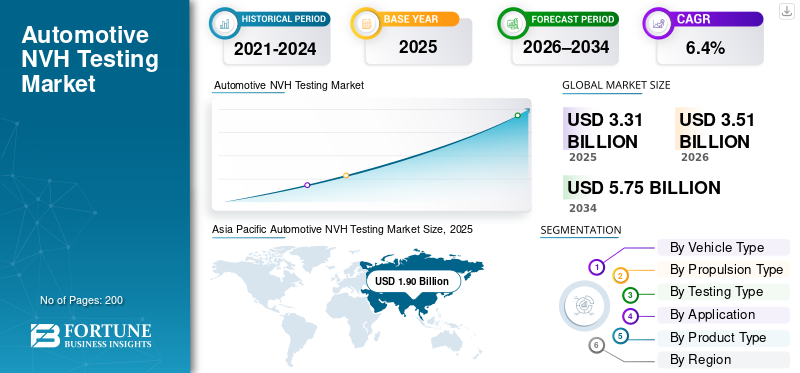
The global automotive NVH Testing market size was valued at USD 3.31 billion in 2025. The market is projected to grow from USD 3.51 billion in 2026 to USD 5.75 billion by 2034, exhibiting a CAGR of 6.4% during the forecast period. Asia Pacific dominated the automotive NVH testing market with a market share of 57.40% in 2025
Automotive NVH testing evaluates noise, vibration, and harshness levels in vehicles to ensure ride comfort, structural integrity, regulatory compliance, and optimized performance across components, systems, and driving conditions. Key market drivers include stricter noise regulations, rising vehicle comfort expectations, EV powertrain adoption, lightweight materials, advanced testing technologies, and increased focus on quality, safety, and customer experience by automakers.
Key market players in the automotive NVH testing market include Bosch, Siemens, Brüel & Kjær (HBK), and National Instruments, competing through advanced measurement systems, simulation-driven NVH analysis, automation, digital integration, and high-precision noise and vibration diagnostics for ICE and electric vehicles.
Download Free sample to learn more about this report.
Automotive NVH Testing Market Key Takeaways
 Global Market Size & Forecast
- 2025 Market Size: USD 3.31 Billion
- 2026 Market Size: USD 3.51 Billion
- 2034 Forecast Market Size: USD 5.75 Billion
- CAGR: 6.4% from 2026–2034
 Market Share
- Asia Pacific dominated the automotive NVH testing market with a 57.40% share in 2025.
- The SUV segment held the largest market share by vehicle type.
- The ICE segment accounted for the largest market share by propulsion type.
 Key Regional Highlights
Asia Pacific
Held 57.40% of the global market in 2025, driven by strong vehicle production and rapid EV adoption.
Europe
Ranked as the second-largest regional market and is projected to grow at a 6.0% CAGR.
North America
Recorded steady growth, supported by strong SUV production and increasing EV adoption.
U.S
The market is estimated at USD 413.6 million in 2026, accounting for 11.8% of global revenue.
Japan
The market is estimated at USD 302.8 million in 2026, representing 8.6% of global revenue.
Read More

AUTOMOTIVE NVH TESTING MARKET TRENDS
Integration of Virtual Simulation with Physical Testing to Shape Market Trends
Automakers are increasingly combining virtual NVH simulation with physical testing to shorten development cycles and reduce costs. Digital twins, model-based engineering, and AI-assisted signal analysis are becoming standard practices in various industries. These types of automotive NVH testing market trends are transforming NVH testing from a hardware-centric activity to a hybrid digital workflow, increasing demand for advanced software platforms that can correlate simulation results with real-world noise and vibration measurements.
- In June 2025, Hyundai announced plans to use VR simulators in vehicle development to accelerate virtual validation of ride, handling, and comfort, including noise and vibration behavior, enabling earlier NVH issue detection, reducing physical prototype cycles, and improving cross-discipline collaboration between engineers and test teams.
Download Free sample to learn more about this report.
MARKET DYNAMICS
MARKET DRIVERS
Rising Electrification and Vehicle Complexity to Drive NVH Testing Demand
The rapid shift toward electric and hybrid vehicles is increasing the complexity of noise, vibration, and harshness characteristics. Unlike ICE vehicles, EVs expose high-frequency motor, inverter, and road noise, requiring extensive NVH validation. The growing electrification across passenger and commercial vehicles is driving OEMs and suppliers to invest more in advanced NVH testing tools, integrated testing platforms, and simulation software to meet comfort, safety, and refinement expectations. Thus, the rising electrification and increasing complexity of vehicles complexity drive the demand for NVH testing in the automotive industry over the forecast period.
- In May 2022, Genesis detailed an NVH technology and testing program for the GV60, using sealing changes, aero refinements, foam-filled tires, and noise-cancellation to raise cabin refinement, illustrating how EVs intensify NVH engineering focus as non-powertrain noises become more perceptible.
MARKET RESTRAINTS
High Capital Cost of Advanced NVH Infrastructure to Restrain Adoption
Advanced NVH testing setups require significant investment in anechoic chambers, multi-channel data acquisition systems, precision sensors, and specialized software. For smaller OEMs, Tier-2 suppliers, and emerging-market manufacturers, these high upfront costs can limit the adoption of NVH testing. Inflation, rising interest rates, and budget prioritization toward electrification hardware can further restrain NVH testing investments, especially in cost-sensitive and developing automotive and aerospace markets.
MARKET OPPORTUNITIES
Localization of Testing and Validation to Create New Growth Opportunities
Geopolitical tensions, trade tariffs, and supply chain disruptions are encouraging automakers to localize vehicle development and validation activities. This shift is creating opportunities for regional NVH testing labs, mobile testing services, and localized software deployments. As OEMs replicate testing capabilities closer to manufacturing hubs, demand for modular NVH hardware, cloud-enabled software, and outsourced testing services is expected to rise across emerging and reshoring-focused markets. Hence, the localization of testing and validation augments the automotive NVH testing market growth.
- In November 2025, Nissan extended its partnership with Monolith to use AI models trained on historical test data to predict outcomes of physical vehicle tests, cutting prototype dependence and accelerating validation, an approach that can also compress NVH-related test cycles across new vehicle platforms.
MARKET CHALLENGES
Shortage of Skilled NVH Engineers to Challenge Market Growth
NVH testing requires specialized expertise in acoustics, signal processing, vehicle dynamics, and software analytics. The global shortage of skilled NVH engineers and acoustics specialists is becoming a key challenge for OEMs and testing service providers. As vehicles become more complex, the lack of trained personnel can slow testing programs, increase reliance on external consultants, and limit the effective use of advanced NVH testing systems.
Segmentation Analysis
By Vehicle Type
Higher Vehicle Mass and Elevated Ride Height to Propel SUV Segmental Dominance
Based on vehicle type, the market of Automotive NVH Testing is segmented into hatchbacks & sedans, SUVs, LCVs, and HCVs.
The SUV segment dominates the automotive NVH testing market share due to its higher vehicle mass, elevated ride height, and more complex body structures, which generates greater noise and vibration challenges. SUVs require extensive testing for road noise, wind noise, drivetrain vibration, and structural resonance to meet sa
fety and comfort expectations. Rapid global SUV adoption across passenger and premium segments, coupled with the increasing availability of electrified SUV platforms and frequent model upgrades, sustains strong and recurring demand for comprehensive NVH testing solutions.
Hatchbacks and sedans represent the second-largest segment and are expected to grow at a 5.1% CAGR during the forecast period. Large production volumes, platform continuity, and incremental refinement requirements continue to drive consistent NVH testing demand, particularly for cabin noise reduction and ride comfort optimization in cost-sensitive passenger car markets.
By Propulsion Type
Well-Established Powertrain Architectures and Vehicle Parc to Sustain ICE Segment Dominance
Based on propulsion type, the market is segmented into ICE and electric.
The ICE segment holds the largest share in the market of automotive NVH testing. The growth is supported due to the vast global ICE vehicle parc and well-established powertrain architectures. Engines, transmissions, and exhaust systems remain primary sources of noise and vibration, requiring extensive NVH validation for compliance, durability, and comfort. Ongoing production of ICE and hybrid vehicles, especially in emerging markets, continues to drive steady demand for powertrain, drivetrain, and vehicle-level NVH testing.
The electric vehicle segment is the fastest-growing, projected to expand at a CAGR of 8.8% during the automotive NVH testing market forecast period. The absence of engine masking exposes motor, inverter, and road noise, driving increased reliance on advanced NVH testing, integrated analysis, and simulation-led validation for next-generation EV platforms.
- In May 2025, ACS demonstrated how EV adoption and light weighting are shifting NVH priorities toward higher-frequency issues, contactless measurement, and tighter integration of real-world test data with digital twins, driving demand for flexible NVH facilities and modern analysis toolchains.
By Testing Type
Stringent Acoustic Comfort Requirements and Regulatory Compliance to Drive Noise Testing Dominance
By testing type, the market is divided into noise testing, vibration testing, harshness testing, and integrated NVH testing.
Noise testing dominates the market for automotive NVH testing due to its critical role in ensuring passenger comfort, regulatory compliance, and perceived vehicle quality. OEMs extensively test engine, wind, road, and cabin noise across vehicle development stages. The rise of EVs has further increased focus on noise testing, as the absence of engine masking exposes high-frequency sounds, making acoustic refinement a primary validation priority across vehicle segments.
- In August 2025, ARAI announced an ARAI-Danfoss collaboration to advance engineering and test capabilities for future mobility programs, supporting faster development loops; such collaborations typically raise demand for structured validation, including acoustic/vibration test planning and correlated simulation-to-test workflows.
Integrated NVH testing is the fastest-growing segment, expanding at a CAGR of 7.1%. Increasing electrification, software-defined vehicles, and platform complexity are driving the automotive NVH testing market demand for combined noise, vibration, and harshness analysis to enable faster correlation, reduced development cycles, and improved overall vehicle refinement.
To know how our report can help streamline your business, Speak to Analyst
By Application
Extensive Testing to Ensure Durability and Regulatory Compliance Drives Powertrain & Drivetrain Dominance
By application, the market is bifurcated into powertrain & drivetrain, body & chassis, interior & cabin, tires & road interaction, and electrical & auxiliary systems.
Powertrain & drivetrain applications dominate the automotive NVH testing market because engines, transmissions, gearboxes, and driveline components are primary sources of noise and vibration. These systems require extensive testing to ensure durability, smooth power delivery, and compliance with relevant regulations. Ongoing production of ICE and hybrid vehicles, coupled with refinement expectations and durability validation needs, sustains consistent NVH testing demand for powertrain and drivetrain components across all vehicle segments.
- In January 2026, KGM Motors UK debuted a BYD-collaborated Dual Tech Hybrid powertrain and noted added sound-absorbing materials and dampers to keep cabins quiet when the engine runs, highlighting how electrified powertrains elevate NVH tuning needs and validation across mixed-mode operation.
Electrical & auxiliary systems are the fastest-growing application, developing with a CAGR of 7.7%. As EV adoption increases, NVH challenges from motors, inverters, cooling systems, and electronic actuators increase. The absence of engine masking amplifies these noises, driving accelerated demand for specialized NVH testing solutions.
By Product Type
Extensive Physical Testing Infrastructure and Installed Base to Sustain Hardware Dominance
By product type, the market is categorized into hardware, software, and services.
Hardware dominates the market of automotive NVH testing due to the widespread use of physical NVH testing equipment such as sensors, microphones, accelerometers, and data acquisition systems. OEMs and testing labs rely heavily on these tools for validation across development and homologation stages. The large installed base of test benches, chambers, and measurement systems ensures steady replacement demand, calibration needs, and incremental upgrades, reinforcing hardware’s dominant market position.
The software segment is the fastest-growing, projected to expand at a CAGR of 7.5%. Increasing use of simulation, digital twins, and AI-driven signal analysis is accelerating demand for advanced NVH software that enables faster development cycles, improved correlation, and reduced reliance on physical testing.
Automotive NVH Testing Market Regional Outlook
By region, the market is categorized into Europe, North America, Asia Pacific, and the rest of the world.
Asia Pacific
Asia Pacific Automotive NVH Testing Market Size, 2025 (USD Billion)
To get more information on the regional analysis of this market, Download Free sample
Asia Pacific dominates and is the fastest-growing market of automotive NVH testing due to its massive vehicle production base and rapid electrification, led by China. High EV penetration, frequent model launches, and intense competition are increasing NVH testing intensity, especially for noise, integrated NVH, and electrical systems. Expanding local OEMs, government support for EVs, and localization of testing facilities amid geopolitical tensions are accelerating investments in advanced NVH hardware, software, and services across the region.
- In November 2022, Kistler supported CAERI’s vehicle NVH and safety labs with accelerometers and DAQ for holistic vehicle/component NVH testing, reflecting China’s scaling of NVH validation capacity as EVs expose previously masked noises and vibration sources.
China Automotive NVH Testing Market
The China automotive NVH testing market in 2026 is estimated at around USD 1,184.0 million, accounting for roughly 33.7% of global revenues. China dominated the Asia Pacific market and is estimated to be the fastest-growing among other countries. The growth is driven by EV production, premiumization, stricter noise norms, and domestic OEM R&D expansion.
Japan Automotive NVH Testing Market
The Japan automotive NVH testing market in 2026 is estimated at around USD 302.8 million, accounting for roughly 8.6% of global automotive NVH testing revenues. The country's growth is supported by hybrid dominance, precision engineering, aging vehicle upgrades, and continuous OEM testing investments.
India Automotive NVH Testing Market
The India automotive NVH testing market in 2026 is estimated at around USD 226.5 million, accounting for roughly 6.4% of global revenues. India’s market is fueled by rapid vehicle production, EV localization, cost-optimized testing adoption, and tightening comfort expectations.
Europe
Europe represents the second-largest automotive NVH testing market share, growing at a CAGR of 6.0%, supported by stringent noise regulations, strong premium vehicle presence, and high customer expectations for comfort. Rapid electrification, platform consolidation, and light-weighting initiatives are increasing demand for sophisticated NVH testing, particularly integrated and software-led solutions.
- In November 2025, Hyundai Motor Group opened its new Square Campus test facility at the Hyundai Motor Europe Technical Center in Rüsselsheim, Germany, featuring one of the company’s largest semi-anechoic chambers and advanced dynos for comprehensive noise, vibration, and harshness (NVH) and drive-by testing, significantly strengthening European NVH validation capabilities for future ICE, hybrid, and EV models.
Germany Automotive NVH Testing Market
The Germany automotive NVH testing market in 2026 is estimated at around USD 167.6 million, accounting for roughly 4.8% of global revenues. The growth of the market in the country is driven by luxury vehicles, EV acoustics, stringent regulations, and the strong presence of global testing technology leaders.
U.K. Automotive NVH Testing Market
The U.K. automotive NVH testing market in 2026 is estimated at around USD 37.0 million, accounting for roughly 1.1% of global revenues. U.K. market is supported by EV startups, motorsport engineering expertise, and increased outsourcing of specialized NVH testing.
North America
North America shows stable growth in the market of automotive NVH testing, driven by high production of SUVs, pickups, and light commercial vehicles. NVH testing demand remains strong for powertrain, drivetrain, and road-noise validation. Growing EV adoption, the reshoring of manufacturing, and the localization of testing facilities support incremental growth.
U.S Automotive NVH Testing Market
The U.S. market can be analytically approximated at around USD 413.6 million in 2026, accounting for roughly 11.8% of global automotive NVH testing sales and services. The U.S. market of automotive NVH testing is growing steadily, driven by high SUV and pickup production, rising EV adoption, and stringent comfort expectations. Localization of testing facilities and continued investment in advanced noise and vibration diagnostics support sustained, moderate market expansion.
Rest of the World
The Rest of the World market is growing gradually, supported by increasing vehicle parc, tightening noise regulations, and rising urbanization in South America, the Middle East, and Africa. NVH testing demand is primarily driven by ICE vehicles and imported EVs, with limited local testing infrastructure. Currency volatility, inflation, and dependence on imported equipment restrain growth, though gradual industrialization and localization of assembly operations are creating long-term opportunities.
- In May 2025, SUTSNAX (formerly ASPIRELI) opened a state-of-the-art R&D and testing lab at the Sharjah Research, Technology & Innovation Park, equipped with ISO IEC 17025-accredited acoustic/NVH, vibration, durability, and environmental validation systems, boosting advanced automotive and OEM component testing services in the Middle East.
COMPETITIVE LANDSCAPE
Key Industry Players
Collaborative OEM Partnerships and EV-Oriented NVH Technology to Define Competitive Dynamics
The automotive NVH testing market is moderately consolidated, with a small group of global NVH testing market players holding a significant share through comprehensive hardware, software, and testing solution portfolios. Leading companies such as Bosch, Siemens Digital Industries Software, Brüel & Kjær (HBK), and National Instruments compete on measurement accuracy, digital integration, and EV-specific NVH capabilities. Players increasingly focus on simulation-led testing, AI-based signal analysis, and integrated NVH platforms. Strategic partnerships, acquisitions, and localized testing services are used to strengthen regional presence and support evolving OEM and supplier requirements globally.
LIST OF KEY AUTOMOTIVE NVH TESTING COMPANIES PROFILED
- Bosch (Germany)
- Siemens Digital Industries Software (Germany)
- HBK – Hottinger Brüel & Kjær (Germany)
- National Instruments (NI) (U.S.)
- Dewesoft (Slovenia)
- m+p international (Germany)
- HEAD acoustics GmbH (Germany)
- Spectris plc (U.K.)
- Data Physics Corporation (U.S.)
- Kistler Group (Switzerland)
- PCB Piezotronics (U.S.)
- Polytec GmbH (Germany)
- Brüel & Kjær Vibro (Denmark)
- AVL List GmbH (Austria)
- HORIBA (Japan)
KEY INDUSTRY DEVELOPMENTS
- In March 2025, GRAS Sound & Vibration launched a new range of automotive NVH microphones, including the rugged surface-mounted 147AX for engine noise and 147EB for brake noise, expanding precision acoustic measurement tools for comprehensive vehicle noise, vibration, and harshness testing.
- In October 2024, AB Dynamics Japan and JARI hosted an Open House showcasing testing innovations and local rental access to test equipment, while ADAS-centric, the expansion of shared test resources also supports broader validation needs, including suspension and ride-related NVH product development.
- In April 2024, Emotors adopted Siemens’ Simcenter Testlab and SCADAS solutions to speed e-drive NVH workflows from channel setup to measurement analysis, helping benchmark and tune e-motor acoustic performance for hybrid and EV programs while reducing iteration time and improving repeatability in validation.
- In December 2023, Punch Powertrain described deploying in-house NVH testing for end-of-line quality, testing 100% of products within minutes, and combining automated benches with in-vehicle validation; this underscores growing demand for production-grade NVH QA alongside R&D validation.
- In November 2023, GRAS released automotive six-microphone arrays explicitly designed for cabin acoustic and NVH testing, enabling more accurate spatial sound analysis inside vehicle interiors and improving multi-point noise data capture for refined passenger comfort evaluation.
REPORT COVERAGE
Request for Customization to gain extensive market insights.
Report Scope & Segmentation
| ATTRIBUTE | DETAILS |
| Study Period | 2021-2034 |
| Base Year | 2025 |
| Estimated Year | 2026 |
| Forecast Period | 2026-2034 |
| Historical Period | 2021-2024 |
| Growth Rate | CAGR of 6.4% from 2026-2034 |
| Unit | Value (USD Billion) |
| Segmentation | By Vehicle Type, By Propulsion Type, By Testing Type, By Application, By Product Type, and By Region |
| By Vehicle Type |
|
| By Propulsion Type |
|
| By Testing Type |
|
| By Application |
|
| By Product Type |
|
| By Region |
|
Frequently Asked Questions
Fortune Business Insights says that the global market value stood at USD 3.31 billion in 2025 and is projected to reach USD 5.75 billion by 2034.
In 2025, the Asia Pacific market value stood at USD 1.90 billion.
The market is expected to exhibit a CAGR of 6.4% during the forecast period of 2026-2034.
The SUVs segment leads the market in terms of vehicle type.
Rising electrification and vehicle complexity to drive NVH testing demand.
Key players in the market include Bosch, Siemens, Brüel & Kjær (HBK), and National Instruments, among others.
Asia Pacific holds the largest share of the market.



- 2021-2034
- 2025
- 2021-2024
- 200
-
(Offer valid till 31st Oct 2026)
Get 30-60 hrs Free Customization
Expand Regional and Country Coverage, Segments Analysis, Company Profiles, Competitive Benchmarking, and End-user Insights.




















-
US +1 833 909 2966 ( Toll Free )
-
Get In Touch With Us