Automotive Relay Market Size, Share & Industry Analysis, By Product Type (PCB Relays, Plug-in Relays, and Others), By Vehicle Type (Hatchback/Sedan, SUV, Light Duty Vehicle, and Heavy Duty Vehicle), By Voltage Type (Low Voltage Relays and High Voltage Relays), By Application (Powertrain Systems, Body & Comfort Systems, Safety & Security Systems, and Others), By Propulsion Type (ICE and EV), and Regional Forecast, 2026-2034
 Download Free Sample
(Offer valid till 15th Oct 2026)

Automotive Relay Market Size and Future Outlook
 Listen to Audio Version
The global automotive relay market size was valued at USD 14.03 billion in 2025. The market is projected to grow from USD 14.42 billion in 2026 to USD 24.65 billion by 2034, exhibiting a CAGR of 6.9% during the forecast period. Asia Pacific dominated the automotive relay market with a market share of 48.46% in 2025.
The market covers the design, production, and supply of electromechanical and solid-state relays used in vehicles. These relays control and switch electrical circuits for functions such as lighting, power windows, fuel systems, HVAC, and safety features. The market growth is driven by vehicle electrification, rising electronic components, and demand for advanced automotive systems.
Key drivers of the market include rising vehicle electrification, increasing use of electronic and safety systems, and growth in electric and hybrid vehicles. The demand for improved power management, stricter safety regulations, and consumer preference for comfort and convenience features across passenger and commercial vehicles further drive industry expansion.
Major players in the market include Bosch, Denso Corporation, TE Connectivity, Panasonic, Omron Corporation, HELLA, Fujitsu, and Littelfuse. These players compete through product reliability, miniaturization, high-voltage relay development, cost efficiency, and innovation aligned with electric and autonomous vehicle technologies.
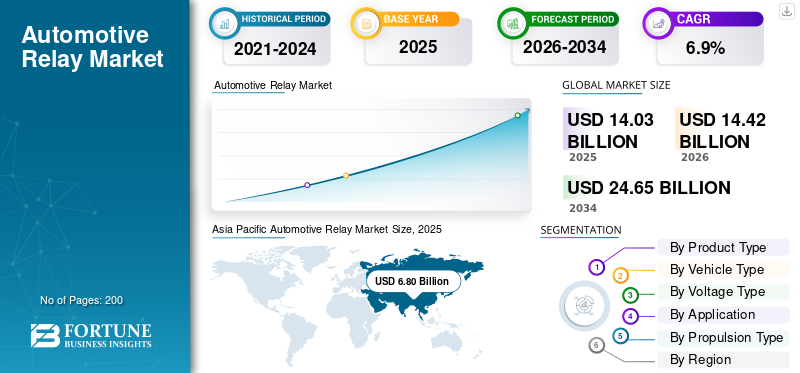
Download Free sample to learn more about this report.
Automotive Relay Market Key Takeaways
 Global Market Size & Forecast
- 2025 Market Size: USD 14.03 billion
- 2026 Market Size: USD 14.42 billion
- 2034 Forecast Market Size: USD 24.65 billion
- CAGR: 6.9% from 2026–2034
 Market Share
- Asia Pacific dominated the automotive relay market with a 48.46% share in 2025.
- The high voltage relays segment is expected to witness the fastest growth during the forecast period.
- The EV segment is projected to register the fastest growth through 2034.
 Key Regional Highlights
Asia Pacific
Asia Pacific held a 48.46% market share in 2025 and remains the fastest-growing regional market, driven by strong automotive production across China, Japan, India, and South Korea.
Europe
Europe accounted for the second-largest market share and is projected to expand at a 6.8% CAGR during the forecast period.
North America
North America represented the third-largest market, supported by strong production and sales of SUVs, pickup trucks, and light commercial vehicles.
U.S.
U.S. The automotive relay market is projected to reach USD 2.25 billion by 2026.
Japan
Japan The market is supported by its strong automotive manufacturing base and increasing adoption of electric and hybrid vehicles.
Read More

AUTOMOTIVE RELAY MARKET TRENDS
Shift toward Solid-State Relays and Smart Switching Solutions
A key trend shaping the market is the gradual shift from traditional electromechanical relays toward solid-state and smart relay solutions. Solid-state relays offer advantages such as faster switching, longer lifespan, silent operation, and reduced mechanical wear. Additionally, smart relays with integrated diagnostics and monitoring capabilities support predictive maintenance and improved system reliability. This trend aligns with the broader move toward software-defined vehicles and intelligent power management systems. While electromechanical relays continue to dominate in cost-sensitive applications, the increasing adoption of advanced electronics is accelerating the integration of solid-state and hybrid relay technologies across premium and electric vehicle platforms.
MARKET DYNAMICS
MARKET DRIVERS
Rising Vehicle Electrification to Drive Market Expansion
The rapid electrification of vehicles is a major driver for automotive relay market growth. Modern vehicles especially electric and hybrid models rely heavily on complex electrical architectures to manage power distribution, battery management, motor control, and auxiliary systems. Relays play a critical role in safely switching high and low currents across these systems while ensuring reliability and thermal stability. As OEMs integrate more electronic features such as ADAS, infotainment, and advanced comfort systems, the number of relays per vehicle continues to rise. Additionally, higher voltage requirements in EVs demand specialized high-performance relays, further expanding product demand across passenger and commercial vehicle segments.
- In May 2025, IEA’s Global EV Outlook 2025 highlights continued expansion in electric mobility and underlying demand for EV power electronics and switching components (where relays/contactors are fundamental).
MARKET RESTRAINTS
Cost Sensitivity and Design Complexity to Limit Market Expansion
Despite growing demand, cost sensitivity remains a key restraint in the market. OEMs continuously face pressure to reduce overall vehicle costs, which can limit the adoption of advanced or premium relay solutions. Additionally, integrating relays into increasingly compact and complex vehicle electrical systems poses design and validation challenges. Relays must meet stringent automotive standards for durability, vibration resistance, and thermal performance, which increases development and testing costs. For low- and mid-range vehicles, manufacturers may opt for simplified electrical architectures or alternative switching technologies to manage costs, thereby restraining the widespread adoption of high-specification relays in certain vehicle segments.
MARKET OPPORTUNITIES
High-Voltage EV Relays to Create New Growth Opportunities
The transition toward electric mobility presents a significant opportunity for the market, particularly in high-voltage applications. Electric vehicles require specialized relays capable of handling higher currents and voltages while ensuring safety, isolation, and rapid switching. These relays are essential in battery disconnect units, charging systems, and power distribution modules. As global EV production accelerates and charging infrastructure expands, the demand for advanced high-voltage and solid-state relays is expected to rise. Suppliers that invest in innovation, compact designs, and enhanced safety features are well positioned to capitalize on long-term opportunities driven by electrification and evolving vehicle architectures.
- In June 2025, FCL Components Europe announced the release of a high-voltage DC switching relay (FTR-E1J 20A) aimed at EV-related applications, illustrating ongoing product development aligned to higher-voltage architectures.
Download Free sample to learn more about this report.
MARKET CHALLENGES
Meeting Stringent Reliability and Safety Standards to Remain a Key Challenge
Ensuring consistent reliability under harsh automotive operating conditions remains a major challenge for relay manufacturers. Automotive relays must function flawlessly despite exposure to extreme temperatures, vibration, moisture, and electrical load variations over long vehicle lifecycles. As vehicles incorporate higher voltages and more electronic systems, the risk associated with relay failure increases, particularly in safety-critical applications. Meeting evolving global automotive safety and quality standards requires continuous testing, certification, and material innovation. Balancing high performance, long-term reliability, and cost efficiency while complying with regulatory requirements remains a critical challenge for market participants.
Segmentation Analysis
By Product Type
Compact Design and High Volume Usage to Drive PCB Relay Segment’s Dominance
Based on product type, the market is classified into PCB relays, plug-in relays, and others.
The PCB relays segment dominates the market due to its extensive use across core vehicle electrical and electronic systems. PCB relays are widely integrated into body control modules, power distribution units, lighting, HVAC, infotainment, and safety systems in passenger vehicles. Their compact size, cost efficiency, ease of integration, and suitability for mass production make them the preferred choice for OEMs. The high production volumes of ICE and electric vehicles, coupled with rising electronic content per vehicle, ensure consistent demand. Additionally, PCB relays support standardized designs, enabling manufacturers to balance performance, reliability, and cost across high-volume vehicle platforms.
The plug-in relays segment is the fastest-growing segment in the market and is projected to expand at a CAGR of 6.9% over the forecast period. Growth is driven by increasing adoption in commercial vehicles and service-intensive applications where the ease of replacement and maintenance is critical. Plug-in relays support modular electrical designs, reducing downtime and improving service efficiency, particularly in fleet and utility-focused vehicles.
By Vehicle Type
Rising SUV Penetration and Higher Electrical Load to Drive Segmental Dominance
In terms of vehicle type, the market is categorized into hatchbacks/sedans, SUVs, light duty vehicles, and heavy duty vehicles.
The SUV segment dominates the automotive relay market share due to its growing global sales share and higher electronic content per vehicle. SUVs integrate advanced comfort features, ADAS, infotainment, power tailgates, and multiple motor-driven systems, increasing relay requirements. The rising popularity of electric and hybrid SUVs further accelerates the demand for power management and high-reliability relays. Strong adoption across personal, premium, and fleet segments, particularly in North America, Europe, and Asia Pacific, sustains consistent OEM demand and reinforces the SUV segment’s leading position in the market.
The hatchback and sedan segment represents the second-largest market share, supported by large global vehicle production volumes and widespread adoption in cost-sensitive markets. These vehicles rely on standardized electrical architectures, ensuring steady demand for PCB and plug-in relays across body, lighting, and control applications.
To know how our report can help streamline your business, Speak to Analyst
By Voltage Type
Low Voltage Relay Segment Leads with Widespread ICE Applications
Based on voltage type, the market is segmented into low voltage relays and high voltage relays.
The low voltage relays segment dominates the market due to their extensive use across conventional ICE vehicles and hybrid platforms. These relays are essential for controlling lighting, HVAC systems, power windows, wipers, infotainment, and body electronics. The high production volumes of passenger cars, long-established electrical architectures, and cost-effective designs ensure consistent OEM and aftermarket demand. Additionally, low-voltage relays support standardized components across vehicle platforms, reinforcing large-scale adoption and sustained replacement requirements.
The high voltage relays segment represents the fastest-growing segment and is expected to expand at a CAGR of 8.0% over the forecast period. The segment growth is driven by rising electric and plug-in hybrid vehicle production, where high-voltage relays are critical for battery isolation, power distribution, charging systems, and safety management.
By Application
High Switching Requirements and Critical Control Functions to Drive Powertrain Systems Dominance
Based on application, the market is segmented into powertrain systems, body & comfort systems, safety & security systems, and others.
The powertrain systems segment dominates the market due to its critical role in engine management, transmission control, and fuel systems and increasingly in electric powertrain architectures. Relays are essential for managing high-current switching, thermal loads, and safety isolation in both ICE and electrified vehicles. The rising penetration of hybrid and electric vehicles further increases relay usage in inverters, battery management systems, and motor controls, reinforcing sustained OEM demand for reliable and high-performance relays within powertrain applications.
The body and comfort systems segment holds the second largest market share, driven by the increasing adoption of power windows, lighting, HVAC, seat controls, and infotainment systems. The growing consumer demand for comfort and convenience features continues to support steady relay demand across this segment.
By Propulsion Type
ICE Segment Leads the Market with Established ICE Production Base
Based on propulsion type, the market is categorized into ICE and EV.
The ICE segment dominates the market due to its large global vehicle parc and long-established production base. Internal combustion engine vehicles rely heavily on low-voltage relays across powertrain, body electronics, lighting, HVAC, and safety systems. Mature electrical architectures, high annual vehicle output, and consistent aftermarket replacement needs ensure stable demand. Continued ICE production in cost-sensitive and emerging markets further reinforces sustained relay consumption across passenger and commercial vehicle categories.
The EV segment is the fastest growing segment and is projected to expand at a CAGR of 7.8% over the forecast period. The rising adoption of battery electric vehicles drives the demand for high-voltage relays used in battery isolation, power distribution, charging, and safety-critical switching applications.
Automotive Relay Market Regional Analysis Outlook
By geography, the market is categorized into Europe, North America, Asia Pacific, and the rest of the world.
Asia Pacific
Asia Pacific Automotive Relay Market Size, 2025 (USD Billion)
To get more information on the regional analysis of this market, Download Free sample
Asia Pacific dominates the market and is also the fastest-growing region, supported by its massive vehicle production base across China, Japan, India, and South Korea. High passenger vehicle volumes, expanding middle-class demand, and strong presence of global and domestic OEMs sustain relay consumption. Accelerating EV adoption, government electrification incentives, and rising integration of electronic features further boost product demand. Cost-effective manufacturing, localized supply chains, and increasing relay penetration per vehicle reinforce Asia Pacific’s leadership and growth momentum.
China Automotive Relay Market
The China market is estimated to touch around USD 4.09 billion in 2026, accounting for a leading share in the regional market. Rapid vehicle production, massive EV adoption, and expanding automotive electronics fuel strong relay demand.
India Automotive Relay Market
The India market is estimated to reach a valuation of around USD 0.62 billion in 2026, emerging as the fastest-growing country in the regional market. The rising vehicle ownership, electrification incentives, and aftermarket growth accelerate relay consumption.
Europe
Europe represents the second-largest share of the market and is projected to grow at a CAGR of 6.8% over the forecast period. Stringent emission regulations, aggressive EV transition targets, and high adoption of advanced safety and comfort systems drive relay demand. The region’s strong focus on electric and hybrid vehicles increases the need for high-voltage relays in powertrain and charging applications. The presence of leading OEMs and Tier-1 suppliers further supports technology-driven, value-focused market expansion.
Germany Automotive Relay Market
The Germany market is estimated to hit a value of around USD 0.72 billion in 2026, accounting for a key share in the Europe market. Stringent safety regulations and EV transition support the demand for advanced relays.
U.K. Automotive Relay Market
The U.K. market is estimated to reach a valuation of around USD 0.48 billion in 2026, accounting for a significant share of the Europe market revenue. Growth is supported by EV sales, electronic system integration, and aftermarket expansion.
North America
North America accounts for the third-largest market share, driven by high production and sales of SUVs, pickup trucks, and light commercial vehicles. Vehicles in the region typically feature higher electrical loads, advanced infotainment, ADAS, and comfort systems, increasing relay usage per unit. The rising adoption of electric vehicles and strong aftermarket demand for replacement components support steady growth. Additionally, emphasis on vehicle safety, reliability, and performance sustains consistent OEM and service-driven relay demand.
U.S. Automotive Relay Market
The U.S. market is estimated to reach around USD 2.25 billion in 2026, accounting for a strong share in the North America market. The product demand is driven by SUVs, electrification trends, and advanced electronic features in the country.
Rest of the World
The rest of the world, including Latin America, the Middle East, and Africa, exhibits moderate growth in the market. Rising vehicle ownership, gradual urbanization, and improving road infrastructure support the demand for basic automotive electrical components. ICE vehicles continue to dominate, sustaining the demand for low-voltage relays across core applications. While EV adoption remains limited, increasing imports of technologically advanced vehicles and expanding aftermarket servicing networks contribute to incremental relay demand across emerging automotive markets.
COMPETITIVE LANDSCAPE
Key Industry Players
Leading Players Emphasize Innovation, Electrification, and Strategic Partnerships to Secure an Edge over Rivals
The automotive relay market is moderately consolidated, with global Tier-1 suppliers and specialized component manufacturers competing on reliability, cost efficiency, and technological innovation. Key players such as Bosch, Denso, TE Connectivity, Panasonic, Omron, and HELLA leverage strong OEM relationships, global manufacturing footprints, and vertically integrated supply chains. These companies focus on the high-volume production of low-voltage and PCB relays while steadily expanding portfolios to address rising EV demand. Scale advantages, compliance with stringent automotive standards, and long-term supply agreements enable established players to maintain strong competitive positioning.
Competition is increasingly shaped by innovation in high-voltage and solid-state relay technologies, driven by vehicle electrification and advanced power management needs. Market participants are investing in miniaturization, thermal management, and enhanced durability to meet evolving performance requirements. Strategic collaborations with EV manufacturers, investments in R&D, and capacity expansion in Asia Pacific are common competitive strategies. Additionally, mid-sized and regional players compete by offering cost-competitive solutions, faster customization, and application-specific relays, intensifying price and technology-based competition across OEM and aftermarket channels.
LIST OF KEY AUTOMOTIVE RELAY COMPANIES PROFILED
- Cit Relay & Switch (U.S.)
- Amperite Co. (U.S.)
- Fujitsu Components America, Inc. (Fujitsu Ltd.) (Japan)
- TE Connectivity Ltd. (Switzerland)
- Omron Corporation (Japan)
- Panasonic Corporation (Japan)
- DENSO Corporation (Japan)
- HELLA GmbH & Co. KGaA (Germany)
- Robert Bosch GmbH (Germany)
- Eaton Corporation plc (Ireland)
- ABB Ltd. (Switzerland)
- Sensata Technologies, Inc. (U.S.)
- NEC Tokin Corporation (Japan)
- Song Chuan Precision Co., Ltd. (Taiwan)
- Mitsuba Corporation (Japan)
KEY INDUSTRY DEVELOPMENTS
- February 2026: Denso announced increased capital allocation toward electrification components, strengthening production capacity for relays and power control units used in hybrid and battery electric vehicles.
- January 2026: Bosch announced the expansion of its automotive electronics portfolio, focusing on next-generation high-voltage relays, to support electric vehicle power distribution and battery safety applications across global OEM platforms.
- November 2025: TE Connectivity introduced advanced compact relay solutions designed for high-density automotive electronic architectures, targeting improved thermal performance and space efficiency in EV platforms.
- November 2025: Panasonic Automotive Systems expanded its relay manufacturing footprint in Asia Pacific to meet the rising demand from electric and hybrid vehicle manufacturers.
- October 2025: Omron Corporation launched automotive-grade solid-state relays aimed at enhancing durability and switching efficiency in powertrain and charging applications.
- April 2025: Durakool launched a first-of-its-kind automotive plug-in relay, featuring advanced magnetic arc blowout technology, for industrial and automotive applications. The DG82M fits standard Micro-ISO sockets despite an additional magnet. This makes it ideal for industrial vehicles making transition toward higher voltage systems and electric power.
- May 2024: Japan-based FCL Components announced the release of the FTR-E1-HC, a compact, 60A 400VDC high-voltage DC relay designed for PCB-mounting in automotive and power applications.
REPORT COVERAGE
Request for Customization to gain extensive market insights.
Report Scope & Segmentation
| ATTRIBUTE | DETAILS |
| Study Period | 2021-2034 |
| Base Year | 2025 |
| Estimated Year | 2026 |
| Forecast Period | 2026-2034 |
| Historical Period | 2021-2024 |
| Growth Rate | CAGR of 6.9% from 2026-2034 |
| Unit | Value (USD Billion) |
| Segmentation | By Product Type, By Vehicle Type, By Voltage Type, By Application, By Propulsion Type, and By Region |
| By Product Type |
|
| By Vehicle Type |
|
| By Voltage Type |
|
| By Application |
|
| By Propulsion Type |
|
| By Region |
|
Frequently Asked Questions
Fortune Business Insights says that the global market value stood at USD 14.03 billion in 2025 and is projected to reach USD 24.65 billion by 2034.
In 2025, the market value stood at USD 6.80 billion.
The market is expected to exhibit a CAGR of 6.9% during the forecast period of 2026-2034.
The ICE segment leads the market by propulsion type.
Rising vehicle electrification is a key factor driving the market.
Asia Pacific dominates the market in terms of share.



- 2021-2034
- 2025
- 2021-2024
- 200
-
(Offer valid till 15th Oct 2026)
Get 30-60 hrs Free Customization
Expand Regional and Country Coverage, Segments Analysis, Company Profiles, Competitive Benchmarking, and End-user Insights.




















-
US +1 833 909 2966 ( Toll Free )
-
Get In Touch With Us