Autonomous Boats Market Size, Share, Industry Analysis and Russia-Ukraine War Impact Analysis, By Autonomy (Semi-Autonomous and Fully Autonomous), By Type (Cruising Boats, Tug & Work Boats, and Combat Boats), By Boat Size (<20 Feet, 20-40 Feet, and >40 Feet), By Propulsion Type (Fully Electric, Fuel-Powered, and Hybrid Electric) and Regional Forecast, 2026-2034
 Download Free Sample
Autonomous Boats Market Size and Industry Overview
 Listen to Audio Version
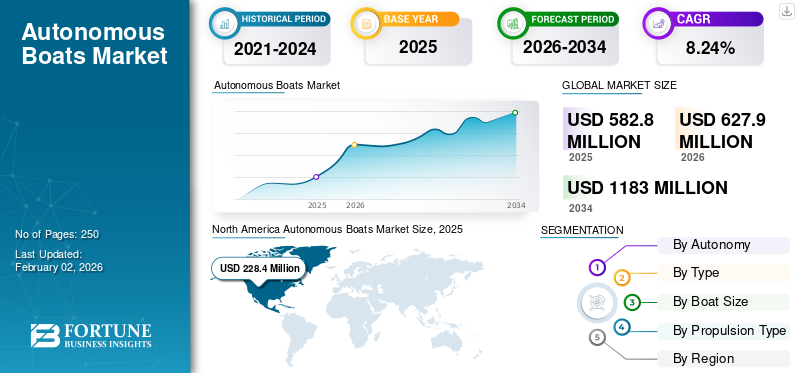
The global autonomous boats market size was valued at USD 582.80 million in 2025 and is projected to grow from USD 627.90 million in 2026 to USD 1,183.00 million by 2034, exhibiting a CAGR of 8.24% during the forecast period. North America dominated the autonomous boats market with a market share of 39.19% in 2025.
Autonomous boats, also known as unmanned surface vehicles (USVs), are revolutionizing maritime operations across commercial, military, and research sectors. These vessels utilize advanced sensors, GPS, AI, and communication technologies to navigate and perform tasks without human intervention. They are increasingly employed in applications such as environmental monitoring, cargo transport, defense operations, and offshore surveys, offering benefits such as enhanced safety, cost efficiency, and operational flexibility.
Key players in the market include prominent companies such as Kongsberg Maritime (Norway), Sea Machines Robotics (U.S.), Maritime Robotics (Norway), ASV Global (now part of L3Harris, U.S.), XOCEAN (U.K), and Zycraft (U.S.). These organizations invest heavily in R&D to develop sophisticated navigation systems, AI algorithms, and hybrid propulsion technologies, aiming to improve autonomy levels and operational endurance.
Download Free sample to learn more about this report.
AUTONOMOUS BOATS MARKET Key Takeaways
 Global Market Size & Forecast
- 2025 Market Size: USD 582.80 million
- 2026 Market Size: USD 627.90 million
- 2034 Forecast Market Size: USD 1,183.00 million
- CAGR: 8.24% from 2026–2034
 Market Share
- North America dominated the autonomous boats market with a market share of 39.19% in 2025.
- The semi-autonomous boat segment is anticipated to hold the largest market with a share of 65.65% in 2026.
- The cruising boats segment is anticipated to hold the largest autonomous boats market share with a share of 50.99% in 2026.
 Key Regional Highlights
North America
North America accounted for USD 228.4 million in 2025, representing 39.19% of the global market share, and is projected to reach USD 244.5 million in 2026.
Europe
The Europe market was valued at USD 125.7 million in 2025, capturing 21.57% of global revenue, and is estimated to reach USD 135.6 million in 2026.
Asia Pacific
In 2025, Asia Pacific held 27.23% of the global market, reaching a valuation of USD 158.7 million, and is projected to grow to USD 173.2 million in 2026.
U.S.
The U.S. autonomous boats market is projected to reach a value of USD 176.20 million by 2026.
Japan
The Japan autonomous boats market is expected to be valued at USD 37.7 million by 2026.
Read More

RUSSIA-UKRAINE WAR IMPACT
Autonomous Boats Demand Has Risen Globally Due to the Russia-Ukraine War
The Russia-Ukraine conflict has significantly influenced the market, primarily by accelerating demand for unmanned maritime systems in the defense and security sectors. As tensions increased, military and defense organizations in various countries prioritized the development and deployment of autonomous vessels for surveillance, reconnaissance, and mine countermeasure operations, reducing risks to human personnel in conflict zones. Additionally, the conflict heightened concerns over maritime security, prompting governments to invest in autonomous systems to monitor critical shipping lanes and territorial waters. This increased military focus has driven innovation and procurement of advanced USVs, boosting market growth.
However, the war has also disrupted supply chains for components and technology, causing delays in product development and deployment. Economic sanctions and geopolitical uncertainties have further constrained international trade, affecting the availability of certain technologies and materials essential for autonomous boat manufacturing. Overall, while the conflict has spurred increased military investment and technological advancements in autonomous maritime systems, it has also introduced supply chain challenges and geopolitical risks. The market is expected to see continued growth driven by defense needs, but with caution due to ongoing instability and economic disruptions.
AUTONOMOUS BOATS MARKET TRENDS
Increased Autonomy and Digitalization in Autonomous Boats Driving the Market Trend
The autonomous boat market is experiencing a strong uptrend driven by technological advancements in areas such as artificial intelligence, sensor fusion, and remote sensing. This is leading to more sophisticated navigation and control systems. Increased demand for enhanced operational efficiency and reduced labor costs is prompting adoption across sectors such as maritime security, surveying, and cargo transport. The rising focus on environmental monitoring and sustainable practices is resulting in increased usage for data collection, pollution control, and oceanographic research. The increasing adoption of remote operation and monitoring systems further drives the market, fueled by better communication infrastructures. Concurrently, the evolving regulatory landscape is setting the stage for wider deployment, making this a dynamic and rapidly changing market.
Download Free sample to learn more about this report.
MARKET DYNAMICS
MARKET DRIVERS
Efficiency, Safety, and Reduced Costs of Autonomous Boats are Leading the Market Growth
The autonomous boat market is propelled by a combination of pressing needs and advantageous capabilities that make it a solution to various marine challenges. First, growing labor shortages and increasing operational costs across the maritime industry fuel the demand for automation. Next, advancements in sensor technologies, navigation systems, and AI are creating more efficient and reliable autonomous vessels. Heightened focus on safety and autonomous boats' ability to perform dangerous tasks without risking human lives is driving deployment. Growing government and private investment in research and development is also fostering innovation and fueling the autonomous boats market growth. Finally, the need for real-time data collection and environmental monitoring in remote locations further supports the expansion of the autonomous boat market.
MARKET OPPORTUNITIES
Untapped Potential in Maritime Sectors Is Boosting the Market Growth
The autonomous boat market is seeing significant opportunities arise from its ability to improve efficiency and safety in various maritime sectors. Specifically, the shipping industry is eager to enhance cargo transport, optimize routes, and lower operational costs through autonomous solutions. Growing opportunities can be found in offshore oil and gas exploration, which seeks efficient support vessels, as well as within naval operations that can benefit from unmanned patrol boats. Environmental agencies are starting to adopt autonomous vessels for comprehensive oceanic data gathering and real-time pollution monitoring. Aquaculture and coastal surveillance show substantial potential for growth with autonomous feeding systems and monitoring drones. There is a significant opportunity to improve profitability and innovation across several marine applications.
MARKET RESTRAINTS
High Development Costs & Regulatory Hurdles Are Anticipated to Hamper the Market Growth
The autonomous boat market faces some substantial restraints that are slowing down its development and limiting wider adoption. High initial investment costs, including advanced sensor systems, automation software, and communication technologies, are a major deterrent. Regulatory uncertainty and the absence of standardized guidelines for autonomous maritime operations are delaying investment and deployment. Safety concerns and cybersecurity vulnerabilities are affecting public confidence and consumer acceptance. Infrastructure limitations, particularly around reliable communication networks and port integration, make it difficult to support wide-scale adoption. Furthermore, a shortage of skilled personnel needed to operate and maintain these systems presents a challenge.
MARKET CHALLENGES
Reliability, Security, and Integration Are Challenging the Market Growth
The market faces challenges related to the technical reliability of autonomous boats, especially in harsh marine environments. Ensuring cybersecurity in autonomous systems, to protect against piracy and unauthorized access to data, is also an important factor. Integrating these vessels seamlessly with existing maritime infrastructure and operational practices presents operational hurdles. Maintaining public acceptance and trust while addressing the potential displacement of human workers is a political consideration. Creating robust regulatory and safety frameworks to minimize accidents and risks is also a key factor. Overcoming these challenges will be key to the future growth of the autonomous boat market.
SEGMENTATION ANALYSIS
By Autonomy
Due to the Optimal Balance Between Automation and Human Oversight, the Semi-Autonomous Boats Demand is Rising
By autonomy, the market is classified into semi-autonomous and fully autonomous.
The semi-autonomous boat segment is anticipated to hold the largest market with a share of 65.65% in 2026, due to its practicality and balance between automation and human control. These boats often feature advanced navigation systems, collision avoidance technology, and remote monitoring capabilities, assisting human operators rather than replacing them entirely. This approach is favored due to regulatory considerations, comfort with proven technologies, and the need for human intervention in complex or unpredictable situations. The semi-autonomous segment finds wide application in areas such as coastal surveillance, hydrographic surveys, and cargo transport tasks, where full autonomy is not yet deemed necessary or feasible. The lower upfront costs and reduced risk perception further contribute to its widespread adoption.
The fully autonomous boat segment is projected to be the fastest-growing segment within the market. This growth is propelled by advances in artificial intelligence, sensor technology, and wireless communication, which enable boats to operate independently without human intervention. Although currently smaller in market share, its potential is vast, particularly in applications including long-duration ocean monitoring, offshore inspections, and remote area patrol.
By Type
Rising Consumer Demand for Leisure and Luxury Experiences Boosting the Growth for Cruising Boats
By type, the market is classified into cruising boats, tug & work boats, and combat boats.
The cruising boats segment anticipated to hold the largest autonomous boats market share in the industry with a share of 50.99% in 2026, driven by increasing demand for leisure and recreational activities. Autonomous cruising boats offer enhanced safety, reduced operational costs, and improved navigation capabilities, making them attractive to yacht owners and luxury vessel operators. Their ability to operate autonomously over long distances with minimal human intervention further fuels their popularity. As technology advances, integrating smart systems and AI enhances user experience, solidifying this segment’s dominance in the market.
The tug & work boats segment is the fastest-growing in the market, owing to their critical role in port operations, vessel towing, and offshore support. Autonomous technology improves safety, precision, and operational efficiency in demanding environments. The need for reliable, cost-effective, and safe vessels in maritime logistics and offshore industries propels the adoption. Innovations in automation and AI enable these vessels to perform complex tasks with minimal crew, making them highly attractive for commercial applications. Rapid technological advancements and increasing maritime activity are expected to sustain this growth trajectory.
To know how our report can help streamline your business, Speak to Analyst
By Boat Size
Due to Versatility and Broad Applicability Across Sectors, 20-40 Feet Boat Size is Growing
Based on boat size, the market is divided into <20 Feet, 20-40 Feet, and >40 Feet.
The 20-40 Feet segment dominates the market with a share of 47.17% in 2026, due to its versatility and suitability for various applications such as patrol, research, and small-scale transportation. These vessels are compact, easy to operate, and cost-effective, making them popular among government agencies, research institutions, and recreational users. Their manageable size allows for easier deployment in diverse environments, including inland waterways and coastal areas. Continuous technological improvements in sensors and navigation systems have increased reliability, further boosting their market share.
The >40 Feet segment is the fastest-growing category, driven by the increasing demand for larger, more capable autonomous vessels in commercial and research sectors. These vessels are suitable for offshore exploration, scientific research, and long-distance cruising, offering greater stability and payload capacity. Technological advancements enable these larger vessels to operate efficiently with autonomous systems, reducing crew requirements and operational costs. As offshore activities expand and the need for extensive data collection grows, the >40 Feet segment is poised for rapid growth due to its scalability and enhanced capabilities.
By Propulsion Type
Due to Increasing Environmental Awareness and Stricter Emission Regulations, the Demand for Fully Electric Boats is Rising
Based on propulsion type, the market is classified into fully electric, fuel-powered, and hybrid electric.
The fully electric segment is anticipated to hold the largest market with a share of 45.81% in 2026, fueled by rising environmental awareness and stricter emission regulations. Electric propulsion offers zero emissions, lower operational costs, and quieter operation, making it ideal for recreational, patrol, and research vessels. Advances in battery technology and power management systems have increased range and efficiency, further boosting adoption. The shift towards sustainable maritime practices and government incentives supports the growth of fully electric autonomous boats, positioning this segment as a leader in eco-friendly maritime solutions.
The hybrid electric segment is the fastest-growing segment, driven by the need for extended range and operational flexibility. Combining traditional fuel engines with electric propulsion allows vessels to operate efficiently in various conditions, reducing emissions and fuel costs. This dual approach is advantageous for applications requiring long endurance or operating in environmentally sensitive areas. Technological improvements in hybrid systems, along with increasing regulatory pressure for greener solutions, are propelling this segment’s rapid growth. The hybrid model offers a practical transition toward fully electric systems, making it a key focus for future developments in autonomous maritime vessels.
AUTONOMOUS BOATS MARKET REGIONAL OUTLOOK
By region, the market is segmented into North America, Europe, Asia Pacific, and Rest of the World.
North America
North America Autonomous Boats Market Size, 2025 (USD Million)
To get more information on the regional analysis of this market, Download Free sample
North America is a significant market for autonomous boats, driven by strong technological infrastructure, government support, and demand from various sectors. North America accounted for USD 228.4 million in 2025, representing 39.19% of the global market share, and is projected to reach USD 244.5 million in 2026. The U.S. leads the region, with substantial investments in defense, homeland security, and oceanographic research driving the adoption of unmanned vessels. Canada is also contributing to market growth through its focus on Arctic exploration, resource management, and maritime security. Key players in North America include L3Harris Technologies, Sea Machines Robotics, and Huntington Ingalls Industries. The region benefits from a robust ecosystem of technology providers, research institutions, and government agencies collaborating to advance autonomous boat technology. Moreover, North America is a hotbed for innovation, with numerous startups developing cutting-edge solutions for autonomous navigation, sensor systems, and data analytics.
The U.S. represents the largest market in North America, driven by strong defense spending, advanced technology infrastructure, and a robust maritime industry. The U.S. Navy is a key adopter of unmanned surface vehicles (USVs) for surveillance, reconnaissance, and mine countermeasures. Additionally, the U.S. Coast Guard is deploying autonomous boats for search and rescue, border patrol, and environmental monitoring. The commercial sector also contributes to market growth, with applications in offshore energy, hydrographic surveying, and cargo transport. The U.S. benefits from a strong ecosystem of technology providers, research institutions, and government agencies collaborating to advance autonomous boat technology. Companies namely L3Harris Technologies, Boeing, and General Dynamics are key players in the U.S. market. The U.S. autonomous boats market is projected to reach a value of USD 176.20 million by 2026.
Europe
The Europe market was valued at USD 125.7 million in 2025, capturing 21.57% of global revenue, and is estimated to reach USD 135.6 million in 2026. Europe is a mature market, driven by a strong focus on maritime safety, environmental protection, and technological innovation. Countries namely Norway, U.K., and Germany are at the forefront of autonomous boat development, with significant investments in research and development, testing, and deployment. The region is witnessing increased demand for autonomous boats for offshore energy, environmental monitoring, and search and rescue. Key players in Europe include Kongsberg Maritime, Rolls-Royce, and Saab. Europe benefits from a highly skilled workforce, a well-established maritime industry, and supportive government policies that promote technological innovation. The region is also actively developing international standards and regulations for autonomous maritime operations. The U.K. autonomous boats market is expected to be valued at USD 42.9 million by 2026., while the German autonomous boats market is expected to be valued at USD 34.8 million by 2026.
Asia Pacific
In 2025, Asia Pacific held 27.23% of the global market, reaching a valuation of USD 158.7 million, and is projected to grow to USD 173.2 million in 2026. The Asia Pacific region is emerging as a high-growth market, driven by increasing maritime trade, rising defense spending, and growing awareness of environmental issues. Countries for instance, China, Japan, and South Korea are investing heavily in autonomous boat technology to enhance their maritime capabilities and address labor shortages in the shipping industry. The region is also witnessing increased demand for autonomous boats for environmental monitoring, fisheries management, and port security. Key players in Asia Pacific include China Shipbuilding Industry Corporation (CSIC), Mitsubishi Heavy Industries, and Hyundai Heavy Industries. The region benefits from a strong manufacturing base, cost-competitive labor, and government support for technological innovation. The Japan autonomous boats market is expected to valued at USD 37.7 million by 2026, the China autonomous boats market is anticipated to reached a valued at USD 76.6 million by 2026, and the India autonomous boats market is expected to reached a valued at USD 29.5 million by 2026
Rest of the World
Rest of the World maintained a strong presence in the global market, reaching USD 70 million in 2025, accounting for 12.01% share, and is expected to reach USD 74.7 million in 2026. The Rest of the World (RoW) represents a diverse and emerging market for autonomous boats, with opportunities in various regions such as the Middle East, Africa, and Latin America. The Middle East is witnessing increased demand for autonomous boats for maritime security, port surveillance, and oil and gas exploration. Africa is exploring the use of autonomous boats for fisheries management, border control, and anti-piracy operations. Latin America is adopting autonomous boats for environmental monitoring, hydrographic surveying, and coastal security. Key players in the RoW segment include regional manufacturers, technology providers, and system integrators. The market is driven by factors such as increasing maritime trade, growing awareness of environmental issues, and the need for cost-effective solutions for maritime security and resource management.
COMPETITIVE LANDSCAPE
KEY INDUSTRY PLAYERS
Key Players are Shaping the Market Landscape Through Product Advancements
The autonomous boat market is characterized by a mix of established maritime giants and innovative technology startups. Key players such as Kongsberg Maritime, L3Harris Technologies, and Sea Machines Robotics are driving advancements in autonomous navigation, control systems, and sensor technologies. These companies offer various autonomous solutions, from small unmanned surface vehicles (USVs) to larger autonomous vessels for commercial and defense applications. Smaller, agile companies including Maritime Robotics and AutoNaut specialize in niche applications such as environmental monitoring and oceanographic research. Partnerships and collaborations are common, with technology firms such as IBM and Microsoft providing AI and cloud computing solutions to enhance the capabilities of autonomous boats. The competitive landscape is rapidly evolving, as companies strive to develop reliable, cost-effective, and secure autonomous solutions that meet the diverse needs of the maritime industry.
LIST OF KEY AUTONOMOUS BOATS COMPANIES PROFILED
- Sea Machines Robotics (U.S.)
- Kongsberg Maritime (Norway)
- Maritime Robotics (Norway)
- ASV Global (L3Harris ASV) (U.S.)
- Boston Engineering Corporation (U.S.)
- Navatics (China)
- XOCEAN (U.K.)
- Marine AI (U.S.)
- Zycraft (U.S.)
- Buffalo Computer Graphics (BCG) (U.S.)
KEY INDUSTRY DEVELOPMENTS
- January 2026: Hanwha Defense USA announced a partnership with HavocAI to develop 200-foot autonomous surface vessels, with Hanwha Philly Shipyard under consideration for manufacturing. The strategic objective/purpose was to develop scalable autonomous maritime platforms for defense missions. Technologies involved included AI-enabled collaborative autonomy, autonomous navigation, shipbuilding integration, modular vessel architecture, and autonomous surface-vessel operations.
- February 2026: Damen Shipyards Group announced a licensing agreement with Blue Water Autonomy for the Liberty Class™ 60-meter autonomous ship for the U.S. Navy, with construction scheduled at Conrad Shipyard. The strategic objective/purpose was to accelerate serial production of unmanned vessels. Technologies involved included Axe Bow hull design, autonomous control systems, long-duration operation, modular payload integration, and autonomous vessel manufacturing.
- April 2026: HII announced production plans for four additional ROMULUS™ 151 unmanned surface vessels, expanding the program beyond the prototype currently under construction. The strategic objective/purpose was to accelerate delivery of autonomous surface capability to naval customers. Technologies involved included AI-driven autonomy, modular open architecture, sensor fusion, COLREGS-compliant navigation, and autonomous surface-vessel operations.
- June 2026: Clear Robotics secured USD 1.75 million in Pre-Series A funding to scale its fleet of AI-enabled autonomous vessels, which included 26 all-electric unmanned surface vessels. The strategic objective/purpose was to expand commercial deployment across international markets. Technologies involved included AI navigation, autonomous operations, electric propulsion, maritime data analytics, and autonomous boat fleet management.
- June 2025: Avikus, recognized as a leader in autonomous navigation solutions and a subsidiary of HD Hyundai, has formed a strategic partnership with maritime technology firm ZeroNorth. This collaboration aims to introduce a joint solution that integrates autonomous navigation with real-time voyage optimization.
- May 2025: Norway has recently declared in a press release that it has entered into a new agreement with the U.K., Belgium, Denmark, and the Netherlands to enhance collaboration in the international operation of autonomous vessels. The aim of this agreement is to streamline the operation of autonomous ships in the North Sea and to guarantee their safe operation within the national regulations and frameworks of each country.
- April 2025: The US-based defense firm Eureka Naval Craft has entered into a partnership agreement with the Australian marine technology company Greenroom Robotics. According to Bo Jardine, the CEO of Eureka Naval Craft, this collaboration with Greenroom is set to propel the development of the most sophisticated autonomous systems ever created for naval vessels, which will also be adapted for the commercial marine workboat sector.
- April 2024: The Kraken Technology Group, a specialist in unmanned systems based in the U.K., has partnered with the software company Auterion to develop autonomous capabilities intended for maritime security vessels optimized for coastal waters. This collaboration centers on the creation and deployment of modular, cost-effective autonomy software and unmanned vehicle systems tailored for the maritime sector.
- January 2023: IDEX-DIO has finalized its 50th SPRINT contract concerning Armed Autonomous Boat Swarms. The Indian Navy has entered into a partnership with Sagar Defence Engineering Pvt. Ltd for the development of armed autonomous boat swarms as part of the 'SPRINT' initiative, which aims to foster the advancement of specialized defense technologies by local firms.
REPORT COVERAGE
This Autonomous Boats research report offers a comprehensive market analysis, identifying key players, product categories, and primary applications. It also details market trends and significant industry developments. Moreover, the report highlights various factors that have fueled the growth of the autonomous boats market in recent years.
Request for Customization to gain extensive market insights.
REPORT SCOPE AND SEGMENTATION
|
ATTRIBUTE |
DETAILS |
|
Study Period |
2021-2034 |
|
Base Year |
2025 |
|
Estimated Year |
2026 |
|
Forecast Period |
2026-2034 |
|
Historical Period |
2021-2024 |
|
Growth Rate |
CAGR of 8.24% from 2026-2034 |
|
Unit |
Value (USD Million) |
|
Segmentation |
By Autonomy
|
|
By Type
|
|
|
By Boat Size
|
|
|
By Propulsion Type
|
|
|
By Region
|
Frequently Asked Questions
Fortune Business Insights says the market value stood at USD 627.90 million in 2025 and is estimated to reach USD 1,183.00 million by 2034.
The market will grow steadily at a CAGR of 8.24% during the forecast period.
The semi-autonomous segment is the leading segment in this market.
Sea Machines Robotics, Kongsberg Maritime, Maritime Robotics, ASV Global (L3Harris ASV), Boston Engineering Corporation, Navatics, XOCEAN, Marine AI, Zycraft, and Buffalo Computer Graphics (BCG) are some of the leading OEMs in the market.
North America is the largest region in the market.



- 2021-2034
- 2025
- 2021-2024
- 250
Get 30-60 hrs Free Customization
Expand Regional and Country Coverage, Segments Analysis, Company Profiles, Competitive Benchmarking, and End-user Insights.




















Related Reports
-
US +1 833 909 2966 ( Toll Free )
-
Get In Touch With Us