Aviation Test Equipment Market Size, Share, Russia-Ukraine War & Industry Analysis, By Equipment Type (Avionics Test Equipment, Electrical / Electronic Test, Engine & APU Test Systems, Actuation, Landing Gear & Fluid Power Test Systems, Environmental & Structural, and Automated Test Equipment (ATE) & Software), By Aircraft Type (Fixed Wing, Rotary Wing, and Others), By Type (Commercial and Military), By Application (Design, Qualification & Type-Certification Testing, Production Testing Line Maintenance & Troubleshooting, & Others), By End User, and Regional Forecast, 2026-2034
 Download Free Sample
KEY MARKET INSIGHTS
 Listen to Audio Version
The global aviation test equipment market size was valued at USD 9.11 Billion in 2025. The market is projected to grow from USD 9.58 Billion in 2026 to USD 14.87 Billion by 2034, exhibiting a CAGR of 5.66% during the forecast period. North America dominated the global aviation test equipment market with a market share of 42.70% in 2025.
Aviation test equipment includes the equipment, instruments, rigs, and software used to check, calibrate, and certify aircraft systems for safety and airworthiness. It covers avionics and IFR test sets, electrical and wiring analyzers, engine and APU test cells, hydraulic and landing-gear rigs, environmental and structural rigs, plus automated test equipment (ATE), and diagnostics software. These tools are used by OEMs, MROs, airlines, business jet operators, and defense depots from design and certification through heavy checks.
Key players include Rohde & Schwarz, Teradyne, Viavi, Honeywell, and Airbus/Boeing-linked test specialists are pushing more automation, remote diagnostics, and data-driven maintenance.
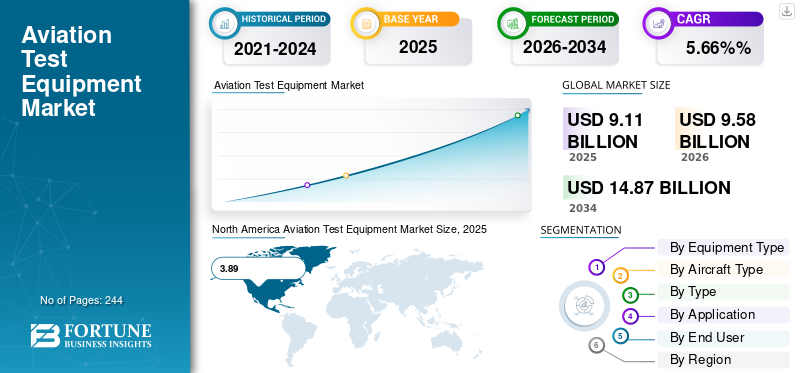
Download Free sample to learn more about this report.
Aviation Test Equipment Market KEY TAKEAWAYS
 Market Size & Forecast
- 2025 Market Size: USD 9.11 billion
- 2026 Market Size: USD 9.58 billion
- 2034 Forecast Market Size: USD 14.87 billion
- CAGR: 5.66% from 2026–2034
 Market Share
- North America dominated the aviation test equipment market with a 42.70% share in 2025.
- The avionics test equipment segment accounted for the largest market share in 2025.
- The fixed wing segment captured the leading market share in 2025.
 Key Regional Highlights
North America
North America maintained its leading position in 2025, with the market valued at USD 3.89 billion, supported by strong aerospace and defense investments.
Europe
Europe is projected to reach USD 1.86 billion in 2026, driven by growing aircraft modernization and maintenance activities.
Asia Pacific
Asia Pacific remains a key growth region, supported by rising air traffic and expanding commercial aviation fleets.
U.S.
U.S. The market is estimated to reach USD 2.49 billion in 2026, fueled by advanced aviation infrastructure and defense spending.
Japan
Japan The market is projected to reach USD 0.45 billion in 2026, supported by investments in aircraft maintenance and testing technologies.
Read More

MARKET DYNAMICS
MARKET DRIVERS:
Rise of Advanced Electronic Testing Tools Drives Market Growth
The increasing complexity of aircraft electronics and systems has significantly driven the growing demand for advanced testing systems and tools in aviation. Modern aircraft integrate advanced digital avionics, communication networks, and electric propulsion, requiring precise calibration and testing. As safety standards tighten and maintenance routines become more automated, the need for reliable, high-accuracy electronic test equipment becomes essential. Innovations in portable testing solutions and automation are enabling maintenance teams to improve efficiency, reduce downtime, and ensure aircraft safety.
MARKET RESTRAINTS
High Cost and Technical Complexity of the Equipment May Restrain Market Growth
Aviation test equipment’s high cost and technical complexity may limit market expansion, especially for smaller and medium-sized operators. Aviation test tools must meet strict safety and regulatory standards, requiring advanced precision and reliability, which drives up development and manufacturing costs. These sophisticated devices often demand specialized training for operators, limiting accessibility for smaller maintenance providers. For smaller and medium-sized maintenance, repair and overhaul (MRO) facilities, advanced automated test equipment might be prohibitively expensive. The deployment of new, sophisticated testers may be delayed by fragmented procurement cycles among smaller regional operators with insufficient funding.
MARKET OPPORTUNITIES
Innovations in Urban Air Mobility is Anticipated to Create Market Opportunities
The emergence of urban air mobility (UAM) vehicles, such as electric vertical takeoff and landing (eVTOL) planes, presents a significant opportunity for the market. These new urban transportation choices must go through rigorous testing and certification to ensure performance, safety, and compatibility with existing airspace systems. Test equipment makers are focused on developing specialized testing solutions for advanced navigation technology, electric propulsion, and autonomous flight systems. The increasing need for effective and sustainable aerial mobility drives innovation in modular, AI-enabled, and portable test systems, supporting the aviation test equipment market growth in this rapidly evolving sector.
AVIATION TEST EQUIPMENT MARKET TRENDS:
Rise of Digital System and Automation as a Major Market Trend
Adoption of digital systems and automation technologies is a latest market trend for aviation test equipment. These improvements have altered testing methods, enabling real-time diagnostics, predictive maintenance, and seamless connection with aviation systems. Particularly for complex avionics and electrical systems, automated test platforms lower human error, speed up maintenance cycles, and increase accuracy. Virtual testing in a controlled setting is made possible by digital simulation and AI-enabled diagnostics, which lower operating expenses and downtime. This trend is in line with the general industry objectives of using smart, connected, and automated testing solutions to improve safety, efficiency, and scalability.
MARKET CHALLENGES:
Shortage of Skilled Technicians is a Market Challenge
The market for aircraft test equipment is severely hampered by the severe lack of qualified technicians in the aviation sector. The Aviation Technician Education Council (ATEC) 2025 Pipeline Report projects that there will be a 10% shortfall of certified mechanics in the commercial aviation industry alone by 2025. By 2035, this disparity will have shrunk to 7%, but there will still be a shortage of over 10,000 skilled mechanics who are essential to the maintenance of commercial passenger and cargo airplanes. The shortage is aggravated by a lack of certified instructors and unfilled training seats, impacting workforce readiness and industry growth.
Impact of Russia Ukraine War:
The Russia-Ukraine war has adversely affected the market by disrupting supply chains for essential materials such as titanium and neon gas, critical for manufacturing and testing aerospace components. The conflict has led to significant delays and cost increases due to restrictions on Russian exports and the closure of Russian aerospace facilities, impacting both civilian and military sectors. Additionally, increased geopolitical tensions and sanctions have slowed industry recovery, elevated operational costs, and prompted companies to seek alternative sourcing. These challenges have hampered the development and deployment of testing solutions, thereby constraining market growth prospects amid ongoing instability.
Download Free sample to learn more about this report.
Segmentation Analysis
By Equipment Type
Rise in Digitization of Aircraft is Anticipated to Boost Avionics Test Equipment Segment Growth
On the basis of equipment type, the market is classified into avionics test equipment, electrical/electronic test, engine & APU test systems actuation, landing gear & fluid power test systems, environmental & structural, Automated Test Equipment (ATE) & software.
The avionics test equipment segment accounted for the significant market share in 2025. The requirement for complex testing solutions has increased dramatically as aircraft integrate increasingly sophisticated digital systems, such as automated flight controls and integrated communication.
Automated Test Equipment (ATE) & Software segment is expected to grow at a highest CAGR of 7.12% over the forecast period.
By Aircraft Type
Fleet Expansion and System Complexity Drive Fixed-Wing Segment Growth
In terms of aircraft type, the market is categorized into fixed wing, rotary wing, and others (UAV, etc.).
The fixed wing segment captured the largest share of the market in 2025. The growth in the segmental share is owing to the continuous expansion and modernization of commercial and military aircraft fleets, which drives recurring demand for avionics, engine, and structural testing.
Others (UAV, etc.) segment is expected to grow at a highest CAGR of 6.42% over the forecast period.
By Type
Passenger and Cargo Traffic Recovery Supports Commercial Segment Growth
Based on type, the market is segmented into commercial and military.
The commercial segment held the dominating position in 2025. The segmental growth is owing to rising passenger and cargo traffic, which results in increased aircraft utilization, more maintenance events, and a bigger volume of test work annually.
The segment of the military is set to flourish and is growing at a highest CAGR of 6.06% growth across the forecast period.
By Application
Aging Fleets and Life-Extension Programs Fuel Heavy Maintenance & Overhaul Testing
Based on application, the market is segmented into design, qualification & type-certification testing, production testing, line maintenance & troubleshooting, heavy maintenance & overhaul, and training & simulation.
The heavy maintenance & overhaul segment held the dominating position in 2025. The segment is growing as aging engines and airframes are being used for longer periods of time, which results in more structural inspections, deep system overhauls, and C/D tests.
The segment of production testing will witness a growth rate of 5.71% growth across the forecast period.
By End User
Platform Development and Certification Needs Support OEMs & Tier-1s Segment Growth
Based on end user, the market is segmented into OEMs & tier-1s companies, airlines & operators, defense & government, and test labs & integrators.
The OEMs & tier-1s companies segment held the dominating position in 2025. Ongoing aircraft and system development initiatives that demand thorough design, qualification, and certification testing prior to entrance into service are responsible for the segment's growth.
The segment of defense & government will witness a highest growth rate of 6.42% growth across the forecast period.
To know how our report can help streamline your business, Speak to Analyst
Aviation Test Equipment Market Regional Outlook
By region, the market is categorized into Europe, North America, Asia Pacific, and Rest of the World.
North America
North America Aviation Test Equipment Market Size, 2025 (USD Billion)
To get more information on the regional analysis of this market, Download Free sample
North America held the dominant aviation test equipment market share in 2024 valuing at USD 3.71 Billion and also took the leading share in 2025 with USD 3.89 Billion. The regional growth is owing to a well-established aerospace sector, strict FAA safety standards, and a focus on fleet modernization and avionics innovations. The growth in the U.S. is owing to the rise in demand for automated and digitally integrated testing solutions, the rise in Maintenance, Repair and Overhaul (MRO) activities, and continuous research into new technologies such as electric aircraft and AI-driven diagnostics. In 2026, the U.S. market is estimated to reach USD 2.49 Billion.
Europe and Asia Pacific
Other regions such as Europe and Asia Pacific are anticipated to witness a notable market growth in the coming years. During the forecast period, the Asia Pacific market is projected to record a growth rate of 6.37%, which is the highest amongst all the regions. Asia Pacific region is the fastest-growing during the study period. The market for aviation testing equipment in Asia Pacific is expanding rapidly due to government efforts, growing investments in cutting-edge avionics and digital systems, and the increase of commercial and military fleets. Backed by these factors, countries including China anticipate to record the valuation of USD 0.96 Billion, Japan to record USD 0.45 Billion, and India to record USD 0.75 Billion in 2026. After Asia Pacific, the market in Europe is estimated to reach USD 1.86 Billion in 2026. In the region, U.K. and Germany both are estimated to reach USD 0.63 Billion and 0.50 Billion each in 2026.
Rest of the World
Over the forecast period, the rest of the world segment including the Middle East & Africa and Latin America regions would witness a moderate growth in this marketspace. The Middle East and Africa market in 2026 is set to record USD 0.50 Billion as its valuation. Latin America is set to attain the value of USD 0.33 Billion 2026.
COMPETITIVE LANDSCAPE
Key Market Players
Technological Innovation and System Integration Define Market Competitiveness
The market for aircraft test equipment is moderately fragmented between specialist regional businesses and well-known international producers. With an emphasis on multi-domain testing platforms that incorporate digital signal processing, automation, and remote calibration, industry giants such as Rohde & Schwarz, Viavi Solutions, Keysight Technologies, and Teradyne are broadening their capabilities through technology-driven diversification. Strong positions in avionics and military-grade testing, especially for radar, navigation, and communication systems, are shown by niche players such as Aeroflex, Tel-Instrument Electronics, and Cobham.
LIST OF KEY AVIATION TEST EQUIPMENTS COMPANIES PROFILED:
- Honeywell International (U.S.)
- Collins Aerospace (U.S.)
- Lockheed Martin Corporation (U.S.)
- Boeing (U.S.)
- Airbus (Netherlands)
- Keysight Technologies (U.S.)
- Teradyne (U.S.)
- VIAVI Solutions (U.S.)
- Rohde & Schwarz (Germany)
- Astronics Corporation (U.S.)
KEY INDUSTRY DEVELOPMENTS:
- October 2025: The U.S. Department of Defense (DoD) has awarded Consolidated Contractors Company (CCC) a new contract to supply pressure test adapters made by Nav-Aids. S. Army maintenance teams will use these adapters to service Black Hawk helicopters. By supplying the required ground support testing equipment, this contract will assist the U.S. Army's maintenance operations.
- September 2025: Singapore Airlines and Pratt & Whitney Canada inked a 15-year maintenance contract for 34 APS5000 auxiliary power units (APUs) supporting the airline's fleet of passenger Boeing 787 Dreamliners.
- September 2025: A USD 980 Billion deal to support US Air Force development, procurement, and sustainment initiatives by supplying automation test systems was awarded to 33 companies. The computer-controlled systems, referred to as ATS, test and diagnose electronic systems and parts on military aircraft and weapon systems.
- June 2025: Borsight Inc. has been given a USD 2.18 billion contract by the U.S. Air Force to modernize all of the T-6A Texan II training fleet's avionics. Upgrades to the aircraft and simulator equipment used for pilot training under the Joint Primary Pilot Training (JPPT) program will be covered by the ten-year contract.
- November 2023: A Base Maintenance Services (BMS) contract for Airbus A380s was signed by Lufthansa Technik and Emirates at the Dubai Airshow. Lufthansa Technik Philippines (LTP) in Manila will execute C-checks on 23 more of the biggest passenger planes in the world by October 2026.
REPORT COVERAGE
The global market analysis provides an in-depth study of market size & forecast by all the market segments included in the report. It includes details on the market dynamics and market trends expected to drive the market in the forecast period. It offers information on the technological advancements, new product launches, key aviation test equipment industry developments, and details on partnerships, mergers & acquisitions. The market research report also encompasses detailed competitive landscape with information on the market share and profiles of key operating players.
Request for Customization to gain extensive market insights.
Report Scope & Segmentation
|
ATTRIBUTE |
DETAILS |
|
Study Period |
2021-2034 |
|
Base Year |
2025 |
|
Forecast Period |
2026-2034 |
|
Historical Period |
2021-2024 |
|
Growth Rate |
CAGR of 5.66% from 2026-2034 |
|
Unit |
Value (USD Billion) |
|
Segmentation |
By Equipment Type, Aircraft Type, Type, Application, End User, and Region |
|
By Equipment Type |
|
|
By Aircraft Type |
|
|
By Type |
|
|
By Application |
|
|
By End User |
|
|
By Region |
|
Frequently Asked Questions
Fortune Business Insights says that the global market value stood at USD 9.11 Billion in 2025 and is projected to reach USD 14.87 Billion by 2034.
In 2024, the market value stood at USD 3.89 Billion.
The market is expected to exhibit a CAGR of 5.66% during the forecast period.
The Avionics Test Equipment suites segment dominated the market by Equipment Type.
The rise of advanced electronic testing tools is the key factor that drives market growth.
Honeywell International (U.S.), Collins Aerospace (U.S.), Lockheed Martin Corporation (U.S.), Boeing (U.S.), and Airbus (Netherlands) are some of the major players in the market.
North America dominated the market share in 2025.



- 2021-2034
- 2025
- 2021-2024
- 244
Get 30-60 hrs Free Customization
Expand Regional and Country Coverage, Segments Analysis, Company Profiles, Competitive Benchmarking, and End-user Insights.




















-
US +1 833 909 2966 ( Toll Free )
-
Get In Touch With Us