Baby Bibs Market Size, Share & Industry Analysis, By Product Type (Feeding Bibs, Drool Bibs, Bandana Bibs, and Others), By Material Type (Cotton, Silicone, Bamboo Fabric, and Others), By Price Range (Economy, Mid-Range, and Premium), By Distribution Channel (Supermarkets & Hypermarkets, Specialty Baby Stores, Online Retail, and Others), and Regional Forecast, 2026-2034
 Download Free Sample
(Offer valid till 15th Oct 2026)

Baby Bibs Market Size and Future Outlook
 Listen to Audio Version
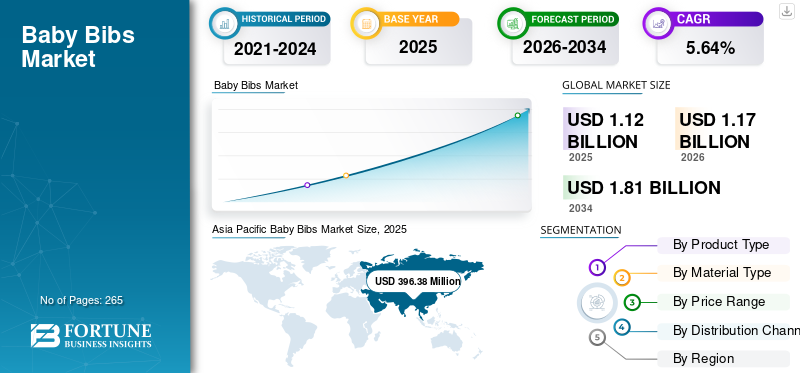
The baby bibs market size was valued at USD 1,120.00 million in 2025. The market is projected to grow from USD 1,172.08 million in 2026 to USD 1,817.78 million by 2034, exhibiting a CAGR of 5.64% during the forecast period. Asia Pacific dominated the baby bibs market with a market share of 35.39% in 2025.
Baby bibs are protective garments worn around a baby’s neck to keep clothing clean and dry during feeding, drooling, teething, or messy play. The market is growing due to increasing consumer interest in infant nutrition and hygiene products, driven by parents' increased focus on convenience, hygiene, and hypoallergenic products. Customer preferences are moving toward more innovative types of baby bibs, including waterproof, silicone-based, organic cotton, bamboo, and washable varieties. These baby mealtime essentials are also available as BPA-free baby bibs for consumers who are conscious of their personal well-being and environmental sustainability. E-commerce sales, gifting demand, high-end baby product purchases, and the increasing availability of fashionable, neutral-colored baby bibs with adjustable straps also drives the market growth.
Leading players in the market include Carter’s, Inc., Gerber Childrenswear LLC, HALO Dream Inc./ aden + anais, Bumkins, and Mayborn Group Ltd./Tommee Tippee. These firms strive to stay competitive in the market by adopting new strategies, mainly focusing on product innovation, including durable materials such as reusable silicone bibs, organic cotton or muslin, adjustable fit, multipacks, and travel-friendly designs.
Download Free sample to learn more about this report.
Baby Bibs Market Key Takeaways
 Global Market Size & Forecast
- 2025 Market Size: USD 1,120.00 million
- 2026 Market Size: USD 1,172.08 million
- 2034 Forecast Market Size: USD 1,817.78 million
- CAGR: 5.64% from 2026–2034
 Market Share
- Asia Pacific dominated the baby bibs market with a 35.39% share in 2025.
- The bandana bibs segment is anticipated to grow at a CAGR of 6.49% over the forecast period.
- The bamboo fabric segment is anticipated to grow at a CAGR of 6.60% over the forecast period.
 Key Regional Highlights
Asia Pacific
Asia Pacific led the market at USD 396.38 million in 2025 and is projected to grow at a CAGR of 7.01%.
North America
North America ranked second at USD 294.81 million in 2025 and is projected to grow at a CAGR of 4.80%.
Europe
Europe ranked third at USD 259.76 million in 2025, accounting for 23.19% of the global market.
U.S.
The market reached USD 230.55 million in 2025, accounting for roughly 20.58% of global sales.
Japan
The market was valued at USD 40.36 million in 2025, accounting for roughly 3.60% of global revenues.
Read More

BABY BIBS MARKET TRENDS
Rising Shift Toward Sustainable and Easy-Clean Bibs is a Prominent Market Trend
Modern-day parents are opting for reusable silicone, organic cotton, and bamboo bibs amid growing safety and sustainability concerns about baby health and the environment. This has prompted companies to replace regular, low-cost fabric bibs with reusable bibs that offer features such as water- and stain-resistance, ease of washing, and safety for baby’s skin.
MARKET DYNAMICS
MARKET DRIVERS
Download Free sample to learn more about this report.
Rising Focus on Infant Hygiene and Feeding Convenience to Accelerate Market Growth
Rising awareness among parents about hygiene, drooling, and no-mess feeding for babies is a major driver of the baby bibs market growth. As babies need to be fed more frequently and drool a lot due to teething, parents are opting for bibs that keep clothing stain-free and prevent skin irritation, along with multiple changes of clothes. Bibs have become an integral part of infant care solutions and serve as weaning essentials for babies. This is leading to the rising adoption of silicone feeding accessories.
MARKET RESTRAINTS
High Price Sensitivity and Low-Cost Alternatives to Restrict Market Penetration
The availability of budget baby bibs without any brand names constitutes a critical constraint to the development of a formal market structure. As bibs are often replaced and considered everyday wear, consumers tend to focus on price rather than brand name, premium products, or certification while making purchasing decisions, which in turn hampers branded product adoption and constrains overall market development.
MARKET OPPORTUNITIES
Expansion through E-commerce and Subscription Models to Create Growth Opportunities
The emergence of the baby care e-commerce industry and subscription programs provides baby bib makers with tremendous growth potential. As more parents opt for convenience through bundling and subscriptions, brands may capitalize by offering products tailored to their preferences, using innovative designs, multipacks, quality, and sustainable materials. The toddler feeding bibs demand forecast remains positive due to rising parental focus on hygiene, mess-free feeding, and reusable baby care products. Therefore, technology supports product promotion, rapid product launches, consumer feedback generation, and brand loyalty development in both mature and developing economies.
MARKET CHALLENGES
Maintaining Product Safety and Compliance Standards is Challenging Market Growth
Consistent product safety and material compliance remain critical issues for the baby bib manufacturing industry. Given that bibs come into direct contact with babies' skin and mouth, companies face risks associated with dyes, plastics, fasteners, and choking hazards, among others. All this makes testing and certification more expensive. Consequently, smaller players find it difficult to enter this market, while a recall or another issue can destroy their brand reputation.
Segmentation Analysis
By Product Type
High Daily Usage During Infant Feeding to Drive Growth of Feeding Bibs Segment
By product type, the market is segmented into feeding bibs, drool bibs, bandana bibs, and others.
The feeding bibs segment dominated the market, as they are mostly used during breastfeeding, bottle feeding, and while introducing solid foods to babies. As parents seek products that help prevent spills and stains on clothes and the need to change clothes regularly, feeding bibs demand for feed baby increases majorly due to their waterproof and easy-to-clean nature.
To know how our report can help streamline your business, Speak to Analyst
The bandana bibs segment is anticipated to rise at the fastest CAGR of 6.49% over the forecast period.
By Material Type
Affordability, Comfort, and High Replacement Demand Leads to Dominance of Cotton Segment
Based on material type, the market is divided into cotton, silicone, bamboo fabric, and others.
The cotton segment dominated the market in 2025 in terms of revenue, due to its soft, breathable, skin-friendly properties, which are preferred by most parents who use it on their babies with sensitive skin. Cotton bibs are cheap, washable, and available in packs, making them a common choice for many parents for regular feeding and saliva management. This makes cotton sales exceed compared to silicone and bamboo baby bibs.
The bamboo fabric segment is anticipated to rise at the fastest CAGR of 6.60% over the forecast period.
By Price Range
Affordability and Frequent Replacement Needs to Boost Economy Segment Growth
Based on price range, the market is divided into economy, mid-range, and premium.
The economy segment captured a dominant market share since bibs are always seen as vital and highly disposable items for babies' care. As most mothers prioritize price when purchasing bibs for their children, budget multi-packs tend to experience a surge in demand. Therefore, economy baby bibs tend to register better sales than mid-range and luxury ones.
The premium segment is anticipated to rise at the fastest CAGR of 6.36% over the forecast period.
By Distribution Channel
Strong Retail Presence and Immediate Product Accessibility to Lead Offline Segment Growth
Based on distribution channel, the market is segmented into supermarkets & hypermarkets, specialty baby stores, online retail, and others.
Online retail held a dominant baby bibs market share in 2025, driven by rising preference for home delivery, greater product variety, ease of price comparison, and reviews when buying baby care items. Since online platforms offer multipack baby bibs, branded baby bibs, silicone baby bibs, organic baby bibs, and personalized baby bibs at affordable prices, they drive repeated business. Thus, online retail revenues grow faster than those of supermarkets and hypermarkets, specialty baby stores, and other offline channels.
The specialty baby stores segment is projected to grow at the second-fastest CAGR of 5.25% during the forecast period.
Baby Bibs Market Regional Outlook
By geography, the market is categorized into Europe, North America, Asia Pacific, South America, and Middle East & Africa.
North America
Asia Pacific Baby Bibs Market Size, 2025 (USD Million)
To get more information on the regional analysis of this market, Download Free sample
North America ranked second in the global market and is projected to grow at a CAGR of 4.80% in the coming years. The region reached a valuation of USD 294.81 million in 2025, driven by high parental spending on expensive, safe, and convenient baby-care products. Increasing preference for reusable silicone, organic cotton, waterproof, and washable bibs will fuel product upgradation. The high adoption of e-commerce portals, specialty baby stores, and bundled branded products helps boost product availability.
U.S. Baby Bibs Market
With North America’s strong contribution, the U.S. market reached USD 230.55 million in 2025, accounting for roughly 20.58% of global market sales. The growing preference for hygienic feeding products and eco-friendly materials is driving revenue growth in the U.S. market.
Europe
Europe held the third-largest share in 2025, valued at USD 259.76 million, accounting for 23.19% of the global market. Increasing consumer preference for safety, certification, skin-friendliness, and sustainability in baby products is driving market growth. Additionally, Europe’s high consumer safety standards for products are driving increased demand for quality products made from materials such as cotton, bamboo, and BPA-free silicone. Moreover, the increasing online purchase penetration rate in Europe is boosting accessibility to branded multipack and sustainable products. For instance, according to European Union statistical office, online shopping in the EU has increased, with 77% of EU internet users purchasing goods or services online by 2024, which has driven sales of online baby-care products.
U.K. Baby Bibs Market
The U.K.’s market in 2025 reached USD 44.59 million, representing roughly 3.98% of global market revenues.
Germany Baby Bibs Market
Germany’s market reached USD 48.14 million in 2025, equivalent to around 4.30% of global market sales.
Asia Pacific
The Asia Pacific dominated the market, reaching USD 396.38 million in 2025 and growing at a CAGR of 7.01%. The large number of infants, the increase in urban households, and spending on branded baby care essentials are propelling the product demand across the region. Additionally, increasing e-commerce accessibility is contributing toward a more accessible market for multipacks, silicone bibs, cotton bibs, and sustainable baby bibs in countries such as India, China, Southeast Asia, Japan, and Australia. Consequently, high-frequency feeding, heightened hygiene awareness, and improved online access to baby bibs have driven product demand.
Japan Baby Bibs Market
The Japanese market in 2025 was valued at USD 40.36 million, accounting for roughly 3.60% of global market revenues. The growth in Japan’s market is attributed to an increase in per-child expenditure, driven by declining births, which has led parents to prefer high-quality, hygienic baby care products. The demand for washable, travel-friendly, organic materials and silicon baby bibs will be fueled by the organized retail and e-commerce sector in Japan. The expansion of childcare products distribution through online and offline channels is improving consumer access to baby care essentials across developed and emerging markets.
China Baby Bibs Market
China’s market in 2025 was valued at USD 107.80 million in revenues, representing roughly 9.63% of global market sales.
India Baby Bibs Market
The Indian market in 2025 was valued at USD 99.82 million, accounting for roughly 8.91% of global market revenues.
South America and Middle East & Africa
The South America and Middle East & Africa regions are expected to witness moderate growth in this market during the forecast period. The South American market reached USD 88.48 million in 2025. Factors fueling the market growth include increasing urbanization, higher middle-class spending on baby care items, and the expansion of online retail, all of which are driving affordable multipacks, cotton baby bibs, and feeding aids. In the Middle East & Africa, the UAE reached USD 13.19 million in 2025.
South Africa Baby Bibs Market
The South African market reached USD 14.82 million in 2025, representing roughly 1.32% of global market revenues.
COMPETITIVE LANDSCAPE
Key Industry Players
Innovation, Value Packs, and Digital Expansion Intensifies Market Competition
Baby bibs are not a perfectly concentrated industry; in fact, some of the key competitors in this market include Carter's, Gerber Childrenswear, aden + anais, Bumkins, Tommee Tippee, Hudson Baby, and Copper Pearl. Baby product retailers are strengthening their bib assortments with cotton, silicone, waterproof, and multipack options to meet growing demand from parents. The companies that manufacture these baby bibs use innovation in their product design and marketing strategies to remain competitive. For instance, the leading firms in the business are focusing on making their baby bibs reusable and made of organic materials such as silicone, bamboo, and cotton.
LIST OF KEY BABY BIBS COMPANIES PROFILED:
- Carter’s, Inc. (U.S.)
- Gerber Childrenswear LLC (U.S.)
- Mayborn Group Ltd. / Tommee Tippee (U.K.)
- Bumkins (U.S.)
- KeaBabies / KeaWorld Pte. Ltd. (Singapore)
- HALO Dream Inc. / aden + Anais (U.S.)
- BabyVision Inc. / Hudson Baby (U.S.)
- Copper Pearl Inc. (U.S.)
- Green Sprouts Inc. (U.S.)
- Brainbees Solutions Ltd. / Babyhug (India)
KEY INDUSTRY DEVELOPMENTS
- August 2025: Carter’s launched its new My First Love Collection, expanding baby essentials with elevated prints, textures, and accessory items, including bibs. The initiative strengthened Carter’s gifting and newborn essentials positioning by combining functional babywear with coordinated accessories.
- July 2025: Sainsbury’s Tu launched a babywear sale that included discounted baby bibs. This price-led initiative supported affordability-focused demand and helped attract parents seeking low-cost everyday baby essentials.
- March 2025: AnyMind Group became the exclusive online distributor for Moyuum in Indonesia, supporting the Korean baby products brand’s online expansion. Since Moyuum’s range includes baby bibs, the initiative helped improve access to the marketplace, live commerce visibility, and cross-border e-commerce reach.
- February 2025: My Little Coco prepared for its first international launch in Dubai, while its wider baby product range included bibs and other infant feeding accessories. The initiative reflected geographic expansion beyond the U.K. and supported broader brand visibility in premium baby care.
REPORT COVERAGE
The global baby bibs market analysis includes a comprehensive study of the market & forecast by all the market segments included in the report. This qualitative and quantitative report includes details on the market dynamics and trends that are expected to drive the market over the forecast period. It provides information on key aspects, including technological advancements, the regulatory environment, and product launches. Additionally, it details partnerships, mergers & acquisitions, and key industry developments. The global research report combines the market outlook with a detailed competitive landscape, including market share and profiles of key players.
Request for Customization to gain extensive market insights.
Report Scope & Segmentation
| ATTRIBUTE | DETAILS |
| Study Period | 2021-2034 |
| Base Year | 2025 |
| Estimated Year | 2026 |
| Forecast Period | 2026-2034 |
| Historical Period | 2021-2024 |
| Growth Rate | CAGR of 5.64% from 2026 to 2034 |
| Unit | Value (USD Million) |
| Segmentation | By Product Type, Material Type, Price Range, Distribution Channel, and Region |
| By Product Type |
|
| By Material Type |
|
| By Price Range |
|
| By Distribution Channel |
|
| By Region |
|
Frequently Asked Questions
According to Fortune Business Insights, the global market value stood at USD 1,120.00 million in 2025 and is projected to reach USD 1,817.78 million by 2034.
In 2025, the North America market value stood at USD 294.81 million.
The market is expected to grow at a CAGR of 5.64% over the forecast period.
By product type, the feeding bibs led the market.
Rising parental focus on infant hygiene, mess-free feeding, and convenient baby care solutions is increasing demand for reusable, easy-clean, skin-friendly, and affordable bib products across both developed and emerging markets are accelerating market growth.
Carter’s, Inc., Gerber Childrenswear LLC, HALO Dream Inc. / aden + anais, Bumkins, and Mayborn Group Ltd. / Tommee Tippee are the major players in the global market.
Asia Pacific held the largest market share.


- 2021-2034
- 2025
- 2021-2024
- 265
-
(Offer valid till 15th Oct 2026)
Get 30-60 hrs Free Customization
Expand Regional and Country Coverage, Segments Analysis, Company Profiles, Competitive Benchmarking, and End-user Insights.










Related Reports
-
US +1 833 909 2966 ( Toll Free )
-
Get In Touch With Us