Baby Drinks Market Size, Share & Industry Analysis, By Demography (Infant, Toddler, and Preschooler), By Nature (Organic and Conventional), By Distribution Channel (Supermarkets/Hypermarkets, Grocery Stores & Pharmacy Stores, Online Retail, and Others), and Regional Forecast, 2026-2034
 Download Free Sample
(Offer valid till 15th Oct 2026)

KEY MARKET INSIGHTS
 Listen to Audio Version
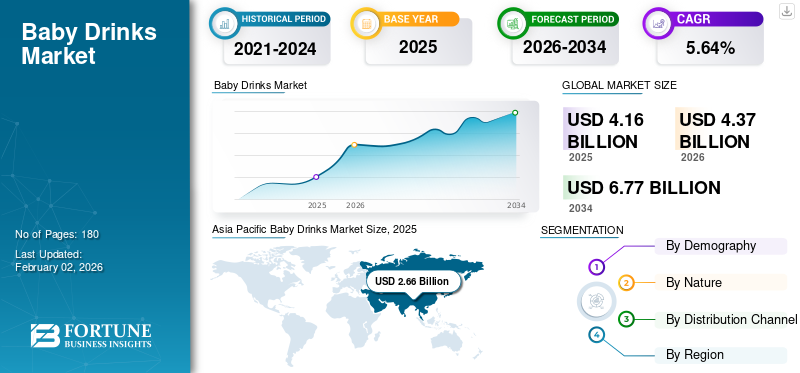
The global baby drinks market size was valued at USD 4.16 billion in 2025 and is projected to grow from USD 4.37 billion in 2026 to USD 6.77 billion by 2034, exhibiting a CAGR of 5.64% during the forecast period. Asia Pacific dominated the baby drinks market with a market share of 3.57% in 2025.
Baby drinks are thick, cold beverages that typically feature whole vegetables/fruits, dairy or non-dairy milk, and other suitable ingredients. Ideally, this drink resembles a thick puree that infants and toddlers can easily digest. With respect to age group, this item can be introduced to babies of around 6 months of age, along with other complementary foods. A few of the famous smoothies include yogurt and green smoothies. However, the baby food industry is expanding globally, but its consumption is mainly concentrated in the Asia Pacific region. The surging awareness of infant nutrition and increasing global birth rates are the prominent components responsible for the demand for baby drinks.
A few of the key players in the industry include The Hain Celestial Group, Inc., Beech-Nut, and Little Spoon, among others.
Download Free sample to learn more about this report.
BABY DRINKS MARKET KEY TAKEAWAYS
 Market Size & Forecast
- 2025 Market Size: USD 4.16 billion
- 2026 Market Size: USD 4.37 billion
- 2034 Forecast Market Size: USD 6.77 billion
- CAGR: 5.64% from 2026–2034
 Market Share
- Asia Pacific dominated the baby drinks market with a 3.57% share in 2025.
- The toddler segment held the largest market share in 2024.
- The conventional segment accounted for the leading share of the global market.
 Key Regional Highlights
North America
North America reached USD 0.68 billion in 2025 and is expected to grow to USD 0.71 billion in 2026, holding a 4.15% market share.
Europe
Europe was valued at USD 0.52 billion in 2025 and is forecast to reach USD 0.54 billion in 2026, contributing a 3.20% market share.
Asia Pacific
Asia Pacific led the market with USD 2.66 billion in 2025 and is projected to reach USD 2.80 billion in 2026, accounting for a 3.57% market share.
U.S.
The country dominated North America, supported by strong baby food manufacturing, innovation, and rising demand for convenient nutrition products
Japan
Growing focus on infant nutrition, premium baby foods, and convenient beverage products is supporting market expansion.
Read More

MARKET DYNAMICS
Market Drivers
Rising Demand for Functional Ingredient-Enriched Smoothies Boosts Market Growth
The increasing demand for functional ingredient-based drinks is the major aspect propelling the growth of the baby drinks market. In this modern era, many consumers have adopted healthy eating habits and are trying to impart similar traits to their children. To maintain their infants’ health, parents are looking for drinks made up of functional ingredients. This reliance on such beverages is increasing due to their targeted health advantages and nutrition. Ingredients such as superfoods and probiotics are considered functional ingredients as they are known to boost energy levels and enhance overall health, coupled with nutritional value. As a result, the factors mentioned above can fuel the sales of functional ingredients-based baby drinks.
Market Restraints
High Prices of Smoothies and Health-Related Concerns Obstruct Industry’s Growth
The high cost of kids’ smoothies is recognized as the pivotal restraint in the global market. Compared to homemade drinks, commercial baby smoothies are expensive, owing to superior quality ingredients, which leads to higher prices. Moreover, the pre-packaged baby beverages include the cost of storage and packaging, which further adds to the price. Along with this, a few popular baby food brands often incur substantial marketing costs, which add up to the high product prices. As a result, soaring prices of finished items inhibit the purchasing capability of consumers globally.
Another factor affecting the global market’s potential is the increasing prevalence of health ailments caused by baby food. The presence of heavy metals (arsenic, mercury) in consumable baby edibles, including smoothies, is known to cause developmental delay and impaired brain development. Also, to enhance the flavor and color, many commercial baby products contain added sodium and preservatives, resulting in several health issues.
Market Opportunities
Growing Popularity of Lactose and Sugar-Free Juices/Smoothies for Infants Unlocks Growth Opportunities
The surging popularity of sugar and dairy-free baby drinks is considered a major growth opportunity that can shape the industry’s growth. In today’s era, parents are highly concerned about infants’ dietary allergies and sensitivities, especially lactose intolerance. To minimize the risk of challenges caused by dairy-based items, most parents are turning toward dairy alternatives, such as plant-based smoothies, finger foods, and others. Another crucial concern faced by global parents is the high amount of sugar in infant food. To overcome such hurdles, parents are looking for items with “no added sugar,” including sugar-free smoothies.
Baby Drinks Market Trends
Surge in Inclination Toward Eco-Friendly and Flexible Packaging is Current Trend
In the baby food sector, flexible and environment-friendly packaging plays a vital role in shaping the dynamics of the industry. Most parents are looking for sustainable, healthier, and convenient solutions, boosting the demand for packaging associated with their preferences. Flexible packaging, such as stand-up pouches with resealable closures and stouts, adds convenience to the parent’s routine. Such packaging can easily protect the smoothies/juices' hygiene from contamination. Additionally, the parents are trying to opt for sustainable packaging to reduce food waste and protect environmental health.
Download Free sample to learn more about this report.
SEGMENTATION ANALYSIS
By Demography
Toddler Segment Led Market Due to Large Dependency on Complementary Foods
On the basis of demography, the global market is segmented into infant, toddler, and preschooler.
Out of all, the toddler segment dominated the global space and generated the maximum share in 2024. Toddlers, typically between 1 to 3 years old, consume complementary foods, such as smoothies, in addition to formula or breast milk. These additional food items offer important nutrients and help toddlers in healthy growth and development and overall well-being. Also, experimenting with complementary foods aids in enhancing their sensory perception. Thus, such advantages drive the global baby drinks market growth.
Preschoolers are the fastest-growing segment and are anticipated to soar at a higher pace during the forecast period. Consuming complementary foods such as smoothies and juice helps to cater to their nutritional needs and reduces the risk of malnutrition.
By Nature
Conventional Segment Dominates Market Owing to Its Wide Availability
Depending on nature, the global market is divided into conventional and organic.
Out of both, the conventional segment leads the market and holds an accountable share. Conventional smoothies are widely available and provide an extended shelf life in comparison to homemade substitutes. Unlike home-cooked meals, these drinks can be directly consumed after purchasing, thus making them a preferred choice for busy parents. Moreover, concerning food quality, these pre-packaged products undergo rigorous quality checks to ensure food safety. As a result, such aspects can proliferate the global baby drinks market share.
The organic segment is the fastest-growing sector and holds a high CAGR. The rising demand for clean-label beverages and increasing allergy incidences collectively drive the sales of organic baby juices/smoothies.
By Distribution Channel
Supermarkets/Hypermarkets Segment Led Market Due to Its Several Advantages
On the basis of distribution channel, the market is categorized into supermarkets/hypermarkets, grocery stores & pharmacy stores, online retail, and others.
Out of all the categories, the supermarkets/hypermarkets segment led in 2024 and is predicted to hold the same position in the future. The availability of superior-quality products, freedom of selection, and discount benefits are responsible for high trajectory growth. Moreover, the affordable price range and easy accessibility further add to the strong growth.
Online retail witnessed the highest CAGR and is considered the fastest-growing segment. The ease of shopping while sitting at home/workplace and convenient return/delivery of baby foods propels the segment’s momentum.
Baby Drinks Market Regional Outlook
On the basis of region, the market is segmented into North America, Europe, Asia Pacific, South America, and the Middle East & Africa.
Asia Pacific
Asia Pacific Baby Drinks Market Size, 2025 (USD Billion)
To get more information on the regional analysis of this market, Download Free sample
Asia Pacific dominated the global marketplace and held the highest market share in 2025. Asia Pacific accounted for USD 2.66 billion in 2025, representing 3.57% of the global market share, and is projected to reach USD 2.8 billion in 2026. The busy work schedules of dual-income households and the growing prevalence of malnutrition are reshaping consumption behavior in the region. Compared to other developing regions, Asia Pacific is known for its high birth rates, which increases their dependency on baby food such as juices and smoothies. Moreover, the improved awareness of infant nutrition amongst Asian parents and the rising demand for convenience further bolsters regional growth.
Among all Asian countries, China emerged as the leading consumer of infant smoothies, primarily due to the changing family structure and increasing need for safe, nutrient-enriched edibles for babies. Thus, such factors facilitate the growth of baby smoothies.
North America
The North America market generated USD 0.68 billion in 2025, representing 4.15% of the global market landscape, and is expected to reach USD 0.71 billion in 2026. In this region, convenience and product innovation play a massive role in stimulating the sales of drinks for babies. To maintain their work-life balance, the working population, especially women, is seeking clean-label, healthy, and convenient baby food that provides health advantages. Due to such demands, American infant food producers are experimenting with plant-centric ingredients to launch smoothies. For instance, in March 2024, Beech-Nut, one of the well-established kids' food brands in the U.S., introduced smoothies with prebiotics. This drink is ideal for 12-month-old babies and is available in two flavors across the U.S.
Out of all, the U.S. led the North American region and held a sizeable market share. The escalating number of baby food manufacturers and technological advancements in the infant food industry aid in market expansion.
Europe
Europe contributed 3.20% to the global market in 2025, with a valuation of USD 0.52 billion, and is projected to reach USD 0.54 billion in 2026. Europe is considered the third leading region in the market globally. This growth can be attributed to e-commerce development and surging demand for organic kids' food items. Predominantly, Europeans are inclined toward veganism and are trying to incorporate plant-sourced products into their children’s diets. As a result, this shift strengthens the need for smoothies produced from fruits & vegetables. Additionally, the rising awareness of early childhood nutrition and enhanced consumer spending power further drive the region’s momentum.
South America
South America is still at its nascent stage and is anticipated to grow at a higher pace in the near term. The surging efforts by pediatricians to educate parents about infant nutrition and the augmented urbanization drive the demand for baby drinks.
Middle East & Africa
In 2025, Middle East & Africa held 3.35% of the global market, reaching a valuation of USD 0.14 billion, and is projected to grow to USD 0.14 billion in 2026. Likewise, South America, the Middle East & Africa region also at its developing stage and is expected to maintain the same pace in the future. The rising local baby food producers and high disposable income, cumulatively, fuel the potential of the region.
Latin America
Latin America contributed approximately USD 0.16 billion to the global market in 2025, accounting for 3.49% share, and is expected to reach USD 0.17 billion in 2026.
COMPETITIVE LANDSCAPE
Key Industry Players
Key Players are Paying Attention to Unique Launches to Boost Product’s Visibility
The active players in the global industry include The Hain Celestial Group, Inc., Beech-Nut, Little Spoon, and Serenity Kids, among others. The firms operating in the market are investing in research and development to expand their product offerings. Through this strategy, top producers of baby drinks enterprises are collaborating with prominent global players, which can assist in fueling the overall market’s momentum.
List of Key Baby Drink Companies Profiled
- Beech-Nut (U.S.)
- Ella’s Kitchen (Brands) Limited (U.K.)
- Holle baby food AG (Switzerland)
- The Hain Celestial Group, Inc. (U.S.)
- HiPP GmbH & Co. Vertrieb KG (Germany)
- Once Upon a Farm (U.S.)
- Little Spoon (U.S.)
- Serenity Kids (U.S.)
- Cerebelly (U.S.)
- Little Bellies (Australia)
KEY INDUSTRY DEVELOPMENTS
- October 2023: PAI Partners, a French private equity enterprise, launched kids’ smoothies via its acquired brand, Tropicana. The smoothies are composed of real fruits and are available across major U.K.-based retailers.
- February 2023: Serenity Kids, a baby food firm in the U.S., launched its new range of dairy-free, vegetable and protein-rich smoothies for toddlers. The products launched are non-GMO project verified and USDA-certified organic, and are available in numerous flavors.
- September 2022: Innocent Drinks, a brand of the Coca-Cola Company, a conglomerate in the U.S., expanded its super smoothies range by adding “Blueberry Whiz”. This smoothie is made up of crushed vegetables and fruits and can be consumed by kids across the U.S.
- July 2022: Whole Kids, an Australian-owned enterprise, released new flavors of its Smoothie Drops range. This item is allergen-friendly and is made up of freeze-dried whole fruits and organic coconut milk, and is ideal for both toddlers and babies. Moreover, the product is easily available across retailers in Australia.
- March 2020: Once Upon a Farm, a plant-based meal brand for toddlers in the U.S., announced the new range of ready-to-drink dairy-free yogurt and bottled protein smoothies for babies. The yogurt was launched in the U.S. and features three appealing flavors: raspberry, blueberry, and strawberry.
REPORT COVERAGE
The market research report includes quantitative and qualitative insights into the market. It also offers a detailed market analysis of the market sizing and growth rate for all market segments. Key insights in the report include an overview of related markets, a competitive landscape, recent industry developments such as mergers & acquisitions, the regulatory environment in critical countries, and current global baby drinks market trends.
Request for Customization to gain extensive market insights.
Report Scope & Segmentation
|
ATTRIBUTE |
DETAILS |
|
Study Period |
2021-2034 |
|
Base Year |
2025 |
|
Estimated Year |
2026 |
|
Forecast Period |
2026-2034 |
|
Historical Period |
2021-2024 |
|
Unit |
Value (USD Billion) |
|
Growth Rate |
CAGR of 5.64% from 2026 to 2034 |
|
Segmentation |
By Demography
|
|
By Nature
|
|
|
By Distribution Channel
|
|
|
By Region
|
Frequently Asked Questions
Fortune Business Insights says that the global market is projected to grow from USD 4.37 billion in 2026 to USD 6.77 billion by 2034.
The baby drink market is expected to grow at a CAGR of 5.49% during the forecast period (2026-2034).
By demography, the toddler segment led the market.
Rising demand for functional ingredient-enriched smoothies boosts market growth.
The Hain Celestial Group, Inc., Beech-Nut, Arla Foods Amba, and Little Spoon are a few of the top players in the market.
Asia Pacific held the highest share of the market.
The growing popularity of lactose and sugar-free smoothies for infants unlocks growth opportunities.



- 2021-2034
- 2025
- 2021-2024
- 180
-
(Offer valid till 15th Oct 2026)
Get 30-60 hrs Free Customization
Expand Regional and Country Coverage, Segments Analysis, Company Profiles, Competitive Benchmarking, and End-user Insights.




















Related Reports
-
US +1 833 909 2966 ( Toll Free )
-
Get In Touch With Us