Ball Sports Equipment Market Size, Share & Industry Analysis, By Sports Type (Football (Soccer) Equipment, Basketball Equipment, Cricket Equipment, Baseball & Softball Equipment, and Others), By Distribution Channel (Specialty Sports Retail Stores, Online Retail, Hypermarkets & Supermarkets, Department Stores, Institutional/Direct Sales (B2B), and Others), and Regional Forecast, 2026-2034
 Download Free Sample
(Offer valid till 15th Oct 2026)

Ball Sports Equipment Market Size and Future Outlook
 Listen to Audio Version
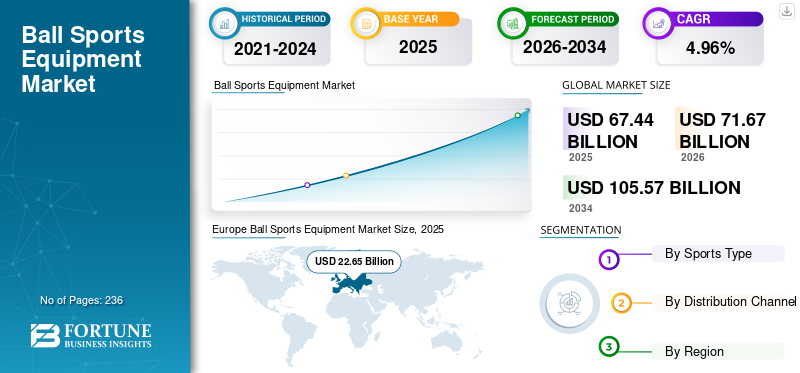
The global ball sports equipment market size was valued at USD 67.44 billion in 2025. The market is projected to grow from USD 71.67 billion in 2026 to USD 105.57 billion by 2034, exhibiting a CAGR of 4.96% during the forecast period. Europe dominated the ball sports equipment market with a market share of 33.59% in 2025.
Ergonomically designed ball sports goods play a crucial role in enhancing athletic performance, safety, and users' physical conditioning. The growing participation in ball-based sports across schools, golf clubs, and academies is driving the demand for such products. In addition, the increasing number of sports clubs, enabling users to buy branded sports equipment for use on these facilities, is positively contributing to global market expansion. According to the National Sporting Goods Association’s (NSGA) U.S. Sports Participation report, in 2024, American youth aged 7 to 17 years' participation in football increased by 21%, followed by basketball and tackle football at 12%.
Key companies in the global market include Amer Sports Corporation, Mizuno Corporation, ASICS Corporation, Adidas AG, and Puma SE.
Download Free sample to learn more about this report.
Ball Sports Equipment Market Key Takeaways
 Global Market Size & Forecast
- 2025 Market Size: USD 67.44 billion
- 2026 Market Size: USD 71.67 billion
- 2034 Forecast Market Size: USD 105.57 billion
- CAGR: 4.96% from 2026–2034
 Market Share
- Europe dominated the ball sports equipment market with a 33.59% share in 2025.
- The Cricket Equipment segment is projected to grow at the fastest CAGR of 5.92% during the forecast period.
- The Online Retail segment is projected to grow at a 6.45% CAGR during the forecast period.
 Key Regional Highlights
Europe
Europe dominated the market with a 33.59% share in 2025.
Asia Pacific
Asia Pacific accounted for 31.46% of the global market, valued at USD 21.22 billion in 2025.
North America
North America is expected to grow steadily, driven by strong demand for sports equipment.
U.S
The market is expected to witness steady growth, supported by strong sports participation.
Japan
The market was valued at USD 2.16 billion in 2025.
Read More

BALL SPORTS EQUIPMENT MARKET TRENDS
Institutional Preference for Professional-Grade Ball Sports Products to Augment Market Growth
The growing institutional preference for professional-grade ball sports goods, including match-grade balls, advanced composite bats, professional-standard gloves, and certified protective gear, is augmenting market growth. In addition, the increasing demand for premium, federation-certified products that deliver consistent ball flight and bounce is favoring product sales across many countries.
MARKET DYNAMICS
MARKET DRIVERS
Download Free sample to learn more about this report.
Rising Demand for Sports Balls of Thermally-Bonded Construction to Drive Market Growth
Balls made of engineered materials improve users' sports performance, consistency, and safety during sports activities. Smart equipment uses data analytics and sensor-based systems, enabling users to track professional athletes’ performance in real time. The rising consumer demand for footballs and basketballs with thermally bonded or hybrid panel-based construction, offering enhanced shape retention, reduced water absorption, and better support for users’ data-driven ball flight and bounce expectations, is driving the global ball sports equipment market growth. In addition, consistent manufacturers' production of ball-based sports equipment with multi-layer internal cushioning systems and enhanced surface texturing technologies that improve ball grip is positively contributing to market expansion.
MARKET RESTRAINTS
High Ball Sports Equipment Cost to Restrain the Market Growth
The high cost of innovative ball sports products is negatively impacting their demand among price-sensitive consumers worldwide. In addition, unorganized manufacturers’ provision of counterfeit products at competitive prices is hindering key players’ product sales and restraining global market growth. Furthermore, intense commoditization of sports goods is enabling manufacturers to lower the prices of mid-range and low-range products. The growing consumer access to low-cost products is hampering demand for key players’ luxury products across many countries.
MARKET OPPORTUNITIES
Increasing Numbers of Sports Sponsors Offering Innovative Products to Institutions to Create Market Growth Opportunities
The growing number of sports sponsors offering innovative products to sports enthusiasts and institutional end-users is creating new market growth opportunities. In addition, governmental and federation initiatives to consistently promote ball sports are creating new market growth avenues for youth participation in sports. Social media influencers consistently promote various moments of cricket, American football, and other ball sports, boosting product demand across many countries.
MARKET CHALLENGES
Volatility in Material Prices and High Production Costs to Challenge Key Players' Business Expansion
Limited availability and volatility in the prices of raw materials used to produce bats, balls, helmets, and other equipment are posing challenges for key players seeking to improve business profitability. In addition, high R&D expenses, re-certification requirements, and the use of new tooling systems extend the product development cycle, negatively impacting the key players’ market positions.
Segmentation Analysis
By Sports Type
Growing Soccer Participation and Preference for Professional-grade Products to Drive Football (Soccer) Equipment Segment
Based on sports type, the market is segmented into football (soccer) equipment, basketball equipment, cricket equipment, baseball & softball equipment, and others. Others segment include golf equipment, American football equipment, pickleball equipment, volleyball equipment, and others.
The football (soccer) equipment segment accounted for the leading global ball sports equipment market share of 32.62% in 2025. Its major share is attributed to greater soccer participation among schools, amateur, and professional end-users, requiring extensive use of balls, goals, nets, shin guards, and goalkeeper gloves in many countries. In addition, the expanding construction of football courts and training centers seeking professional-grade soccer balls & nets is favoring the segment’s growth.
To know how our report can help streamline your business, Speak to Analyst
The cricket equipment segment is projected to grow at the fastest rate of 5.92% from 2026 to 2034. The growing number of cricket participants, the formation of new leagues, and the expanding visibility of international tournaments increase demand for branded cricket equipment, driving the segment’s growth.
By Distribution Channel
Wider Assortment of Branded Products at Specialty Stores Led to the Dominance of Specialty Sports Retail Stores Segment
Based on the distribution channel, the market is segmented into specialty sports retail stores, online retail, hypermarkets & supermarkets, department stores, institutional/direct sales (B2B), and others.
The specialty sports retail stores segment exhibited a leading global market share of 35.69% in 2025. The segment’s leading share is attributed to the broader assortment of branded goods at specialty retail shops. In addition, consistent store sales representatives’ provision of product technical guidance and other product attributes to the store visitors and institutional buyers is positively contributing to the segment’s growth.
The online retail segment is growing at a CAGR of 6.45% from 2026 to 2034. The growing number of e-commerce marketplaces for sports goods offering certified cricket and basketball equipment across mass, mid-range, and premium price segments is driving growth in online retail.
Ball Sports Equipment Market Regional Outlook
By region, the market is categorized into North America, Europe, Asia Pacific, South America, and Middle East & Africa.
North America
Europe Ball Sports Equipment Market Size, 2025 (USD Billion)
To get more information on the regional analysis of this market, Download Free sample
The North America region held the third leading global market share of 22.79% in 2025 and is expected to maintain its leading position during the forecast period. The North American market size is estimated to reach USD 16.16 billion by 2026. A stronger sports culture, a high number of outdoor sports infrastructure facilities, and increasing participation in ball sports are driving market growth across the U.S. and Canada. In addition, the expanding network of specialty goods stores and brand stores offering premium-based products is positively contributing to the product revenue generation across Mexico and Canada.
U.S Ball Sports Equipment Market
The U.S. market size reached USD 11.43 billion in 2025. The U.S. market accounted for around 16.95% of the global market sales in 2025. Greater participation in American football, hunting, and basketball activities, and institutional preference for luxury goods are generating considerable product revenue across the U.S.
Europe
The European region is expected to maintain its leading global market position during the forecast period. The European market size reached USD 22.65 billion in 2025, accounting for approximately 33.59% of the global product sales. Increasing soccer participation and expanding the number of publicly funded playing fields, training academies, and municipal sports facilities, while requiring the use of match-grade and federation-compliant products, is driving European market growth. In addition, governmental initiatives to promote baseball and softball are favoring market growth across the region.
U.K Ball Sports Equipment Market
The U.K. market in 2025 touched around USD 2.40 billion, representing approximately 3.56% of global product revenues.
Germany Ball Sports Equipment Market
Germany’s market reached approximately USD 3.30 billion in 2025, equivalent to around 4.90% of global product sales.
Asia Pacific
The Asia Pacific region held the second-largest global market share of 31.46% and a market value of USD 21.22 billion in 2025. The growing awareness regarding maintaining health and fitness is driving the demand for sports goods in the region. In addition, the increasing government investments in building organized sports infrastructure and the growing number of middle-income sports participants seeking affordable products are driving the region’s market growth. The increasing number of sports goods retailers and brand stores offering premium ball sports products made of sustainable materials is also driving product demand across the region.
Japan Ball Sports Equipment Market
The Japanese market in 2025 was valued at around USD 2.16 billion, accounting for roughly 3.20% of global product revenues. The growing popularity of high school baseball tournaments and established professional leagues increases the demand for bats, gloves, balls, and other baseball equipment across the Japanese market.
China Ball Sports Equipment Market
China’s market is projected to be one of the largest worldwide, with revenues reaching around USD 9.79 billion in 2025, representing roughly 14.52% of global product sales.
India Ball Sports Equipment Market
The Indian market in 2025 accounted for USD 2.85 billion, accounting for roughly 4.23% of global market revenues.
South America
Over the global market forecast period, the South American market is expected to grow at a moderate rate from 2026 to 2034. The South America market in 2025 reached a valuation of USD 5.04 billion. The increasing participation in football sports in Argentina, Brazil, Colombia, and Chile increases demand for balls, goals, nets, and other basic protective gear across the region.
Middle East & Africa
The Middle East & African market is projected to witness 6.90% growth during the forecasted period of 2026-2034. The growing youth engagement in sports and physical activity, and the popularity of international sports events, are driving market growth across the Middle East & Africa. In addition, the growing number of sports stadiums and training facilities seeking ergonomically designed products is driving product demand across the region. In the Middle East & African market, Saudi Arabia reached a market value of USD 0.77 billion in 2025.
South Africa Ball Sports Equipment Market
The South African market reached a value of USD 0.42 billion in 2025, accounting for roughly 0.63% of the global market revenues.
COMPETITIVE LANDSCAPE
Key Industry Players
Robust R&D Investments and Global Distribution Channel Network to Help Key Players Maintain Market Positions
The key players operating in the global market are Amer Sports Corporation, Mizuno Corporation, ASICS Corporation, Adidas AG, and Puma SE. These players consistently focus on conducting multiple rounds of R&D investments to design newer sports gear and timely launch those products across worldwide markets. In addition, they partner with sports goods retailers to expand product reach globally.
LIST OF KEY BALL SPORTS EQUIPMENT COMPANIES PROFILED
- Amer Sports Corporation (The Wilson Sporting Goods Company) (Finland)
- Mizuno Corporation (Japan)
- BRG Sports, Inc. (U.S.)
- Adidas AG (Germany)
- Puma SE (Germany)
- Nike, Inc. (U.S.)
- Descente Ltd. (Japan)
- Yonex Co., Ltd. (Japan)
- Rawlings Sporting Goods Company, Inc. (U.S.)
- Sumitomo Rubber Industries, Ltd. (Japan)
KEY INDUSTRY DEVELOPMENTS
- February 2026: Scottsdale Golf, a U.K.-based golf equipment retailer, partnered with The Loop, a golf marketing agency, to launch SGTV, a new YouTube content channel, and promote its golf products.
- February 2026: Resilient Gloves launched patented G-Lock technology-based baseball and softball gloves, enabling players to achieve a personalized glove fit with 25 micro-adjustments.
- October 2025: So Hockey expanded in the Dublin, Ireland hockey and cricket equipment market segments with the acquisition of Edward Dwyer Sports Limited. The acquisition is helping the company increase its product distribution capabilities through Edward Dwyer Sports Limited’s two stores, which supply goods to clubs and schools.
- June 2025: Brera Holdings PLC, an Ireland-based international holding company, acquired a 52% majority stake in the Italian Serie B football club SS Juve Stabia srl to broaden its portfolio of women's and men's sports clubs worldwide. The acquisition is expected to boost demand for football equipment at these club facilities.
- May 2025: ABEO, a global supplier of sports and leisure equipment acquired a 70% stake in the Vietnamese operations of the sodex, a French sports equipment manufacturer. The acquisition was aimed to broaden its portfolio of products including soccer goals, tennis nets, athletics hurdles, and outdoor fitness equipment. The acquisition also enabled ABEO broaden its business presence across Asian market through multiple free-trade agreements.
- April 2025: GMR Global Pte Ltd., a supplier to the GMR Group, acquired Hampshire Sport & Leisure Holdings Limited to expand its reach in cricket equipment distribution across the U.K. market.
- April 2025: Sports Endeavors, LLC, a parent company of American soccer specialty retailers, Soccer.com and WorldSoccerShop acquired Soccer Master, a soccer specialty goods retailer located at St. Louis, Missouri, U.S. The acquisition was aimed to broaden product portfolio and capability of offering personalized equipment to the soccer players, teams, and their fan-followings.
REPORT COVERAGE
The global ball sports equipment market analysis provides an in-depth study of market insights, size, and forecast by distribution channel, as well as all other market segments included in the report. In addition, the report on the ball sports equipment market outlooks market dynamics, supply chain analysis, and market trends expected to drive the market in the forecast period. The report on the market includes information on technological advancements, new product launches, key developments in the ball sports goods industry, and details on partnerships, mergers & acquisitions. The ball sports equipment market research report also encompasses a detailed competitive landscape with information on the market share and profiles of key operating players.
Request for Customization to gain extensive market insights.
Report Scope & Segmentation
| ATTRIBUTE | DETAILS |
| Study Period | 2021-2034 |
| Base Year | 2025 |
| Estimated Year | 2026 |
| Forecast Period | 2026-2034 |
| Historical Period | 2021-2024 |
| Growth Rate | CAGR of 4.96% from 2026 to 2034 |
| Unit | Value (USD Billion) |
| Segmentation | By Sports Type, Distribution Channel, and Region |
| By Sports Type |
|
| By Distribution Channel |
|
| By Region |
|
Frequently Asked Questions
Fortune Business Insights says that the global market value stood at USD 67.44 billion in 2025 and is projected to reach USD 105.57 billion by 2034.
In 2025, the European market value stood at USD 22.65 billion.
At a CAGR of 4.96%, the global ball sports equipment market forecasted to grow during the forecast period.
By sports type, the football (soccer) equipment segment is projected to hold the leading global market share throughout the forecast period.
The rising demand for sports balls with thermally bonded construction is driving market growth.
Amer Sports Corporation, Mizuno Corporation, ASICS Corporation, Adidas AG, and Puma SE are among the prominent players in the market.
Europe dominated the market in 2025.
The growing number of sports sponsors offering innovative products to institutional end-users is creating new market growth opportunities.



- 2021-2034
- 2025
- 2021-2024
- 236
-
(Offer valid till 15th Oct 2026)
Get 30-60 hrs Free Customization
Expand Regional and Country Coverage, Segments Analysis, Company Profiles, Competitive Benchmarking, and End-user Insights.



















Related Reports
-
US +1 833 909 2966 ( Toll Free )
-
Get In Touch With Us