Barium Market Size, Share & Industry Analysis, By Form (Powder, Granular, and Others), By Grade (Technical Grade, Industrial Grade, and Others), By Type (Barium Carbonate, Barium Sulfate, Barium Nitrate, Barium Hydroxide, Barium Titanate, Barium Fluoride, and Others), By Application (Oil & Gas, Electro-Ceramic Materials (MLCC, Thermistors, and Others), Chemical & Industrial Applications, Pigments, Pyrotechnics & Fireworks, and Others), and Regional Forecast, 2025-2035
 Download Free Sample
Barium Market Size and Future Outlook
 Listen to Audio Version
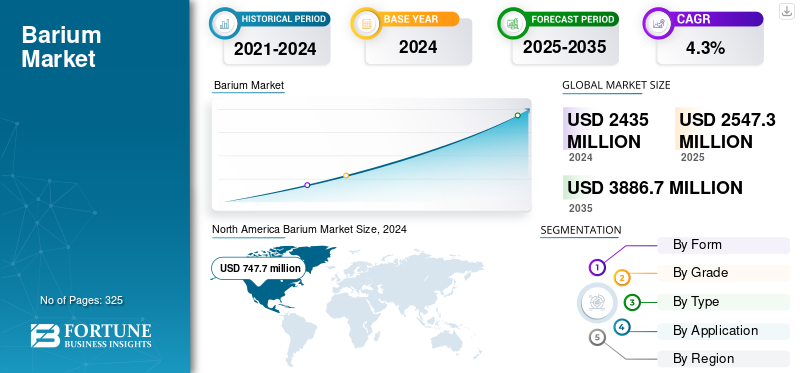
The global barium market size was valued at USD 2,435.0 million in 2024 and is projected to grow from USD 2,547.3 million in 2025 to USD 3,886.7 million by 2035, exhibiting a CAGR of 4.3% during the forecast period. North America dominated the global barium market with a market share of 32.35% in 2024.
Barium is a soft and silvery alkaline earth metal known for its high density, reactivity, and versatility, but it is not used in metallic form as it reacts rapidly with air and moisture. Its commercial use relies on barite, the most important natural source, valued for its exceptional density, brightness, and chemical stability. Barite is essential in drilling fluids for oil and gas exploration, where it controls well pressure and stabilizes boreholes, and its whiteness and inertness support use in coatings, plastics, rubber, and filler applications. These are produced either through physical mineral processing of barite to obtain high-purity barium sulfate or through chemical conversion to create compounds such as barium carbonate, chloride, and hydroxide, which offer higher purity but demand better ore quality, more energy, and stricter environmental controls.
Furthermore, the market encompasses several key players with Solvay sa, Nippon Chemical Industrial CO., LTD., Hubei JingshanChutianBarium Salt Corp., Ltd, YingfengyuanIndustrial Group Limited, and SAKAI CHEMICAL INDUSTRY CO., LTD., at the forefront. Broad product portfolio, expansion of production capacities, and strong geographic presence expansion have supported the dominance of these companies in the global market.
Download Free sample to learn more about this report.
Barium Market Takeaways
 Market Size & Forecast
- 2025 Market Size: USD 2,435.0 million
- 2026 Market Size: USD 2,547.3 million
- 2034 Forecast Market Size: USD 3,886.7 million
- CAGR: 4.3% from 2025–2035
 Market Share
- North America dominated the barium market with a 32.35% share in 2024.
- The electro-ceramic materials segment accounted for a 16.26% market share in 2024.
- The oil and gas segment is projected to grow at a CAGR of 4.4% during the forecast period.
 Key Regional Highlights
North America
North America maintained its leading position in 2024 with a market valuation of USD 747.7 million.
Europe
Europe is expected to reach USD 695.6 million in 2025, securing its position as the third-largest regional market.
Asia Pacific
Asia Pacific is projected to record a CAGR of 4.6% during the forecast period, supported by expanding industrial and electronics manufacturing activities.
U.S.
The U.S. market continues to contribute significantly to regional demand, supported by oil & gas drilling and industrial applications.
Japan
The Japan market is witnessing steady growth due to increasing demand for advanced electronic components and electro-ceramic materials.
Read More

MARKET DYNAMICS
MARKET DRIVERS:
Growing Integration of Barium Compounds in High-Performance Coatings and Polymer Systems Drives Market Growth
Barium compounds are increasingly used in high-performance coatings and polymer systems as they improve opacity, brightness, and overall surface quality. In coatings, precipitated barium sulfate works as a stable extender that enhances gloss control, chemical resistance, and uniform film formation, making it valuable for automotive finishes, powder coatings, and industrial protective layers. In polymer processing, it boosts mechanical strength, dimensional stability, and density control, while its fine particle size ensures uniform dispersion, reduced shrinkage, and smoother molded or extruded surfaces used in engineering plastics, appliance housings, electrical components, and X-ray-detectable grades. With coatings and polymer demand rising across automotive, construction, and industrial sectors, the growing use of these compounds as essential additives that improve durability, consistency, and processing efficiency is expected to drive the barium market growth.
- According to the U.S. Geological Survey (USGS, 2025), global barite mine production reached about 8.2 million metric tons in 2024, highlighting the strong raw material base that underpins the production of barium sulfate for coatings and polymer applications.
MARKET RESTRAINTS:
Stringent Environmental Regulations on Barium Mining and Processing Activities Hinders Market
Barium production from barite mining and chemical processing is increasingly constrained by strict environmental regulations targeting emissions, waste handling, and risks from soluble compounds. Authorities across major regions are tightening oversight, raising compliance costs, and slowing approvals for new projects. In the U.S., the Environmental Protection Agency enforces strict discharge limits under the Safe Drinking Water Act, while Europe’s REACH framework continues to strengthen requirements for safer handling and processing. These rules affect every stage from ore extraction to refinement, increasing operational complexity. As regulations intensify, industries are exploring alternatives and optimized formulations, making environmental compliance a key restraint on the global market.
MARKET OPPORTUNITIES:
Growing Investment in Sustainable and Eco-Efficient Barium Production Technologies Boost Market
Sustainable and eco-efficient processing technologies are opening new opportunities for the industry as producers aim to reduce environmental impact and improve resource efficiency. Cleaner beneficiation, low-emission processing, and water-recycling systems help lower waste and enhance the consistency of high-purity compounds used in coatings, polymers, electronics, and advanced ceramics. Producers are also implementing modern filtration, better residue management, and optimized chemical conversion methods to reduce emissions and limit soluble release. With digital process control and energy-efficient equipment becoming more common, companies can meet stricter regulations while improving operational efficiency. As end-use sectors increasingly prefer responsibly produced materials, sustainable production technologies are driving growth prospects in these segments.
BARIUM MARKET TRENDS:
Rising Demand for Ultrafine and High-Performance Barium Grades Pose as Market Trends
The market is experiencing increasing demand for ultrafine and high-performance compounds as advanced manufacturing gains prominence across electronics, coatings, ceramics, and technical polymers. Producers are developing finely controlled particle size materials and surface-treated grades that offer better opacity, dielectric behavior, thermal stability, and mechanical reinforcement. These qualities are essential for applications such as multilayer capacitors, specialty ceramics, automotive coatings, and engineering plastics. Additionally, progress in milling, dispersion, and surface modification technologies allows manufacturers to tailor product properties with greater precision. This growing preference for engineered and application-specific compounds reflects a clear shift toward higher value and performance-driven formulations.
MARKET CHALLENGES:
Limited Advancement in Processing Technologies Restricting High-Purity Output
The market faces a significant challenge due to slow technological progress in beneficiation and chemical processing across several major producing regions. Many facilities continue to operate with outdated crushing, milling, or conversion systems that limit their ability to produce ultra-fine, high-purity, and application-specific barium grades. This gap affects consistency in particle size, brightness, and impurity control, making it harder for manufacturers to meet the stringent quality requirements of advanced coatings, electronics, ceramics, and polymer applications. As end-use industries shift toward tighter performance standards, the lack of modern, high-efficiency processing infrastructure restricts producers’ ability to scale premium grades competitively and reliably.
Download Free sample to learn more about this report.
Segmentation Analysis
By Form
Powder Form Leads Market Backed by Wide Industrial Applications
Based on form, the market is classified into powder, granular, and others.
The powder segment holds the dominant barium market share in 2024, driven by its extensive use in electronics, ceramics, coatings, and polymer applications. Fine particle size, high purity, and good dispersion make powdered barium sulfate, carbonate, and titanate essential for MLCCs, ceramic frits, engineered coatings, and plastic additives. It also supports uniform blending and consistent performance in advanced manufacturing processes. With rising demand for high-performance electronic components, durable ceramics, and functional materials, the powder segment continues to hold the leading share. It is expected to remain the primary form of consumption during the forecast period.
The granular form holds a steady share of the market, mainly used in applications that require easier handling and lower dust generation. It is preferred in specific glass, ceramic, and chemical processing operations where controlled feedstock and gradual dissolution are important. Although its use is more limited compared to powder, the granular form continues to serve traditional industrial applications and maintains stable demand across these sectors.
By Grade
Technical Grade Dominates Market Due to High Demand in Large-Scale Industrial Processes
On the basis of grade, the market is classified into technical grade, industrial grade, and others.
Technical grade holds the dominant share of the barium market, supported by its extensive use in drilling fluids, coatings, ceramics, and polymer applications. Its balanced purity, stable performance, and cost effectiveness make it the preferred choice for large-volume industrial processes, including oil and gas drilling, ceramic glaze production, and general-purpose filler applications. The consistent quality of technical-grade compounds ensures reliable performance across diverse end-use industries, reinforcing its leading position throughout the forecast period.
Industrial grade holds a significant share, primarily used in applications that require broader tolerance levels and lower processing costs. It is commonly applied in glass manufacturing, certain chemical formulations, and traditional ceramic processes where ultra-high purity is not essential. The segment continues to support long-standing industrial applications that rely on functional yet economical materials.
By Type
Barium Sulfate Leads Market Due to Its Important Role in Drilling and Industrial Applications
On the basis of type, the market is classified into barium carbonate, barium sulfate, barium nitrate, barium hydroxide, barium titanate, barium fluoride, and others.
Barium sulfate holds the dominant share of the market due to its essential use in oil and gas drilling fluids, where its high density and inert nature help maintain wellbore stability and precise pressure control. Beyond drilling, it is widely used in coatings, plastics, rubber, and ceramics as a functional filler that improves opacity, durability, and overall surface performance. Its chemical stability, broad availability, and suitability for both large-scale and specialized applications reinforce its strong market position. As demand continues across energy, industrial, and material processing sectors, barium sulfate is expected to remain the leading type throughout the forecast period.
Barium titanate represents the second-largest segment, supported by growing demand from the electronics industry. It is a key dielectric material in MLCCs, thermistors, sensors, and other high-performance electronic components. Its high permittivity, thermal stability, and suitability for miniaturized designs make it vital for smartphones, EVs, 5G equipment, and advanced industrial electronics. As global electronic manufacturing expands, barium titanate continues to gain significant traction across premium electro-ceramic applications.
By Application
Oil & Gas Segment to Dominate Market during Forecast Period
Based on application, the market is segmented into oil & gas, electro-ceramic materials (MLCC, Thermistors, and Others), chemical & industrial applications, pigments, pyrotechnics & fireworks, and others.
The oil and gas segment dominates the market, driven by the essential use of high-density barium sulfate in drilling fluids. It is critical for controlling wellbore pressure, stabilizing formations, and maintaining safe drilling operations in both onshore and offshore wells. Barium sulfate supports drilling across shale plays, deepwater fields, high-temperature reservoirs, and extended-reach wells where precise density control is necessary to prevent blowouts and ensure well integrity. Growing drilling activity, especially in complex and deeper formations, continues to strengthen demand for consistent, low-contaminant baryte. With ongoing investment in exploration and advanced drilling technologies, the oil and gas segment is expected to remain the leading consumer of the material. It is projected to grow at a CAGR of 4.4% during the study period.
To know how our report can help streamline your business, Speak to Analyst
The electro-ceramic materials segment is witnessing strong growth, driven by rising demand for MLCCs, thermistors, sensors, and other advanced electronic components. High-purity compounds, especially barium titanate, are essential for achieving the dielectric performance, stability, and miniaturization required in modern electronics. These materials enable the production of compact and reliable capacitors used in smartphones, EVs, 5G devices, and industrial systems. As global electronics manufacturing expands and component designs become smaller and more efficient, the need for premium barium-based electro-ceramic materials continues to increase. In addition, the segment is set to hold a 16.26% share in 2024.
Barium Market Regional Outlook
By region, the market is categorized into North America, Europe, Asia Pacific, Latin America, and the Middle East & Africa.
North America
North America Barium Market Size, 2024 (USD Billion)
To get more information on the regional analysis of this market, Download Free sample
North America region held a dominant share in 2023, valued at USD 729.5 million. It also maintained a strong position in 2024 with USD 747.7 million and is expected to continue expanding over the forecast period. Growth in the U.S. is strongly supported by intensive oil and gas drilling activity across major shale basins, where high-density barium sulfate is essential for pressure control and wellbore stability. Canada follows a similar trend, with steady demand from oil sands, conventional drilling, and emerging offshore projects. The region also benefits from its advanced aerospace and defense industries, which rely on engineered ceramics for sensors, guidance systems, and other high-reliability electronics. Together, these factors reinforce North America’s strong and sustained consumption.
To know how our report can help streamline your business, Speak to Analyst
Asia Pacific
Asia Pacific is anticipated to witness a notable growth in the coming years. During the forecast period, the Asia Pacific region is projected to record a growth rate of 4.6%, which is the second highest amongst all the regions, and will further reach a valuation of USD 344.4 million in 2025. In the Asia Pacific, market demand is driven by strong electronics, ceramics, and construction industries. China leads consumption with its large MLCC, semiconductor, and ceramic tile production base that relies on barium titanate and carbonate. India adds steady demand from its expanding ceramic and construction sectors, while Japan and South Korea contribute through advanced semiconductor and high-value MLCC manufacturing that requires ultra-pure compounds. This broad industrial base positions Asia Pacific as the fastest-growing market.
Backed by these factors, countries including China are expected to record the valuation of USD 166.2 Million, India to record USD 18.3 Million, and South Korea to record USD 11.8 Million in 2025.
Europe
Europe is estimated to reach USD 695.6 million in 2025 and secure the position of the third-largest region in the market. In Europe, the U.K. dominates the market, supported by strong demand from electronics, ceramics, and specialty chemical industries. The country’s expanding capacitor production, advanced ceramics manufacturing, and engineered materials sectors rely heavily on high-purity compounds. Additionally, Europe’s broader automotive, construction, and industrial coatings markets contribute to steady consumption of barium sulfate and carbonate for performance enhancement and material durability. With rising emphasis on high-quality and application-specific barium grades, the region continues to show stable growth. In 2025, the U.K. market is estimated to reach USD 57.6 million.
Latin America
Latin America market in 2025 is set to record USD 238.0 million in its valuation. Growth is supported by the region’s expanding ceramic tile manufacturing sector, where barium carbonate is increasingly used to enhance glaze performance and firing reliability. Countries such as Brazil and Mexico remain key contributors, driven by large-scale ceramic production and rising construction activity. Steady industrialization and continued investment in building materials and specialty chemicals further support the demand across the region.
Middle East & Africa
The Middle East & Africa market is expected to grow at a 3.4% CAGR during the forecast period. Growth in the GCC is driven by extensive upstream oil and gas activity, where drilling-grade barium sulfate is essential for controlling wellbore pressure in deep and high-temperature wells. The region’s continuous investment in exploration and drilling programs supports strong and steady consumption. In South Africa, demand is supported by the country’s ceramics, glass, and specialty materials industries, which rely on these compounds to enhance opacity, durability, and processing performance. GCC is set to attain the value of USD 294.1 million in 2025.
COMPETITIVE LANDSCAPE
Key Industry Players:
Expansion as well as Acquisition Initiatives Are Essential for Growth of Companies Operating in Market
Large companies use their scale, R&D, and sustainability efforts to stay competitive, whereas, on the other hand, regional firms focus on cost savings and proximity to local infrastructure projects. Solvay, Nippon Chemical Industrial CO., LTD., Hubei JingshanChutianBarium Salt Corp., Ltd, YingfengyuanIndustrial Group Limited, and SAKAI CHEMICAL INDUSTRY CO., LTD are some of the key players in the market. In order to gain share in the market, these players are adopting certain strategies such as acquisition, market expansion, and partnerships.
LIST OF KEY BARIUM COMPANIES PROFILED:
- Solvay (Belgium)
- ThermoFisher Scientific Inc. (U.S.)
- Nippon Chemical Industrial CO., LTD. (Japan)
- Hubei Jingshan Chutian Barium Salt Corp., Ltd. (China)
- American Elements (U.S.)
- Kandelium (Germany)
- Yingfengyuan Industrial (China)
- FUJIFILM Wako Pure Chemical Corporation (Japan)
- SAKAI CHEMICAL INDUSTRY CO., LTD. (Japan)
- Vishnu Chemicals (India)
KEY INDUSTRY DEVELOPMENTS:
- April 2024: Vishnu Chemicals commissioned its Precipitated Barium Sulphate plant and commenced production, enabling entry into new markets such as paints and batteries. The expanded capacity is expected to enhance product quality and significantly boost future business.
REPORT COVERAGE
Request for Customization to gain extensive market insights.
The global market analysis provides an in-depth study of market size & forecast by all the market segments included in the report. It includes details on the market dynamics and market trends expected to drive the market in the forecast period. It offers information on the technological advancements, new product launches, key industry developments, and details on partnerships, mergers & acquisitions. The market research report also encompasses a detailed competitive landscape with information on the market share and profiles of key operating players.
Report Scope & Segmentation
| ATTRIBUTE | DETAILS |
| Study Period | 2021-2035 |
| Base Year | 2024 |
| Forecast Period | 2025-2035 |
| Historical Period | 2021-2023 |
| Growth Rate | CAGR of 4.3% from 2025-2032 |
| Unit | Value (USD Million), Volume (Kilotons) |
| Segmentation | By Form, Grade, Type, Application, and Region |
| By Form |
|
| By Grade |
|
| By Type |
|
| By Application |
|
| By Region |
|
Frequently Asked Questions
Fortune Business Insights says that the global market value stood at USD 2,435.0 million in 2024 and is projected to reach USD 3,886.7 million by 2035.
In 2024, the market value stood at USD 747.7 million.
The market is expected to exhibit a CAGR of 4.3% during the forecast period.
Barium sulfate segment led the market by type.
The key factors driving the market are the increasing adoption of barium-based materials in electronic and ceramic technologies.
Solvay, Nippon Chemical Industrial CO., LTD., Hubei Jingshan Chutian Barium Salt Corp., Ltd, Yingfengyuan Industrial Group Limited, and SAKAI CHEMICAL INDUSTRY CO., LTD., are some of the prominent players in the market.
North America dominated the market in 2024.
Increased demand for high-purity and performance-driven barium compounds across coatings, polymers, electronics, and advanced ceramics applications is expected to favor product adoption.



- 2021-2034
- 2025
- 2021-2024
- 325
Get 30-60 hrs Free Customization
Expand Regional and Country Coverage, Segments Analysis, Company Profiles, Competitive Benchmarking, and End-user Insights.


















-
US +1 833 909 2966 ( Toll Free )
-
Get In Touch With Us