Barrier Films Market Size, Share & Industry Analysis, By Material Type (Polyethylene (PE), Polyethylene Terephthalate (PET), Polypropylene (PP), Polyamide (PA/Nylon), and Others), By Application (Food & Beverage Packaging, Electronics & Industrial Protective Packaging, Pharmaceutical Packaging, Personal Care & Cosmetics, Medical & Healthcare Packaging, Agriculture, and Others), and Regional Forecast, 2026-2034
 Download Free Sample
Barrier Films Market Size and Future Outlook
 Listen to Audio Version
The global barrier films market size was valued at USD 35.82 billion in 2025 and is projected to grow from USD 37.43 billion in 2026 to USD 55.83 billion by 2034, exhibiting a CAGR of 5.2% during the forecast period. Asia Pacific dominated the barrier films market with a market share of 42.18% in 2025.
Barrier film materials are flexible plastic films, multilayer film structures, coated films, metalized films, and specialty barrier substrates designed to protect packaged or covered products from oxygen, moisture, aroma loss, gas transmission, light exposure, and external contamination. Commercial demand spans polyethylene, polypropylene, polyethylene terephthalate, polyamide/nylon, and other specialty barrier materials supplied into food and beverage packaging, pharmaceutical packaging, medical and healthcare packaging, personal care and cosmetics, electronics and industrial protective packaging, agriculture, and other end-use applications.
The market expansion is driven by food shelf-life extension needs, wider use of high-barrier flexible packaging, growth in pharmaceutical and medical packaging, expansion of electronics and industrial protective packaging, and increasing demand for recyclable or mono-material barrier structures. Growth is further supported by the rising use of transparent vapor-deposited films, EVOH-based barrier layers, PVDC alternatives, metalized films, and high-performance co-extruded and laminated films from leading flexible packaging producers.
Furthermore, the market comprises several major players, including Amcor plc, Berry Global, TORAY INTERNATIONAL, INC., Mondi Group, and Mitsubishi Chemical Group Corporation. Resin technology, coating know-how, extrusion capability, lamination expertise, food-contact compliance, pharmaceutical packaging qualification, sustainability positioning, and customer application support influence these companies' competitive edge in the global market.
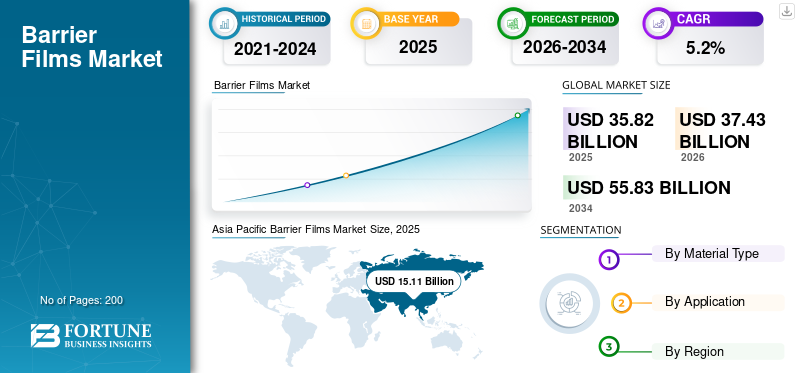
Download Free sample to learn more about this report.
Barrier Films Market Key Takeaways
 Global Market Size & Forecast
- 2025 Market Size: USD 35.82 billion
- 2026 Market Size: USD 37.43 billion
- 2034 Forecast Market Size: USD 55.83 billion
- CAGR: 5.2% (2026–2034)
 Market Share
- Asia Pacific dominated the market with a 42.18% share in 2025.
- The polyethylene (PE) segment accounted for the largest market share of 27.4% in 2025.
- The food & beverage packaging segment held the largest application share of 42.3% in 2025.
 Key Regional Highlights
Asia Pacific
Asia Pacific generated USD 15.11 billion in 2025, maintaining its leading market position.
North America
North America generated USD 7.25 billion in 2025, representing a significant regional market.
Europe
Europe accounted for USD 7.76 billion in 2025 and is projected to witness steady growth at a 4.7% CAGR during the forecast period.
U.S.
U.S. market is projected to reach USD 6.86 billion by 2026.
Japan
Japan market is projected to reach USD 2.07 billion by 2026.
Read More

BARRIER FILMS MARKET TRENDS
Recyclable High-Barrier Structures and Shelf-Life Extension Emerge as Significant Market Trends
The demand is increasingly driven by the need to extend shelf life, reduce food loss, protect sensitive pharmaceuticals and medical devices, and improve the durability of packaged electronics and industrial products. Food processors, retailers, pharmaceutical companies, and medical packaging converters are placing greater weight on oxygen-barrier performance, moisture control, aroma retention, puncture resistance, heat-seal integrity, and compatibility with existing filling and converting systems. This is strengthening the commercial role of PE-based sealant films, PET-based high-barrier laminates, PP barrier films, PA/nylon films, EVOH layers, PVDC-coated structures, metalized films, and transparent oxide-coated films.
Alongside performance requirements, portfolio strategies are increasingly centered on recyclability, mono-material structures, downgauging, transparent barrier coatings, and lower material intensity. Producers are investing in recyclable PE and PP barrier laminates, vapor-deposited PET/PP/PE substrates, high-barrier lidding films, retortable structures, and specialty films that combine barrier protection with recyclability claims. As packaging policy and customer sustainability targets become more formalized, suppliers are highlighting source reduction, mono-material design, and verifiable barrier performance to retain major customers in food, healthcare, personal care, and industrial sectors.
- For instance, transparent vapor-deposited films, EVOH-based gas-barrier layers, recyclable mono-material barrier packaging, and high-barrier lidding and overwrap films are strengthening commercial demand signals for barrier film materials.
MARKET DYNAMICS
MARKET DRIVERS
Download Free sample to learn more about this report.
Packaged Food Growth, Shelf-Life Protection, and Pharmaceutical Packaging Demand to Support Product Consumption
Food and beverage packaging remains the largest demand center given that barrier films help protect oxygen-, moisture-, aroma-, and contamination-sensitive products. Meat, seafood, dairy, bakery, snacks, ready meals, coffee, pet food, and beverage-related formats require films that can maintain freshness, prevent oxidation, preserve flavor, and reduce spoilage. Public industry data support the scale of the product demand base, as Plastics Europe reported 430.9 million tonnes of global plastics production in 2024. In addition, the United Nations Environment Programme (UNEP) notes that approximately 36% of plastics produced are used in packaging.
Beyond food packaging, pharmaceutical, medical, personal care, electronics, and industrial applications are recording an increasing need for high-barrier materials, driving barrier films market growth. Pharmaceutical and healthcare applications require moisture and oxygen protection, sterile packaging integrity, puncture resistance, and qualification under strict converting and regulatory requirements. Electronics and industrial protective packaging require moisture, static, contamination, and gas-barrier performance for sensitive components, chemicals, and export goods. As customers seek longer shelf life, reduced waste, product safety, and improved logistics performance, barrier film materials are becoming a practical means of protection and value retention across global supply chains.
- For instance, high-barrier films for oxygen and moisture protection, co-extruded polyolefin films, transparent oxide-coated films, and EVOH-based gas-barrier structures are increasingly used in commercial packaging systems. This is driven by the protection that they offer to product quality without requiring rigid packaging substitution.
MARKET RESTRAINTS
Raw-Material Volatility, Multilayer Recycling Complexity, and Qualification Costs May Restrict Market Expansion
Although barrier films are commercially important, the market remains sensitive to resin prices, coating costs, energy inputs, logistics costs, and the economics of specialty additives and tie layers. Multilayer films often combine PE, PP, PET, PA/nylon, EVOH, PVDC, adhesives, coatings, and metalized or oxide layers, which can increase costs compared with commodity flexible films. Flexible Packaging Europe price indicators also suggest that core film substrates such as LDPE, HDPE, BOPP, BOPET/PET, BOPA, and aluminum foil may experience price volatility, which could affect converter margins and customer purchasing behavior.
Recycling complexity is another restraint. High-barrier films often require multiple layers to provide oxygen, moisture, aroma, and gas barriers, as well as puncture protection, but these structures can be harder to recycle than simple mono-material films. Shifting from conventional laminates to recyclable mono-material solutions requires reformulation, testing, customer approval, shelf-life validation, and sometimes changes to the filling line. These factors can slow conversion in cost-sensitive or highly regulated applications, especially where food-contact, pharma, retort, sterilization, or medical-device packaging requirements are strict.
MARKET OPPORTUNITIES
Demand for Recyclable Barrier Packaging, Medical Films, and High-Value Industrial Protection to Create Lucrative Growth Opportunities
Opportunities are emerging from recyclable flexible packaging, transparent barrier coatings, downgauged films, and mono-material PE or PP structures that can replace hard-to-recycle mixed-material laminates. Brand owners and converters are actively seeking films that maintain oxygen, moisture, aroma, and light protection while improving recyclability or lowering material consumption. This is creating opportunities for coated PET and PP films, PE-based barrier laminates, EVOH-compatible recyclable structures, SiOx- and AlOx-coated films, and high-performance lidding or pouch films.
Additional opportunities exist in pharmaceutical packaging, medical and healthcare packaging, electronics protection, and industrial export packaging. These applications are generally less commodity-driven and place higher value on validated performance, reliability, cleanliness, and product protection. Suppliers that can combine strong barrier properties, processability, supply consistency, regulatory support, and sustainability positioning are better placed to capture premium demand. Asia Pacific capacity additions, U.S. flexible packaging strength, European recyclable packaging regulation, and Latin American food and agriculture packaging needs are expected to support wider adoption over the forecast period.
MARKET CHALLENGES
Performance-Recyclability Trade-offs, Regional Infrastructure Gaps, and Customer Requalification May Hamper Market Growth
Producers and downstream buyers must balance barrier performance with recyclability, cost, downgauging, machineability, sealing performance, and shelf-life requirements. Some recyclable or mono-material formats may not immediately match the performance of multilayer PET/foil/PA/PVDC-based structures in retort, high-moisture, high-fat, or aroma-sensitive applications. Packaging suppliers also face evolving rules on recyclable design, extended producer responsibility, recycled-content targets, and packaging waste reduction, which can affect material selection and investment priorities.
Infrastructure gaps remain a challenge given that flexible film collection, sorting, and recycling systems are uneven across regions. The product adoption also depends on customer requalification, filling-line compatibility, shelf-life testing, food-contact approvals, sterile packaging validation, and performance assurance across storage and distribution conditions. These factors can slow substitution even when long-term demand fundamentals remain favorable, especially in pharmaceutical, medical, food-service, and export packaging applications where failure risks are high.
Segmentation Analysis
By Material Type
Polyethylene (PE) Segment Dominated the Market Due to Broad Use in Sealant Layers and Flexible Packaging Structures
Based on material type, the market is segmented into polyethylene (PE), polyethylene terephthalate (PET), polypropylene (PP), polyamide (PA/Nylon), and others.
The polyethylene (PE) segment accounted for the largest barrier films market share in 2025. The segment's growth is driven by the PE's broad role in flexible packaging sealant layers, moisture-barrier products, pouches, liners, lidding structures, food packaging, medical and personal care packaging, and cost-effective multilayer barrier formats. Furthermore, the segment is set to hold a 27.4% share in 2025.
The polyethylene terephthalate (PET) segment is expected to grow significantly, driven by PET's use in high-barrier laminates, metalized films, oxide-coated transparent barrier films, lidding films, retortable structures, and premium food and pharmaceutical packaging applications. The segment is projected to grow at a CAGR of 5.2% during the forecast period.
By Application
To know how our report can help streamline your business, Speak to Analyst
Food & Beverage Packaging Segment Led the Market Due to Extensive Use of Barrier Protection
By application, the market is categorized into food and beverage packaging, electronics and industrial protective packaging, pharmaceutical packaging, personal care and cosmetics, medical and healthcare packaging, agriculture, and others.
The food & beverage packaging segment accounted for the largest share in 2025. The segment growth is driven by the extensive use of oxygen, moisture, aroma, gas, and contamination-barrier films across meat, seafood, dairy, bakery, snacks, coffee, ready meals, beverages, pet food, and other packaged food formats. Furthermore, the segment is set to hold a 42.3% share in 2025.
The agriculture segment is also expected to expand considerably over the forecast period. The segment growth is driven by moisture-sensitive electronics, semiconductors, industrial components, chemicals, export packaging, and protective films used where water-vapor control, contamination prevention, and package durability are commercially important. The segment is expected to grow at a CAGR of 5.3% over the forecast period.
Barrier Films Market Regional Outlook
By geography, the market is categorized into North America, Europe, Asia Pacific, Latin America, and the Middle East & Africa.
Asia Pacific
Asia Pacific Barrier Films Market Size, 2025 (USD Billion)
To get more information on the regional analysis of this market, Download Free sample
Asia Pacific held the dominant share in 2024, valued at approximately USD 14.42 billion, and maintained its leading share in 2025 with a value of USD 15.11 billion. The region benefits from its large packaging-conversion base, polymer-processing capacity, electronics-manufacturing scale, food-packaging demand, and the central role of China and India in materials production and consumption. China remains the largest market, while India, Japan, South Korea, and the broader Asia Pacific region continue to support demand. This is driven by industrial scale, export manufacturing, rising packaged-food consumption, e-commerce growth, and the expanding use of high-barrier flexible packaging.
China Barrier Films Market
In 2026, the China market is estimated to reach USD 7.80 billion. The demand in China is supported by its large packaging conversion base, food and beverage packaging consumption, electronics export supply chains, industrial protective packaging needs, and the growing adoption of recyclable and high-barrier packaging structures across major supply chains.
To know how our report can help streamline your business, Speak to Analyst
India Barrier Films Market
The India market is estimated to touch around USD 2.31 billion in 2026, representing approximately 6.5% of the global market revenue.
Japan Barrier Films Market
The Japan market is projected to reach approximately USD 2.07 billion in 2026, accounting for about 5.8% of global sales.
North America
North America is also a significant contributor to the market and reached a value of USD 7.25 billion in 2025. The regional market growth is driven by the U.S. flexible packaging industry, strong demand for food and beverage packaging, pharmaceutical and medical packaging requirements, personal care packaging, and advanced industrial protective packaging. Application intensity remains strong in the U.S., supported by mature converting capacity, brand-owner shelf-life requirements, medical device packaging, and established qualification pathways.
U.S. Barrier Films Market
The U.S. market is estimated to reach USD 6.86 billion in 2026. The U.S. dominates regional consumption due to its large flexible packaging sector, strong food-processing base, demand for medical and pharmaceutical packaging, high-value personal-care packaging, and product usage in industrial and protective packaging.
Europe
The Europe market is expected to experience steady growth in the coming years. The European region reached a valuation of USD 7.76 billion in 2025 and is projected to grow at approximately 4.7% during the forecast period. The market's growth is supported by mature demand for food packaging, pharmaceutical and healthcare packaging, regulatory pressure to improve recyclability, active development of mono-material barrier structures, and the increased adoption of coated, metalized, and specialty films. The region benefits from technical know-how, pressure on packaging-waste policies, and a greater willingness among industrial buyers to qualify recyclable high-barrier materials.
U.K. Barrier Films Market
The U.K. market is estimated to touch around USD 1.30 billion in 2026, representing approximately 3.6% of the global market revenue.
Germany Barrier Films Market
The Germany market is projected to reach approximately USD 1.91 billion in 2026, accounting for about 5.3% of global sales.
Latin America
The Latin America market is experiencing steady growth. The Latin America market reached a valuation of USD 3.10 billion in 2025. The product demand is concentrated in food and beverage packaging, agriculture, industrial packaging, personal care, and flexible packaging formats, with Brazil and Mexico representing the most important country markets. Food packaging, agribusiness supply chains, pet food, beverages, and cost-effective PE/PP-based barrier structures continue to support the regional product adoption.
Brazil Barrier Films Market
The Brazil market is anticipated to reach approximately USD 1.59 billion in 2026, equivalent to around 4.4% of global sales.
The Middle East & Africa
The Middle East & Africa market is gradually expanding, supported by GCC-led polymer and chemical conversion capabilities, food logistics, demand for industrial packaging, agricultural film use, and growing interest in high-barrier packaging for retail, export, healthcare, and consumer goods. The GCC resin availability and flexible packaging conversion support regional supply, while South Africa and the broader African market support the demand from packaging, agriculture, personal care, and industrial uses.
GCC Barrier Films Market
The GCC market is expected to reach USD 1.43 billion by 2026, accounting for approximately 4.0% of global revenues.
COMPETITIVE LANDSCAPE
Key Industry Players
Key Players to Expand Barrier Film Platforms, Recyclable Structures, and Specialty Grades to Maintain their Positions in the Market
The market includes a mix of global flexible packaging producers, film manufacturers, resin suppliers, specialty chemical companies, coating technology providers, and multilayer film converters that supply barrier films for food, beverage, pharmaceutical, medical, personal care, electronics, industrial, and agriculture applications. Competition is shaped by resin access, extrusion scale, lamination capability, vapor-deposition technology, coating formulation, regulatory compliance, converting consistency, sustainability claims, and the ability to provide application-specific barrier performance.
Leading companies differentiate through recyclable mono-material barrier designs, high-barrier PE and PP structures, PET-based transparent barrier films, EVOH and PVDC alternatives, multilayer co-extruded films, customer qualification support, and strong relationships with food processors, pharmaceutical companies, medical device manufacturers, brand owners, retailers, and industrial buyers. Some key market players include Amcor plc, Berry Global, TORAY INTERNATIONAL, INC., Mondi Group, and Mitsubishi Chemical Group Corporation.
LIST OF KEY BARRIER FILMS COMPANIES PROFILED
- Amcor plc (Switzerland)
- Berry Global (U.S.)
- Sealed Air (U.S.)
- Mondi Group (U.K.)
- TOPPAN Inc. (Japan)
- TORAY INTERNATIONAL, INC. (Japan)
- Kuraray Co., Ltd. (Japan)
- Jindal Poly Films Limited (India)
- UFlex Limited (India)
- Mitsubishi Chemical Group Corporation (Japan)
KEY INDUSTRY DEVELOPMENTS
- March 2026: Amcor invested in a new production line at Lugo di Vicenza, Italy (high-barrier, recycle-ready films for lidding and pouches, supported by an expansion of about 7,000 m² with a quality-control lab and a curing warehouse). The move signals a scale-up of recyclable high-barrier films for food, beverage, pet food, and healthcare packaging.
- February 2026: ProAmpac expanded its ProActive Recyclable RP-2000 High Barrier Series (curbside recyclable fiber-based platform replacing paper/foil, paper/metPET, and selected film laminations for sensitive dry foods). The move signals the further displacement of non-recyclable high-barrier multilayer structures.
- November 2023: UFlex launched F-PTX, a high-barrier, thermally stable Alox BOPET film (transparent, oxide-coated BOPET with strong moisture and oxygen barriers, suitable for hot-fill, sterilization, pasteurization, and retort applications). The move indicates growth in transparent high-barrier films for food and industrial packaging.
- August 2023: Kuraray announced EVAL EVOH capacity expansion in the U.S. and Europe (+5,000 tons/year in 2024 and another +5,000 tons/year in 2026, increasing global capacity from 103,000 to 113,000 tons/year). This step indicates capacity addition for thin high-gas-barrier layers used in shelf-life extension and mono-material packaging.
- July 2022: Mitsubishi Chemical Group announced an expansion of SoarnoL EVOH capacity at its Hull, U.K. facility (a 21,000 tons/year addition, raising U.K. capacity from 18,000 to 39,000 tons/year, with operations planned for July 2025). The expansion is aimed at long-term supply strengthening for EVOH-based high-gas-barrier packaging materials.
- April 2022: Mondi launched PerFORMing Monoloop and Mono Formable PP at Anuga FoodTec in Cologne (recyclable fresh-food tray formats, including a mono-material PP high-barrier MAP solution around 30% lighter than comparable PET trays). The move signifies the substitution of recyclable materials in high-barrier food packaging.
- September 2021: Flex Films, the global film manufacturing arm of UFlex, launched F-UHB-M metallic polyester ultra-high-barrier film from its Kentucky facility, signaling foil substitution and laminate simplification in high-barrier flexible packaging. The solution is a patented BOPET-based aluminum-foil replacement with strong oxygen and moisture barriers.
REPORT COVERAGE
The global market analysis provides an in-depth study of market size and forecast by all the market segments included in the report. It includes details on market dynamics and trends expected to drive the market during the forecast period. It offers information on technological advancements, new product launches, key industry developments, partnerships, mergers, and acquisitions. The market research report also includes a detailed competitive landscape, providing market share and profiles of key players.
Request for Customization to gain extensive market insights.
Report Scope & Segmentation
| ATTRIBUTE | DETAILS |
| Study Period | 2021-2034 |
| Base Year | 2025 |
| Estimated Year | 2026 |
| Forecast Period | 2026-2034 |
| Historical Period | 2021-2024 |
| Growth Rate | CAGR of 5.2% from 2026 to 2034 |
| Unit | Value (USD Billion), Volume (Kiloton) |
| Segmentation | By Material Type, Application, and Region |
| By Material Type |
|
| By Application |
|
| By Region |
|
Frequently Asked Questions
Fortune Business Insights estimates that the global market size was valued at USD 35.82 billion in 2025 and is projected to reach USD 55.83 billion by 2034.
The market is slated to exhibit steady growth at a CAGR of 5.2% during the forecast period of 2026-2034.
The food & beverage packaging application segment led the market in 2025.
Asia Pacific held the highest market share in 2025.
Amcor plc, Berry Global, TORAY INTERNATIONAL, INC., Mondi Group, and Mitsubishi Chemical Group Corporation are the prominent players in the market.
The rising demand for high-performance food, pharmaceutical, and medical packaging that extends shelf life and protects products from oxygen, moisture, aroma loss, and contamination is a key factor driving market growth.
The growth in packaged food consumption and stricter pharmaceutical and healthcare packaging requirements are key factors expected to drive product adoption.



- 2021-2034
- 2025
- 2021-2024
- 200
Get 30-60 hrs Free Customization
Expand Regional and Country Coverage, Segments Analysis, Company Profiles, Competitive Benchmarking, and End-user Insights.


















Related Reports
-
US +1 833 909 2966 ( Toll Free )
-
Get In Touch With Us