Basalt Fiber Market Size, Share & Industry Analysis, By Type (Composites and Non-composites), By End-use Industry (Building & Construction, Automotive, Aerospace & Defense, Energy Generation, Insulation & Thermoacoustic, and Others), and Regional Forecast, 2026-2034
 Download Free Sample
KEY MARKET INSIGHTS
 Listen to Audio Version
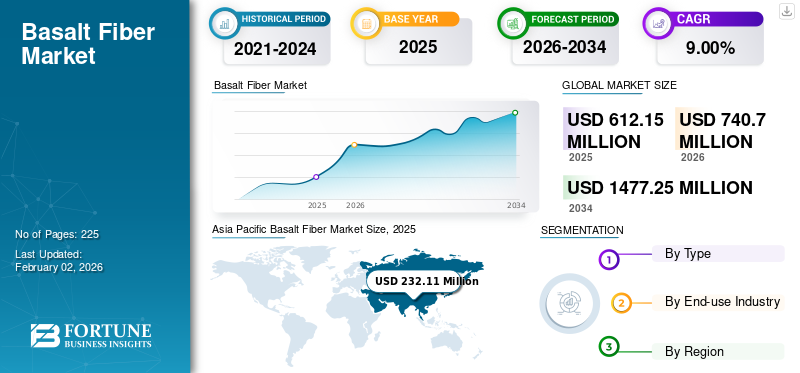
The global basalt fiber market size was valued at USD 612.15 million in 2025 and is projected to grow from USD 740.70 million in 2026 to USD 1,477.25 million by 2034 at a CAGR of 9.00% during the forecast period of 2026-2034. Asia Pacific dominated the basalt fiber market with a market share of 37.90% in 2025.
Basalt fiber, derived from basalt rocks, represents a cost-efficient and environmentally friendly alternative to glass and carbon fibers in various applications. This naturally occurring material is formed through the rapid cooling of basaltic lava, exhibiting high mechanical strength, excellent chemical resistance, and superb thermal and acoustic insulating properties. The market is driven by increased demand from industries such as construction and automotive due to its non-corrosive nature, durability, and ability to withstand high temperatures.
The COVID-19 pandemic had a significant impact on the market, particularly in 2020 and early 2021. The key manufacturers of basalt fiber had to face the shortage of workforce, raw materials, and demand from end-use applications, such as building & construction, automotive, and energy generation. This also impacted the demand for the products from these industries. Despite the uncertainties, the market recovered. The demand for the product increased owing to the rise in activities of end-use industries. Moreover, the end-users started to store the product to avoid chemical shortages in the upcoming years if such conditions fall again. This has created a novel opportunity for the producers.
Download Free sample to learn more about this report.
Basalt Fiber Market Key Takeaways
 Market Size & Forecast
- 2025 Market Size: USD 612.15 million
- 2026 Market Size: USD 740.70 million
- 2034 Forecast Market Size: USD 1,477.25 million
- CAGR: 9.00% from 2026–2034
 Market Share
- Asia Pacific dominated the basalt fiber market with a 37.90% share in 2025.
- The Composites segment accounted for a 70.81% market share in 2026.
- The Building & Construction segment is projected to hold a 34.14% market share in 2026.
 Key Regional Highlights
North America
North America accounted for a 32.60% share in 2025, valued at USD 199.70 million.
Asia Pacific
Asia Pacific held a 37.90% share in 2025, valued at USD 232.11 million.
Europe
Europe held a 21.50% share in 2025, valued at USD 131.42 million.
U.S.
The market projected to reach USD 198.26 million by 2026.
Japan
The market projected to reach USD 26.64 million by 2026.
Read More

Basalt Fiber Market Trends
Growth in Wind Energy Sector is Prominent Trend in Market
The wind energy sector has been experiencing significant growth and playing a vital role in global efforts to transition to renewable energy sources. Due to its strength and lightness, basalt fiber is commonly used in the manufacturing of wind turbine blades. This makes it an ideal material for creating large, durable, and efficient blades that can more effectively capture wind energy.
Its durability translates into longer life spans for wind turbine components and other infrastructural elements. This is crucial for reducing maintenance costs and ensuring the reliability of wind energy production.
As the demand for wind energy increases, the industry seeks more cost-effective materials that maintain performance. Basalt fiber offers a compelling balance of performance and cost, making it a viable option for many manufacturers looking to optimize their investments in wind energy infrastructure.
The increased focus on sustainability in the wind energy sector aligns with the environmental benefits of using basalt fibers. Since basalt is natural and the production of fiber is less energy-intensive compared to some traditional materials, its use in the wind energy sector amplifies the overall environmental benefits.
Download Free sample to learn more about this report.
Basalt Fiber Market Growth Factors
Increased Demand for Lightweight Materials in Automotive and Aerospace Industries to Drive Market
In recent years, the automotive and aerospace industries have been rigorously pursuing advancements in lightweight materials. In the automotive sector, basalt fiber is increasingly being used in the production of vehicle components, such as exhaust systems, brake pads, and other internal parts. Its high thermal resistance makes it ideal for components that are exposed to high temperatures. Furthermore, its lightweight nature contributes to overall vehicle weight reduction, leading to improved fuel efficiency and reduced CO2 emissions – a crucial factor in today's environmentally conscious market.
In the aerospace industry, the strength-to-weight ratio of basalt fiber makes it an excellent material for various structural and non-structural components. It offers significant advantages over traditional materials such as aluminum and steel, providing enhanced performance, fuel efficiency, and resistance to harsh environmental conditions. For spacecraft, its resistance to electromagnetic radiation adds another layer of appeal, making it a potential key material in future space missions.
The quest for lightweight materials is a trend and also a critical need for the automotive and aerospace industries to meet stringent regulatory requirements and sustainability goals. As more manufacturers and engineers recognize the potential, its demand is set to increase significantly.
RESTRAINING FACTORS
Lack of Standardization is Expected to Limit Market Growth
The basalt fiber industry lacks global standards for production and quality, unlike more established materials, such as glass and carbon fibers. This lack of standardization can hinder its acceptance in critical applications, such as the aerospace or automotive industries, where materials must meet stringent standards. The demand can be significantly impacted by considerable variability in the quality of basalt products. This inconsistency can lead to reliability issues in applications, where performance characteristics can influence demand.
The need for more standardization can also slow down the process of obtaining regulatory approvals and certifications for basalt products, as each product may need to be individually assessed. Ultimately, the lack of standardization impedes the wider acceptance and use of basalt fibers. Manufacturers, suppliers, and consumers may hesitate to commit to a material that has yet to have widely recognized and adopted standards.
Standardization plays a crucial role in fostering innovation. The absence of standards can discourage research and development efforts because it is challenging to establish a baseline for improvement or quantify advancements in the field. This unpredictability may cause cautious purchasing behavior among buyers, thereby reducing overall basalt fiber market growth.
Basalt Fiber Market Segmentation Analysis
By Type Analysis
Composites Hold Leading Position Owing to its Increasing Use in Construction and Automotive Industries
Based on type, the market is classified into composites and non-composites.
The composites segment is anticipated to hold a dominant market share of 70.81% in 2026 and is estimated to record a significant growth rate during the forecast period. Basalt fibers offer high tensile strength and modulus, making them suitable for reinforcing composites. This results in materials with excellent strength and stiffness. The Basalt Fiber-Reinforced (BFR) composites have excellent durability, with resistance to UV radiation, moisture, corrosion resistance, and mechanical wear. This leads to longer service life and lower maintenance costs. Used in concrete reinforcement, rebar, and structural components, BFR composites improve strength and durability in the construction industry. In the automotive industry, BFR composites are used for body panels, interiors, and other components, as they reduce vehicle weight and enhance performance.
The non-composites segment will register significant growth during the forecast period. The properties of basalt fibers, such as high strength, thermal stability, chemical resistance, and environmental friendliness, make them crucial for use in non-composites in various industries.
They are used to produce fire-resistant fabrics for protective clothing, such as firefighter suits, heat-resistant gloves, and industrial safety gear. Their fabrics and mats are used as insulation materials in high-temperature environments, such as furnaces, ovens, and kilns. They are also used in the manufacturing of brake pads and clutch discs in the automotive industry, due to their high thermal stability and wear resistance.
By End-use Industry Analysis
To know how our report can help streamline your business, Speak to Analyst
Building & Construction Dominate Due to Technological Advancements and Innovations
In terms of end-use industry, the market is segmented into building & construction, automotive, aerospace & defense, energy generation, insulation & thermoacoustic, and others.
The building & construction segment is anticipated to hold a dominant market share of 34.14% in 2026. The dominance of the segment is associated with the widespread use of components such as beams, columns, and joints in different buildings and construction, where basalt fiber is used in the production of precast concrete products. The rapid expansion of the residential sector globally fuels the segment growth. This segment is predicted to capture 34% of the market share in 2025.
The automotive segment is predicted to witness notable growth in the coming years. The use of the product in the automotive industry offers significant advantages, including improved performance, durability, and sustainability. As the industry continues to seek lightweight and high-performance materials, the adoption of BFR composites is likely to increase. This segment is set to register a significant CAGR of 12.13% during the forecast period (2024-2032).
The aerospace & defense is expected to grow considerably during the forecast period. BFR composites are used in the construction of fuselage sections and wing components, providing strength and weight savings. They are also used for interior panels and seating structures, enhancing safety, reducing weight, and improving fire resistance. The establishment of industry standards and regulatory support for the use of BFR composites in aerospace & defense applications is facilitating wider adoption.
REGIONAL INSIGHTS
By region, the market is segmented into North America, Europe, Asia Pacific, Latin America, and Middle East & Africa.
Asia Pacific Basalt Fiber Market Size, 2025 (USD Million)
To get more information on the regional analysis of this market, Download Free sample
Asia Pacific
The Asia Pacific market accounted for USD 232.11 million in 2025, representing 37.90% of the global industry, and is expected to reach USD 282.02 million in 2026. Asia Pacific occupies the dominant share of the global market and might emerge as the fastest-growing region in the future. In Asia Pacific, product demand is expanding due to its growing construction sector, which includes new construction and renovation activities. The Chinese market is forecasted to reach USD 110.31 million in 2026. The increase in industrial operations, especially in China and India, coupled with a growing population, has led to increased demand for construction and building activities, thus boosting the demand for the market. India is predicted to be valued at USD 44.2 million in 2026, while Japan is expected to hit USD 26.64 million in the same year.
To know how our report can help streamline your business, Speak to Analyst
North America
North America maintained a strong presence in the global market, reaching USD 199.7 million in 2025, accounting for 32.60% share, and is expected to reach USD 241.91 million in 2026. The market in North America is growing significantly due to rising demand from the aerospace & defense industry. The use in aerospace has gained momentum in the past few decades, with more than 50% of the latest Airbus aircraft under the A350XWB lineup being made up of composite materials as compared to the older fleet, which only used 2–5% aerospace composites. Additionally, government policies and incentives promoting sustainable building practices, innovation, and advanced materials contribute to the growth of the market in the U.S. the U.S. market is predicted to be valued at USD 198.26 million in 2026.
Europe
In 2025, Europe generated USD 131.42 million, contributing 21.50% to global market revenue, and is projected to grow to USD 157.83 million in 2026. Europe is expected to make substantial gains during the forecast timeframe. Rising spending on electrical vehicles supported by environmental norms has mainly led to the increasing adoption of lightweight materials in the automotive manufacturing process in this region. The U.K. market continues to grow, projected to grow with a valuation of USD 21.27 million in 2026. The regional automotive industry is expected to rise, with growing collaborations and government policies regarding smart- and energy-efficient electric vehicles. Germany is foreseen to hold USD 40.06 million in 2026, while France is set to gain USD 13.94 million in 2025.
Latin America
Latin America is expected to showcase considerable growth in the global market during the forecast period, where Brazil is the leading contributor. Favorable demand for automotive, consumer appliances, construction materials, and renewable energy systems is expected to push demand for advanced composite materials in the near future, driving the market in the region. Latin America contributed 3.70% to the global market in 2025, with a valuation of USD 22.74 million, and is projected to reach USD 27.42 million in 2026.
Middle East & Africa
In 2025, Middle East & Africa represented USD 26.18 million, accounting for 4.30% of the worldwide market, and is projected to grow to USD 31.52 million in 2026. The Middle East & Africa is expected to indicate tremendous growth in the global market backed by the development of end-use industries such as automotive, aerospace, construction, and others. Moreover, changing government regulations to attract foreign direct investment is projected to play a vital role in the expansion of the market in the fastest-growing economies such as Saudi Arabia, UAE, & South Africa. The GCC market is expected to reach USD 17.63 million in 2025.
KEY INDUSTRY PLAYERS
Key Players to Focus on Capacity Expansion and Invest in R&D to Maintain Dominance in Market
The competitive landscape of the market is somewhat fragmented, with several global & regional players operating. Some of the key players in the market include Kamenny Vek, Zhejiang Shijin Basalt Fiber Co., Ltd., Deutsche Basalt Faser GmbH, Basalt Fiber Tech, and ISOMATEX S.A. These players are engaged in the expansion of their manufacturing capacity, and distribution & sales network in different parts of the world. The companies’ investment in research and development to innovate and improve their product offering also helps them in gaining a competitive edge in the market.
List of Top Basalt Fiber Companies:
- Kamenny Vek (Russia)
- Zhejiang Shijin Basalt Fiber Co., Ltd. (China)
- Arab Basalt Fiber Company (UAE)
- Technobasalt Invest LLC (Ukraine)
- JSC “Polotsk-Steklovolokno” (Belarus)
- ISOMATEX S.A. (Belgium)
- INCOTELOGY GmbH (Germany)
- Sudaglass Fiber Technology, Inc. (U.S.)
- Basalt Fiber Tech (Australia)
- Deutsche Basalt Faser GmbH (Germany)
KEY INDUSTRY DEVELOPMENTS:
- June 2021: FibreCoat GmbH, located in Aachen, Germany, collaborated with DBF Deutsche Basalt GmbH to create a novel fiber material that effectively and affordably shields electromagnetic radiation from digital devices, medical technology, and e-car batteries. The collaborative project received the top award at the "IQ Innovationspreis Mitteldeutschland." DBF Deutsche Basalt GmbH and FibreCoat GmbH have combined basalt and aluminum materials to develop efficient protection against electromagnetic radiation.
- September 2020: Kamnney Vek implemented a new production line in Kimry. The highly automated line increases output capacity by threefold. It also produces roving with bobbin weights of up to 20 kg on this line to innovate continuous basalt fiber production.
- June 2019: ISOMATEX S.A. announced the establishment of a strategic partnership with Gruschwitz Textilwerke AG. Through this partnership, the company will serve as the sole distributor for a wide range of European countries for FILAVA traditional yarns designed for the technical textiles and composites industries. The company aims to offer its clients top-notch quality and exceptional customer support.
REPORT COVERAGE
The report provides a detailed analysis of the market. It focuses on key aspects, such as leading companies, types, compositions used to produce these products, and end-use industries of the product. Besides this, it offers insights into the market and current industry trends, and highlights key industry developments. In addition to the factors mentioned above, it encompasses several factors contributing to the market's growth.
Request for Customization to gain extensive market insights.
Report Scope & Segmentation
|
ATTRIBUTE |
DETAILS |
|
Study Period |
2021-2034 |
|
Base Year |
2025 |
|
Estimated Year |
2026 |
|
Forecast Period |
2026-2034 |
|
Historical Period |
2021-2024 |
|
Unit |
Value (USD Million) and Volume (Kiloton) |
|
Growth Rate |
CAGR of 9.00% from 2026 to 2034 |
|
Segmentation |
By Type
|
|
By End-use Industry
|
|
|
By Region
|
Frequently Asked Questions
Fortune Business Insights says that the global market size was valued at USD 612.15 million in 2025 and is projected to record a valuation of USD 1,477.25 million by 2034.
In 2025, the Asia Pacific market value stood at USD 232.11 million.
Recording a CAGR of 9.00%, the market will exhibit steady growth during the forecast period of 2026-2034.
The building & construction industry is the leading segment in the market.
Growing demand from the automotive industry will drive the growth of the market.
Asia Pacific dominated the basalt fiber market with a market share of 37.90% in 2025.
Properties, such as high mechanical strength, excellent chemical resistance, and excellent thermal and acoustic insulating will drive product adoption.



- 2021-2034
- 2025
- 2021-2024
- 225
Get 30-60 hrs Free Customization
Expand Regional and Country Coverage, Segments Analysis, Company Profiles, Competitive Benchmarking, and End-user Insights.


















Related Reports
-
US +1 833 909 2966 ( Toll Free )
-
Get In Touch With Us