Base Chemicals Market Size, Share & Industry Analysis, By Type (Inorganic Chemicals and Organic Chemicals), By Application (Packaging, Building & Construction, Automotive & Transportation, Agriculture, and Others), and Regional Forecast, 2026-2034
 Download Free Sample
BASE CHEMICALS MARKET SIZE AND FUTURE OUTLOOK
 Listen to Audio Version
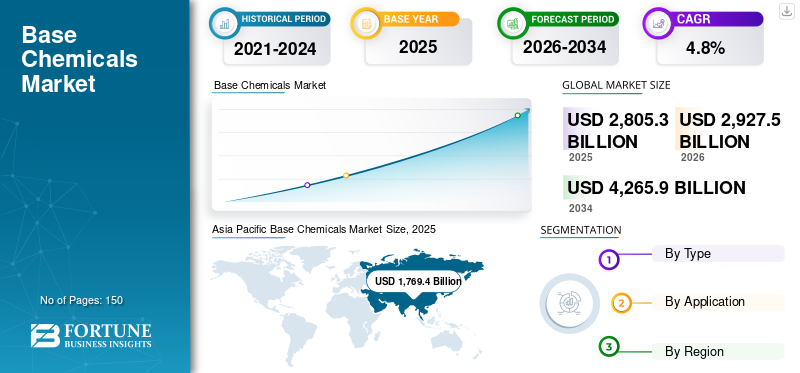
The global base chemicals market size was valued at USD 2,805.3 billion in 2025 and is projected to grow from USD 2,927.5 billion in 2026 to USD 4,265.9 billion by 2034 at a CAGR of 4.8% during the forecast period. Asia Pacific dominated the base chemicals market with a market share of 63.07% in 2025
The base chemicals market comprises high-volume, standardized chemicals produced through primary chemical processes and supplied mainly as feedstocks and intermediates for further manufacturing. In industry classification terms, basic chemicals are the first layer of chemical manufacturing, separate from the intermediate and end products made by further processing them. In market, this product is commonly separated from specialty, agricultural, and consumer chemicals, and includes core inorganic and organic chemical chains such as petrochemicals, resins, synthetic rubber, and manufactured fibers.
The global market growth is associated with the rising demand from packaging, construction, automotive, agriculture, and industrial manufacturing, supported by expanding petrochemical consumption across downstream value chains. Key players in the market include BASF SE, Dow Inc., SABIC, and LyondellBasell Industries N.V.
Download Free sample to learn more about this report.
BASE CHEMICALS MARKET KEY TAKEAWAYS
 Global Market Size & Forecast
- 2025 Market Size: USD 2,805.3 billion
- 2026 Market Size: USD 2,927.5 billion
- 2034 Forecast Market Size: USD 4,265.9 billion
- CAGR: 4.8% from 2026–2034
 Market Share
- Asia Pacific dominated the base chemicals market with a 63.07% share in 2025.
- Organic chemicals held the dominant share, supported by petrochemicals, resins, and carbon-based building blocks.
- Packaging led the application segment in 2025 due to strong demand for polymers and petrochemical derivatives.
 Key Regional Highlights
Asia Pacific
Asia Pacific dominated with USD 1,769.4 billion in 2025, supported by strong chemical production and downstream manufacturing.
North America
North America maintained significant demand due to feedstock availability and established resin and intermediates chains.
Europe
Europe recorded significant market activity, supported by automotive, construction, healthcare, and manufacturing demand.
U.S.
The U.S. base chemicals market reached USD 299.7 billion in 2025, representing roughly 10.7% of global sales.
Japan
Japan remains an important Asian industrial market, supported by established manufacturing and downstream chemical applications.
Read More

BASE CHEMICALS MARKET TRENDS
Shift Toward Cost-Advantaged Feedstocks, Circular Carbon Models, and Lower-Carbon Basic Chemicals to be a Significant Market Trend
A major trend in the global market is the shift from conventional volume-led production toward more cost-efficient, lower-carbon, and circular feedstock-based chemical systems. Leading producers are increasingly repositioning their base chemicals portfolios around lower-carbon ethylene, propylene, synthesis gas, and other core intermediates, while also improving integration across petrochemicals and downstream value chains. BASF states that it’s Chemicals segment supplies other segments with basic chemicals and intermediates and is being strengthened through technological leadership, operational excellence, and products with a lower carbon footprint.
At the same time, the market is seeing a stronger circular-feedstock trend, especially in crackers and integrated chemical systems. BASF notes that many of its value chains begin in synthesis gas plants or steam crackers, where fossil raw materials are converted into important basic chemicals such as ethylene and propylene, and that alternative raw materials such as bionaphtha, biomethane, and pyrolysis oil are now also being fed into the Verbund through mass balance. Dow is moving in the same direction through investments in a net-zero ethylene and derivatives complex in Alberta and partnerships aimed at converting plastic waste into circular feedstock and recycled plastics.
MARKET DYNAMICS
MARKET DRIVERS
Download Free sample to learn more about this report.
Strong Demand from Packaging Applications to Drive Market Growth
One of the strongest drivers for the base chemicals market growth is the sustained demand from packaging applications, especially across flexible packaging, rigid packaging, food-contact materials, industrial packaging, and health & hygiene products. Packaging remains a major outlet for petrochemical derivatives such as ethylene, propylene, polyethylene, and polypropylene, which are core products within the organic chemicals of this study. The IEA notes that petrochemicals are embedded in packaging and many other everyday products, and that petrochemical feedstock account for a significant share of global oil demand, with this share expected to rise as demand grows for plastics and other downstream products. This is structurally important for the market as packaging is one of the most volume-intensive and recurring demand channels for commodity polymers and intermediates.
This driver is also reinforced by ongoing producer investment aimed specifically at packaging-linked polymer demand. Dow states in its annual reporting that it is constructing a world-scale polyethylene unit on the U.S. Gulf Coast to meet consumer-driven demand in specialty packaging, health and hygiene, and industrial and consumer packaging applications. This shows that major base chemicals producers continue to allocate capital toward packaging-oriented resin and feedstock chains, reflecting the sector’s importance as a stable, high-volume consumption base.
MARKET RESTRAINTS
Feedstock Volatility, High Energy Costs, and Prolonged Oversupply to Restrict Market Growth
A major restraint for the market is the strong exposure of base chemicals producers to feedstock and energy costs. Basic chemicals are dominated by raw-material costs, which can account for as much as two-thirds of total costs. This cost structure makes profitability especially sensitive to swings in naphtha, natural gas, and other hydrocarbon inputs, unlike more formulation-driven chemical segments that carry higher value-add and lower raw-material intensity.
This restraint is more significant in the current environment as it is being amplified by energy-price gaps and weak utilization. Cefic says European gas prices are still three times higher than those in the U.S. LyondellBasell also warns that industry production capacities and operating rates can create extended periods of oversupply and low profitability, with excess capacity driving down utilization rates, prices, and margins. Together, these factors restrict earnings recovery for base chemicals producers and make new capacity decisions more difficult, especially in higher-cost regions.
MARKET OPPORTUNITIES
Low-Carbon Feedstocks, Circular Raw Materials, and Net-Zero Cracker Investments Create New Growth Space
One of the biggest opportunities in the market is the commercialization of lower-carbon base molecules without fully replacing existing integrated assets. BASF explains that alternative raw materials such as biomethane, bionaphtha, and pyrolysis oil can be fed into its production system and allocated via mass balance to downstream products. This matters as it allows producers to create lower-carbon basic chemicals while still using existing cracker and Verbund infrastructure, improving the economics of decarbonization.
MARKET CHALLENGES
Balancing Global Competitiveness, Decarbonization, and Regional Supply Security Challenges Market Growth
A major challenge for the market is that base chemicals producers must remain globally cost-competitive while also funding decarbonization, circularity, and supply-chain resilience.
Cefic says Europe’s share of the global chemical market has dropped, while China now leads with global sales. It also notes that the sector faces weak demand, growing import pressure, and low capacity utilization. These pressures are especially difficult for base chemicals, where margins are thinner and scale economics matter more.
This challenge is becoming sharper as regional growth patterns are diverging. BASF reports that global chemical production increased in 2025, but positive contributions came almost exclusively from China; Europe share declined, and BASF expects a further decline in Europe production while import pressure remains. That means producers are being forced to balance regional restructuring, green-transition investments, and trade pressure at the same time. For base chemicals, this is not just a cyclical challenge but a strategic one, since long-term competitiveness depends on feedstock access, energy pricing, utilization, and proximity to downstream demand clusters.
RESEARCH AND DEVELOPMENT (R&D) TRENDS
R&D in the global base chemicals market is increasingly focused on lower-carbon process technologies, circular feedstock, and more efficient integrated production systems. BASF says its chemicals segment is being strengthened through technological leadership and products with a lower carbon footprint, while its mass-balance model integrates alternative feedstock into steam crackers and synthesis-gas value chains. Dow’s investments in a net-zero ethylene complex and circular feedstock show that innovation in base chemicals is moving beyond simple capacity additions toward decarbonized asset design and recycled-carbon integration.
SEGMENTATION ANALYSIS
By Type
Organic Chemicals Segment Dominate Due to Large Share of Petrochemicals, Resins, and Other Core Carbon-Based Building Blocks
Based on type, the market is segmented into organic chemicals and inorganic chemicals.
The organic chemicals segment holds the dominant share of the global market. The segment’s dominance is supported by the scale of bulk petrochemicals and intermediates, plastic resins, synthetic rubber, manufactured fibers, and other carbon-based building blocks that move into plastics, packaging, construction materials, automotive systems, textiles, and industrial intermediates.
The inorganic chemicals segment expected to grow at a CAGR of 4.0% during the forecast period. Although smaller than organic chemicals, it remains a strategically important category as it includes foundational materials used in chlor-alkali chains, industrial gases, mineral-derived chemical systems, and other process-industry applications. Inorganic chemicals continue to play a critical supporting role in broad industrial manufacturing, but their aggregate market scale remains below the combined weight of petrochemical and resin-linked organic chains.
By Application
To know how our report can help streamline your business, Speak to Analyst
Packaging Segment Leads Due to Heavy Consumption of Base Polymers and Petrochemical Derivatives Across Flexible and Rigid Formats
Based on application, the market is segmented into packaging, building & construction, automotive & transportation, agriculture, and others.
The packaging segment held the largest global base chemicals market share in 2025. This is mainly driven by the heavy use of ethylene, propylene, polyethylene, polypropylene, and related intermediates in food packaging, industrial packaging, health and hygiene, and consumer packaging.
The building & construction accounts for significant growth during the forecast period. The growth is supported by demand for base chemical derivatives used in pipes, insulation, panels, films, sealants, coatings, and structural plastics.
The automotive & transportation segment represents a positive growth. The growth is due to continued use of plastics, elastomers, and intermediates across interiors, under-the-hood components, lightweighting systems, and mobility-linked materials. The segment expected to grow at a CAGR of 4.1% during the forecast period.
The others segment includes electronics, detergents, textiles, industrial goods, and additional downstream chemical uses.
BASE CHEMICALS MARKET REGIONAL OUTLOOK
By region, the market is segmented into North America, Europe, Asia Pacific, Latin America, and the Middle East & Africa.
Asia Pacific
Asia Pacific Base Chemicals Market Size, 2025 (USD Billion)
To get more information on the regional analysis of this market, Download Free sample
Asia Pacific holds the dominant share of the global market. The region leads owing to its massive concentration on chemical production, strong petrochemical integration, large downstream manufacturing base, and continuing investment across polymers, intermediates, and industrial chemicals.
China Base Chemicals Market
China’s market is one of the largest globally, with 2025 revenue valued at USD 1,081.1 billion, representing roughly 38.5% of global sales.
To know how our report can help streamline your business, Speak to Analyst
North America
North America registers significant demand in the global market. The growth is supported by feedstock depth, large resin and intermediates chains, and continuing investment in packaging- and ethylene-related assets. The U.S. country remains the structural center of North American base-chemicals production and downstream conversion.
U.S. Base Chemicals Market
In 2025, the U.S. market was valued at USD 299.7 billion, driven primarily by strong demand from the industrial sector. The U.S. accounts for roughly 10.7% of global market sales.
Europe
Europe registers significant growth during the forecast period. The region maintains a strong industrial base and broad downstream exposure across automotive, construction, healthcare, and manufacturing.
Germany Base Chemicals Market
The German market was valued at around USD 108.2 billion in 2025, representing roughly 3.9% of global market revenues.
U.K. Base Chemicals Market
The U.K. market was valued at around USD 65.8 billion in 2025, representing roughly 2.3% of global market revenues.
Latin America
The market in Latin America is supported by agriculture-linked consumption, packaging, selected industrial manufacturing, and imports of intermediates and polymers for downstream conversion.
Brazil Base Chemicals Market
The Brazilian market was valued at around USD 50.1 billion in 2025, representing roughly 1.8% of global market revenues.
Middle East & Africa
The Middle East & Africa market is supported by hydrocarbon-based feedstock, petrochemical integration, and gas-linked chemical production. It remains important in base chemicals as low-cost feedstocks continue to support ethylene, glycols, styrene, and related commodity chains, particularly in the Gulf.
GCC Base Chemicals Market
The GCC market was valued at around USD 67.0 billion in 2025, representing roughly 2.4% of global market revenues.
COMPETITIVE LANDSCAPE
KEY INDUSTRY PLAYERS
Key Players are Strengthening Feedstock Integration, Lower-Carbon Cracker Technologies, and Portfolio Optimization to Defend their Market Positions
Competitive intensity in the market is being shaped less by specialty differentiation and more by feedstock advantage, scale, integration, operating-rate discipline, and the ability to decarbonize core olefins and intermediates chains. In practical terms, market leadership in base chemicals is increasingly tied to integrated asset positions, cost-advantaged raw materials, carbon-footprint reduction, and proximity to downstream polymers and industrial demand centers.
LIST OF KEY BASE CHEMICALS COMPANIES PROFILED IN REPORT
- BASF SE (Germany)
- Dow Inc. (U.S.)
- SABIC (Saudi Arabia)
- LyondellBasell Industries N.V. (Netherlands)
- Exxon Mobil Corporation (U.S.)
- INEOS Group Holdings S.A. (U.K.)
- China Petroleum & Chemical Corporation (Sinopec) (China)
- Westlake Corporation (U.S.)
- Braskem S.A. (Brazil)
- Formosa Plastics Corporation (Taiwan)
KEY INDUSTRY DEVELOPMENTS
- June 2025: LyondellBasell entered into an agreement and exclusive negotiations with AEQUITA for the sale of four European olefins and polyolefins assets in France, Germany, the U.K., and Spain. The move reflects a sharper focus on portfolio optimization and regional competitiveness in commodity petrochemicals.
- May 2025: ExxonMobil commenced operations at its China Chemical Complex ahead of schedule and under budget. When fully operational, the complex is expected to have capacity for 1.6 million tons per year of polyethylene and 850,000 tons per year of polypropylene, reinforcing China’s role in global base-chemicals expansion.
- October 2024: BASF PETRONAS Chemicals inaugurated its second 2-ethylhexanoic acid production line in Kuantan, Malaysia. BASF’s expansion doubled capacity to 60,000 metric tons per year from the third quarter of 2024, strengthening its intermediates position in Asia.
REPORT COVERAGE
The base chemicals market report provides a detailed analysis of the market. It focuses on key aspects, such as leading companies, type, and application. Besides this, it offers insights into the market and current industry trends and highlights key industry developments. In addition to the factors mentioned above, the report also covers several factors contributing to market growth.
Request for Customization to gain extensive market insights.
Report Scope & Segmentation
| ATTRIBUTE | DETAILS |
| Study Period | 2021-2034 |
| Base Year | 2025 |
| Estimated Year | 2026 |
| Forecast Period | 2026-2034 |
| Historical Period | 2021-2024 |
| Unit | Value (USD Billion) |
| Growth Rate | CAGR of 4.8% from 2026 to 2034 |
| Segmentation | By Type, By Application, and By Region |
| By Type |
|
| By Application |
|
| By Region |
|
Frequently Asked Questions
Fortune Business Insights says that the global market size was valued at USD 2,805.3 billion in 2025 and is projected to reach USD 4,265.9 billion by 2034.
Recording a CAGR of 4.8%, the market is slated to exhibit steady growth during the forecast period of 2026-2034.
The packaging segment is expected to lead the market during the forecast period.
Asia Pacific held the highest market share in 2025.
Strong demand from packaging applications to drive market growth.



- 2021-2034
- 2025
- 2021-2024
- 150
Get 30-60 hrs Free Customization
Expand Regional and Country Coverage, Segments Analysis, Company Profiles, Competitive Benchmarking, and End-user Insights.


















Related Reports
-
US +1 833 909 2966 ( Toll Free )
-
Get In Touch With Us