Basketball Equipment Market Size, Share & Industry Analysis, By Product (Basketballs, Hoops & Systems and Backboards), By Distribution Channel (Specialty Sports Retail Stores, Online Retail, Hypermarkets & Supermarkets, Department Stores, Institutional/Direct Sales (B2B) and Others), and Regional Forecast, 2026-2034
 Download Free Sample
(Offer valid till 30th Sep 2026)

Basketball Equipment Market Size and Future Outlook
 Listen to Audio Version
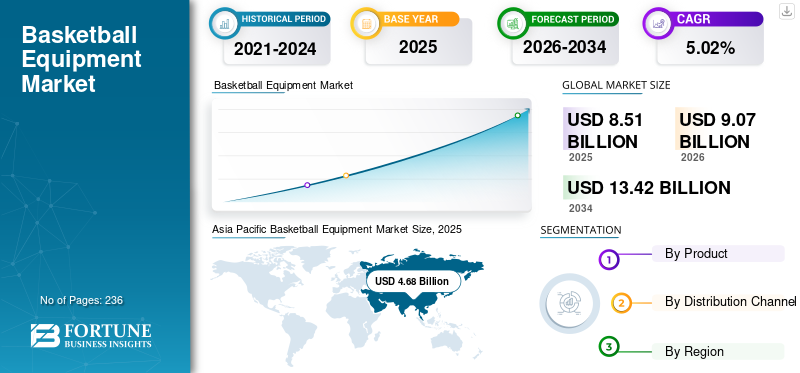
The basketball equipment market size was valued at USD 8.51 billion in 2025. The market is projected to grow from USD 9.07 billion in 2026 to USD 13.42 billion by 2034, exhibiting a CAGR of 5.02% during the forecast period. Asia Pacific dominated the basketball equipment market with a market share of 54.99% in 2025.
Basketball training equipment improves players' ball-handling and goal-scoring skills and contributes more effectively to the physical development of newer players. Professional players seek ergonomically designed equipment to enhance basketball performance, safety and learning. Manufacturers produce basketballs made of advanced composite leathers and high-grip rubber compounds that improve moisture control, tactile feel, and bounce reliability across indoor and outdoor surfaces. Consistent manufacturers' investments in developing innovative basketballs and hoop systems are driving global market expansion.
Key companies in the global market include Adidas AG, Nike, Inc., Spalding, Wilson Sporting Goods Co., and Molten Corporation.
Download Free sample to learn more about this report.
BASKETBALL EQUIPMENT MARKET KEY TAKEAWAYS
 Market Size & Forecast
- 2025 Market Size: USD 8.51 Billion
- 2026 Market Size: USD 9.07 Billion
- 2034 Forecast Market Size: USD 13.42 Billion
- CAGR: 5.02% from 2026–2034
 Market Share
- Asia Pacific dominated the basketball equipment market with a 54.99% share in 2025.
- The basketball segment accounted for 55.18% of the market in 2025.
- The online retail segment held a 35.63% market share in 2025.
 Key Regional Highlights
North America
North America captured 11.26% of the global market in 2025 and is projected to reach USD 1.02 billion in 2026.
Europe
Europe accounted for 20.77% of global sales and reached USD 1.77 billion in 2025, supported by growing amateur and club-level participation.
Asia Pacific
Asia Pacific held a 54.98% share and generated USD 4.68 billion in revenue in 2025, with a forecast CAGR of 5.78% through 2034.
U.S.
The market reached USD 0.66 billion in 2025 and represented 7.74% of global basketball equipment sales.
Japan
The market was valued at USD 0.22 billion in 2025, accounting for 2.56% of global revenues.
Read More

BASKETBALL EQUIPMENT MARKET TRENDS
Rising Demand for Smart Basketball Training Tools to Augment Market Growth
The rising demand for smart, connected basketball training equipment equipped with integrated sensor technology, motion tracking, and mobile application connectivity for real-time monitoring of shooting accuracy, ball rotation and dribble speed is driving basketball equipment market growth. In addition, the growing number of training institutes offering personalized basketball training programs is driving demand for these products across many countries.
MARKET DYNAMICS
MARKET DRIVERS
Download Free sample to learn more about this report.
Increasing Basketball Sports Participation to Drive Product Demand
The increasing global participation in basketball and the growing number of schools, colleges and community league facilities seeking federation-certified basketball equipment are driving the market growth. According to the International Basketball Federation (FIBA), global interest in basketball increased from 68% in 2019 to 74% in 2023. In addition, governmental and institutional efforts to promote basketball for youth physical development encourage youth to play basketball, boosting product demand across many countries.
MARKET RESTRAINTS
Price Sensitivity and Cost Competition to Restrain Market Growth
The schools, community programs, and casual players prioritize affordability over premium basketball products, leading them to buy low-priced products. This dynamic increases pricing competition among industry manufacturers, tending to lower product prices and shorten profit margins. Such a price rise is restraining key players' premium product sales across many countries. In addition, the growing presence of low-cost imports and private-label offerings increases the pricing pressure across online marketplaces, hampering business profitability.
MARKET OPPORTUNITIES
Rising Eco-Conscious Consumers' Demand for Sustainability-made Basketball Goods to Create Growth Opportunities
The rising demand from eco-conscious consumers for basketball goods made of sustainable materials, including recycled rubber, bio-based synthetic materials and eco-friendly packaging solutions, is creating new market growth opportunities. In addition, consistent manufacturers' production of sustainable materials for basketballs is contributing to environmental sustainability and favoring global market growth.
MARKET CHALLENGES
Supply Chain Challenges and Volatility in Raw Material Prices to Challenge Market Expansion
Supply chain challenges, including transportation delays, port congestion, geopolitical tensions and trade restrictions, are hampering the international supply of key components of basketball goods, including synthetic leather, rubber compounds, steel frames, polycarbonate backboards and protective foams. In addition, volatility in the raw material prices due to heavy industry manufacturers' reliance on international sourcing is hindering the global market expansion.
Segmentation Analysis
By Product
Essential Usage of Basketballs in Sport is Generating Considerable Basketballs Segmental Revenues
By product, the market is segmented into basketballs, hoops & systems, and backboards.
The basketball segment accounted for the leading basketball equipment market share of 55.18% in 2025. Its major share is due to the basketball product's essential nature and recurring demand across casual and professional basketball. Advancements in motion-sensor-based ball technology are positively contributing to the segment's growth.
To know how our report can help streamline your business, Speak to Analyst
The hoops & systems segment is projected to grow at the fastest rate of 5.08% from 2026 to 2034. The growing number of basketball facilities across schools, homes, community centers, sports clubs and other venues is driving demand for newer hoop systems. In addition, the growing adoption of portable, adjustable hoop systems for basketball facilities with limited space is driving the segment's growth.
By Distribution Channel
Higher Convenience of Shopping Leads to Online Retail Segment Growth
Based on the distribution channel, the market is segmented into specialty sports retail stores, online retail, hypermarkets & supermarkets, department stores, institutional/direct sales (B2B), and others.
The online retail segment exhibited a leading global market share of 35.63% in 2025. The segment's leading share is attributed to the greater convenience of shopping, product variety, and price transparency at online sports goods marketplaces. In addition, the growing number of manufacturers adopting a Direct-To-Consumer (DTC) online sales model to improve brand visibility and consumer engagement is favoring the segment's growth.
The institutional/direct sales (B2B) segment is growing at the second-fastest CAGR of 5.75% from 2026 to 2034. The growing number of manufacturers' partnerships with sports leagues and training institutions is driving B2B product sales worldwide.
Basketball Equipment Market Regional Outlook
By region, the market is categorized into North America, Europe, Asia Pacific, South America and Middle East & Africa.
North America
Asia Pacific Basketball Equipment Market Size, 2025 (USD Billion)
To get more information on the regional analysis of this market, Download Free sample
The North America region held 11.26% of the global market share in 2025. The market is estimated to reach USD 1.02 billion by 2026. Increasing consumer preference for technologically advanced products and smart training devices that cater to the requirements of amateur players is driving market growth across the region. In addition, the growing number of schools, community centers and institutions upgrading existing products with equipment meeting safety, performance and specification standards is favoring product sales across the region.
U.S. Basketball Equipment Market
The U.S. market size reached USD 0.66 billion in 2025. The U.S. market accounted for around 7.74% of the global market sales in 2025. The growing popularity of the National Basketball Association (NBA), the Basketball League (TBL), and semi-pro American Basketball Association (ABA) leagues, with their widespread media coverage, reinforces basketball's cultural prominence, driving demand for the product among professional athletes across the U.S.
Europe
The European region is expected to maintain its second leading global market position during the forecast period. The European market size reached USD 1.77 billion in 2025, accounting for approximately 20.77% of the global product sales. The growing number of youth participating in amateur and club-level basketball is favoring product sales across eastern and central Europe. In addition, the rising product replacement rate and the growing popularity of federation-certified products are driving market growth across Western Europe.
U.K. Basketball Equipment Market
The U.K. market in 2025 was at USD 0.18 billion, representing approximately 2.13% of global product revenues.
Germany Basketball Equipment Market
Germany's market reached USD 0.25 billion in 2025, equivalent to around 2.95% of global product sales.
Asia Pacific
The Asia Pacific region held the largest global market share of 54.98% with a market size of USD 4.68 billion in 2025. The region's market is projected to grow at the fastest rate of 5.78% during 2026-2034. Increasing sports participation, expanding basketball court construction, and rising disposable incomes are favoring the product demand across China, India, and Southeast Asia. In addition, rising consumer spending on customized basketball gear for performance is driving higher product replacement rates across Japan, South Korea, Australia and New Zealand. Consistent governmental and institutional support for basketball is driving the region's market growth.
Japan Basketball Equipment Market
The Japanese market in 2025 was at USD 0.22 billion, accounting for roughly 2.56% of global product revenues. The rising demand for compact hoops for small basketball facilities is driving growth in Japan.
China Basketball Equipment Market
China's market is projected to be one of the largest worldwide and held revenues at USD 3.11 billion in 2025, representing roughly 36.59% of global product sales.
India Basketball Equipment Market
The Indian market in 2025 was valued at USD 0.23 billion, accounting for roughly 2.69% of global market revenues.
South America
Over the forecast period, the South American market is expected to grow at a moderate rate. The South America market in 2025 reached USD 0.66 billion. The market growth is driven by increasing number of training academies and youth development programs seeking premium-grade basketball products, which is driving market growth across South America.
Middle East & Africa
The Middle East & African market is projected to grow at the second fastest rate of 5.35% during 2026-2034. Consistent government and federation efforts to promote basketball and expand community engagement programs are driving demand for such products across the Middle East. The increasing participation of women in basketball, driven by the emergence of online marketplaces selling women's basketball gear, is driving African market expansion. In the Middle East & African market, Saudi Arabia reached a valuation of USD 0.085 billion in 2025.
South Africa Basketball Equipment Market
The South African market was at USD 0.055 billion by 2025, accounting for roughly 0.65% of the global market revenues.
COMPETITIVE LANDSCAPE
Key Industry Players
Consistent R&D Investments and Strategic Partnerships with Professional Leagues to Expand Market Competition
The key players operating in the global market are Adidas AG, Nike, Inc., Spalding, Wilson Sporting Goods Co., and Molten Corporation. These players consistently focus on product innovations to produce basketball balls and hoop systems with enhanced material quality, grip technology, durability, and performance consistency. In addition, they partner with professional leagues, federations and tournament facilities to increase their product reach and brand visibility.
LIST OF KEY BASKETBALL EQUIPMENT COMPANIES PROFILED
- Adidas AG (Germany)
- Nike, Inc. (U.S.)
- Spalding (U.S.)
- Wilson Sporting Goods Co. (U.S.)
- Molten Corporation (Japan)
- Rawlings Sporting Goods Company, Inc. (U.S.)
- ASICS Corporation (Japan)
- Baden Sports, Inc. (U.S.)
- McDavid, Inc. (U.S.)
- Puma SE (Germany)
KEY INDUSTRY DEVELOPMENTS
- November 2025: Lifetime Products established a partnership with the National Basketball Association (NBA) and Women's National Basketball Association (WNBA) to gain an opportunity to deliver high-quality balls to the organization's fans and communities.
- April 2025: Basketball Ireland announced the extension of its partnership with OMW Supplies, a sports and educational equipment specialist to get access to high-quality practice, in-game equipment and all-weather courts across Ireland.
- March 2025: DECATHLON, a global sports goods brand partnered with Alex Sarr to broaden its product reach of high performance basketball equipment.
- January 2025: HoopsBasket, a high-quality equipment manufacturer and player-focused solutions provider, established a partnership with Scheldesports, an international sports equipment maker, to provide eco-friendly, material-based equipment to schools and amateur sports clubs.
- October 2024: SPALDING, a global basketball manufacturer, established a partnership with SportIQ (SIQ), a producer of official-size, weight-smart basketballs, to broaden its product portfolio.
- April 2023: The Wilson Sporting Goods Company launched an eco-friendly line of sports equipment, including basketballs, volleyballs, footballs, and soccer balls.
- February 2023: FIBA's Equipment & Venue Centre established a strategic partnership with Equip, a basketball smart locker provider, to enable sportsmen to participate in basketball activities and track their leisure performances.
REPORT COVERAGE
Request for Customization to gain extensive market insights.
Report Scope & Segmentation
| ATTRIBUTE | DETAILS |
| Study Period | 2021-2034 |
| Base Year | 2025 |
| Estimated Year | 2026 |
| Forecast Period | 2026-2034 |
| Historical Period | 2021-2024 |
| Growth Rate | CAGR of 5.02% from 2026 to 2034 |
| Unit | Value (USD Billion) |
| Segmentation | By Product, Distribution Channel, and Region |
| By Product |
|
| By Distribution Channel |
|
| By Geography |
|
Frequently Asked Questions
Fortune Business Insights says that the global market value stood at USD 8.51 billion in 2025 and is projected to reach USD 13.42 billion by 2034.
In 2025, the Asia Pacific market value stood at USD 4.68 billion.
The market is predicted to grow at a CAGR of 5.02% during forcast period of 2026-2034.
By product, the basketball segment is projected to hold the leading global market share throughout the forecast period.
Increasing participation in basketball sports is driving market growth.
Adidas AG, Nike, Inc., Spalding, Wilson Sporting Goods Co., and Molten Corporation are among the prominent players in the market.
Asia Pacific dominated the market in 2025.
The rising demand from eco-conscious consumers for sustainability-focused basketball equipment is creating new market growth opportunities.



- 2021-2034
- 2025
- 2021-2024
- 236
-
(Offer valid till 30th Sep 2026)
Get 30-60 hrs Free Customization
Expand Regional and Country Coverage, Segments Analysis, Company Profiles, Competitive Benchmarking, and End-user Insights.



















Related Reports
-
US +1 833 909 2966 ( Toll Free )
-
Get In Touch With Us