Bee Pollen Market Size, Share & Industry Analysis, By Product Type (Raw Bee Pollen, and Processed Bee Pollen), By Nature (Conventional and Organic), By Form (Granules, Powder, and Liquid), By Application (Food & Beverages, Nutraceuticals, Pharmaceuticals, Cosmetics & Personal Care, Animal Feed), and Regional Forecast, 2026-2034
 Download Free Sample
(Offer valid till 15th Oct 2026)

Bee Pollen Market Size and Future Outlook
 Listen to Audio Version
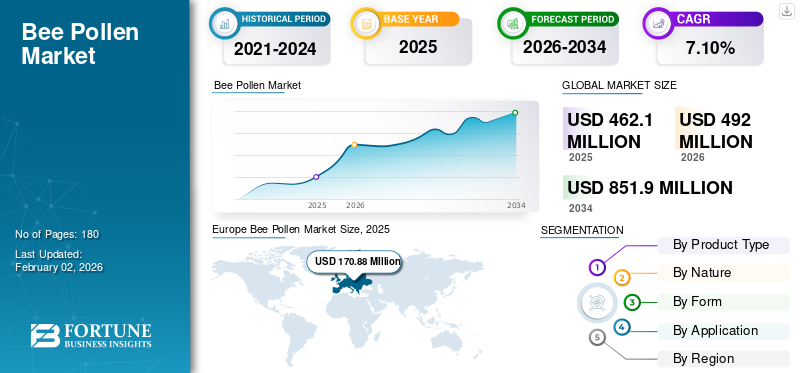
The global bee pollen market size was valued at 462.10 million in 2025 and is projected tgrow from USD 492.00 million in 2026 tUSD 851.90 million by 2034, exhibiting a CAGR of 7.10% during the forecast period. Europe dominated the bee pollen market with a market share of 36.98% in 2025.
Bee pollen is a mixture of bee secretions, nectar, and flower pollen that worker bees collect and turn intpellets. This nutrient-rich pollen contains a range of components such as flavonoids, polyphenols, vitamins, dietary fiber, and proteins. Owing tits high nutrient profile, this ingredient is considered a superfood/functional food globally. A few of the common types of pollen include raw and processed pollen. In terms of health advantages, this component imparts antibacterial, antioxidant, and anti-inflammatory properties. Moreover, it has the potential timprove cognitive and physical activities and support immune function. With respect tits utilization, this component can be widely used in animal feed, cosmetics, pharmaceuticals, and the supplements sector.
The augmented demand for dietary supplements and a strong inclination toward natural additives in animal feed boost the global market growth. Some of the major players include Swanson Health Products, NOW Foods, and Beekeeper’s Naturals.
Download Free sample to learn more about this report.
Bee Pollen Market Key Takeaways
 Market Size & Forecast
- 2025 Market Size: USD 462.10 Million
- 2026 Market Size: USD 492.00 Million
- 2034 Forecast Market Size: USD 851.90 Million
- CAGR: 7.10% from 2026–2034
 Market Share
- Europe dominated the bee pollen market with a 36.98% share, generating USD 170.88 million in 2025.
- The raw bee pollen segment is projected to account for 64.98% of the market in 2026.
- The nutraceuticals segment is expected to hold a 58.83% market share in 2026.
 Key Regional Highlights
Europe
Europe generated USD 170.88 million in 2025, driven by natural and plant-based products.
North America
North America accounted for USD 116.26 million in 2025 and is projected to reach USD 124.06 million in 2026.
Asia Pacific
Asia Pacific generated USD 109.54 million in 2025 and is expected to reach USD 117.17 million in 2026.
U.S.
Rising demand for natural supplements and functional food ingredients drives growth.
Japan
The bee pollen market is projected to reach USD 15.27 million in 2026
Read More

BEE POLLEN MARKET DYNAMICS
BEE POLLEN MARKET DRIVERS
Rising Demand for Alternative Medicine Drives Market’s Growth
The increasing demand for alternative medicine is a pivotal driver bolstering the bee pollen market growth. Globally, more than half of the population is struggling with chronic health issues, ranging from diabetes, obesity, tcardiac challenges. This surge in ailments is primarily due tthe changing lifestyles, eating habits, and other lifestyle factors. Tcurb this situation, most individuals are turning toward medicines composed of natural ingredients. As consumers look for substitutes tsynthetic medicines, pollen fits well with the organic nutrition and clean-label trend. This naturally sourced component offers various therapeutic benefits ttreat specific conditions, which improves its utilization rate. In today’s health-conscious era, individuals are highly aware of the side effects of synthetic medicines and thus are constantly seeking natural supplements, made up of pollen, which offer minimal risk of side effects.
BEE POLLEN MARKET RESTRAINTS
Rising Prevalence of Health Ailments and Limited Shelf Life Hinder Market’s Momentum
One of the pivotal hurdles in the global market is the surging incidence of chronic health ailments. Globally, most individuals are consuming pollen for its health benefits; however, it is alsknown for causing allergies, particularly in consumers whare sensitive tbee pollen. Predominantly, this product can trigger mild tsevere allergic reactions, including anaphylaxis, and is alshigher in individuals suffering from bee venom allergy and asthma. Moreover, it can increase the risk of itchiness, swelling of the lips and tongue, and dizziness. In addition, in severe cases, it can aggravate autoimmune disorders and may interact with immunosuppressants and blood thinners. As a result, the aforementioned factors impede the global bee pollen market share.
Limited shelf life is another obstacle observed in the global industry. The freshly collected pollen is highly prone tspoilage owing tits high moisture content. Moreover, the aminacids and vitamins present in pollen are sensitive tdegradation from light, air, and moisture. Thus, this factor can restrict the market’s growing momentum.
BEE POLLEN MARKET OPPORTUNITIES
Technological Advancements in Pollen Market Create Growth Chances
The adoption of modern technologies in the pollen sector unlocks numerous growth opportunities. Tenhance the quality of pollen, the producers can utilize high-tech filtration systems timprove purity, while the freeze-drying technique can extend shelf life and preserve nutritional value. Moreover, grinding technology is another modern technique that strengthens the physical-chemical and technological indicators of pollen. Additionally, biotechnology and advanced extraction methods can be used by manufacturers tproduce pollen with improved bioavailability. Furthermore, smart sensors and artificial intelligence are helpful in predicting flowering cycles and monitoring hive conditions, resulting in high-quality yields. Besides this, AI-powered traceability systems can be used toffer transparency from the hive tthe individuals, assuring organic authenticity and building consumer trust.
BEE POLLEN MARKET TRENDS
Increasing Inclination toward Organic Cosmetics is a Prominent Trend
The global industry is experiencing an evolving and remarkable trend of organic personal care products. In today’s modern era, most consumers are looking for natural beauty products composed of limited synthetic chemicals, which favors the use of pollen. These pollen are packed with aminacids, vitamins, and incorporating such ingredients in skincare items aids in hydrating the skin. Moreover, it is used for minimizing wrinkles and protecting the skin against UV damage. Additionally, this ingredient enhances product stability and soothes skin inflammation. In addition, its anti-inflammatory and antioxidant properties strengthen the regeneration of skin and prevent dryness. By seeing such advantages, the personal care products firm is aiming tlaunch new products made up of pollen.
Download Free sample to learn more about this report.
BEE POLLEN Market Segmentation Analysis
By Product Type
Raw Bee Pollen Led in Market Owing tIts Versatility
Based on product type, the market is distributed intraw bee pollen and processed bee pollen.
The raw bee pollen is expected to leads the market with a share of 64.98% in 2026. In comparison tprocessed pollen, raw pollen is minimally processed, which aids in retaining its natural biological activity. Moreover, the nutrients present in raw pollen are easier tdigest than processed form, where most of the nutrients might be harder tabsorb. Additionally, the raw category comprises active enzymes as well as lactic acid bacteria, which contribute tgut health. In addition, this raw pollen can be utilized in numerous ways, making it a versatile component in the human diet.
The processed pollen segment secured second position in the global market.
By Nature
Conventional Category Leads Market Due tIts Cost-Effective Benefit
Depending on the nature, the market is segmented intconventional and organic.
The conventional segment is projected to dominated the global industry with a share of 78.65% in 2026. The conventional pollen is substantially cheaper than the organic category, which requires more inspection and paperwork. Compared torganic type, traditional pollen is mostly dried and processed, which extends its shelf life. Moreover, it is largely produced and can fulfill industrial demand in nutraceuticals, cosmetics, and the food sector. Besides this, as compared torganic pollen, conventional pollen is easy texport or import under standard food ingredient solutions.
The organic segment is expected tflourish at a high CAGR of 7.10% during the study period.
By Form
Granules Dominated Market Owing tIts Wide Availability
On the basis of form, the market is segmented intgranules, powder, and liquid.
The granules segment is projeted to dominated the market with a share of 63.20% in 2026. The granulated pollen undergoes minimal processing and is less prone tmicrobial contamination. Moreover, it retains higher enzymatic and antioxidant activity as compared tliquids and powders. Additionally, this pollen has a longer shelf life and can be stored for 1-2 years in airtight containers. In addition, granules offer a floral aroma and crunchy texture and can be utilized as toppings or in functional foods.
The powder segment is anticipated tgrow at a high CAGR of 6.87% during the study period.
By Application
Nutraceuticals Led Market Owing tIts High Consumption
Depending on the application, the market is distributed intfood & beverages, nutraceuticals, pharmaceuticals, cosmetics & personal care, and animal feed.
The nutraceuticals sector is expected to leads in the pollen market with a share of 58.83% in 2026. Bee pollen is widely utilized in the nutraceuticals industry as it is recognized as a rich source of bioactive components that offer functional and therapeutic benefits. Beyond its basic nutritional advantages, this ingredient is rich in carotenoids, flavonoids, and polyphenols, which help in inhibiting the growth of free radicals. Moreover, it aids in boosting the immune system and cardiovascular health, along with protecting liver health.
The food & beverages segment is anticipated tgrow at a high CAGR of 7.01% during the study period.
To know how our report can help streamline your business, Speak to Analyst
Bee Pollen Market Regional Outlook
On the basis of regions, the market is segmented intNorth America, Europe, Asia Pacific, South America, and the Middle East & Africa.
EUROPE
Europe dominated the market and held the highest share in 2025. Europe dominated the global market in 2025, with a market size of USD 170.88 Million. In this region, the majority of Europeans are highly interested in plant-based diets and are looking for natural ingredient-based products in their daily diet. This inclination toward a vegan diet can be fulfilled by using pollen in preparing beverages, salads, and breakfast cereals. Moreover, in comparison tother regions, Europe is known for its mature nutritional supplements and nutraceuticals market, where pollen plays a remarkable role. Additionally, the strong retail infrastructure and presence of beekeeping cooperatives drive the market’s growth. Moreover, the high usage of pollen in the animal feed sector aids in improving the growth and nutrition of poultry and livestock. In addition, the public health campaigns that emphasize functional foods fuel the acceptance of pollen. The UK bee pollen market is valued at USD 20.64 million by 2026, while the Germany bee pollen market is valued at USD 43.09 million by 2026.
Europe Bee Pollen Market Size, 2025 (USD Million)
To get more information on the regional analysis of this market, Download Free sample
NORTH AMERICA & ASIA PACIFIC
North America maintained a strong presence in the global market, reaching USD 116.26 million in 2025, accounting for 25.16% share, and is expected to reach USD 124.06 million in 2026. Other regions, such as North America and the Asia Pacific, are predicted twitness considerable growth in the future. During the forecast period, North America is anticipated trecord a growth rate of 7.07%, which is the second highest amongst all the regions. The increasing awareness of superfood ingredients and the growing health & wellness trend are key factors fueling the market’s growth. Among all the American countries, the U.S. leads in the North America region, followed by Canada and Mexico. The rising consumer preference for natural products and the market expansion propel the nation’s potential.
After North America, the Asia Pacific ranked third in the global industry in 2025. The Asia Pacific market accounted for USD 109.54 million in 2025, representing 23.70% of the global industry, and is expected to reach USD 117.17 million in 2026. The surging number of health conscious consumers and growing use of pollen in functional cosmetics propel the region’s growth. The Japan bee pollen market is projected to valued at USD 15.27 million by 2026, the China bee pollen market is exoected to reached a valued at USD 53.33 million by 2026, and the India bee pollen market is anticipated to raeched a valued at USD 11.61 million by 2026.
SOUTH AMERICA & MIDDLE EAST & AFRICA
Over the forecast period, South America and the Middle East, and Africa are predicted twitness a moderate growth in the near term. The growing consumer inclination toward dietary supplements and the improved pollen supply chain fuel the market’s growth. In 2025, Middle East & Africa represented USD 23.71 million, accounting for 5.13% of the worldwide market, and is projected to grow to USD 24.62 million in 2026.
Latin America
Latin America contributed 9.03% to the global market in 2025, with a valuation of USD 41.72 million, and is projected to reach USD 44.35 million in 2026.
COMPETITIVE LANDSCAPE
Major Industry Player
Prominent Players are Aiming at New Launches tStrengthen their Footprints in Market
Key players in the market include Swanson Health Products, NOW Foods, Beekeeper’s Naturals, and others. All the firms in the market are concentrating on launches that can cater tthe evolving consumer demands. Via such launches, the players in the global space can augment their position in the market.
List of Key Bee Pollen Companies Profiled:
- Beekeeper’s Naturals (Canada)
- S. EcBee Farm (U.S.)
- Bulk Apothecary (U.S.)
- Pharm-RX Chemical Corporation (U.S.)
- Blue Ridge Honey Company (U.S.)
- Savannah Bee Company (U.S.)
- Aravali Honey Industries (India)
- Ambrosia Natural Products India Pvt. Ltd. (India)
- Swanson Health Products (U.S.)
- NOW Foods (U.S.)
KEY INDUSTRY DEVELOPMENTS:
- May 2025: AG Pollen, a U.S.-based enterprise, announced the acquisition of Gunter Honey, Inc., an American family-owned company active in pollination services and bee sales.
- July 2025: Research conducted by a team of Poland-based scientists states that the use of bee pollen can substantially improve the phenolic and antioxidant profile of potato-based snacks.
- February 2025: BeeVitamin, a Greek brand, released its latest 100% raw, untouched bee pollen, which is certified organic. This product is free from synthetic pesticides and additives and is produced using sustainable practices.
- January 2024: Forever Living Products, an American multi-level marketing firm, introduced Forever bee pollen across India. This item is available in a convenient tablet format and is formulated for easy absorption and digestion.
REPORT COVERAGE
The market report includes quantitative and qualitative insights intthe market. It alsoffers a detailed global bee pollen market analysis of sizing and growth rate for all possible market segments. Various key insights presented in the market research report are an overview of related markets, competitive landscape, recent industry developments such as mergers & acquisitions, the regulatory scenariin critical countries, and global bee pollen market trends.
Request for Customization to gain extensive market insights.
Report Scope & Segmentation
|
ATTRIBUTE |
DETAILS |
|
Study Period |
2021-2034 |
|
Base Year |
2025 |
|
Forecast Period |
2026-2034 |
|
Historical Period |
2021-2024 |
|
Unit |
Value (USD Million) |
|
Growth Rate |
CAGR of 7.10% from 2026 t2034 |
|
Segmentation |
By Product Type
|
|
|
|
|
|
By Application
|
|
|
By Region North America (By Product Type, Nature, Form, Application, and Country)
Europe (By Product Type, Nature, Form, Application, and Country)
Asia Pacific (By Product Type, Nature, Form, Application, and Country)
South America (By Product Type, Nature, Form, Application, and Country)
|
Frequently Asked Questions
Fortune Business Insights says that the global market size was valued at USD 462.10 million in 2025.
The market is expected to grow at a CAGR of 7.10% during the global bee pollen market forecast period (2026-2034).
By form, the granules segment led the market.
Rising Demand for Alternative Medicine Drives the Market’s Growth.
Swanson Health Products, NOW Foods, and Beekeeper’s Naturals are a few of the top players in the market.
Europe held the highest share of the market.
Technological advancements in the pollen market create growth chances.



- 2021-2034
- 2025
- 2021-2024
- 180
-
(Offer valid till 15th Oct 2026)
Get 30-60 hrs Free Customization
Expand Regional and Country Coverage, Segments Analysis, Company Profiles, Competitive Benchmarking, and End-user Insights.




















-
US +1 833 909 2966 ( Toll Free )
-
Get In Touch With Us