Bicycle Derailleur Market Size, Share & Industry Analysis, By Product Type (Front Derailleur and Rear Derailleur), By Actuation Technology (Mechanical (Cable-Operated), Electronic (Wired) and Wireless Electronic), By Speed Type (Up to 9-Speed, 10–11 Speed, 12-Speed, and Above 12-Speed), By Bicycle Type (Mountain, Road, Hybrid, Cargo, and Others), By Material (Aluminum, Steel, and Carbon Fiber) and Regional Forecast, 2026-2034
 Download Free Sample
(Offer valid till 30th Sep 2026)

Bicycle Derailleur Market Size and Future Outlook
 Listen to Audio Version
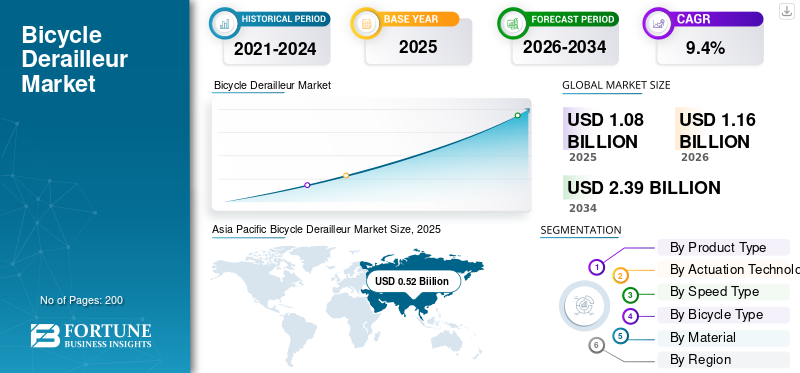
The global bicycle derailleur market size was valued at USD 1.08 billion in 2025. The market is projected to grow from USD 1.16 billion in 2026 to USD 2.39 billion by 2034, exhibiting a CAGR of 9.4% during the forecast period. Asia Pacific dominated the bicycle derailleur market with a market share of 48.15% in 2025.
The bicycle derailleur market involves in the design, manufacturing, and sale of front and rear derailleur systems for bicycles that shift chains between gears. It includes components for road bikes, mountain bikes, hybrid, and electric bicycles across OEM and aftermarket channels. The market is driven by cycling participation, technological advancements, lightweight materials, and demand for high-performance and durable gear-shifting mechanisms.
Key drivers of the market include rising global cycling participation for fitness and commuting, growing demand for high-performance, lightweight bicycles, the increasing popularity of e-bikes, technological advancements in electronic shifting systems, expanding cycling infrastructure, and greater consumer spending on premium and performance-oriented bicycle components.
Key players in the market include Shimano Inc., SRAM LLC, Campagnolo S.r.l., MicroSHIFT, and SunRace Sturmey-Archer, competing through lightweight component designs, electronic shifting technologies, precision engineering, durability enhancements, and continuous product innovation tailored for road bikes, mountain bikes, and electric bicycles across OEM and aftermarket segments.
Download Free sample to learn more about this report.
Bicycle Derailleur Market KEY TAKEAWAYS
 Global Market Size & Forecast
- 2025 Market Size: USD 1.08 billion
- 2026 Market Size: USD 1.16 billion
- 2034 Forecast Market Size: USD 2.39 billion
- CAGR: 9.4% from 2026–2034
 Market Share
- Asia Pacific dominated the bicycle derailleur market with a 48.15% share in 2025.
- The front derailleur segment is projected to grow at a CAGR of 10.0% during the forecast period.
- The wireless electronic segment is projected to grow at the highest CAGR of 11.6% during the forecast period.
 Key Regional Highlights
Asia Pacific
Asia Pacific dominated the market in 2025, driven by strong bicycle manufacturing and rapid e-bike adoption.
North America
North America remained the third-largest market, supported by growing recreational cycling and demand for premium drivetrain components.
Europe
Europe is projected to grow at a CAGR of 9.5%, fueled by high cycling adoption and expanding e-bike usage.
U.S.
The U.S. market is estimated to reach USD 0.16 billion by 2026, driven by rising mountain biking and gravel cycling trends.
Japan
Japan remains a key regional manufacturing hub, supported by advanced bicycle component production and strong cycling culture.
Read More

BICYCLE DERAILLEUR MARKET TRENDS
Shift Toward Electronic and Wireless Shifting Systems is a Key Market Trend
Technological advancement is shaping a prominent trend toward electronic and wireless derailleur systems. Cyclists increasingly seek precise, low-maintenance, and smooth gear transitions, driving demand for electronically actuated shifting mechanisms. Wireless systems reduce cable clutter, improve aerodynamics, and enhance overall bicycle aesthetics, particularly in premium road and mountain bike categories. Integration with cycling computers and mobile applications enables gear customization and performance tracking, appealing to performance-oriented riders. Although currently concentrated in high-end segments, gradual cost optimization and technological refinement are expanding accessibility. Manufacturers are investing in research and development to improve battery life, system responsiveness, and environmental resistance. This shift toward digital integration reflects broader smart mobility trends influencing the cycling component ecosystem.
Download Free sample to learn more about this report.
MARKET DYNAMICS
MARKET DRIVERS
Rising Global Cycling Participation and Fitness Awareness to Drive Derailleur Demand
Increasing global awareness of health, fitness, and sustainable mobility is significantly driving demand in the market. Urban populations are increasingly adopting cycling as a cost-effective and environmentally friendly transportation option, supported by expanding bike-sharing programs and dedicated cycling infrastructure. Recreational and competitive cycling activities are also gaining traction, particularly in Europe, North America, and parts of the Asia Pacific. As more consumers purchase geared bicycles for road, mountain, gravel, and hybrid applications, demand for reliable and high-performance derailleur systems rises. Additionally, the growing popularity of e-bikes, which often require advanced multi-speed drivetrains, further strengthens component demand. Continuous upgrades and replacement cycles in both OEM and aftermarket channels contribute to sustained bicycle derailleur market growth.
MARKET RESTRAINTS
Limited Adoption of Geared Bicycles in Emerging and Utility Segments to Constrain Market Growth
The continued prevalence of single-speed and low-cost utility bicycles in several emerging markets acts as a restraint on the market. In many regions across Africa and rural areas of South Asia, consumers prioritize affordability, low maintenance, and durability over multi-speed performance. Single-speed drivetrains are easier to maintain and less expensive to repair, making them preferable for daily commuting and commercial use. Additionally, relatively flat terrain in certain urban areas reduces the functional need for complex gear systems. This limits penetration of advanced derailleur-equipped bicycles in price-sensitive demographics. As a result, market growth remains concentrated in performance, recreational, and urban premium segments rather than mass-market utility categories.
MARKET OPPORTUNITIES
Growing E-Bike Penetration to Create Advanced Drivetrain Opportunities
The rapid global expansion of electric bicycles presents a strong opportunity for the bicycle derailleur market. E-bikes typically require robust, high-precision drivetrains capable of handling greater torque and sustained loads generated by electric motors. This demand encourages the development of reinforced rear derailleurs, optimized gear ratios, and integrated electronic shifting systems. As governments promote e-mobility solutions to reduce urban congestion and emissions, e-bike adoption is accelerating across Europe and the Asia Pacific. Premium e-MTBs and urban commuter e-bikes particularly rely on high-performance gear systems, creating opportunities for innovation in durability and seamless shifting. Collaborations between drivetrain manufacturers and e-bike OEMs further support specialized product development, enabling market participants to capture value in this expanding segment.
MARKET CHALLENGES
Supply Chain Volatility and Component Standardization Issues to Challenge Market Stability
The market faces ongoing challenges related to supply chain volatility and compatibility complexities. Disruptions in global logistics, fluctuating raw material availability, and dependency on specialized component suppliers can delay production cycles and increase costs. Additionally, the presence of multiple drivetrain standards and proprietary technologies across brands can create compatibility constraints for OEMs and aftermarket retailers. Consumers may face confusion when upgrading or replacing components, potentially slowing purchase decisions. Smaller manufacturers often struggle to align with dominant industry standards while maintaining differentiation. Ensuring consistent quality control across geographically dispersed manufacturing facilities further adds operational complexity. Addressing these structural challenges requires strategic sourcing, stronger supplier partnerships, and continued efforts toward interoperability within the industry.
Segmentation Analysis
By Product Type
Widespread Multi-Speed Bicycle Adoption to Strengthen Rear Derailleur Segment Leadership
Based on product type, the market is classified into front derailleur and rear derailleur.
The rear derailleur segment dominates the market due to its essential role in multi-speed drivetrains across road bikes, mountain bikes, hybrid bicycles, and e-bikes. Rear derailleurs manage wider gear ranges and are subject to higher wear, leading to frequent replacements in both OEM and aftermarket channels. Strong global adoption of performance and recreational cycling further sustains volume demand, reinforcing the segment’s leading revenue contribution.
The front derailleur segment is projected to grow at a CAGR of 10.0% during the forecast period. Growth is supported by increasing demand for multi-chain ring setups on performance road and touring bicycles, alongside technological refinements that improve shifting precision and compatibility with compact drivetrain systems.
By Actuation Technology
Cost Efficiency and Broad Compatibility to Sustain Mechanical Segment Dominance
In terms of actuation technology, the market is categorized into mechanical (cable-operated), electronic (wired) and wireless electronic.
The mechanical (cable-operated) segment dominates the market due to its affordability, reliability, and widespread compatibility with entry-level, mid-range, and high performance bicycles. Mechanical systems are easy to maintain, cost-effective to replace, and preferred in commuter, utility, and mass-market bicycles globally. Strong OEM integration and extensive aftermarket servicing further reinforce steady volume demand across diverse regional markets.
The wireless electronic segment is projected to grow at a CAGR of 11.6% during the forecast period. Growth is driven by rising demand for precision shifting, clean cockpit aesthetics, and seamless digital integration in premium road, mountain, and e-bike categories, particularly among performance-focused and professional cyclists.
To know how our report can help streamline your business, Speak to Analyst
By Speed Type
High Affordability and Mass-Market Bicycle Integration to Drive Up to 9-Speed Segment Dominance
Based on speed type, the market is segmented into up to 9-speed, 10–11 speed, 12-speed, and above 12-speed.
The up to 9-speed segment dominates the market due to its extensive adoption in entry-level, commuter, hybrid, and utility bicycles worldwide. These systems offer adequate gear range, lower cost, and easier maintenance, making them highly suitable for daily urban commuting and recreational cycling. Strong penetration in emerging markets and OEM preference for cost-effective drivetrain configurations further support sustained volume demand in this segment.
The above 12-speed segment is projected to grow at a CAGR of 15.2% during the forecast period. Growth is driven by rising demand for high-performance road, gravel, and mountain bikes requiring wider gear ratios, smoother cadence transitions, and enhanced efficiency, particularly among professional and enthusiast cyclists.
By Bicycle Type
Urban Commuting Preference and Versatile Performance to Strengthen Hybrid Segment Leadership
Based on bicycle type, the market is segmented into mountain, road, hybrid, cargo and others.
The hybrid segment dominates the market due to its balanced design combining road efficiency and light off-road capability. Hybrid bikes are widely adopted for urban commuting, fitness riding, and recreational use, particularly across North America and Europe. Their compatibility with multi-speed drivetrains supports consistent demand for durable and mid-range derailleur systems. Growing city-based cycling infrastructure and increasing preference for practical, everyday mobility solutions further reinforce OEM production volumes and aftermarket replacement demand within this segment.
The cargo segment is projected to grow at a CAGR of 11.1% during the forecast period. Growth is driven by rising last-mile delivery services, family mobility use cases, and expanding e-cargo bike adoption, which are increasing demand for reinforced, high-load-capacity derailleur systems.
By Material
Lightweight Performance and Cost Efficiency to Reinforce Aluminum Segment Dominance
Based on material, the market is segmented into aluminum, steel and carbon fiber.
The aluminum segment held the largest bicycle derailleur market share due to its optimal balance between lightweight properties, strength, corrosion resistance, and cost efficiency. Aluminum derailleurs are widely used across entry-level, mid-range, and performance bicycles, making them suitable for road, mountain, and hybrid applications. OEMs prefer aluminum for large-scale production due to its machinability and durability, while consumers value its reliability and moderate pricing. The material’s ability to support precise shifting mechanisms without significantly increasing bicycle weight further sustains its leading revenue and volume share across global markets.
The carbon fiber segment is projected to grow at a CAGR of 12.4% during the forecast period. Growth is driven by rising demand for ultra-lightweight, high-performance bicycles among professional and enthusiast riders, particularly in premium road and racing segments.
Bicycle Derailleur Market Regional Analysis Outlook
By geography, the market is categorized into Europe, North America, Asia Pacific, and the rest of the world.
Asia Pacific
Asia Pacific market held the maximum share and is projected to register the fastest growth over the forecast period. The region benefits from strong bicycle manufacturing hubs in China, Japan, and Taiwan, ensuring large-scale OEM production and component exports. Rising urbanization, expanding middle-class populations, and increasing cycling adoption for commuting and recreation further stimulate demand. Rapid e-bike penetration across China and Southeast Asia is strengthening the need for advanced drivetrains. Growing sports cycling participation and government-backed cycling infrastructure projects continue to accelerate both volume sales and aftermarket replacement demand.
Asia Pacific Bicycle Derailleur Market Size, 2025 (USD Billion)
To get more information on the regional analysis of this market, Download Free sample
China Bicycle Derailleur Market
The China’s market in 2026 is estimated at around USD 0.20 billion, accounting for a significant market share. Strong domestic bicycle manufacturing, expanding e-bike production, and export-oriented component supply chains support sustained volume demand and regional dominance.
India Bicycle Derailleur Market
The Indian market in 2026 is estimated at around USD 0.16 billion, accounting for a notable share of global revenues. Rising urban commuting, growing fitness awareness, and increasing adoption of geared bicycles drive the fastest growth momentum.
Europe
Europe represents the second-largest market and is expected to grow at a CAGR of 9.5% during the forecast period. High cycling penetration, strong environmental awareness, and well-developed cycling infrastructure support consistent demand for geared bicycles. Countries such as Germany, the Netherlands, and France highlight strong adoption of road bikes, mountain bikes, and e-bikes. The region’s mature aftermarket ecosystem and premium bicycle segment further contribute to steady replacement cycles. Technological advancements in electronic shifting systems also gained early traction in Europe, supporting revenue growth.
Germany Bicycle Derailleur Market
The German market in 2026 is estimated at around USD 0.03 billion, accounting for a significant market share. Strong e-bike adoption, a premium cycling culture, and established aftermarket service networks sustain steady component replacement demand.
Italy Bicycle Derailleur Market
The Italian market in 2026 is estimated at around USD 0.06 billion, accounting for a stable share of global revenues. Road cycling heritage, competitive sports participation, and premium bicycle manufacturing contribute to consistent drivetrain demand.
North America
North America holds the third-largest share of the market, driven by strong participation in recreational and performance cycling. The U.S. leads regional demand, driven by trends in mountain biking, gravel riding, and road cycling. Growth in e-bike adoption and fitness-oriented consumer behavior further supports drivetrain upgrades and premium component demand. A well-established network of specialty bicycle retailers and service workshops strengthens aftermarket sales. Increasing interest in outdoor sports and organized cycling events sustains steady OEM and replacement demand across the region.
U.S. Bicycle Derailleur Market
The U.S. market in 2026 is estimated at around USD 0.16 billion, accounting for a considerable share of global revenues. Growth is supported by mountain biking popularity, expanding gravel cycling trends, and rising demand for performance-oriented drivetrain upgrades.
Rest of the World
The rest of the world, including South America, the Middle East, and Africa, presents emerging growth opportunities in the market. Urban mobility challenges, rising fuel costs, and the gradual expansion of cycling culture support incremental bicycle adoption. While single-speed bicycles remain prevalent in certain areas, demand for geared bicycles is steadily increasing in urban centers. Expanding middle-class populations and improving retail distribution channels contribute to gradual market penetration. International brands entering untapped markets further support long-term growth potential.
COMPETITIVE LANDSCAPE
Key Industry Players
Technological Innovation and OEM Partnerships Strengthening Competitive Positioning
The bicycle derailleur market is moderately consolidated, with leading players such as Shimano Inc., SRAM LLC, Campagnolo S.r.l., MicroSHIFT, and SunRace Sturmey-Archer accounting for a significant share of global revenues. These companies compete primarily through technological innovation, precision engineering, lightweight material integration, and expanded gear range offerings. Strong OEM partnerships with global bicycle manufacturers provide a stable revenue base, while extensive distribution networks strengthen aftermarket presence. Continuous investment in research and development enables product differentiation, particularly in electronic and wireless shifting systems across premium segments.
Competition is intensifying as manufacturers focus on expanding product portfolios across multiple price tiers to capture both mass-market and high-performance demand. Companies are emphasizing backward compatibility, durability enhancements, and drivetrain efficiency improvements to strengthen brand loyalty. Strategic collaborations with e-bike manufacturers are becoming increasingly important, given the growing torque requirements of electric drivetrains. Additionally, regional players are competing through cost-effective mechanical systems in price-sensitive markets. Branding, sponsorship of professional cycling teams, and participation in global cycling events further support competitive positioning and market visibility.
LIST OF KEY BICYCLE DERAILLEUR COMPANIES PROFILED
- Shimano Inc. (Japan)
- SRAM LLC (U.S.)
- Campagnolo S.r.l. (Italy)
- microSHIFT (Taiwan)
- SunRace Sturmey-Archer Inc. (Taiwan)
- SR Suntour Inc. (Japan)
- Miche S.p.A. (Italy)
- FSA (Full Speed Ahead) (Taiwan)
- KCNC International (Taiwan)
- Rotor Componentes Tecnologicos SL (Spain)
KEY INDUSTRY DEVELOPMENTS
- February 2026: Shimano launched XT and Deore Wireless Di2 2026 mountain bike drivetrain platforms, expanding wireless electronic shifting.
- November 2025: SRAM LLC announced capacity expansion at its Taiwan facility to support rising global demand for Eagle 12-speed and wireless AXS drivetrain systems across mountain and e-bike categories.
- September 2025: Campagnolo S.r.l. launched a lightweight carbon-enhanced rear derailleur for premium road racing applications, improving aerodynamic efficiency and shifting precision in competitive cycling markets.
- August 2025: Shimano unveiled an upgraded XTR Di2 wireless mountain bike groupset, improving battery efficiency and durability for high-performance off-road applications.
- August 2025: MicroSHIFT introduced a new Advent X gravel-focused derailleur series, enhancing clutch stability and wide-range cassette compatibility for adventure and touring cyclists.
- October 2024: Shimano announced investment in advanced cold-forging and machining technologies at its Japan facility to enhance derailleur production efficiency and precision engineering capabilities.
- August 2024: MicroSHIFT expanded its North American aftermarket network, improving availability of mechanical derailleur systems for independent bicycle retailers and service workshops.
REPORT COVERAGE
The global bicycle derailleur market analysis provides an in-depth study of market size and forecast by all the market segments included in the report. It includes details on the market dynamics and trends expected to drive the market over the forecast period. It offers information on the technological advancements, new product launches, key industry developments, and details on partnerships, mergers, and acquisitions. The market research report also encompasses a detailed competitive landscape, including market share and profiles of key operating players.
Request for Customization to gain extensive market insights.
Report Scope & Segmentation
| ATTRIBUTE | DETAILS |
| Study Period | 2021-2034 |
| Base Year | 2025 |
| Forecast Period | 2026-2034 |
| Historical Period | 2021-2024 |
| Growth Rate | CAGR of 9.4% from 2026-2034 |
| Unit | Value (USD Billion) |
| Segmentation | By Product Type, By Actuation Technology, By Speed Type, By Bicycle Type , By Material and By Region |
| By Product Type |
|
| By Actuation Technology |
|
| By Speed Type |
|
| By Bicycle Type |
|
| By Material |
|
| By Geography |
|
Frequently Asked Questions
Fortune Business Insights says that the global market value stood at USD 1.08 billion in 2025 and is projected to reach USD 2.39 billion by 2034.
In 2025, Asia Pacific’s market value stood at USD 0.52 billion.
The market is expected to exhibit a CAGR of 9.4% during the forecast period.
The rear derailleur segment is leading the market by product type.
Rising global cycling participation and fitness awareness are the key factors driving the market.
Asia Pacific dominated the market in 2025 with the largest share.



- 2021-2034
- 2025
- 2021-2024
- 200
-
(Offer valid till 30th Sep 2026)
Get 30-60 hrs Free Customization
Expand Regional and Country Coverage, Segments Analysis, Company Profiles, Competitive Benchmarking, and End-user Insights.




















Related Reports
-
US +1 833 909 2966 ( Toll Free )
-
Get In Touch With Us