Biochemical Reagents Market Size, Share & Industry Analysis, By Type (Molecular Biology Reagents, Cell/Tissue Culture Reagents, Protein Chemistry Reagents, Electrophoresis & Chromatography Reagent, Immunochemistry Reagents, Clinical Chemistry Reagents, & Others), By Source (Natural/Biological, Synthetic/Chemical, and Recombinant/Biotechnological), By Grade (Research Grade and GMP), By Application (Molecular Biology, Drug Discovery & Development, & Others), By End User (Pharmaceutical and Biotechnology Companies, Research & Academic Institutes, & Others), and Regional Forecasts, 2026-2034
 Download Free Sample
Biochemical Reagents Market Size and Future Outlook
 Listen to Audio Version
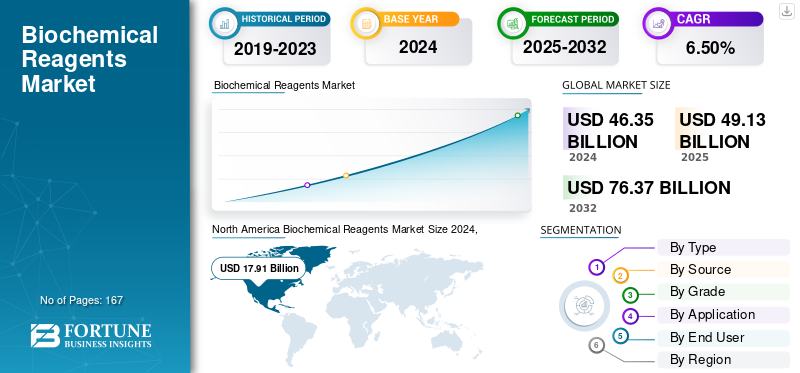
The global biochemical reagents market size was valued at USD 49.13 billion in 2025. The market is projected to grow from USD 52.14 billion in 2026 to USD 87.60 billion by 2034, exhibiting a CAGR of 6.70% during the forecast period. North America dominated the global biochemical reagents market, with a 38.78% share in 2025.
Biochemical reagents are among the most crucial tools used in biotechnology, widely used in various laboratory experiments and diagnostic procedures to detect, quantify, or visualize biological materials. Their wide range of applications, from biochemical tests to complex molecular biology techniques, reinforces their importance as essential tools for scientific research and medical advancements. Owing to the strong market potential, industry stakeholders are increasingly collaborating to diversify their product offerings.
- For instance, in October 2025, Saguaro Biosciences collaborated with Bio-Techne Corporation to provide better access to the company’s portfolio of non-toxic, live-cell imaging reagents.
Key industry players, including Thermo Fisher Scientific, Merck KGaA, Bio-Rad Laboratories, Inc., QIAGEN, and Takara Bio Inc., are investing significantly in expanding their manufacturing capacity for biochemical reagents, strengthening their competitive positioning in the market.
Download Free sample to learn more about this report.
Biochemical Reagents Market Key Takeaways
 Market Size & Forecast
- 2025 Market Size: USD 49.13 Billion
- 2026 Market Size: USD 52.14 Billion
- 2034 Forecast Market Size: USD 87.60 Billion
- CAGR: 6.70% from 2026–2034
 Market Share
- North America dominated the biochemical reagents market with a 38.78% share in 2025.
- Molecular biology reagents are expected to lead the type segment with a 22.57% share in 2026.
- Research-grade reagents dominated the grade segment with an 84.15% share in 2026.
 Key Regional Highlights
North America
North America accounted for USD 19.05 billion in 2025 and held 38.78% of the global market.
Europe
Europe generated USD 13.41 billion in 2025, representing 27.30% of global revenue.
Asia Pacific
Asia Pacific reached USD 11.77 billion in 2025 and captured a 23.95% market share.
U.S.
The U.S. biochemical reagents market is estimated to reach USD 18.11 billion by 2026.
Japan
The Japan biochemical reagents market is estimated to reach USD 3.44 billion by 2026.
Read More

MARKET DYNAMICS
MARKET DRIVERS
Increasing Application of Molecular Biology and Genomics to Drive Market Growth
One of the primary factors driving market growth is the increasing application of molecular biology and genomics in medicine. Rapid advancements in genetic sequencing, gene editing, and molecular diagnostics have heightened the need for a wide range of high-quality reagents to conduct these research experiments. Additionally, the development of targeted therapies has accelerated the use of various biotechnology processes that extensively rely on specialized biochemical reagents.
Large-scale genomic research initiatives and personalized medicine programs, which span both academic and clinical settings, continue to drive reagent consumption. This growing research activity creates sustained demand and fuels innovation in reagent formulation.
- For instance, in July 2025, Azenta, Inc. collaborated with Fresenius Medical Care and Nephronomics to initiate genomic sequencing and data generation for the company’s MyReaso genomics research program. Such initiatives in genomics and personalized medicine are expected to drive the global biochemical reagents market growth over the forecast period.
MARKET RESTRAINTS
Stringent Regulatory Policies and Quality Control to Restrict Market Growth
A major factor restraining the growth of the global biochemical reagents market is the stringent regulatory policies and quality control standards. Reagents used in pharmaceutical manufacturing, diagnostics, and clinical research must meet strict regulatory requirements to ensure the accuracy and safety of research and therapeutic applications. Failure to comply with these regulations implies a product recall and delayed product launches, restricting industry’s growth.
- For instance, in January 2024, Abbott Inc. recalled some cartridges within the Alinity i Anti-HBs Reagent Kit due to aspiration errors related to the micro particle component of the reagent kit.
MARKET OPPORTUNITIES
Technological Advancement to Offer Several Growth Opportunities
One of the significant growth opportunities for the market is the rapid advancement of technological innovations that underpin next-generation targeted therapeutics. These advancements drive greater demand for custom reagents that support complex biological assays and therapeutic screening. Reagent manufacturers have the opportunity to develop advanced, application-specific products that cater to the expanding pipeline of targeted therapies. Many key players are directing their focus toward new product launches to capitalize on the market growth.
- For instance, in August 2025, Revvity, Inc. launched pHSense reagents to advance internalization studies in drug discovery. Designed for high-throughput, plate-based workflows, these reagents are intended for researchers studying G protein-coupled receptors (GPCRs) or antibody-drug conjugates (ADCs). These pHSense reagents can accelerate preclinical development timelines of candidates toward clinical evaluation.
GLOBAL BIOCHEMICAL REAGENTS MARKET TRENDS
Development of Reagents Compatible with Automated Technology is a Key Market Trend
The development of reagents compatible with automated technologies, such as robotics, is a prominent trend observed in the biochemical reagents market. As laboratories increasingly adopt automation to enhance efficiency and accuracy, the demand for reagents compatible with the system also increases. Moreover, the growing use of robotic liquid handlers in genomics, proteomics, and clinical diagnostics is driving demand for such specialized reagents. This shift toward digital and automated laboratory supports faster and more scalable scientific workflows.
- For instance, in October 2024, BD launched robotics-compatible reagent kits that enabled automation and improved consistency and increased efficiency in large-scale single-cell discovery studies.
MARKET CHALLENGES
Limited Access in Developing Regions Poses a Significant Challenge for Market Expansion
Limited access to biochemical reagents in developing regions is a significant challenge for market growth. Many low- and middle-income countries have limited laboratory infrastructure, inadequate funding for research, and a dependence on imports for high-quality reagents. The lack of local manufacturing and distribution networks restricts the availability of specialized reagents required for advanced molecular and diagnostic studies. As a result, research and clinical laboratories in these regions often experience higher operational costs and slower adoption of new technologies, thereby limiting their overall market potential.
- For instance, in July 2024, the International Alliance for Biological Standardization (IABS) and Humane Society International (HSI) co-hosted a webinar on the global availability and affordability of critical reagents for vaccine and biologics production. The webinar reported that low-income countries faced financial and supply chain challenges for biological reagents.
Download Free sample to learn more about this report.
Segmentation Analysis
By Type
Key Players are Engaging in Strategic Acquisitions to Propel Molecular Biology Reagents Segment Growth
Based on type, the market is divided into molecular biology reagents, cell/tissue culture reagents, protein chemistry reagents, electrophoresis & chromatography reagents, immunochemistry reagents, clinical chemistry reagents, and others.
To know how our report can help streamline your business, Speak to Analyst
The molecular biology reagents segment is expected to dominate the market with a market share of 22.57% in 2026. The dominance of the segment is attributed to its high applications in critical workflows, such as PCR/qPCR, next-generation sequencing, cloning, and CRISPR. These reagents are highly consumable, resulting in faster replacement cycles and higher revenue per instrument installed. Due to these advantages, key companies are engaging in strategic mergers and acquisitions to drive the segment's growth.
- For instance, in September 2024, Molecular Designs acquired Lambda Biotech, a provider of research products for applications in molecular biology, functional genomics, proteomics, and gene therapy. The development expanded the company’s product offering across PCR products, RT-PCR reagents, RT-qPCR kits, Direct-PCR genotyping kits, DNA ladders, SafeStain, and other protein and cell biology products.
The cell/tissue culture reagents segment is expected to grow at a CAGR of 7.82% during the forecast period.
By Source
High Usage of Synthetic Reagents in Various Applications Boosted the Synthetic/Chemical Segment Growth
Based on source, the market is segmented into natural/biological, synthetic/chemical, and recombinant/biotechnological.
In 2026, the synthetic/chemical segment held the largest global biochemical reagents market share. The dominance of the segment is attributed to high volumes of essential reagents, such as buffers, salts, solvents, surfactants, and small-molecule substrates used across various laboratory assays. These reagents are cheaper to produce at scale, offer long shelf lives, and provide tight lot-to-lot consistency, characteristics that labs prioritize for reproducibility and automation. Furthermore, the segment is set to hold a 45.23% share in 2026. Given the diverse applications of these chemical reagents, many key players are directing their resources toward expanding their manufacturing facilities, driving segment growth.
- For instance, in May 2023, MGI Tech GmbH, Ltd. launched DNBSEQ technology production in Europe. The facility expanded the production capacity of DNBSEQ-G400 gene sequencing instruments and sequencing reagents.
The recombinant/biotechnological reagents segment is projected to grow at a CAGR of 9.53% during the study period.
By Grade
Growing Dependency on Research Grade Reagents Leads the Segment’s Growth
Based on grade, the market is segmented into research-grade and GMP.
In 2026, the global market was dominated by research-grade biochemical reagents. The segment dominates the market with an 84.15% share, largely since most molecular biology, cloning, screening, and preclinical workflows are run on research-grade equipment, resulting in large volumes of consumption.
- For example, in October 2025, Isolere Bio by Donaldson launched research-grade IsoTag AAV reagent for the purification of adeno-associated viral vectors (AAV).
The GMP segment is projected to grow at a CAGR of 9.59% during the study period.
By Application
New Product Launches Boosted the Growth of Clinical Diagnostics Segment
Based on application, the market is segmented into molecular biology, drug discovery & development, clinical diagnostics, and others.
In 2024, the clinical diagnostics segment dominated the market. Some of the factors contributing to the segment's dominance include high test volumes across hospitals for routine chemistry, immunoassays, and nucleic acid tests for infectious diseases and chronic conditions. These workflows consume large quantities of reagents with limited turnaround-time targets, supporting the segment's growth. Furthermore, the segment is set to hold a 40.20% share in 2026. Additionally, new product launches and regulatory approvals from regulatory bodies further boost segment growth.
- For instance, in December 2024, F. Hoffmann-La Roche Ltd. received CE mark approval for its cobas Mass Spec solution, which includes the cobas i 601 analyser and the Ionify reagent pack, comprising four assays for steroid hormones. The development aimed to bring automated, integrated, and standardized clinical mass spectrometry testing to routine laboratories worldwide.
The molecular biology segment is projected to grow at a CAGR of 9.13% during the study period.
By End User
Extensive Research by Research & Academic Institutes Led the Segment’s Growth
Based on end user, the market is segmented into pharmaceutical and biotechnology companies, research & academic institutes, clinical laboratories & diagnostic centers, and others.
In 2024, the global biochemical reagents market was dominated by research and academic institutions. Techniques that extensively utilize reagents and consumables, such as PCR, NGS, and ELISA, are used across thousands of labs and teaching facilities, driving demand for effective reagents to achieve accurate results. Furthermore, the research institutes segment is set to hold a 34.7% share in 2025.
- For instance, in October 2024, LGC, a quality manufacturer of reagents, partnered with AccuGenomics to drive innovation in clinical diagnostic tools by combining the company’s expertise in quality control solutions with AccuGenomics’ advanced next-generation sequencing (NGS) monitoring technologies.
The pharmaceutical & biotechnology companies segment is projected to grow at a CAGR of 7.50% during the study period.
Biochemical Reagents Market Regional Outlook
By geography, the market is categorized into Europe, North America, Asia Pacific, Latin America, and the Middle East & Africa.
North America
North America accounted for USD 19.05 Billion in 2025, representing 38.78% of the global market share, and is projected to reach USD 20.29 Billion in 2026. The market in North America is poised for robust growth in the region due to the rising prevalence of key diseases, resulting in increasing research and diagnostic activities. With the increasing use of diagnostics driven by new product launches, the biological reagents market is also growing. The U.S. market is estimated to reach USD 18.11 billion by 2026. The country has vast network of diagnostic laboratories with high volumes of numerous molecular immunoassays conducted. Additionally, key companies are focusing on collaborations and partnerships to capitalize on this increasing demand.
North America Biochemical Reagents Market Size 2025,(USD Billion)
To get more information on the regional analysis of this market, Download Free sample
- For instance, in June 2020, Aalto Bio Reagents Ltd. declared that it would supply reagents for the manufacturing of millions of COVID-19 antibody tests per month, supporting growth in the region.
Europe
Europe is expected to experience notable growth in the coming years. During the forecast period, the Europe market was valued at USD 13.41 Billion in 2025, capturing 27.30% of global revenue, and is estimated to reach USD 14.17 Billion in 2026. The growth in the region is attributed to the expansion of manufacturing capacity by key operating companies, which caters to increased demand. Backed by these factors, countries including the U.K. market is estimated to reach USD 3.05 billion by 2026, while the Germany market is estimated to reach USD 3.40 billion by 2026.
Asia Pacific
After Europe, In 2025, Asia Pacific held 23.95% of the global market, reaching a valuation of USD 11.77 billion, and is projected to grow to USD 12.57 Billion in 2026. and secure the position of the third-largest region in the market. The Japan market is estimated to reach USD 3.44 billion by 2026, the China market is estimated to reach USD 4.41 billion by 2026, and the India market is estimated to reach USD 1.56 billion by 2026. The growth in the region is attributed to increasing healthcare spending, coupled with rising investment in these emerging economies.
Latin America and the Middle East & Africa
Latin America and the Middle East & Africa region are expected to witness significant growth over the forecast period. The Latin America region captured 5.62% of the global market in 2025, generating USD 2.76 Billion in revenue, and is projected to reach USD 2.9 Billion in 2026. Increasing collaboration among academics and key operational entities for diagnostic assays is likely to drive market growth.
Middle East & Africa contributed approximately USD 2.14 Billion to the global market in 2025, accounting for 5.62% share, and is expected to reach USD 2.22 Billion in 2026.
COMPETITIVE LANDSCAPE
Key Industry Players
Capacity Expansion by Key Players to Cater to Increasing Demand
The global biochemical reagents market has a semi-consolidated market structure, comprising prominent players such as Merck KGaA, Thermo Fisher Scientific Inc., Bio-Rad Laboratories, Inc., and Qiagen N.V. The significant market share of these companies is due to numerous strategic activities, including new product launches, acquisitions, technological advancements, and capacity expansion.
- For instance, in June 2023, Merck KGaA expanded its reagent production capacity in China to increase annual output.
Other notable players in the global market include Takara Bio Inc., Promega Corporation, and Agilent Technologies. These companies are expected to prioritize the launch of novel reagents and kits to increase their global market share in the biochemical reagents segment during the forecast period.
LIST OF KEY BIOCHEMICAL REAGENTS MARKET PROFILED
- Thermo Fisher Scientific Inc. (U.S.)
- Merck KGaA (Germany)
- Bio-Rad Laboratories, Inc. (U.S.)
- QIAGEN (Germany)
- Takara Bio Inc. (Japan)
- Promega Corporation (U.S.)
- Agilent Technologies Inc. (U.S.)
- New England Biolabs (U.S.)
- Bio-Techne Corporation (U.S.)
- Danaher Corporation (Cytiva) (U.S.)
KEY INDUSTRY DEVELOPMENTS
- October 2025: Cambridge Isotope Laboratories, Inc. (CIL), collaborated with Chemtatva Chiral Solutions, Pvt. Ltd. (CCS), to enhance their capabilities in the development and production of deuterated reagents and other isotopically enriched products.
- July 2025: Siemens Healthineers AG received My Green Lab ACT Ecolabel Certification for more than 150 immunoassay and clinical chemistry reagents used globally by medical laboratories for in vitro diagnostic testing.
- December 2024: Sysmex Corporation launched the HISCL Line Washing Solution Concentrated reagent in horizontally recycled containers made from plastic reagent bottles in Japan.
- February 2024: LordsMed launched a set of 10 reagents and diagnostic testing kits for Triglycerides, Uric Acid, Alkaline Phosphatase, Bilirubin, Calcium (Arsenazo III), Creatinine, Glucose, Serum Glutamic Oxaloacetic Transaminase (SGOT)/Aspartate Aminotransferase, Serum Glutamic Pyruvic Transaminase (SGPT), Alanine Aminotransferase (ALT), and Total Protein. The company filed India patents for these kits to strengthen the preventive healthcare mechanism for critical diseases.
- April 2021: Associates of Cape Cod, Inc., a Seikagaku Group Company, launched PyroSmart NextGen, a recombinant LAL reagent for Bacterial Endotoxin Testing (BET).
REPORT COVERAGE
The global market analysis provides a detailed study of the market size & forecast by all segments included in the report. The report also provides insights into market dynamics and trends expected to drive the market during the forecast period. The global biochemical reagents market report also comprises key aspects, such as an overview of technological advancements, product launches, insights on strategic partnerships, mergers & acquisitions, and key industry developments by key regions. The global market forecast also provides a detailed competitive landscape, including market share and profiles of major industry players.
Request for Customization to gain extensive market insights.
Report Scope & Segmentation
| Attribute | Details |
| Study Period | 2021-2034 |
| Base Year | 2025 |
| Estimated Year | 2026 |
| Forecast Period | 2026-2034 |
| Historical Period | 2021-2024 |
| Growth Rate | CAGR of 6.70% from 2026-2034 |
| Segmentation | By Type, Source, Grade, Application, End User, and Region |
| By Type |
|
| By Source |
|
| By Grade |
|
| By Application |
|
| By End User |
|
| By Geography |
|
Frequently Asked Questions
Fortune Business Insights states that the global market value stood at USD 52.14 billion in 2026 and is projected to reach USD 87.60 billion by 2034.
In 2025, the market value stood at USD 19.05 billion.
The market is expected to exhibit a CAGR of 6.70% during the forecast period (2026-2034).
The molecular biology reagents segment is expected to lead the market in terms of type.
The expanding application of biochemical reagents in molecular biology and personalized medicine is the key factor driving market growth.
Who are the top players in the market?
North America dominated the market in 2025.



- 2021-2034
- 2025
- 2021-2024
- 167
Get 30-60 hrs Free Customization
Expand Regional and Country Coverage, Segments Analysis, Company Profiles, Competitive Benchmarking, and End-user Insights.













.webp)






Related Reports
-
US +1 833 909 2966 ( Toll Free )
-
Get In Touch With Us