Biodefense Market Size, Share & Industry Analysis, By Technology (UV Light, Gamma Radiation, Cold Plasma, Microwave heating, and Others), By System (Digital Biosurveillance Networks, Early Warning Systems, Biohazard Detection Systems, AI-Assisted Surveillance system, Biosensors, and Others), By End User (Military Forces, Homeland Security, Hospitals & Clinics, Pharmaceutical & Biotech Companies, and Virological Research Institutes), and Regional Forecast Report, 2026-2034
 Download Free Sample
Biodefense Market Overview
 Listen to Audio Version
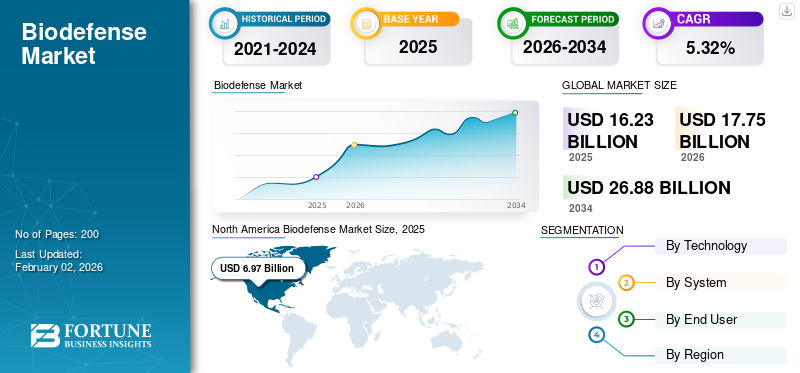
The global biodefense market size was valued at USD 16.23 billion in 2025 and is projected to grow from USD 17.75 billion in 2026 to USD 26.88 billion by 2034, exhibiting a CAGR of 5.32% during the forecast period. North America dominated the biodefense market with a market share of 42.97% in 2025.
The industry is growing due to various factors, such as rising fears of bioterrorism, the emergence of new infectious diseases, and progress in biotechnology. Increased government funding, private investment, and a greater awareness of biological threats are further fueling this growth.
Biological defense encompasses strategies aimed at tackling biological threats, reducing biological risks, and preparing for, responding to, and recovering from biological events, regardless of their origin, whether they occur naturally, by accident, or through intentional actions, and whether they impact humans, animals, plants, or the environment. Initiatives in this sector often focus on improving biosecurity and biosafety. This issue is frequently discussed in the context of biological warfare or bioterrorism and is generally considered relevant to military or emergency response situations. Biodefense is significant for two distinct groups: civilian populations and military personnel (soldiers engaged in operations). Protecting water and food supplies often plays a crucial role in efforts related to biological defense.
Download Free sample to learn more about this report.
The major key entities such as AirBoss Defense Group, Inc. (U.S.), Bioquell, An Ecolab Solution (U.S.), Bio-Rad Laboratories, Inc. (U.S.), BlueDot Inc. (Canada), E4life Srl (Australia), Emergent BioSolutions Inc. (U.S.), SIGA Technologies, Inc. (U.S.), and others are making significant investments in various fields, such as vaccine development and treatment development, diagnostic tools, and sophisticated technologies for detection and monitoring. These increasing investments are propelled by the rising risks of bioterrorism and pandemics, along with the necessity to enhance national security and readiness for public health emergencies anticipates market growth.
Download Free sample to learn more about this report.
Biodefense Market Key Takeaways
 Market Size & Forecast
- 2025 Market Size: USD 16.23 billion
- 2026 Market Size: USD 17.75 billion
- 2034 Forecast Market Size: USD 26.88 billion
- CAGR: 5.32% from 2026–2034
 Market Share
- North America dominated the biodefense market with a 42.97% share in 2025.
- The military forces segment is projected to dominate the market with a 36.61% share in 2026.
- The military forces segment led demand due to increasing focus on biological threat preparedness and development of countermeasures.
 Key Regional Highlights
North America
North America was valued at USD 6.97 billion in 2025 and is projected to reach USD 7.65 billion in 2026, supported by government investment and strong research infrastructure.
Europe
Europe was valued at USD 3.8 billion in 2025 and is projected to reach USD 4.2 billion in 2026, driven by biosecurity funding and preparedness initiatives.
Asia Pacific
Asia Pacific was valued at USD 4.05 billion in 2025 and is projected to reach USD 4.41 billion in 2026, supported by health infrastructure and biosafety focus.
U.S
The market is projected to reach USD 7.41 billion by 2026, driven by defense support and biodefense initiatives.
Japan
The market is projected to reach USD 0.44 billion by 2026, supported by increased medical countermeasure funding and expanding biodefense capabilities.
Read More

Market Dynamics
Market Drivers
Increased Awareness of Biological Risks and Government Initiatives to Boost Market Expansion
The biodefense market growth is witnessing considerable expansion, driven by heightened awareness of biological risks, government involvement, and significant investment. This growth is further accelerated by the frequent occurrence of pandemics, infectious diseases, and changing security issues, along with progress in biotechnology and life sciences.
Companies in the pharmaceutical and biotechnology fields are leading the way in the creation of vaccines and treatments to address biological dangers. Moreover, governments globally are making substantial investments in industry efforts, which include research and development, vaccine stockpiling, and the creation of advanced detection and decontamination technologies. For instance, in April 2025, Parsons Corporation was awarded a USD 24 million contract by the Naval Medical Research Command aimed at improving research, particularly in the area of quick detection of infectious diseases. This contract highlights Parsons' continuous partnership with the NMRC and its dedication to bolstering national security initiatives.
Innovations in fields such as AI, machine learning, IoT-enabled biosensors, and rapid diagnostics are improving the efficiency and scalability of measures. The persistent threat of pandemics and the rise of new infectious diseases generate an ongoing requirement for strong defense capabilities. Rising geopolitical tensions and the risk of biological warfare also play a role in the expansion of the biodefense industry.
For instance, in August 2023, Researchers at the University of Missouri developed a novel nanopore-based method for biosensor applications, which could enhance breakthroughs in neuroscience, medical biosensors, and various other disciplines.
Market Restraints
Risk, Uncertainty, High R&D Costs, and Long Approval Times Hamper Market Growth
The sector encounters several considerable limitations, primarily stemming from elevated research and development (R&D) expenses, protracted approval timelines, and the intrinsic risks linked to creating products for uncommon or low-incidence diseases. These obstacles restrict market access for smaller firms and delay the advancement and implementation of essential technologies. The creation of products, such as vaccines and treatments, necessitates substantial investment in research, clinical trials, and obtaining regulatory approvals. The regulatory framework for key products is especially demanding, requiring comprehensive data submissions and often presenting few opportunities for real-world testing.
These formidable barriers inhibit innovation and market growth, leaving many companies reluctant to pour resources into a sector with unpredictable returns. Biological defense products typically focus on rare or low-prevalence diseases, complicating the execution of large-scale clinical trials and the evaluation of effectiveness. The possibility of liability concerns and the threat of product failure can discourage larger pharmaceutical companies from venturing into this field. In the absence of guaranteed purchases from government bodies, companies may find it challenging to recover development expenditures, thus diminishing the motivation to pursue biodefense solutions.
Market Opportunities
Rising Biological Risks Present Several Market Opportunities
The biodefense industry is on the brink of considerable expansion, fueled by rising global apprehensions about biological risks and advancements in related technologies. Key prospects involve creating quick-response vaccines and treatments, improving pathogen detection and biosurveillance systems, and incorporating emerging technologies such as AI and IoT-enabled sensors.
The growing prevalence of pandemics and outbreaks, including COVID-19 and Ebola, has underscored the necessity for strong mechanisms. The risk of bioterrorism also boosts the demand for technologies and solutions. The implementation of these technologies in healthcare settings for timely detection and intervention is further contributing to market growth.
Collaboration among government entities, research organizations, and private companies is vital for the development and deployment of effective biological measures. Public-private partnerships can enable the exchange of knowledge, technology, and resources, speeding up the creation and implementation of biological defense innovations.
Biodefense Market Trends
Increasing Adoption of Advanced Technologies to Cater to Potential Market Growth
The industry is at an inflection point where technological innovations are converging to address evolving biological threats while creating substantial market opportunities. Major players are examining the use of artificial intelligence (AI) and machine learning (ML) to enhance detection and response capabilities. AI and ML are being implemented in fields such as identifying pathogens, assessing risks, and forecasting outbreaks.
For instance, in February 2022, TeselaGen Biotechnology revealed a two-year agreement with BioMADE, the bioindustrial Manufacturing Innovation Institute supported by the Department of Defense, aimed at enhancing the informatics framework surrounding fermentation-based biomanufacturing. In this partnership, TeselaGen will create innovative technologies that standardize data transfer, link various software systems, and set up secure protocols to promote collaboration on projects that leverage AI.
There is also a focus on investing in advanced technologies for decontamination and personal protective equipment. Progress in genetic engineering and biotechnology has enabled the creation of innovative vaccines, diagnostic tools, and therapeutics for a broader array of pathogens. The rapid development of detection and decontamination technologies, including biosensors and sterilization equipment, is enhancing the capacity to recognize and address biological threats. New vaccine technologies, such as vector-based vaccines, are facilitating quicker and more effective responses to emerging challenges.
The persistent risk of pandemics and the rise of new infectious diseases necessitate a continuous investment in strong biodefense capabilities. An increasing priority is being placed on creating vaccines and therapies that can be rapidly modified to address new and emerging pathogens. Governments are putting resources into technologies aimed at real-time detection of pathogens, biosurveillance systems, and platforms for pathogen identification. There is an intensified emphasis on building strong biosurveillance systems to keep watch for possible biological threats.
Market Regulatory Analysis
Rapid Emergency Response Capabilities and Stringent Security Standards Create Unique Compliance Challenges for Market Participants
Regulatory assessment entails evaluating how regulations influence biological operations, pinpointing deficiencies in current regulations, and suggesting enhancements to ensure efficient practices. This assessment encompasses regulations related to biosafety, biosecurity, and the creation and distribution of medical countermeasures.
Biosafety and Biosecurity: Reviewing the regulations that govern the management and containment of biological agents in both research and clinical environments, which includes laboratory biosecurity and the secure transport of infectious materials.
Medical Countermeasures (MCMs): Investigating regulatory pathways for the development, authorization, and deployment of vaccines, treatments, and diagnostics utilized in biological defense, incorporating the implementation of Emergency Use Authorizations (EUAs).
Dual-Use Research of Concern (DURC): Evaluating the regulatory framework surrounding research that has the potential for both beneficial and detrimental applications, including recognizing and addressing the risks linked to such research.
International Cooperation: Examining the impact of global regulations and treaties in promoting international biological defense initiatives and thwarting the misuse of biological agents.
Statistical Analysis: Assessing the statistical techniques employed in bio research and surveillance, pinpointing possible biases or constraints in data evaluation, and creating standardized methodologies.
Essentially, regulatory analysis in biodefense seeks to guarantee that regulations are thoughtfully crafted, efficiently executed, and suitably modified to address the changing nature of threats, thereby enhancing stronger and resilient biological defense strategies to anticipate the market growth.
SEGMENTATION ANALYSIS
By Technology
Rising Need to Kill Microorganisms to Boost UV Light Segment Growth
The military forces segment dominated the global market with a market share of 36.61% in 2026.
The UV light segment accounted for the largest market share in 2025 and is estimated to be the fastest-growing segment. It plays a role in biological defense by effectively killing or inactivating microorganisms such as bacteria, viruses, and fungi. The future demand for UV light in bio is expected to grow due to its effectiveness in disinfection and sterilization, particularly in light of the COVID-19 pandemic and increasing awareness of biosecurity threats. The vaccinations and medications segment is projected to account for 23.43% of the market share in 2026.
The cold plasma segment is experiencing significant growth, driven by its expanding applications in various industries. While the primary focus is on medical and food applications, the potential for cold plasma in biodefense is emerging, particularly in sterilization and decontamination of surfaces and materials.
By System
Biosensors to Lead Market as They Assist Swift and Precise Identification of Biological Threats
By system, the market is classified into digital biosurveillance networks, early warning systems, biohazard detection systems, AI-assisted surveillance system, biosensors, and others.
The biosensors segment is estimated to be the fastest-growing segment during the forecast period of 2026-2034. The growth is anticipated due to its important function in the swift and precise identification of biological threats, improvements in miniaturization and transportability, and increased governmental support for bio research and innovation, driving the market growth. Moreover, biosensors provide the capability to rapidly and sensitively identify pathogens and toxins, which is essential for prompt reactions to bioterrorism threats or outbreaks of contagious diseases. Progress in biosensor technology has resulted in the creation of smaller, more portable units, facilitating their application in a range of environments, including field operations, border security, and point-of-care diagnostics, anticipating the segmental growth.
The biohazard detection systems segment is expected to represent 35.19% of the market share in 2026.
The segment is witnessing substantial expansion in the biological defense field due to various factors, such as increasing uncertainties about bioterrorism, pandemics, and other biological dangers, along with progress in detection technology. These systems are essential for the swift and accurate recognition of biological threats, facilitating prompt actions to reduce potential damage. Furthermore, the risk of bioterrorism, particularly concerning the possible deployment of biological weapons by non-state entities, has heightened the need for sophisticated detection systems. In addition, advancements in domains including next-generation sequencing (NGS), biosensors, and other technologies have led to more sensitive, specific, and rapid identification of biological agents, driving the growth of this segment.
To know how our report can help streamline your business, Speak to Analyst
By End User
Increasing Research and Development by Pharmaceutical & Biotech Companies to Propel Segmental Growth
The end user classifies the market into military forces, homeland security, hospitals & clinics, pharmaceutical & biotech companies, and virological research institutes.
The pharmaceutical & biotech companies segment is estimated to be the fastest-growing segment during the forecast period of 2026-2034. The segment is experiencing heavy growth due to increasing global apprehensions regarding bioterrorism, newly emerging infectious diseases, and biological warfare, alongside substantial government/private funding and progress in biotechnology, which are propelling the creation of innovative vaccines, therapeutics, and diagnostic tools to address biological threats. This results in expanded market prospects for these companies.
The military forces segment is projected to dominate the market with a share of 36.61% in 2026. The increasing worries regarding pandemics, biological warfare, and the possibility of both state and non-state actors creating and using biological weapons necessitate not only building defenses against these threats but also comprehending and addressing potential offensive bioweapon abilities. In addition, military personnel can be at risk from biological threats, whether in combat or non-combat scenarios. Research in bio aids in the development of counter-measures such as vaccines, protective equipment, and quick diagnostic tools aid the segmental growth.
BIODEFENSE MARKET REGIONAL OUTLOOK
By region, the global market is analyzed across North America, Europe, Asia Pacific, the Middle East & Africa, and Latin America.
North America
North America Biodefense Market Size, 2025 (USD Billion)
To get more information on the regional analysis of this market, Download Free sample
North America dominated the biodefense market share in 2024. The U.S., along with Canada, constitutes the largest regional market in the global bio sector, primarily fueled by significant government investment, a robust framework, and a dynamic network of private-sector collaborators and research organizations. Key elements involve a strong infrastructure, and strategic programs fuel the demand. The U.S. government, especially through the Department of Defense and Homeland Security, allocates significant resources to this sector. Programs such as Project BioShield and BARDA (Biomedical Advanced Research and Development Authority) have been essential in promoting research and development, procurement, and the stockpiling of countermeasures. The U.S. market is projected to reach USD 7.41 billion by 2026. The North America market generated USD 6.97 billion in 2025, representing 42.97% of the global market landscape, and is expected to reach USD 7.65 billion in 2026.
Additionally, prominent organizations, including the National Institutes of Health (NIH) and the Centers for Disease Control and Prevention (CDC), are crucial in progressing biodefense research. For instance, in August 2024, SIGA Technologies, Inc. revealed a new agreement with the U.S. Department of Defense (DOD) for the purchase of around USD 9 million worth of TPOXX. This contract mainly includes oral TPOXX, along with a limited quantity of intravenous (IV) TPOXX, and marks the third time in three years that the DOD has awarded a procurement contract.
The U.S. is adopting different sectors to combat biological threats, boost pandemic readiness, strengthen global health security, and implement the National Biodefense Strategy. A crucial element of this strategy is the synchronization of efforts throughout the federal government, involving entities such as the Department of Health and Human Services (HHS) and the Department of Defense (DoD), which are preparing for the U.S. market share.
Europe
Europe is expected to be the fastest-growing region in the market during the forecast period. The increasing government funding for biosecurity, technological advancements, and a commitment to sustainability are on the rise. Growing awareness of biological threats, along with a heightened focus on research and development, is propelling growth in the industry. For instance, in October 2024, in partnership with the European Investment Bank (EIB), HERA has pledged USD 22.4 million to assist the French biopharmaceutical firm Fabentech in creating and implementing broad-spectrum therapies designed to address biological threats to public health. National governments across Europe are making significant investments in bio systems to strengthen their readiness against biological dangers. Initiatives such as the European Health Emergency Response Authority (HERA) and the European Wastewater Surveillance Dashboard exemplify proactive efforts to enhance bio-intelligence and improve early detection methods. The UK market is projected to reach USD 0.71 billion by 2026, while the Germany market is projected to reach USD 0.62 billion by 2026. Europe contributed 23.43% to the global market in 2025, with a valuation of USD 3.8 billion, and is projected to reach USD 4.2 billion in 2026.
Europe leads in biotechnology innovation, boasting robust research and development capabilities. The region is witnessing a surge in digitalization, sustainability efforts, and the assimilation of AI and automation into solutions. Advancements in technology are paving the way for the creation of more effective and efficient tools and strategies. For instance, in October 2023, Smiths Detection announced that after a competitive bidding process, it had secured a USD 89.6 million contract to design, produce, deliver, and maintain advanced Chemical Sense Equipment for the U.K. Ministry of Defence (MoD). This contract is part of an initiative by the MoD aimed at enhancing and replacing its chemical detection abilities, working to guarantee that locations are free from hazardous chemicals that may pose a threat to defense personnel or civilians.
Asia Pacific
Asia Pacific is expected to witness lucrative opportunities during the forecast period. The industry in the region is expanding due to various factors, such as growing public health issues, escalating geopolitical challenges, and the region's economic growth. Substantial investments in health infrastructure, disease surveillance, and military biosafety measures drive this expansion. The region is witnessing an uptick in infectious disease outbreaks, highlighted by the COVID-19 pandemic, which has exposed the susceptibility of Asia Pacific countries to biological risks. Consequently, there has been an increase in funding for systems and research and development focused on medical countermeasures. The Japan market is projected to reach USD 0.44 billion by 2026, the China market is projected to reach USD 3.48 billion by 2026, and the India market is projected to reach USD 0.65 billion by 2026. Asia Pacific accounted for USD 4.05 billion in 2025, representing 24.95% of the global market share, and is projected to reach USD 4.41 billion in 2026.
For instance, in January 2025, Smiths Detection will provide the Japan Ministry of Defense (JMOD) with LCD 4 personal chemical detectors for use by its Ground Self-Defense Force (JGSDF). After a thorough and competitive assessment of products by the JMOD, the LCD3.3 and LCD4 were selected due to their outstanding performance and adaptability. The ease of integration into the JMOD system was also a significant factor in the selection process.
Middle East & Africa
The Middle East & Africa region is estimated to experience moderate growth in the market. Rising awareness of biological threats, government initiatives, and progress in biotechnology are contributing to this trend. Heightened fears regarding bioterrorism, infectious diseases, and the potential abuse of biological agents are prompting increased investments in biotechnologies, such as vaccines, diagnostics, and therapeutics. In 2025, Middle East & Africa held 6.55% of the global market, reaching a valuation of USD 1.06 billion, and is projected to grow to USD 1.14 billion in 2026.
The biotechnology sector in the Middle East & Africa region is undergoing expansion due to a growing prevalence of chronic diseases and advancements in technology. This growth is also supported by government backing for research and development in fields such as plant biotechnology and biosafety. Emphasis on sustainable agriculture and biopesticides is further driving the growth of the technology industry.
Latin America
Latin America is witnessing expansion due to various reasons, such as heightened governmental funding for public health safety, a move toward decentralized testing, and the area's abundant biodiversity, which presents opportunities for new biopesticides and bio-based goods. The growth in the region has increased local producers creating diagnostics specifically designed for its unique health challenges, including those related to dengue, chikungunya, and Zika. This focus on point-of-care (POC) diagnostics is fueling the growth of the industry. Latin America contributed approximately USD 0.34 billion to the global market in 2025, accounting for 2.09% share, and is expected to reach USD 0.36 billion in 2026.
Latin America is regarded as a promising region for biosimilars, with domestic firms implementing robust growth strategies and concentrating on research and development and manufacturing. These companies can provide high-quality products at more affordable prices, enhancing their competitiveness in the international market.
Competitive Landscape
KEY INDUSTRY PLAYERS
Key Players Focus on New Development, Mergers, and Acquisitions to Gain Competitive Edge
The market is marked by fierce rivalry between both established and new firms, motivated by the need to respond to changing biological threats and a growing emphasis on national security. Major participants consist of pharmaceutical and biotech companies that create vaccines, treatments, and diagnostic tools, and specialized firms that concentrate on technologies for decontamination and detection systems. Collaborations between public and private sectors, government funding, and progress in fields such as artificial intelligence and synthetic biology are also significantly influencing the competitive environment.
Established businesses utilize their resources and expertise, while cutting-edge companies bring forth new technologies. For instance, in March 2025, Alnylam Pharmaceuticals, Inc. emphasized the importance of the U.S. Food and Drug Administration's (FDA) endorsement of Qfitlia (fitusiran), marking it as the sixth RNAi therapeutic discovered by Alnylam to gain approval in the U.S., and the first and only treatment designed to lower antithrombin (AT). This protein plays a role in inhibiting blood clotting, aiming to enhance thrombin production to restore hemostasis and avert bleeding episodes.
Businesses are strengthening their market standings by engaging in acquisitions. These collaborations are essential for research and development, speeding up innovation and filling resource gaps. For instance, in February 2025, Bavarian Nordic A/S revealed a strategic collaboration with Biological E. Limited (BE) aimed at increasing the availability of Bavarian Nordic's chikungunya vaccine in low- and middle-income (LMIC) nations.
List of Top Biodefense Companies Profiled:
- AirBoss Defense Group, Inc. (U.S.)
- Bioquell, An Ecolab Solution (U.S.)
- Bio-Rad Laboratories, Inc. (U.S.)
- BlueDot Inc. (Canada)
- E4life Srl (Australia)
- Emergent BioSolutions Inc. (U.S.)
- SIGA Technologies, Inc. (U.S.)
- Dynavax Technologies (U.S.)
- Alnylam Pharmaceuticals, Inc. (U.S.)
- Ichor Medical Systems Inc. (U.S.)
- Bavarian Nordic A/S (Denmark)
- SKAN AG (Switzerland)
- Smiths Detection Group Ltd. (U.K.)
- Parsons Corporation (U.S.)
KEY INDUSTRY DEVELOPMENTS
- May 2025: The SKAN Group AG, a global leader in premium isolator systems for aseptic production in the (bio-) pharmaceutical sector, has reached an agreement to purchase a controlling interest in Metronik d.o.o.
- March 2025: Bavarian Nordic A/S announced that the Food and Drug Administration (FDA) of the U.S. has granted approval for the freeze-dried version of JYNNEOS (Live, Non-replicating Smallpox and Mpox Vaccine) aimed at preventing smallpox and mpox in adults aged 18 and over. This authorization will offer greater flexibility for stockpiling in preparation for a potential smallpox incident or mpox outbreak.
- March 2025: Emergent BioSolutions revealed that it has obtained around USD 27 million in overseas orders intended for delivery in 2025, connected to its medical countermeasures (MCM) portfolio. These orders will assist in mitigating potential risks posed by smallpox and anthrax and will enhance the overall availability of MCMs in the international Market for 2025.
- January 2025: Emergent BioSolutions Inc. revealed that it has exercised a contract option and modification worth around USD 20 million to provide BioThrax (Anthrax Vaccine Adsorbed) to the U.S. Department of Defense (DoD). The initial delivery, valued at roughly USD 7 million, started in December 2024, with the subsequent deliveries anticipated in 2025.
- January 2024: The Department of Defense (DOD) granted an indefinite delivery/indefinite quantity (ID/IQ) procurement contract to Emergent BioSolutions, Inc. for the provision of the FDA-approved BioThrax (Anthrax Vaccine Adsorbed), which serves as pre-exposure prophylaxis (PrEP) against anthrax disease, for utilization across all military branches over the upcoming decade.
REPORT COVERAGE
The report provides a detailed analysis of the market and focuses on key aspects such as leading companies, technologies, systems, and end users. Besides, the report offers insights into market trends and highlights key industry developments. In addition to the factors above, the report encompasses several factors that contributed to the growth of the market in recent years.
Request for Customization to gain extensive market insights.
Report Scope & Segmentation
|
ATTRIBUTE |
DETAILS |
|
Study Period |
2021–2034 |
|
Base Year |
2025 |
|
Estimated Year |
2026 |
|
Forecast Period |
2026-2034 |
|
Historical Period |
2021–2024 |
|
Growth Rate |
CAGR of 5.32% from 2026-2034 |
|
Unit |
Value (USD Billion) |
|
By Segmentation |
By Technology
|
|
By System
|
|
|
By End User
|
|
|
By Region
|
Frequently Asked Questions
As per the Fortune Business Insights study, the market is projected to grow from USD 16.23 billion in 2026 to USD 26.88 billion by 2034.
The market is likely to grow at a CAGR of 5.32% during the forecast period.
By end-user, the pharmaceutical & biotech companies segment is expected to be the fastest-growing in the market.
North America held the largest market share in 2025.
Some of the top players are AirBoss Defense Group, Inc. (U.S.), Bioquell, An Ecolab Solution (U.S.), Emergent BioSolutions Inc. (U.S.), SIGA Technologies, Inc. (U.S.), Smiths Detection Group Ltd. (U.K.), and Parsons Corporation (U.S.).



- 2021-2034
- 2025
- 2021-2024
- 200
Get 30-60 hrs Free Customization
Expand Regional and Country Coverage, Segments Analysis, Company Profiles, Competitive Benchmarking, and End-user Insights.




















Related Reports
-
US +1 833 909 2966 ( Toll Free )
-
Get In Touch With Us