Biohacking Market Size, Share & Industry Analysis by Offering (Products {Wearables, Implants, Nutraceuticals, Nootropics, and Others} and Services), By Application (Health Monitoring, Longevity/Anti-aging, Cognitive Enhancement, Personalized Nutrition, and Others), By Distribution Channel (Retail Pharmacies & Drug Stores, Specialty Health & Wellness Retailers, Online Channels, and Others), and Regional Forecast, 2026-2034
 Download Free Sample
Biohacking Market Size and Industry Overview
 Listen to Audio Version
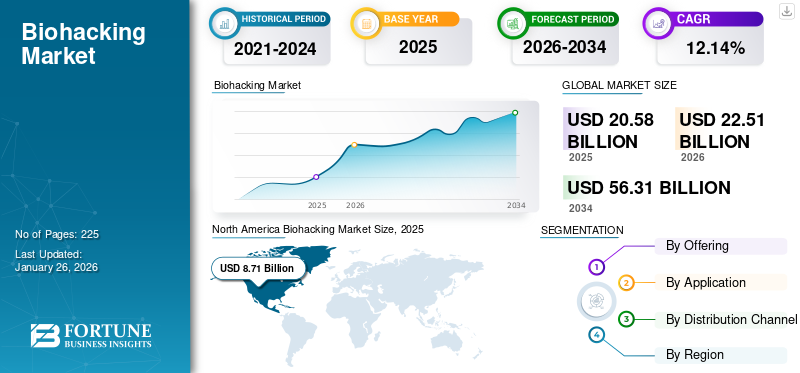
The global biohacking market size was valued at USD 20.58 billion in 2025. The market is projected to grow from USD 22.51 billion in 2026 to USD 56.31 billion by 2034, exhibiting a CAGR of 12.14% during the forecast period. North America dominated the biohacking market with a market share of 42.32% in 2025.
Biohacking technologies refer to the practice of optimizing, augmenting, or modifying biological systems, often by individuals, startups, or small groups, using technology, biotechnology, data, and self-experimentation. The upward trajectory of the market can be attributed to several factors such as growing interest in preventive health, advances in wearable devices, expansion of DIY biology, and others.
Furthermore, the market incorporates various major players such as Apple Inc., The ODIN, Wellness, LLC, and Health Via Modern Nutrition Inc., among others. Wide product portfolio coupled with strong geographic expansion have supported the dominance of these companies in the global market.
Download Free sample to learn more about this report.
Biohacking Market Key Takeaways
 Market Size & Forecast
- 2025 Market Size: USD 20.58 billion
- 2026 Market Size: USD 22.51 billion
- 2034 Forecast Market Size: USD 56.31 billion
- CAGR: 12.14% from 2026–2034
 Market Share
- North America dominated the biohacking market with a 42.32% share in 2025.
- The products segment is expected to hold a 75.91% market share in 2026.
- The health monitoring segment is projected to account for 43.60% of the market in 2026.
 Key Regional Highlights
North America
North America generated USD 8.71 billion in 2025 and is projected to reach USD 9.52 billion in 2026.
Europe
Europe accounted for 25.77% of global revenue in 2025 and is expected to reach USD 5.78 billion in 2026.
Asia Pacific
Asia Pacific represented 24.76% of the global market in 2025 and is projected to grow to USD 5.63 billion in 2026.
U.S.
The biohacking market is estimated to reach USD 9.02 billion in 2026.
Japan
Growing adoption of advanced healthcare technologies and preventive wellness solutions is supporting market growth.
Read More

MARKET DYNAMICS
MARKET DRIVERS
Shift toward Preventive & Personalized Health to Boost Market Growth
One of the significant growth drivers of the market is the shift toward preventive and personalized health. The traditional “one-size-fits-all” healthcare model is giving way to proactive health management, where individuals prefer to anticipate and prevent disease rather than react when symptoms arise. Advances in genomics, biomarker testing, and wearable sensors allow deep personalization tailoring diet, supplements, interventions, and monitoring to individual biology, resulting in growing market demand. Additionally, after the COVID-19 pandemic, people are more engaged in their own health, seeking control over biomarkers, immunity, recovery, and longevity. All these factors are collectively propelling the global biohacking market growth.
- For instance, in April 2024, Function Health partnered with Equinox Group to provide members with personalized nutrition, sleep, and fitness coaching programs integrated with lab testing.
MARKET RESTRAINTS
Safety Risks and Ethical Concerns to Restrict Market Expansion
Safety and ethical issues remain one of the most significant restraints in the global market. Many biohacking practices including self-implantation of chips, unregulated genetic modification, and unsupervised use of cognitive enhancers or nootropics — pose potential health hazards and long-term physiological risks. The absence of standardized clinical validation and medical oversight raises concerns about infection, device malfunction, or unintended biological effects. Ethically, interventions aimed at human enhancement blur the boundary between therapeutic use and augmentation, sparking debates over fairness, consent, and potential misuse. Governments and medical associations are increasingly cautious about endorsing invasive or experimental biohacking practices. All these factors are anticipated to slow down the market growth.
MARKET OPPORTUNITIES
Integration of AI and Data Analytics to Offer Lucrative Growth Opportunities
The integration of artificial intelligence (AI) and advanced data analytics represents a lucrative growth opportunity in the market. AI enables the conversion of raw biometric, genetic, and lifestyle data into personalized, actionable health insights, enhancing user engagement and outcome precision. Machine learning algorithms can analyze patterns from continuous wearable or implant data to predict stress, fatigue, or metabolic changes — allowing real-time preventive interventions. As AI models become more sophisticated, they support adaptive supplementation, nutrition, and sleep optimization tailored to each individual’s biology. Moreover, integration with cloud platforms and electronic health records is bridging the gap between consumer biohacking tools and formal healthcare systems.
BIOHACKING MARKET TRENDS
Expansion of Longevity and Anti-Aging Biohacking is one of the Significant Market Trends
The growing global interest in extending healthy lifespan has fueled rapid expansion in longevity and anti-aging biohacking. Advances in biotechnology and regenerative medicine are enabling companies to explore cellular rejuvenation, mitochondrial repair, and senolytic compounds that slow or reverse aspects of aging. Consumers are increasingly turning to supplements, diagnostics, and therapies aimed at optimizing cellular health and delaying age-related decline. The shift from cosmetic anti-aging to scientifically validated longevity interventions has also drawn strong investor attention. Startups and biotech giants are establishing longevity clinics and research partnerships to integrate genomic testing, AI analytics, and precision nutrition into personalized aging solutions.
MARKET CHALLENGES
Data Privacy and Cybersecurity Risks to Hamper Market Growth
Data privacy and cybersecurity concerns represent major challenge in the global market. Most biohacking products such as wearables, implants, and personalized health platforms collect sensitive biometric, genetic, and behavioral data. Without robust encryption, transparent consent mechanisms, or standardized governance, users face risks of data breaches, unauthorized sharing, and misuse by third parties including insurers or employers. Growing dependence on cloud-based analytics and AI-driven personalization further amplifies the vulnerability of health data to hacking or profiling. Consumers are increasingly cautious about entrusting continuous health tracking to companies lacking clear data protection policies. Thus, the market faces challenges in product adoption to a certain level.
- For instance, according to data published in TechTarget in September 2025, more than 29 million individuals were affected by healthcare data breaches in the first half of 2025.
Download Free sample to learn more about this report.
Segmentation Analysis
By Offering
High Usage of Various Products Contributed to Segment Growth
On the basis of offering, the market is classified into products and services.
To know how our report can help streamline your business, Speak to Analyst
The products segment is expected to capture the largest share of the global biohacking market, accounting for 75.91% in 2026. Factors such as the widespread adoption of wearables, implants, nutraceuticals, and nootropics along with advancements in wearable technologies have primarily driven the segment growth. Additionally, the increasing preference of consumers for self-monitoring and performance-enhancing products propels the segment. Furthermore, frequent new product launches also support the segment’s dominance.
- For instance, in August 2023, a new 3D printing facility in the U.S. was opened by Materialise, a leading 3D printing and personalized medical solutions provider, to enhance the delivery of patient-specific and customized medical implants.
The services segment is expected to witness a CAGR of 15.29% over the forecast period.
By Application
Increasing Focus on Health Monitoring Fuels the Growth of the Segment
In terms of application, the market is categorized into health monitoring, longevity/anti-aging, cognitive enhancement, personalized nutrition, and others.
The health monitoring segment is expected to witness the highest market share, accounting for 43.60% in 2026. over the forecast period. Rising awareness about preventive health, increasing shift toward tracking vital parameters, high patient burden of chronic diseases, and technological advancements in self-health monitoring devices are some of the factors propelling the segment growth. Furthermore, increasing awareness programs for self-health monitoring are also supplementing the market growth.
- For instance, World Health Organization (WHO) is one of the actively involved organizations in increasing awareness programs for self-health monitoring.
The longevity/anti-aging segment is expected to witness the fastest growth rate of 18.15% over the forecast period.
By Distribution Channel
Easy Availability of Products through Retail Pharmacies & Drug Stores Propelled Segment Growth
Based on distribution channel, the market is segmented into retail pharmacies & drug stores, specialty health & wellness retailers, online channels, and others.
The retail pharmacies & drug stores segment is expected to hold the dominating share, accounting for 36.74% in 2026. of the global market in terms of distribution channel. This is owing to their established distribution networks, easy access to consumers and wide availability of products. Furthermore, the segment is estimated to hold 37.8% share in 2025.
In addition, the online channels segment is projected to grow at a CAGR of 15.96% during the forecast period.
Biohacking Market Regional Outlook
By region, the market is divided into Europe, North America, Asia Pacific, Latin America, and the Middle East & Africa.
North America
North America Biohacking Market Size, 2025 (USD Billion)
To get more information on the regional analysis of this market, Download Free sample
North America captured the dominating share of the global market in 2025, valuing at USD 8.71 billion, and also took the leading share in 2026 with USD 9.52 billion. Key factors responsible for this dominance include strong technological infrastructure in the region, high consumer spending, and early adoption of products. In 2026, the U.S. market is estimated to reach USD 9.02 billion. Additionally, the presence of well-established companies along with emerging start-ups supports the market growth.
- For instance, Apple Inc., and Health Via Modern Nutrition Inc. are some of the leading market players that are based in the U.S.
Europe
In 2025, Europe generated USD 5.3 billion, contributing 25.77% to global market revenue, and is projected to grow to USD 5.78 billion in 2026. Europe is projected to witness notable growth during the forecast period and is expected to register a CAGR of 10.77%, making it the second-largest regional market. The region is anticipated to reach a valuation of USD 5.30 billion in 2025. This growth is primarily driven by the increasing adoption of implants and genetic testing kits, along with rising awareness regarding preventive healthcare. Supported by these factors, the U.K., Germany, and France are projected to record market values of USD 1.34 billion, USD 1.21 billion, and USD 0.86 billion, respectively, by 2026.
Asia Pacific
The Asia Pacific market accounted for USD 5.1 billion in 2025, representing 24.76% of the global industry, and is expected to reach USD 5.63 billion in 2026. The growth of the region is supported by increasing healthcare investments, expanding adoption of advanced medical technologies, and rising awareness about early diagnosis and preventive care. Within the region, India and China are projected to reach USD 1.02 billion and USD 1.04 billion, respectively, by 2026.
Latin America
Latin America is expected to experience relatively slower growth during the forecast period. Latin America contributed 4.06% to the global market in 2025, with a valuation of USD 0.84 billion, and is projected to reach USD 0.9 billion in 2026. However, the increasing adoption of digital healthcare products and technologies is anticipated to support market growth in the coming years.
Middle East & Africa
In 2025, Middle East & Africa represented USD 0.63 billion, accounting for 3.08% of the worldwide market, and is projected to grow to USD 0.68 billion in 2026. The Middle East & Africa region is also projected to witness slower growth over the forecast period. In this region, the GCC market is expected to reach a value of USD 0.31 billion in 2025, supported by the gradual adoption of digital healthcare solutions and improving healthcare infrastructure.
COMPETITIVE LANDSCAPE
Key Industry Players
Diversified Therapeutic Portfolio and Robust R&D Capabilities Strengthened the Market Position of Leading Companies
The global biohacking market reflects a semi-consolidated structure with a mix of consumer health companies, technology innovators, and biotech-driven startups accounting for a significant market share. Key players such as Apple Inc., The ODIN, Wellness, LLC, and Health Via Modern Nutrition Inc. dominate the global market. This can be attributed to their diverse product portfolios, integrated digital platforms, and expanding global distribution networks.
In addition to these entities, emerging biohacking-focused companies are gaining traction through specialized product portfolios and R&D innovations. These companies include ReCELLebrate, Revive Biohacking, Human Longevity, Inc., and others.
LIST OF KEY BIOHACKING COMPANIES PROFILED
- Apple Inc. (U.S.)
- The ODIN (U.S.)
- Wellness, LLC. (U.S.)
- Health Via Modern Nutrition Inc. (U.S.)
- Revive Biohacking (U.S.)
- ReCELLebrate (U.S.)
KEY INDUSTRY DEVELOPMENTS
- September 2024: Apple Inc. introduced the Apple Watch Series 10, featuring enhanced blood pressure monitoring and sleep apnea detection capabilities.
- May 2024: The Fitbit ACE LTE smartwatch with interchangeable straps and 16 hours of battery life was launched by Fitbit Inc. for kids.
- February 2024: Samsung rolled out a new fitness band with aluminum frame in the Philippines market.
- September 2023: WHOOP Inc. introduced its AI-powered “Coach” feature, which uses continuous physiological data to deliver personalized recommendations for recovery, training, and sleep optimization.
- April 2021: Pacific Northwest-based Premera Blue Cross partnered with NeuroMetrix, Inc. to roll out the new Quell wearable device for the treatment of pain caused by chronic ailments.
REPORT COVERAGE
Request for Customization to gain extensive market insights.
Report Scope & Segmentation
|
ATTRIBUTE |
DETAILS |
|
Study Period |
2021-2034 |
|
Base Year |
2025 |
|
Forecast Period |
2026-2034 |
|
Estimated Year |
2026 |
|
Historical Period |
2021-2024 |
|
Growth Rate |
CAGR of 12.14% from 2026-2034 |
|
Unit |
Value (USD Billion) |
|
Segmentation |
By Offering, Application, Distribution Channel, and Region |
|
By Offering |
· Products o Wearables o Implants o Nutraceuticals o Nootropics o Others · Services |
|
By Application |
· Health Monitoring · Longevity / Anti-aging · Cognitive Enhancement · Personalized Nutrition · Others |
|
By Distribution Channel |
· Retail Pharmacies & Drug Stores · Specialty Health & Wellness Retailers · Online Channels · Others |
|
By Geography |
· North America (By Offering, Application, Distribution Channel, and Country) o U.S. o Canada · Europe (By Offering, Application, Distribution Channel, and Country/Sub-region) o Germany o U.K. o France o Spain o Italy o Scandinavia o Rest of Europe · Asia Pacific (By Offering, Application, Distribution Channel, and Country/Sub-region) o China o Japan o India o Australia o Southeast Asia o Rest of Asia Pacific · Latin America (By Offering, Application, Distribution Channel, and Country/Sub-region) o Brazil o Mexico o Rest of Latin America · Middle East & Africa (By Offering, Application, Distribution Channel, and Country/Sub-region) o GCC o South Africa o Rest of the Middle East & Africa |
Frequently Asked Questions
Fortune Business Insights says that the global market value stood at USD 20.58 billion in 2025 and is projected to reach USD 56.31 billion by 2034.
In 2025, the North America market value stood at USD 8.71 billion.
The market is expected to exhibit a CAGR of 12.14% during the forecast period of 2026-2034.
The health monitoring segment is the leading segment in the market by application.
The key factors driving the market include a shift toward preventive & personalized health, rising interest in preventive health, longevity, & performance optimization, and growth in genomics and personalized medicine.
Apple Inc., The ODIN, Wellness, LLC, and Health Via Modern Nutrition Inc. are some of the prominent players in the market.
North America dominated the market in 2025.
Advances in wearable technology and sensors and shift toward preventive health are some of the factors that are expected to favor product adoption.



- 2021-2034
- 2025
- 2021-2024
- 225
Get 30-60 hrs Free Customization
Expand Regional and Country Coverage, Segments Analysis, Company Profiles, Competitive Benchmarking, and End-user Insights.













.webp)






Related Reports
-
US +1 833 909 2966 ( Toll Free )
-
Get In Touch With Us