Bioherbicides Market Size, Share & Industry Analysis, By Source (Microbial, Biochemical, and Others), By Form (Liquid and Dry), By Mode of Application (Seed Method, Foliar Method, Soil Method, and Others), By Crop Type (Cereals & Grains, Oilseeds & Pulses, Fruits & Vegetables, and Others), and Regional Forecast, 2026-2034
 Download Free Sample
(Offer valid till 15th Oct 2026)

KEY MARKET INSIGHTS
 Listen to Audio Version
The global bioherbicides market size was valued at 2,747.65 million in 2025 and is projected to grow from USD 3010.03 million in 2026 to USD 6380.1 million by 2034, exhibiting a CAGR of 9.87% during the forecast period. North America dominated the bioherbicides market with a market share of 36.11% in 2025.
Bioherbicides are natural weed control agents produced from natural sources (fungi, plants, and bacteria), formulated to offer an eco-friendly substitute to artificial chemicals. This solution acts by disrupting plant growth by inhibiting germination and producing phytotoxins, with negligible risk to the environment and non-target organisms. The surging need for weed management solutions and rising awareness of sustainable farming are pivotal factors bolstering the market’s potential. With respect to advantages, this herbicide minimizes water and soil contamination and is safe for non-target organisms. Moreover, it is residue-free and is biodegradable in nature. Additionally, it has low resistance development and promotes microbial biodiversity. In terms of consumption, North America and Europe are the leading nations in the market.
Some of the major players include FMC Corporation, Marrone Bio Innovations Inc., and Hindustan Bio Tech.
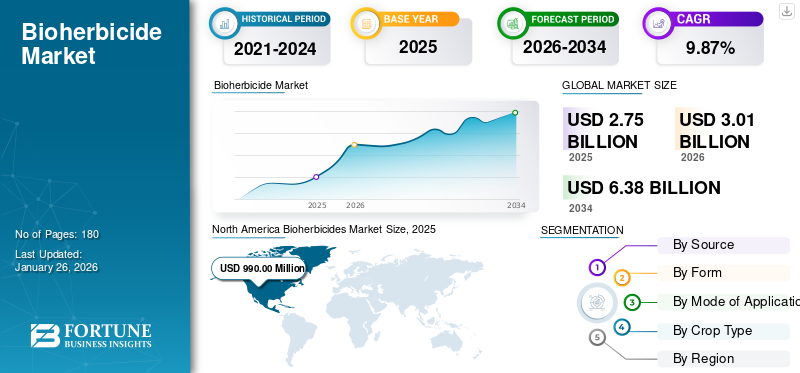
Download Free sample to learn more about this report.
Bioherbicides Market Takeaways
 Market Size & Forecast
- 2025 Market Size: USD 2.75 billion
- 2026 Market Size: USD 3.01 billion
- 2034 Forecast Market Size: USD 6.38 billion
- CAGR: 9.87% from 2026–2034
 Market Share
- North America dominated the bioherbicides market with a 36.11% share in 2025.
- The microbial segment is projected to lead the market with a 55.86% share in 2026.
- The liquid segment is expected to dominate with a 63.89% share in 2026, while the market grows at a CAGR of 9.87%.
 Key Regional Highlights
North America
North America led the market with USD 0.99 billion in 2025 and is projected to reach USD 1.08 billion in 2026, supported by rising organic farming and sustainable agriculture practices.
Europe
Europe accounted for 27.12% of global revenue in 2025 and is expected to reach USD 0.81 billion in 2026, driven by demand for residue-free food and advanced agricultural technologies.
Asia Pacific
Asia Pacific held 21.99% of the global market in 2025 and is projected to grow to USD 0.68 billion in 2026, supported by increasing organic food demand and R&D investments.
U.S.
The market is estimated to reach USD 800.0 million by 2026, fueled by strong adoption of sustainable farming practices and supportive environmental regulations.
Japan
The market is forecast to attain USD 70.0 million by 2026, supported by growing interest in eco-friendly crop protection solutions and sustainable agriculture.
Read More

MARKET DYNAMICS
MARKET DRIVERS
Rising Health and Environmental Concerns Bolster Use of Bioherbicides
The increasing awareness of environmental and health concerns is a critical driver promoting the market’s potential. In this modern era, most global consumers are aware of the adverse impact of artificial chemicals on both human and environmental health. Synthetic chemical solutions have been utilized for ages in agricultural fields; however, their adverse effects have raised concerns globally. The extensive use of these chemicals increases the risk of water contamination and degrades soil quality. Moreover, the active ingredients in traditional herbicides are linked to endocrine disruption and potential carcinogenicity.
Additionally, it harms beneficial insects and pollinators, which further creates challenges in the market. To control this scenario, farmers are turning toward bioherbicides as they are perceived as safe and eco-friendly. Moreover, this natural herbicide enhances soil health, which in turn, strengthens the crop quality.
MARKET RESTRAINTS
Short Shelf Life and Limited Farmer Awareness Hinder Market’s Momentum
One of the pivotal hurdles in the global industry is the limited shelf life of bioherbicides. In comparison to artificial herbicides, bioherbicides are produced from living and natural organisms (plants, bacteria, and fungi), and their effectiveness is dependent on their formulation as well as storage conditions. For instance, excessive moisture increases the chances of mold in solid-based formulations, ultimately leading to spoilage. Moreover, high temperatures can degrade/kill the microorganisms in naturally produced herbicides. Additionally, harmful radiation from sunlight can destroy the microorganisms present in herbicides. As a result, the aforementioned factors can impede the global bioherbicides market share.
Limited farmer awareness is another main obstacle observed in the market. Globally, the majority of farmers are unaware of naturally-sourced herbicides, which deters them from adopting bioherbicides.
MARKET OPPORTUNITIES
Technological Advancements in Market Unlocks Growth Opportunities
The utilization of modern technologies in the herbicides sector opens lucrative growth possibilities. To improve the quality of herbicides, companies can utilize nanotechnology, which strengthens solubility, targeted delivery, and stability. Moreover, advanced techniques such as metabolomics and genomics can be used to identify new natural compounds with herbicidal properties. Additionally, gas chromatography-mass spectrometry (GC–MS) and high-performance liquid chromatography (HPLC) are proven beneficial in identifying particular phytotoxins produced by microbes. Besides this, artificial intelligence is gaining huge popularity in the herbicides industry as it aids in accelerating the discovery of novel bioactive components from microbes.
BIOHERBICIDES MARKET TRENDS
Growing Adoption of Organic Farming is the Prominent Trend
The global industry is witnessing a growing and remarkable trend of organic farming. In today’s health-conscious era, more than half of the global population is suffering from chronic health ailments, ranging from cardiovascular issues to obesity. This hike in prevalence of health conditions is mainly due to lifestyle changes, dietary habits, and lack of preventative healthcare. In order to curb this scenario, the majority of individuals are seeking organic and healthier food products. In comparison to traditional items, organic food is produced using natural solutions that are free from artificial chemicals. By considering this the agricultural solutions producers are aiming to introduce new organic herbicides that can cater to the evolving consumer demands.
Download Free sample to learn more about this report.
Segmentation Analysis
By Source
Microbial Source Led Market Due to Their Lower Development Costs
Based on the source, the market is segmented into microbial, biochemical, and others.
The microbial category leads the market in 2024. In comparison to other active ingredients, microbial bio herbicides are highly selective and pose limited impact on non-target organisms. Moreover, unlike chemical herbicides, this solution is derived from natural sources and has reduced health risk to wildlife and humans. Additionally, the active ingredients present in crop protection herbicides are biodegradable, which limits the environmental pollution rate. Thus, such benefits propel the global bioherbicides market growth. The microbial segment is projected to dominate the market with a share of 55.86% in 2026.
The others segment is expected to flourish at a high CAGR of 12.14% during the study period.
By Form
Liquid Form Dominated Market Owing to Its High Shelf Life
On the basis of form, the market is distributed into liquid and dry.
The liquid form led the global market in 2024. In comparison to dry forms, the liquid bioherbicide has a faster absorption rate and has a higher concentration, which is a main factor in enhancing the herbicide’s performance. Moreover, it has an extended shelf life and has better stability than a dry product. Additionally, it is flexible to utilize and has uniform consistency, which appeals to farmers. As a result, such aforementioned advantages bolster the segment’s potential.
The liquid segment is projected to dominate the market with a share of 63.89% in 2026.
The dry segment is expected to flourish at a high CAGR of 11.19% during the study period.
By Mode of Application
Seed Method Leads in Market Due to Targeted Delivery
Depending on the mode of application, the market is segmented into the seed method, foliar method, soil method, and others.
The seed method dominated the market in 2024. The seed treatment offers numerous benefits, which include early weed suppression and long-term soil health advantages. Moreover, it is economical for large-acre crops and has improved consistency and microbial survival. Additionally, it can be integrated with existing seed coating practices, further promoting its usage. The seed method segment is expected to lead the market, contributing 43.93% globally in 2026.
The soil method is anticipated to grow at a high CAGR of 13.34% during the study period.
By Crop Type
To know how our report can help streamline your business, Speak to Analyst
Cereals & Grains Led Market Due to Their High Production
Based on crop type, the market is divided into cereals & grains, oilseeds & pulses, fruits & vegetables, and others.
The cereals & grains category leads in the market in 2024. As compared to vegetables and oilseeds, cereals are grown on open and large fields, creating conditions for high weed attack. In order to suppress this scenario, farmers rely on crop protection solutions, including natural herbicides. Additionally, it is easier to incorporate naturally produced herbicides with existing herbicide programs, which propels the market’s potential. The cereals & grains segment will account for 37.68% market share in 2026.
The fruits & vegetables are anticipated to grow at a high CAGR of 11.87% during the study period.
Bioherbicides Market Regional Outlook
On the basis of regions, the market is segmented into North America, Europe, Asia Pacific, South America, and the Middle East & Africa.
North America
North America Bioherbicides Market Size, 2025 (USD Million) To get more information on the regional analysis of this market, Download Free sample
North America accounted for USD 0.99 billion in 2025, representing 36.11% of the global market share, and is projected to reach USD 1.08 billion in 2026. In this region, most of the Americans are seeking organic food options, which fuels the demand for organic farming practices and, in turn, bioherbicides. Moreover, the stringent government regulations on artificial herbicides and technological advancements boost the use of natural solutions. Additionally, the improved awareness of integrated pest management strategies and surging adoption of bioherbicides enhance the market’s potential. In addition, the increasing environmental concerns and improved purchasing power of farmers further propel the nation’s growth. Among all the American countries, the U.S. leads in the region in 2024. The surging focus on sustainable agriculture and support from environmental protection agencies are responsible for enhanced growth. The U.S. market is estimated at USD 800.0 million by 2026.
Europe
Other regions, such as the Asia Pacific and Europe, are predicted to witness considerable growth in the future. The Europe market was valued at USD 0.75 billion in 2025, capturing 27.12% of global revenue, and is estimated to reach USD 0.81 billion in 2026. During the forecast period, Europe is anticipated to record a growth rate of 8.90%, which is the second-highest amongst all the regions. The advancements in agricultural technology and rising preference for residue-free food are key factors bolstering the market’s potential.
Asia Pacific
After Europe, the Asia Pacific ranked third in the global industry in 2024. In 2025, Asia Pacific held 21.99% of the global market, reaching a valuation of USD 0.6 billion, and is projected to grow to USD 0.68 billion in 2026. The rising demand for organic products and investment in research and development drive the nation’s momentum. The Japan market is forecast to attain USD 70.0 million by 2026, the China market is set to reach USD 290.0 million by 2026, and the India market is anticipated to achieve USD 140.0 million by 2026. The UK market is expected to reach USD 130.0 million by 2026, while the Germany market is assessed at USD 250.0 million by 2026.
Rest of The World
Over the forecast period, South America and the Middle East and Africa are predicted to witness a moderate growth in the near term. The high bioherbicide production and technological advancements fuel the region’s growth. Middle East & Africa contributed approximately USD 0.16 billion to the global market in 2025, accounting for 5.68% share, and is expected to reach USD 0.17 billion in 2026. The Latin America region captured 9.10% of the global market in 2025, generating USD 0.25 billion in revenue, and is projected to reach USD 0.27 billion in 2026.
COMPETITIVE LANDSCAPE
Major Industry Player
Active Players are Concentrating on Launches to Enhance Their Position in Market
Key players in the market include Seipasa, BioWest Ag Solutions, Emery Oleochemicals, and others. All the firms in the market are focusing on new product launches, which enhances the quality of crop yield. Via such launches, the companies can improve their image and position in the market.
List of Key Bioherbicides Companies Profiled
- Seipasa (Spain)
- BioWest Ag Solutions (U.S.)
- Harpe BioHerbicide Solutions, Inc. (U.S.)
- Emery Oleochemicals (U.S.)
- BioHerbicides Australia (Australia)
- Herbanatur (Canada)
- FMC Corporation (U.S.)
- FireHawk Bioherbicide (U.S.)
- Green Vision Life Sciences Pvt Ltd. (India)
- Marrone Bio Innovations, Inc. (U.S.)
KEY INDUSTRY DEVELOPMENTS
- April 2024: Seipasa, a Spanish biotechnology enterprise, announced the news of working on the registration of a novel bioherbicide. This item will be useful for controlling weed attack in agricultural fields.
- March 2024: Moa Technology, a U.K.-based agricultural firm, and Croda International, a British chemicals company, entered into a partnership to introduce bio-herbicides for land-based farms.
- July 2020: Seipasa, a biotechnology company located in Spain, collaborated with the Technical University of Valencia to develop a sustainable and effective substitute to synthetic herbicides.
REPORT COVERAGES
The global bioherbicides market report includes quantitative and qualitative insights into the market. It also offers a detailed global bioherbicides market analysis of sizing and growth rate for all possible market segments. Various key insights presented in the market research report are an overview of related markets, competitive landscape, recent industry developments such as mergers & acquisitions, the regulatory scenario in critical countries, and global market trends.
Request for Customization to gain extensive market insights.
Report Scope & Segmentation
|
ATTRIBUTE |
DETAILS |
|
Study Period |
2021-2034 |
|
Base Year |
2025 |
|
Estimated Year |
2026 |
|
Forecast Period |
2026-2034 |
|
Historical Period |
2021-2024 |
|
Unit |
Value (USD Million) |
|
Growth Rate |
CAGR of 9.87% from 2026 to 2034 |
|
Segmentation |
By Source
|
|
By Form
|
|
|
By Mode of Application
|
|
|
By Crop Type
|
|
|
By Region
|
Frequently Asked Questions
Fortune Business Insights says that the global market size was valued at USD 2,747.65 million in 2025.
The market is expected to grow at a CAGR of 9.87% during the global market forecast period.
By form, the liquid segment led the market.
Rising health and environmental concerns bolster the use of bioherbicides.
FMC Corporation, Seipasa, and Marrone Bio Innovations Inc. are a few of the top players in the market.
North America held the highest share of 36.11% in 2025 of the market.
Technological advancements in the bioherbicides market unlocks growth opportunities.



- 2021-2034
- 2025
- 2021-2024
- 180
-
(Offer valid till 15th Oct 2026)
Get 30-60 hrs Free Customization
Expand Regional and Country Coverage, Segments Analysis, Company Profiles, Competitive Benchmarking, and End-user Insights.




















Related Reports
-
US +1 833 909 2966 ( Toll Free )
-
Get In Touch With Us