 Download Free Sample



Get a Quote
Receive a tailored pricing based on your needs.
- Choose license type
- Multiple user options
- Custom scope & coverage
- Fast turnaround
"Designing Growth Strategies is in our DNA"
 Listen to Audio Version
The global bionic ear market size was valued at USD 2.72 billion in 2025 and is projected to grow from USD 2.90 billion in 2026 to USD 4.49 billion by 2034, exhibiting a CAGR of 5.6% during the forecast period. North America dominated the bionic ear market with a market share of 38.60% in 2025.
Bionic ears are surgically implanted electrical systems that restore hearing to people with severe-to-profound hearing loss, especially when hearing aids are ineffective. The growing prevalence of chronic diseases, rising screening of health disorders, and the expansion of healthcare infrastructure are increasing the rising adoption rate of these systems. The aging population is further boosting demand for audiological evaluations among patients.
The growing incorporation of technological advancements in these devices by Cochlear Ltd., Sonova, and other major companies, is further contributing to its demand.
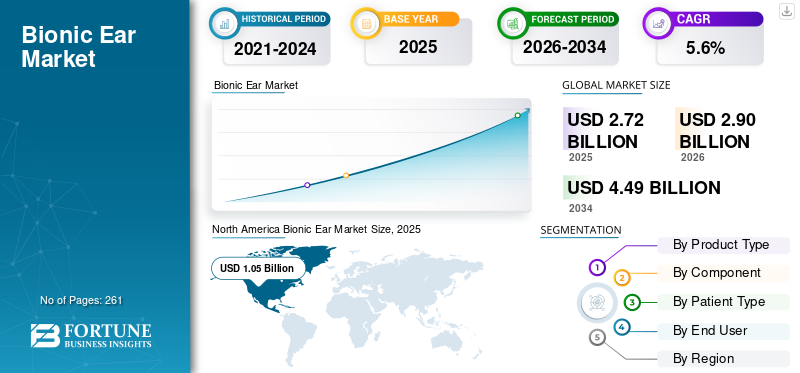
Download Free sample to learn more about this report.
 Market Size & Forecast
 Market Share
 Key Regional Highlights
North America
North America led the market with a valuation of USD 1.05 billion in 2025, maintaining its dominant regional position.
Asia Pacific
Europe is projected to reach USD 0.79 billion in 2026, supported by a forecast CAGR of 4.6%.
Asia Pacific
Asia Pacific is estimated to reach USD 0.77 billion in 2026, driven by expanded screening programs, government initiatives, and growing local suppliers.
U.S.
U.S. The market is projected to reach approximately USD 1.00 billion in 2026, accounting for around 34.3% of global sales.
Japan
Japan The market is estimated to reach USD 0.16 billion in 2026, representing approximately 5.4% of global revenues.
Read More

Technological Advancements to Drive Product Demand
There is an increasing shift toward advanced, better-connected devices that minimize the wearing burden while enhancing hearing performance among the patient population. Companies are emphasizing miniaturization of products, upgradation of sound-processing and noise-management functions, and digital/remote-care features, resulting in improved follow-up and long-term user experience, contributing to the growing adoption and upgradation cycles for these products.
Download Free sample to learn more about this report.
Increasing Prevalence of Hearing Disorders to Boost Market Growth
The growing prevalence of severe and profound hearing loss is one of the vital factors resulting in a rising diagnosis and treatment rate. The growing elderly population is another factor contributing to the increasing number of patients suffering from the disorders, as the risk of hearing loss is higher among this age group.
Chronic ear inflammation, vascular disorders, noise exposure, and genetic susceptibility, among various other factors, causes hearing loss. These factors combined with the increasing number of key players receiving regulatory approvals for their products, are anticipated to fuel the adoption rate of these systems.
Lower Adoption Rate of the Devices in Developing Nations to Hinder Market Growth
There is a growing demand for technologically advanced hearing products worldwide. However, despite many benefits associated with hearing products, a certain percentage of the patient population still does not address their hearing impairment, which limits the adoption rate of these systems.
Furthermore, several research findings have also concluded that people with hearing disorders never get tested for their hearing loss, further hampering the penetration of these products.
Expansion of Healthcare Infrastructure Provides Growth Prospects for the Industry
There is a rapid expansion of healthcare facilities in developing markets, such as South Africa, Mexico, and others. Rising diagnostic and treatment activities, expansion of healthcare infrastructure, and the increasing number of hospitals are consequently supporting the adoption of bionic ears in clinical facilities.
Additionally, growing preference for evidence-based recommendations across healthcare facilities and rising access and reimbursement in Asia Pacific and Latin America are driving procedure volumes. This is further strengthening screening and referral programs, improving aided speech testing in routine audiology, and scaling targeted outreach to adults with severe-to-profound loss.
High Cost Associated with Advanced Bionic Ears to Limit Market Growth
There is a growing adoption rate for advanced bionic ears to treat hearing impairment among the patient population. However, the high cost associated with these products and their upgrades is limiting patients from adopting the devices.
Moreover, a limited number of healthcare settings and limited audiologists, among others, are some of the prominent factors, resulting in the delayed diagnostic and treatment procedures among the patient population, particularly in developing nations, such as Mexico, Brazil, and others.
Cochlear Implants are Highly Preferred Due to Increasing Number of Product Approvals
Based on product type, the market is classified into cochlear implants and auditory brainstem implants (ABI).
The cochlear implants segment held the largest bionic ear market share in 2025 owing to the rising prevalence of chronic conditions among patients, resulting in a growing adoption of bionic ears such as cochlear implants globally. This, along with the increasing focus of key companies on receiving product approvals, is further anticipated to support market growth.
The auditory brainstem implants (ABI) segment is expected to grow at a CAGR of 5.7% over the forecast period.
To know how our report can help streamline your business, Speak to Analyst
Internal Implants is the Leading Component Led by Increasing Strategic Initiatives
Based on component, the market is split into internal implants and external sound processor.
The internal implants segment dominated the global market in 2025 and accounted for the maximum bionic ear share. The growth is supported by the increasing strategic initiatives among key players to boost their adoption rate.
The external sound processor segment is set to flourish with a growth rate of 5.5% across the forecast period.
Increasing Prevalence of Hearing Loss Among Adults Led to the Dominance of the Segment
Based on patient type, the market is bifurcated into adults and pediatrics.
The adults segment dominated the global market in 2025 and acquired the largest market share owing to the growing prevalence of severe and profound hearing loss among the patient population. This results in an increasing number of diagnostic and treatment procedures globally, thereby contributing to the adoption rate of these devices.
The pediatrics segment is set to flourish with a growth rate of 5.5% across the forecast period.
Availability of Treatment Procedures in Hospitals & ASCs Leads to its Dominance
Based on end user, the market is categorized into hospitals & ASCs, specialty ENT & audiology clinics, and others.
The hospitals & ASCs segment dominated the market in 2025 and is set to hold an 84.2% share in 2026. The increasing prevalence of hearing disorders, growing number of diagnostic and treatment procedures in hospitals, increasing number of hospitals and ambulatory surgical centers, among others, are some of the prominent factors.
The specialty ENT & audiology clinics’ end users are projected to grow at a 6.6% CAGR during the forecast period.
Based on region, the market has been studied across North America, Europe, Asia Pacific, Latin America, and the Middle East & Africa.
North America Bionic Ear Market Size, 2025 (USD Billion)
To get more information on the regional analysis of this market, Download Free sample
North America held the dominant share in 2024 at USD 0.99 billion, and also took the leading share in 2025 with USD 1.05 billion. The established reimbursement and surgical infrastructure, growing adoption of cochlear implants, and increased awareness about hearing disorders, among others, are some of the factors supporting the growth.
Based on North America’s strong contribution and the U.S. dominance within the region, the U.S. market can be analytically approximated at around USD 1.00 billion in 2026, accounting for roughly 34.3% of the global sales.
Europe’s market is projected to record a growth rate of 4.6% in the coming years, which is the second highest, and reach a valuation of USD 0.79 billion in 2026. The growing number of surgical procedures and increasing demand for bionic ears are likely to support its growth.
In 2026, the U.K. is estimated to capture USD 0.14 billion, representing roughly 4.8% of the global revenues.
Germany is projected to reach approximately USD 0.16 billion in 2026, equivalent to around 5.6% of the global sales.
Asia Pacific is estimated to reach USD 0.77 billion in 2026 and secure third position in the market supported by expanded screening, government programs, and growing local suppliers. India and China are estimated to reach USD 0.10 billion and USD 0.22 billion, respectively, in 2026.
In 2026, Japan is estimated to achieve USD 0.16 billion, accounting for roughly 5.4% of global revenues. Japan has historically reported a relatively high prevalence of hearing loss, with a large adoption of bionic ear products.
The Chinese market is projected to be one of the largest worldwide, with 2026 revenues estimated at around USD 0.22 billion, representing roughly 7.5% of global sales.
In 2026, India is estimated at around USD 0.10 billion, accounting for roughly 3.5% of global revenues.
The Latin America and the Middle East & Africa are expected to witness moderate growth during the forecast period. Latin America is set to reach USD 0.13 billion in 2026 due to rising disposable incomes, growing adoption of cochlear implants, and improved supply chain of products in the region. The Middle East & Africa is also expected to grow, driven by rising research and development activities to launch novel products in the market. In the Middle East & Africa, the GCC is set to reach a value of USD 0.05 billion in 2026.
The South African market is projected to reach around USD 0.02 billion in 2026, representing roughly 0.7% of global revenues.
Increasing Number of Product Launches By Key Players to Contribute to Their Dominance
A significant product portfolio, along with a substantial emphasis on strategic initiatives globally, is one of the vital factors supporting the dominance of key companies. Cochlear Ltd., and Sonova are major companies in the market. Moreover, the growing focus of prominent players on research and development activities to launch novel products is likely to strengthen their brand presence.
Other key players, including MED-EL, are also growing due to their increased emphasis on mergers among other players.
The market research report provides a detailed global bionic ear market analysis and focuses on key aspects such as leading companies and market segmentation, including product type, component, patient type, and end user. Besides this, the report offers insights into the market growth trends and highlights key industry developments. In addition, the report encompasses several factors that have contributed to the growth and advancement of the market over recent years.
Request for Customization to gain extensive market insights.
| ATTRIBUTE | DETAILS |
| Study Period | 2021-2034 |
| Base Year | 2025 |
| Estimated Year | 2026 |
| Forecast Period | 2026-2034 |
| Historical Period | 2021-2024 |
| Growth Rate | CAGR of 5.6% from 2026-2034 |
| Unit | Value (USD Billion) |
| Segmentation | By Product Type, Component, Patient Type, End User, and Region |
| By Product Type |
|
| By Component |
|
| By Patient Type |
|
| By End User |
|
| By Region |
|
Fortune Business Insights says that the global market size was at USD 2.72 billion in 2025 and is projected to reach USD 4.49 billion by 2034.
In 2025, North Americas market value stood at USD 1.05 billion.
The market is estimated to growing at a CAGR of 5.6% over the forecast period.
By product type, the cochlear implants segment leads the market.
The introduction of the novel bionic ear is one of the major factors driving the market's growth.
Sonova and Cochlear Ltd., are the major players in the global market.
North America dominated the market share in 2025.
The growing prevalence of hearing impairment, the increasing number of surgical procedures, among others, are some of the vital factors expected to boost the adoption of these products worldwide.

Get 30-60 hrs Free Customization
Expand Regional and Country Coverage, Segments Analysis, Company Profiles, Competitive Benchmarking, and End-user Insights.













.webp)






Related Reports
Get In Touch With Us
US +1 833 909 2966 ( Toll Free )
Receive a tailored pricing based on your needs.
Discuss your questions with our industry experts.
Have questions? Get quick answers before you purchase.

