 Download Free Sample



Get a Quote
Receive a tailored pricing based on your needs.
- Choose license type
- Multiple user options
- Custom scope & coverage
- Fast turnaround
"Designing Growth Strategies is in our DNA"
 Listen to Audio Version
The global biopharmaceutical CMO downstream processing market size was valued at USD 4.80 billion in 2025. The market is projected to grow from USD 5.53 billion in 2026 to USD 18.85 billion by 2034, exhibiting a CAGR of 16.57% during the forecast period. North America dominated the global biopharmaceutical CMO downstream processing market with a market share of 39.01% in 2025.
Downstream processing in biopharmaceutical manufacturing refers to the series of operations followed by the fermentation or cell culture stage that are aimed at the purification and formulation of the biologic product. These processes include cell separation, extraction, purification, and polishing, ensuring that the final product is of high purity and meets regulatory standards.
The market growth is attributed to the rising demand for biologics and biosimilars, expansion in contract manufacturing services, and innovation in purification technologies. Moreover, rising approvals of biosimilars and regulatory pressure for efficient manufacturing practices are compelling companies to adopt advanced downstream technologies.
Some of the major players in the biopharmaceutical CMO downstream processing industry are Lonza, Catalent Inc., Thermo Fisher Scientific, and Samsung Biologics. These players are focusing on massive investments, expansion of production capabilities, and technological advancements with an aim to maintain a substantial market share. In addition, emphasis on strategic partnerships and robust research & development activities is projected to accelerate market expansion during the forecast period.
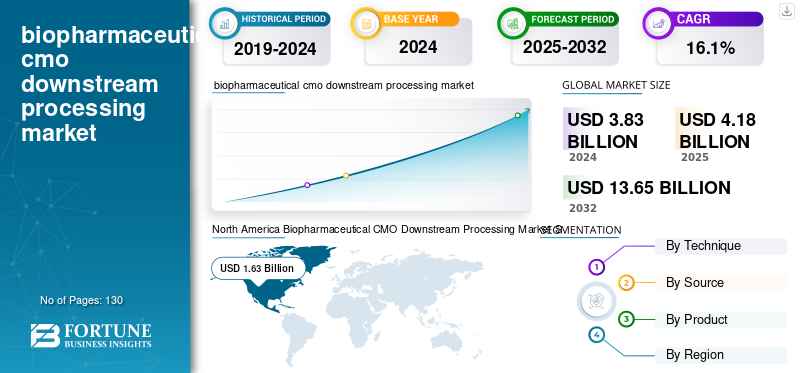
Download Free sample to learn more about this report.
 Market Size & Forecast
 Market Share
 Key Regional Highlights
North America
North America reached USD 1.87 billion in 2025, accounting for 39.01% of the global market.
Europe
Europe accounted for USD 1.61 billion and 33.48% of the global market in 2025.
Asia Pacific
Asia Pacific generated USD 0.93 billion, representing 19.33% of the global market in 2025.
U.S.
Market growth is driven by strong investments, strategic collaborations, and expanding commercial-scale biopharmaceutical manufacturing.
Japan
Market expansion is supported by growing CDMO capabilities and increasing investments in biopharmaceutical research and manufacturing.
Read More

Robust Pipeline and Rising Demand for Biologics to Boost Market Growth
The demand for biologics is increasing for the treatment of chronic conditions due to their efficacy and specificity. As pharmaceutical companies invest heavily in biologic drug development pipelines, the need for efficient downstream processing has increased. These products typically require highly specialized purification and formulation steps to ensure safety, potency, and regulatory compliance. Furthermore, the complexity and sensitivity of biologics necessitate advanced purification methods that minimize product loss while maximizing yield and purity.
Additionally, the significantly increasing number of biologics pipelines and the number of approved products are also major factors driving the global biopharmaceutical CMO downstream processing market growth. The complexity inherent in the development of biopharmaceutical drugs and their mass production for commercial purposes results in the growing demand for contract manufacturing by manufacturers. This boosts the demand for outsourcing services for the manufacturing of these products.
High Cost of Equipment and Operations Deter Market Growth
The high cost associated with equipment procurement, maintenance, and operational complexities is one of the prominent restraining factors impacting the market growth. The cost challenge is further exacerbated by the need for stringent validation, compliance with regulatory standards, and periodic calibration of instruments to maintain product quality. Operational inefficiencies, material losses during purification, and batch failures due to contamination or inconsistency can further escalate production costs.
Additionally, the skilled workforce required to operate and manage complex downstream systems is limited and demands higher salaries, contributing to rising labor costs. As manufacturers strive to balance high purity requirements with affordability, the economic burden of downstream processing remains a key concern. This financial barrier may deter new entrants and delay product development cycles, ultimately impacting the scalability and accessibility of biologics in the global biopharmaceutical CMO downstream processing industry. Further, the deployment of stainless steel manufacturing facilities for producing biopharmaceutical drugs at a large scale leads to higher costs of manufacturing, decreasing the affordability of the final product to the general patient population.
Growth of Biosimilars in Emerging Markets Offer Substantial Opportunity for Market Growth
The global expansion of biosimilars represents a major opportunity for downstream processing solution providers, particularly in emerging markets where affordability and access to biologic therapies are key priorities. As patents for blockbuster biologics continue to expire, biosimilar manufacturers are aggressively pursuing market entry with cost-effective alternatives. Countries across Asia, Latin America, and the Middle East are witnessing a surge in the demand for biosimilars due to supportive regulatory frameworks, increasing healthcare coverage, and a growing burden of chronic diseases. In addition, an increasing number of partnerships is estimated to offer lucrative opportunities for biopharmaceutical CMO downstream processing.
Moreover, biopharmaceutical CMO downstream processing manufacturers in these regions are adopting modular and scalable downstream systems to meet diverse product demand while maintaining regulatory compliance. International collaborations, technology transfers, and government incentives are further catalyzing the development of localized biopharmaceutical ecosystems.
Product Degradation During Downstream Process Challenges Market Growth
One of the critical challenges in biopharmaceutical CMO downstream processing is significant product degradation that can occur during purification stages. Biologics, especially monoclonal antibodies and recombinant proteins are often produced in low concentrations and require multiple purification steps to achieve the necessary purity levels for clinical and commercial use. Each step, whether centrifugation, filtration, or chromatography, presents a risk of product loss due to adsorption, degradation, or inefficiencies in separation.
In addition, biologics are sensitive to pH, temperature, and shear stress, which increases the risk of denaturation or aggregation during handling. Process optimization is further complicated by batch variability and the biological nature of source materials.
Shift toward Single-Use Technologies Boost Efficiency of Downstream Processing
The biopharmaceutical CMO downstream processing market is witnessing a rise in the adoption of single-use technologies across biopharmaceutical manufacturing facilities. These disposable systems, including single-use filters, chromatography columns, and bioreactors, are increasingly replacing traditional stainless-steel setups due to their operational flexibility and cost-efficiency.
Furthermore, these technologies require lower capital investment and facility infrastructure, making them attractive to both emerging biotech firms and established pharmaceutical players looking to expand capacity. As innovation continues, with enhanced material durability and sensor integration, single-use technologies are poised to transform downstream processing by enabling faster development timelines, lower operational costs, and improved process consistency, thereby contributing significantly to the evolving demand for biopharma production.
Download Free sample to learn more about this report.
Market Recorded Expansion as High Number of Manufacturing Contracts were Signed during the Pandemic
As a result of the COVID-19 pandemic, the global biopharmaceutical CMO downstream processing industry experienced a positive impact on growth as compared to 2019. The major market players, such as Lonza, Wuxi Biologics, and other players operating in the market, reported a positive growth in their biopharmaceutical CMO segment revenues during this period.
This sudden growth was mainly due to the high number of manufacturing contracts signed between biopharmaceutical manufacturers and contract manufacturing service providers for the manufacturing of COVID-19 vaccines. Several vaccine manufacturers partnered with CMOs for the effective and timely manufacturing of vaccines to fulfill the market demand.
Major Emphasis on Product Purification to Boost Segment Growth
Based on technique, the market is segmented into purification, concentration, and others.
The purification segment is expected to hold the highest share of the biopharmaceutical manufacturing market, driven by its critical role in ensuring product safety, efficacy, and regulatory compliance. The purification phase is indispensable in removing impurities, host cell proteins, DNA fragments, and aggregates from biologic drug products. Techniques such as chromatography, ultrafiltration, and diafiltration are widely used and continuously evolving to support high-throughput and high-yield processes.
The concentration segment is projected to hold the second-highest share of the biopharmaceutical manufacturing market, owing to its essential function in increasing the strength of active pharmaceutical ingredients post-cultivation or purification. Concentration processes such as tangential flow filtration (TFF), vacuum evaporation, and centrifugation are widely employed to condense product volumes for downstream processing or final formulation.
Major Focus on Manufacturing through Mammalian Source to Accelerate Segment Growth
Based on source, the market is categorized into non-mammalian and mammalian.
The mammalian segment held a significant global biopharmaceutical CMO downstream processing market share in 2026. This is mainly due to the rising number of mammalian systems-based regulatory-approved products, coupled with the high usage of these systems in research and development of new biopharmaceutical products.
The non-mammalian segment is expected to grow considerably during the forecast period. The non-mammalian-based sources are increasingly being used in the drug discovery pipeline. This is due to the various factors such as their speed, lower cost, and scale.
High Production of Biologics to Dominate the Market During the Forecast Period
Based on product, the market is fragmented into biosimilars and biologics.
The biologics segment held a dominant share of the market in 2026. Some of the factors contributing to the dominance of the segment include the strong focus of biopharmaceutical manufacturers on the development and manufacturing of biologics such as monoclonal antibodies, vaccines, and others, coupled with a supportive regulatory environment leading to an increasing number of product approvals among others.
The biosimilars segment is poised to witness strong growth over the coming years due to cost-effectiveness of biosimilars, growing demand, and other factors.
By geography, the market is categorized into North America, Europe, Asia Pacific, Latin America, and the Middle East & Africa.
North America Biopharmaceutical CMO Downstream Processing Market Size, 2025 (USD Billion)
To get more information on the regional analysis of this market, Download Free sample
North America recorded a market size of USD 1.87 Billion in 2025, capturing 39.01% of the global market share, and is projected to reach USD 2.16 Billion in 2026. The dominance of North America in the global market is attributed to the increasing number of contract manufacturing companies in the region. Similarly, the surging initiatives by key market players for expanding their production capabilities are expected to propel regional growth.
In the U.S., massive investments by contract manufacturing companies coupled with a focus on strategic collaborations and technological advancements is set to boost the market growth during the forecast period.
In 2025, Europe represented USD 1.61 Billion, accounting for 33.48% of the worldwide market, and is projected to grow to USD 1.84 Billion in 2026. The strong focus on innovation, coupled with the emphasis of biopharma companies to outsource their manufacturing process, is likely to have a positive impact on market growth.
The Asia Pacific market generated USD 0.93 Billion in 2025, representing 19.33% of the global market landscape, and is expected to reach USD 1.08 Billion in 2026. The market growth is attributed to increasing investments by leading companies in the region, expanding healthcare infrastructure, and rising research and development activities.
In 2025, Latin America held 4.85% of the global market, reaching a valuation of USD 0.23 Billion, and is projected to grow to USD 0.27 Billion in 2026. The growth of the Latin America market is attributed to the increasing number of biopharmaceutical manufacturing facilities and the rising emphasis of leading players to enter this market due to lower costs.
On the other hand, the Middle East & Africa market is expected to witness lucrative growth due to the surging number of strategic initiatives. Middle East & Africa accounted for USD 0.16 Billion in 2025, representing 3.33% of the global market share, and is projected to reach USD 0.18 Billion in 2026.
Strategic Partnerships and Introduction of Advanced Products Drive Revenue Growth for Key Players
The market is highly fragmented, given the operation of a considerable number of players. The players, such as Lonza, Catalent Inc., and Thermo Fisher Scientific, are some of the players actively operating in the market with comparatively considerable market share.
Other major players, including Samsung Biologics, FUJIFILM Corporation, and others, are focusing on the expansion of their service portfolio and strengthening market share. These market players have also increased their emphasis on partnerships and mergers with other players for expanding their service offerings.
Request for Customization to gain extensive market insights.
| ATTRIBUTE | DETAILS |
| Study Period | 2021-2034 |
| Base Year | 2025 |
| Forecast Period | 2026-2034 |
| Historical Period | 2021-2024 |
| Growth Rate | CAGR of 16.57% from 2026-2034 |
| Unit | Value (USD Billion) |
| Segmentation |
By Technique
By Source
By Product
By Geography
|
Fortune Business Insights says that the global market value stood at USD 3.83 billion in 2025 and is projected to reach USD 18.85 billion by 2034.
In 2025, the market value stood at USD 1.87 billion.
The market is expected to exhibit a CAGR of 16.57% during the forecast period of 2026-2034.
By source, the mammalian segment is the leading segment in the market.
The key factors driving the market are the increasing manufacturing capacities of biopharmaceutical CMO companies and rising investments by these companies.
Lonza, Thermo Fisher Scientific, and Catalent Inc. are the top players in the market.
North America dominated the global biopharmaceutical CMO downstream processing market with a market share of 39.01% in 2025.

Get 30-60 hrs Free Customization
Expand Regional and Country Coverage, Segments Analysis, Company Profiles, Competitive Benchmarking, and End-user Insights.













.webp)






Related Reports
Get In Touch With Us
US +1 833 909 2966 ( Toll Free )
Receive a tailored pricing based on your needs.
Discuss your questions with our industry experts.
Have questions? Get quick answers before you purchase.

