Birch Water Market Size, Share & Industry Analysis, By Product Type (Still {Flavored and Unflavored} and Carbonated {Flavored and Unflavored}), By Nature (Organic and Conventional), By End Use (Household, Foodservice and Industrial {Beverages, Cosmetics, Pharmaceuticals, Nutraceuticals, and Others}), By Distribution Channel (B2B {Industries and Foodservice/Institutional} and B2C {Supermarkets/Hypermarkets, Convenience Stores, Specialty stores, and Online Stores}), and Regional Forecast, 2026-2034
 Download Free Sample
(Offer valid till 15th Oct 2026)

Birch Water Market Size and Industry Overview
 Listen to Audio Version
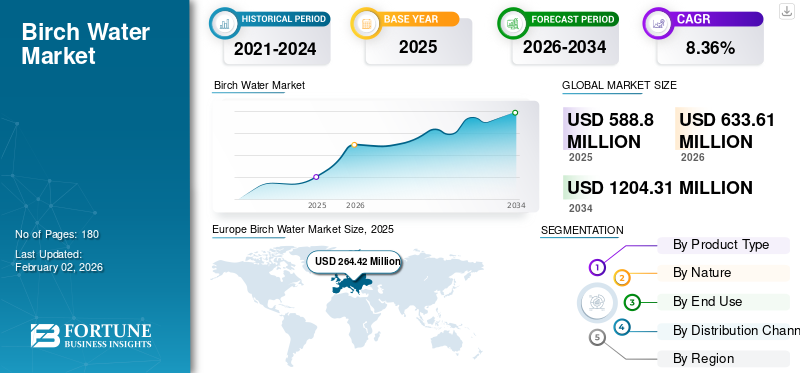
The global birch water market size was valued at USD 588.80 million in 2025 and is projected to grow from USD 633.61 million in 2026 to USD 1,204.31 million by 2034, exhibiting a CAGR of 8.36% during the forecast period. Europe dominated the birch water market with a market share of 44.91% in 2025.
Birch water is a naturally derived product derived from birch trees harvested during the early spring season. It is rich in electrolytes, antioxidants, and minerals, and hence is popular among consumers for its natural hydration and detoxification characteristics. As global demand for water which is clean-label and functional ingredient-based beverages is increasing, the popularity of such products is expected to increase in the future as well. The birch water market is growing rapidly, driven by increasing consumer awareness of the health benefits of birch.
Companies such as Nordic Koivu Ltd, Alaska Wild Harvest LLC, and Sibberi are some of the well-known players operating in the birch water industry. Expansion in new markets and diversification of product lines in this category are expected to support the market's steady growth.
Download Free sample to learn more about this report.
Birch Water Market KEY TAKEAWAYS
 Global Market Size & Forecast
- 2025 Market Size: USD 588.80 million
- 2026 Market Size: USD 633.61 million
- 2034 Forecast Market Size: USD 1,204.31 million
- CAGR: 8.36% from 2026-2034
 Market Share
- Europe dominated the global market with a 44.91% share in 2025.
- Still held the largest product type share at 62.44% in 2026.
- Conventional held the largest nature share at 65.40% in 2026.
 Key Regional Highlights
Europe
Dominated the market with USD 264.42 million in 2025 and is projected to reach USD 285.97 million in 2026.
North America
Reached USD 163.12 million in 2025, representing a 27.70% share, and is projected to reach USD 175.53 million in 2026.
Asia Pacific
Reached USD 100.72 million in 2025 and is projected to remain the third-largest region.
U.S.
The market is projected to reach approximately USD 123.36 million in 2026.
Japan
The market is projected to reach approximately USD 24.08 million in 2026.
Read More

MARKET DYNAMICS
MARKET DRIVERS
Ever-rising Demand for Hydrating, Natural Low-Calorie Products to Play a Crucial Role in Product Demand
Consumer concerns regarding health and awareness have heightened in recent years. Along with an increasing demand for losing weight, consumers are also looking for products that help boost nutrition and immunity and support detox functions. The COVID-19 pandemic has further heightened the demand for similar products. Hence, to cater to consumers who are looking for low-calorie, naturally hydrating, organic products with functional ingredients, it is a suitable alternative. Benefits of birch water include hydration, detoxification, rich antioxidant content, and anti-inflammatory properties thus acting as a suitable alternative.
MARKET RESTRAINTS
Limited production and Susceptibility of Climate Aberrations May Hamper Market Growth
Birch sap is harvested in a very short time period, which ranges from 2-3 weeks during the springtime. Specific weather conditions are essential for harvesting birch water. Any climatic changes can disrupt the production and shorten the sap flow season. As climate change has become frequent, this has led to unpredictable sap seasons, which lead to poor yield from trees. Another crucial factor that impacts the market is the limited availability of trees across the world. Birch trees are found in Europe and parts of Canada, and Scandinavia only. Hence, as the production area is limited, the price of this product is also expensive.
MARKET OPPORTUNITIES
Expansion in Presence of International Markets to Generate More Profits for Manufacturers
Consumers of North America, Asia, the Middle East, and South America are less familiar with this product, as most of these products are manufactured and consumed in the European market. As the popularity of natural, preservative-free functional beverages is growing among consumers globally, manufacturers have the opportunity to position their products as premium-quality, luxury drinks that appeal to consumers looking for health and wellness products. The manufacturers can also partner with research organizations, which can test and validate the healthy attributes of their products. These validations can help them position their product as a premium offering among consumers.
BIRCH WATER MARKET TRENDS
Birch Trees Production Expansion Initiative to Fuel Market Growth
The growing demand in the global market is prompting sap collectors to expand their production capacity. This includes planting more trees and harvesting a higher quantity of water from those trees, which can be used for retail consumption or manufacturing industrial products. As demand for functional beverages continues to grow, manufacturers will continue to invest in expanding production initiatives to meet the growing market demand.
- For instance, in April 2024, Hammers Family Birch (HFB) announced that it would expand its production capacity from 8,000 trees to 20,000 trees by 2025. The water collected is used to manufacture handcrafted, premium birch products for retail and industrial use.
Download Free sample to learn more about this report.
Segmentation Analysis
By Product Type
Subtle flavor of the product Escalated Still Water Segment Growth
By product type, the market is divided into still and carbonated.
The still segment is accounted for the largest global birch water market with a share of 62.44% in 2026, owing to its fresh, delicate, and sweet flavor. Traditional consumers prefer such products as they do not have an overpowering taste such as carbonated versions. Birch is also used in manufacturing health and detox beverages, and the still form is perceived to be less processed and healthy compared to the carbonated form. Flavored forms of both still and carbonated products are available and some of the key flavors include strawberry, rose, bilberry, apple, ginger among others.
The Carbonated segment is expected to grow at a CAGR of 7.34% over the forecast period.
By Nature
Wide Availability of Conventional Products to Augment Segment Growth
Based on category, the market is segmented into organic and conventional.
Conventional products are popular among consumers mainly due to the high cost of organic products and the limited availability of organic produce in the market with a share of 65.40% in 2026. Conventional type is sourced directly from the trees, and hence, it is perceived to be fresh, natural, and healthy by consumers. As they are mostly harvested globally, there is very little difference between organic and conventional products. Hence, consumers opt for cheaper options. Moreover, such products are widely available in the market, in supermarkets, health stores, and even online retailers.
The organic segment is expected to grow at a CAGR of 8.62% over the forecast period. Growing health awareness about the necessity of detoxification and hydration, and the increasing consumer shift toward sustainable and plant-based drinks, support this segment’s growth.
By End Use
Household Segment to Hold Larger Revenue Chunk Due to Wide Consumption among Health Conscious Consumers
In terms of end use, the market is divided into household, foodservice, and industrial. The industrial segment is further divided into beverage, cosmetics, pharmaceuticals, and nutraceuticals, and others.
The household usage of these products is higher owing to their wide popularity among health-conscious consumers is anticipated with a share of 66.16% in 2026, who consume them as functional health drinks. Such products are perishable, and hence, they are difficult to store for a long period of time. They also have a mild taste and are not used widely for cooking, baking, or as a flavor enhancer, leading to very limited culinary application of this product.
Industrial usage is set to flourish with a growth rate of 7.88% growth across the forecast period. The growing popularity of clean label ingredients is one of the key factors influencing the birch water market growth.
To know how our report can help streamline your business, Speak to Analyst
By Distribution Channel
B2C Segment Exhibited a Majority Share Attributed to Direct Access to Consumers
On the basis of the distribution channel, the market is segregated into B2B and B2C.
The B2C segment, which includes supermarkets/hypermarkets, convenience stores, specialty stores, and online stores, projected to led with a share of 66.16% in 2026, owing to the manufacturers' direct access to consumers through online channels and health food stores. Hence, these products are targeted toward health-conscious consumers who want to consume natural plant-based drinks.
The use of B2B channels is still limited due to slow growth in the foodservice sector. However, with the increasing usage of these products as an ingredient in the industrial sector, the segment is projected to grow at a CAGR of 7.73% during the study period.
Birch Water Market Regional Outlook
By geography, the market is categorized into Europe, North America, Asia Pacific, South America, and Middle East & Africa.
EUROPE
Europe Birch Water Market Size, 2025 (USD Million)
To get more information on the regional analysis of this market, Download Free sample
Europe held the dominant share in 2025, valued at USD 264.42 million, and also projected to took the leading share in 2026, with USD 285.97 million. The growth of birch water in the European market is attributed to the century-old practices of several European countries to consume this water as a spring tonic. This product is also appealing to consumers due to the low-calorie, organic products that fit the growing health and wellness trend in the region. Backed by these factors, countries including Finland are expected to record the valuation of USD 41.96 million, Sweden to record USD 38.37 million, and Germany expected to record USD 34.47 million in 2026. The UK birch water market expected to reache a valued at USD 25.7 million by 2026
NORTH AMERICA
North America contributed 27.70% to the global market in 2025, with a valuation of USD 163.12 million, and is projected to reach USD 175.53 million in 2026. Birch trees are found in certain regions of Canada and the U.S., which makes it favored by consumers who support local drinks. During the forecast period, the North American region is projected to record a growth rate of 8.16%, which is the third highest among all the regions. However, the product is still not widely consumed in the U.S. market, but companies are positioning it as a niche product in the health and wellness category. This is expected to boost the sales of the products in the country. In 2026, the U.S. market is estimated to reach USD 123.36 million.
ASIA PACIFIC
The market in the Asia Pacific is estimated to reach USD 100.72 million in 2025 and secure the position of the third-largest region in the market. As there are several other traditionally consumed alternatives already popular in the region, which include green tea, coconut water, and other traditional herbal drinks, the market size is very limited. However, as the trend of detoxification is growing in China, Japan, and other Asian countries, the demand for such products is expected to rise in the future. In this region, China and Japan are estimated to reach USD 46.1 million and anticipated to reached a USD 24.08 million each in 2026, the India birch water market is expected to reached a valued at USD 6.57 million by 2026.
SOUTH AMERICA
Over the forecast period, South America and the Middle East & Africa regions would witness a moderate growth in this market. The South America market in 2025 is set to record USD 39.79 million as its valuation. Limited awareness among consumers acts as one of the major factors hindering the market’s growth.
MIDDLE EAST & AFRICA
The market in Middle East & Africa reached USD 20.75 million in 2025, representing 3.52% of total market revenue, and is projected to reach USD 21.98 million in 2026. In the Middle East & Africa, South Africa is set to grow at a CAGR of 6.81% during the forecast period.
Latin America
In 2025, the Latin America market stood at USD 39.79 million, representing 6.76% of global demand, and is projected to grow to USD 42.2 million in 2026.
COMPETITIVE LANDSCAPE
Key Industry Players
Companies Focus on Expanding Product Lines to Compete in Market
The global market exhibits a fragmented structure due to the presence of several local manufacturers competing with other regional players for higher market shares. In several European countries, which are the major producers of birch water, smaller local producers harvest the water and operate their stores seasonally, selling their products to the local or regional market. However, with the growing focus on health and wellness, functional beverage brands such as TreTap and others are also including birch water product lines in their existing product category. As the market is growing, several new entrants have the opportunity to expand their market presence and compete with other market players.
LIST OF KEY BIRCH WATER COMPANIES PROFILED
- Nordic Koivu Ltd (Finland)
- Alaska Wild Harvest LLC (U.S.)
- Sibberi (U.K.)
- The Birch Factory Aps (Denmark)
- TreeVitalise Organic Birch Water (U.K.)
- Tapped Birch Water (Finland)
- Sealand Birk (Denmark)
- BelSeva (Belgium)
- ÖselBirch (Estonia)
- Nature On Tap Ltd (U.K.)
KEY INDUSTRY DEVELOPMENTS
- September 2025: Beverage manufacturing company Nordic Tree water launched a new birch product line named Extra Strong Birch water in Finland. It is derived from organically grown trees.
- November 2022: Singer Jason Derulo acquired a significant ownership in the birch water based beverage manufacturing company named TREO.
- August 2021: Birkentree, a birchwater manufacturerer, launched bottle water which is specifically designed for mixing 50/50 with whisky.
- July 2020: Treo Brands LLC launched a new product as part of its birch water product line. The new product is a fruit flavored product which is marketed as an alternative to water and flavored waters.
- January 2019: Finish beverage manufacturing company Yönalé expanded its presence in the U.S. market. It launched its mineral rich birch water line in the U.S. market.
REPORT COVERAGE
Request for Customization to gain extensive market insights.
Report Scope & Segmentation
|
ATTRIBUTE |
DETAILS |
|
Study Period |
2021-2034 |
|
Base Year |
2025 |
|
Estimated Year |
2026 |
|
Forecast Period |
2026-2034 |
|
Historical Period |
2021-2024 |
|
Growth Rate |
CAGR of 8.36% from 2026-2034 |
|
Unit |
Value (USD Million) |
|
Segmentation |
By Product Type · Still o Flavored o Unflavored · Carbonated o Flavored o Unflavored |
|
By Nature · Organic · Conventional |
|
|
By End Use · Household · Foodservice · Industries o Beverage o Cosmetics o Pharmaceuticals o Nutraceuticals o Others |
|
|
By Distribution Channel · B2B o Industries o Foodservice/Institutional · B2C o Supermarkets/Hypermarkets o Convenience Stores o Specialty Stores o Online Stores |
|
|
By Region North America (By Product Type, Nature, End Use, Distribution Channel, and Country)
Europe (By Product Type, Nature, End Use, Distribution Channel and Country)
Asia Pacific (By Product Type, Nature, End Use, Distribution Channel and Country)
South America (By Product Type, Nature, End Use, Distribution Channel and Country)
Middle East and Africa (By Product Type, Nature, End Use, Distribution Channel and Country)
o Rest of the Middle East & Africa (By Nature) |
Frequently Asked Questions
Fortune Business Insights says that the global market value stood at USD 633.61 million in 2026 and is projected to reach USD 1,204.31 million by 2034.
In 2025, the market value stood at USD 163.12 million.
The market is expected to exhibit a CAGR of 8.36% during the forecast period of 2026-2034.
By product type, the still water segment led the global market in 2025.
Ever-rising demand for hydrating, natural low-calorie products to play a crucial role in product demand.
Nordic Koivu Ltd, Alaska Wild Harvest LLC, Sibberi are a few of the key players in the market.
Europe held the largest market share in 2025.
Birch Trees Production Expansion Initiative to Fuel the Market Growth.



- 2021-2034
- 2025
- 2021-2024
- 180
-
(Offer valid till 15th Oct 2026)
Get 30-60 hrs Free Customization
Expand Regional and Country Coverage, Segments Analysis, Company Profiles, Competitive Benchmarking, and End-user Insights.




















Related Reports
-
US +1 833 909 2966 ( Toll Free )
-
Get In Touch With Us