 Download Free Sample


Download Free sample to learn more about this report.
Black Pepper MARKET Key Takeaways
 Market Size & Forecast
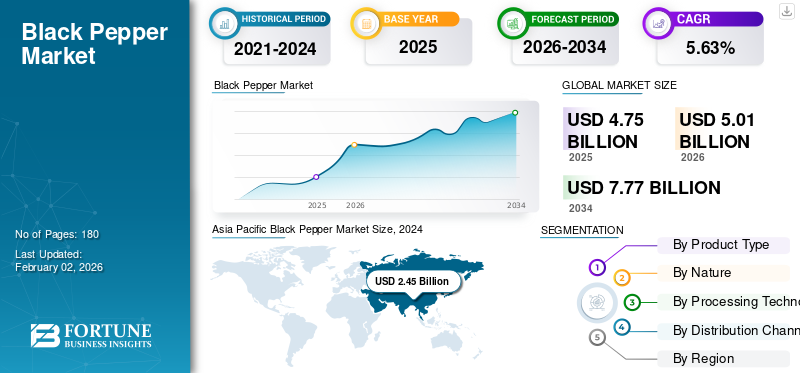
- 2025 Market Size: USD 4.75 Billion
- 2026 Market Size: USD 5.01 Billion
- 2034 Forecast Market Size: USD 7.77 Billion
- CAGR: 5.63% from 2026–2034
 Market Share
- Asia Pacific dominated the black pepper market with a 55.04% share in 2025.
- The whole black peppercorn segment accounted for a 45.69% market share in 2026.
- The supermarkets/hypermarkets segment is expected to hold a 63.83% market share in 2026.
 Key Regional Highlights
Asia Pacific
Asia Pacific generated USD 2.62 billion in 2025 and maintained its position as the leading regional market for black pepper.
Europe
Europe accounted for USD 0.92 billion in 2025, representing 19.29% of the global market, supported by strong demand from food processing industries.
North America
North America reached USD 0.63 billion in 2025, driven by increasing consumption of spices and seasonings across retail and foodservice channels.
U.S.
U.S. The U.S. black pepper market is projected to reach USD 0.52 billion by 2026, supported by growing demand for premium spice products.
Japan
Japan The Japan black pepper market is projected to reach USD 0.27 billion by 2026, fueled by rising usage in processed foods and culinary applications.
Read More

MARKET DYNAMICS
MARKET DRIVERS
Expanding Convenience/Processed Food Industry Drives Market’s Potential
The expanding processed food industry is a key driver supporting the market’s growth. As the majority of individuals move to urban cities and work longer hours, single and dual-income households have minimal energy and time for meal preparation. Convenience or processed food products directly address this requirement by providing low effort and quick solutions. To add flavor to their packaged meals, most consumers depend on flavor enhancers, including pepper. Moreover, the evolving foodservice industry utilizes a range of condiments and spices (pepper) for sauces and marinades. Additionally, consumers are trying to experiment with new flavors and are utilizing pepper in preparing fusion cuisine and other culinary applications. By keeping this in view, the manufacturers are focusing on introducing a blend of pepper that can cater to the consumer’s preferences.
MARKET RESTRAINTS
Pests and Disease Infestations and Climate Change Hinder Market’s Momentum
One of the pivotal hurdles in the global industry is the growing risk of disease and pest infestations. Pepper vines are highly vulnerable to disease infestation, such as fungal diseases (foot rot, seedling blight, and anthracnose), and several viral diseases (mosaic virus). These chronic diseases are mainly spread via high humidity, infected planting material, and insects (mealybugs and aphids), leading to crop loss in several infected areas. Moreover, pepper vines are susceptible to pest infestations, which damage leaves and shoots, resulting in poor vine health and low yield. Leaf gall thrips, scale insects, and nematodes are key pests responsible for attacking the plants. As a result, the above-mentioned factors impede the global black pepper market share.
Climate change is another obstacle observed in the global market. Erratic and unseasonal rainfall, temperature fluctuations, and water shortages pose a negative impact on crop growth, further impeding the market’s growth.
MARKET OPPORTUNITIES
Technological Advancements in Pepper Market Unlock Growth Chances
The utilization of modern techniques opens lucrative growth opportunities in the global industry. To strengthen the quality of pepper, the companies can utilize the cryogenic grinding technique, which aids in preserving the quality and flavor of peppercorns. Steam processing is another crucial technique that can be used to process peppers, especially before canning, minimizing the requirement for preservatives. Moreover, hyperspectral imaging is another technology that can easily detect imperfections in peppers to maintain the quality. Additionally, biotechnology and genetic breeding can be helpful in producing disease-resistant pepper varieties. Besides this, producers can adopt automated machinery to streamline grading and sorting, further improving consistency and efficiency.
BLACK PEPPER MARKET TRENDS
Surging Inclination toward Functional Foods is a Prominent Trend
The global industry is experiencing a growing and remarkable trend of functional foods. In today’s era, most global consumers are inclined toward functional foods that offer advantages beyond basic nutrition. The majority of individuals are increasingly drawn to functional items owing to concerns regarding their health and the desire for disease prevention. To enhance the nutritional profile of functional foods, pepper, especially pepper oil, is widely utilized as it contains various bioactive compounds. These components strengthen gastrointestinal health, cognitive function, and minimize the rate of inflammation. Moreover, it improves the bioavailability of phytochemicals and various nutrients, which eases the absorption.
Download Free sample to learn more about this report.
Segmentation Analysis
By Product Type
Whole Black Peppercorn Leads in Market Owing to Its Prolonged Shelf Life
On the basis of product type, the market is distributed into whole black peppercorn, ground black peppercorn, crushed black peppercorn, and others.
The whole black peppercorn segment led the market accounting for 45.69% market share in 2026. In comparison to other types, the whole form of pepper retains the volatile compounds for a longer period and offers superior aroma. Moreover, this ingredient has a longer shelf life of about 2 to 3 years and requires minimal preservation. Additionally, it has a restricted risk of adulteration, as well as quality degradation, which fuels its usage. As a result, such benefits bolster the global black pepper market growth.
The others segment is predicted to grow at a high CAGR of 10.52% during the study period.
By Nature
Conventional Segment Dominated Market Owing to Its Wide Availability
On the basis of nature, the market is distributed into conventional and organic.
The conventional segment led the market in 2024. In comparison to organic pepper, traditional pepper is less expensive and is widely available in numerous stores. Moreover, conventional peppers are grown using readily available agrochemicals, which minimizes the overall cost of black pepper production. Additionally, compared to organic spices, traditional peppers have a consistent supply and are easy to distribute immediately after harvesting. As a result, such advantages propel the segment’s potential.
The organic segment is expected to flourish at a high CAGR of 7.24% during the study period.
By Processing Technology
Sun Drying Technology Dominated Market Owing to Its Cost-Effectiveness
Based on processing technology, the market is segmented into sun-drying/traditional, mechanical drying, steam sterilization, and others.
The sun-drying/traditional segment led the market accounting for 40.71% market share in 2026. In comparison to other technologies, the traditional sun-drying technique is economical as it requires limited operating expense and capital. Moreover, it is eco-friendly and preserves the natural aroma and flavor of peppers. Additionally, it is appropriate for bulk drying operations and needs minimal maintenance. Thus, the aforementioned factors propel the segment’s growth.
The steam sterilization is anticipated to grow at a high CAGR of 7.72% during the study period.
By Distribution Channel
To know how our report can help streamline your business, Speak to Analyst
Supermarkets/Hypermarkets Dominated Market Owing to their Affordability Benefit
On the basis of distribution channels, the market is bifurcated into supermarkets/hypermarkets, convenience stores, specialty stores, online retail, and others.
The supermarkets/hypermarkets segment will account for 63.83% market share in 2026. The supermarkets/hypermarkets offer consumers a one-stop shopping experience by providing a vast range of essential products. These channels are known for bulk purchasing and discount coupons, which appeal to consumers. Additionally, the option of self-service and lower price advantages further strengthen the segment’s potential.
The online retail segment is anticipated to grow at a high CAGR of 6.97% during the study period.
Black Pepper Market Regional Outlook
On the basis of regions, the market is segmented into North America, Europe, Asia Pacific, South America, and the Middle East & Africa.
ASIA PACIFIC
Asia Pacific Black Pepper Market Size, 2025 (USD Billion) To get more information on the regional analysis of this market, Download Free sample
The Asia Pacific market generated USD 2.62 billion in 2025, representing 55.04% of the global market landscape, and is expected to reach USD 2.79 billion in 2026. In this region, countries such as Vietnam, Indonesia, and India are recognized as the key producers of pepper, which fulfills the regional demand. The surging popularity of fusion and ethnic cuisines is another strong factor that fuels the utilization of pepper. Moreover, the surging health & wellness trend boosts the demand for functional ingredients, including pepper, as well as the increasing preference for organic spices. Additionally, the rising adoption of sustainable farming practices and innovations in product development further drives the demand for black pepper. As a result, the above-mentioned factors enhance the market’s potential. The Japan market is projected to reach USD 0.27 billion by 2026, the China market is projected to reach USD 0.8 billion by 2026, and the India market is projected to reach USD 0.99 billion by 2026.
Europe
In 2025, Europe represented USD 0.92 billion, accounting for 19.29% of the worldwide market, and is projected to grow to USD 0.96 billion in 2026.
NORTH AMERICA & EUROPE
North America recorded a market size of USD 0.63 billion in 2025, capturing 13.21% of the global market share, and is projected to reach USD 0.65 billion in 2026. Other regions, such as North America and Europe, are predicted to witness considerable growth in the future. During the forecast period, Europe is anticipated to record a growth rate of 4.62%, which is the second-highest among all the regions. The rising demand for organic products and surging awareness of the potential health benefits of black pepper bolster the region’s growth. After Europe, North America ranked third in the global industry in 2024. The improved investment in technologies and rising product innovation enhance the market’s momentum. Among all the American countries, the U.S. leads in the North America region, followed by Canada and Mexico. The increasing use of pepper in personal care products and the growing demand for processed foods drive the nation’s potential. The U.S. market is projected to reach USD 0.52 billion by 2026.
MIDDLE EAST & AFRICA
Middle East & Africa accounted for USD 0.25 billion in 2025, representing 5.19% of the global market share, and is projected to reach USD 0.25 billion in 2026. Middle East & Africa are predicted to witness a moderate growth in the near term. The improved disposable income and rising health conscious consumers propel the region’s growth.
Latin America
In 2025, Latin America held 7.27% of the global market, reaching a valuation of USD 0.35 billion, and is projected to grow to USD 0.36 billion in 2026.
COMPETITIVE LANDSCAPE
Key Industry Players
Active Players are Concentrating on Launches to Expand their Presence in Market
Key players in the market include Everest Spices, Givaudan, Olam International, and others. All the companies in the marketplace are concentrating on new launches that can fulfill the rising consumer demands. Through these launches, the firms can enhance their position in the global space.
List of Key Black Pepper Companies Profiled
- British Pepper & Spice Co Ltd (U.K.)
- Everest Spices (India)
- Givaudan (Switzerland)
- Symrise AG (Germany)
- Olam International (Singapore)
- International Flavors & Fragrances (U.S.)
- T Hageswa (Japan)
- Ajinomoto Co., Inc. (Japan)
- Catch Foods (India)
- Mane Kancor (India)
KEY INDUSTRY DEVELOPMENTS
- May 2024: McCormick & Company, Inc., an American spices producer, introduced Max The Meat Guy Seasoning Blends via its Grill Mates brand. These blends are available in three varieties and are composed of pepper, salt, and other aromatic spices.
- March 2024: The Central Arecanut and Cocoa Marketing and Processing Cooperative Ltd. (CAMPCO), an Indian cooperative, announced the launch of sterilized whole black pepper sachets (30 grams) across the Indian market.
- December 2023: The Indian Spice Research Institute, based in Kerala, developed a variety of black pepper, named “Chandra.” This pepper was produced using Cholamundi and Thommankodi varieties.
- April 2020: Moon Cheese, a U.S.-based cheese snack firm, released cheese bites in black pepper flavor. This product is low in carbohydrates and provides 10 grams of protein.
REPORT COVERAGE
The global black pepper market report includes quantitative and qualitative insights into the market. It also offers a detailed global market analysis of sizing and growth rate for all possible market segments. Various key insights presented in the market research report are an overview of related markets, competitive landscape, recent industry developments such as mergers & acquisitions, the regulatory scenario in critical countries, and global market trends.
Request for Customization to gain extensive market insights.
Report Scope & Segmentation
|
ATTRIBUTE |
DETAILS |
|
Study Period |
2021-2034 |
|
Base Year |
2025 |
|
Estimated Year |
2026 |
|
Forecast Period |
2026-2034 |
|
Historical Period |
2021-2024 |
|
Unit |
Value (USD Billion) |
|
Growth Rate |
CAGR of 5.63% from 2026 to 2034 |
|
Segmentation |
By Product Type · Whole Black Peppercorn · Ground Black Peppercorn · Crushed Black Peppercorn · Others |
|
By Nature · Conventional · Organic |
|
|
By Processing Technology · Sun - Drying/ Traditional · Mechanical Drying · Steam Sterilization · Others |
|
|
By Distribution Channel · Supermarkets/Hypermarkets · Convenience Stores · Specialty Stores · Online Retail · Others |
|
|
By Region · North America (By Product Type, Nature, Processing Technology, Distribution Channel, and Country) o U.S. (Nature) o Canada (Nature) o Mexico (Nature) · Europe (By Product Type, Nature, Processing Technology, Distribution Channel, and Country) o Germany (Nature) o France (Nature) o Italy (Nature) o Spain (Nature) o U.K. (Nature) o Rest of Europe (Nature) · Asia Pacific (By Product Type, Nature, Processing Technology, Distribution Channel, and Country) o China (Nature) o India (Nature) o Japan (Nature) o Australia (Nature) o Rest of Asia Pacific (Nature) · South America (By Product Type, Nature, Processing Technology, Distribution Channel, and Country) o Brazil (Nature) o Argentina (Nature) o Rest of South America (Nature) · Middle East & Africa (By Product Type, Nature, Processing Technology, Distribution Channel, and Country) o UAE (Nature) o South Africa (Nature) o Rest of the Middle East & Africa (Nature) |






















