Bladder Cancer Therapeutics Market Size, Share & Industry Analysis, By Drug (Pembrolizumab, Enfortumab Vedotin, Avelumab, Nivolumab, Erdafitinib, and Others), By Product Type (Cytotoxic Chemotherapy, Immune Checkpoint Inhibitors, Antibody-Drug Conjugates, FGFR Inhibitors, and Others), By Disease Stage (Non-Muscle-Invasive Bladder Cancer, Muscle-Invasive Bladder Cancer, and Others), By Therapy, By Route of Administration, By Distribution Channel (Hospital Pharmacies, Drug Stores & Retail Pharmacies, Online Pharmacies, and Specialty Pharmacies), and Regional Forecast, 2026-2034
 Download Free Sample
Bladder Cancer Therapeutics Market Size and Future Outlook
 Listen to Audio Version
The global bladder cancer therapeutics market size was valued at USD 5.75 billion in 2025. The market is projected to grow from USD 6.90 billion in 2026 to USD 18.35 billion by 2034, exhibiting a CAGR of 13.01% during the forecast period. North America dominated the bladder cancer therapeutics market with a market share of 47.48% in 2025.
Bladder cancer therapeutics refer to the use of drug-based treatments for non-muscle-invasive, muscle-invasive, locally advanced, unresectable, and metastatic bladder cancer. The market is growing as treatment is shifting from conventional chemotherapy toward immunotherapy, antibody-drug conjugates, and biomarker-driven targeted therapy. This shift is improving outcomes for patients who are not eligible for cisplatin-based chemotherapy and for patients with advanced urothelial carcinoma. Also, rising diagnosis rates, label expansions, and strong clinical trial activity are encouraging key companies to invest in differentiated bladder cancer treatment portfolios.
- For instance, in November 2025, Pfizer, in collaboration with Astellas, announced that the U.S. FDA approved PADCEV in combination with KEYTRUDA as neoadjuvant treatment followed by adjuvant treatment after cystectomy for cisplatin-ineligible adults with muscle-invasive bladder cancer.
Major players such as Merck & Co., Inc., Astellas Pharma Inc., Bristol-Myers Squibb Company, and AstraZeneca plc are actively pursuing strategic collaborations and acquisitions, as well as investment initiatives to expand their offerings, enhance market access, and strengthen their market presence.
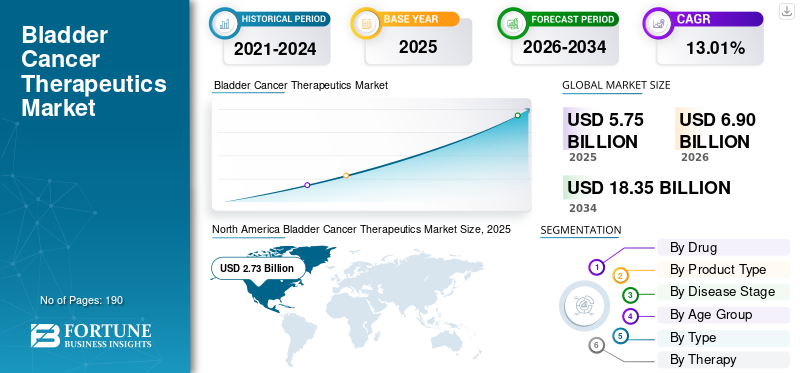
Download Free sample to learn more about this report.
Bladder Cancer Therapeutics Market KEY TAKEAWAYS
 Global Market Size & Forecast
- 2025 Market Size: USD 5.75 billion
- 2026 Market Size: USD 6.90 billion
- 2034 Forecast Market Size: USD 18.35 billion
- CAGR: 13.01% from 2026–2034
 Market Share
- North America dominated the bladder cancer therapeutics market with a 47.48% share in 2025.
- Immune checkpoint inhibitors dominated the market in 2025.
- Nogapendekin alfa inbakicept is projected to register the fastest CAGR of 42.56% during the forecast period.
 Key Regional Highlights
North America
North America led the market, supported by high diagnosis rates, strong reimbursement, and rapid adoption of advanced therapies.
Europe
Europe is projected to grow at a CAGR of 11.81%, driven by broader access to advanced urothelial cancer treatments.
Asia Pacific
Asia Pacific is expected to reach USD 1.35 billion in 2026, supported by a large patient pool and rising healthcare spending.
U.S.
U.S. The U.S. market is estimated at around USD 3.02 billion in 2026.
Japan
Japan The Japanese market is estimated at around USD 0.40 billion in 2026, accounting for approximately 5.75% of global revenues.
Read More

BLADDER CANCER THERAPEUTICS MARKET TRENDS
Shift Toward Immunotherapy-Based Combinations to Improve Treatment Outcomes is a Prominent Trend
The market witnessed a strong shift toward immunotherapy-based combinations as physicians seek treatment options that deliver better survival, deeper responses, and longer disease control. Bladder cancer treatment has traditionally depended on platinum-based chemotherapy and surgery, but many patients are not eligible for cisplatin or experience disease recurrence after standard treatment. This has created a need for therapies that combine immune checkpoint inhibition with targeted mechanisms such as antibody-drug conjugates. As a result, combinations such as pembrolizumab with enfortumab vedotin are gaining importance as they can address both immune activation and tumor-specific targeting, improving outcomes across advanced and perioperative treatment settings. Key companies are actively directing their resources toward new product launches, followed by regulatory approvals to capitalize on the growth potential.
- For instance, in January 2026, Astellas Pharma Inc. submitted a Supplemental New Drug Application (sNDA) to Japan's Ministry of Health, Labor and Welfare (MHLW) for PADCEVTM, an antibody-drug conjugate, in combination with Keytruda (pembrolizumab), a PD-1 inhibitor, as neoadjuvant treatment (before surgery), and then continued after radical cystectomy (surgery) as adjuvant treatment (after surgery), for adults with muscle-invasive bladder cancer (MIBC) who are ineligible for cisplatin-containing chemotherapy.
MARKET DYNAMICS
MARKET DRIVERS
Download Free sample to learn more about this report.
Increased Advanced Therapeutics Demand Due to Rising Bladder Cancer Incidences to Drive Market Growth
The global bladder cancer therapeutics market growth is driven by the rising number of bladder cancer cases. This increases the need for effective treatment options across early-stage, high-risk, and advanced disease settings. As more patients are diagnosed, the demand for therapies that can reduce recurrence, delay disease progression, and improve survival is also increasing. This is especially important as bladder cancer often requires long-term monitoring and repeated treatment, creating a continuous need for advanced drug regimens. As a result, companies are focusing on immunotherapies, antibody-drug conjugates, targeted therapies, and intravesical treatments to address unmet needs in minimally invasive bladder cancer.
- For instance, in April 2024, ImmunityBio received approval from the U.S. FDA for ANKTIVA in combination with BCG for BCG-unresponsive non-muscle-invasive bladder cancer with carcinoma in situ, with or without papillary tumors. ANKTIVA is a first-in-class IL-15 receptor agonist immunotherapy and is expected to provide a new treatment option for patients with limited alternatives after BCG failure.
MARKET RESTRAINTS
High Safety Burden of Advanced Therapies to Restrain Market Growth
The high safety burden of these therapies is restraining market growth. Many bladder cancer patients are older and may have renal impairment, frailty, or multiple comorbidities, which makes treatment-related side effects more difficult to manage. When therapies cause severe skin reactions, neuropathy, ocular toxicity, stomatitis, or other serious toxicities, physicians may need to interrupt treatment, reduce doses, or discontinue therapy. As a result, the clinical value of advanced drugs remains strong. Still, their real-world use can be limited in patients who cannot tolerate intensive monitoring and adverse-event management.
- For instance, in May 2025, Johnson & Johnson’s U.K. update on BALVERSA stated that adverse reactions led to treatment discontinuation in 19.4% of patients, with retinal pigment epithelial detachment and stomatitis among the most common adverse events leading to discontinuation. This highlights how toxicity-related discontinuation can limit broader use of targeted bladder cancer therapies despite their clinical benefits.
MARKET OPPORTUNITIES
Rising Demand for BCG-Unresponsive NMIBC Therapies to Open New Growth Opportunities
The global market is expected to offer strong growth opportunities driven by rising demand for therapies for BCG-unresponsive Non-Muscle-Invasive Bladder Cancer (NMIBC). BCG has been a key standard treatment for high-risk NMIBC. Still, many patients either do not respond to it or experience recurrence after treatment, leaving limited options other than repeated procedures or bladder removal surgery. This creates a clear treatment gap for bladder-sparing therapies that can delay progression, reduce recurrence, and improve quality of life. As a result, companies are increasingly developing intravesical immunotherapies, gene therapies, and novel immune-activating combinations, opening new commercial opportunities for a patient group with high unmet medical need.
- For instance, in July 2025, ImmunityBio announced that the U.K. MHRA approved ANKTIVA plus BCG for BCG-unresponsive non-muscle-invasive bladder cancer carcinoma in situ. The company stated that this was ANKTIVA’s first marketing approval outside the U.S. and that the therapy offers a new option for eligible patients in the U.K., supporting the market expansion.
MARKET CHALLENGES
High Toxicity Burden of Advanced Therapies to Challenge Wider Adoption
The global market is advancing with immunotherapies, antibody-drug conjugates, and targeted biologic therapies, but the toxicity burden of these advanced treatments remains a key challenge. FGFR inhibitor therapies and antibody-drug conjugates may require dose reductions, treatment delays, discontinuation, ophthalmologic monitoring, or close management of skin reactions, neuropathy, stomatitis, and ocular toxicity. As a result, even when these therapies show strong clinical benefit, their broader use can be restricted in real-world settings where patients may not tolerate intensive treatment and monitoring requirements.
- For example, the U.S. prescribing information for PADCEV states that adverse reactions led to discontinuation in 20% of patients, with peripheral neuropathy being one of the common reasons for discontinuation. This highlights how serious toxicity and treatment stoppage can restrict wider use of advanced antibody-drug conjugates in bladder cancer patients, especially among elderly or medically fragile populations.
Segmentation Analysis
By Drug
Nogapendekin Alfa Inbakicept Segment to Grow Fastest Due to Its Higher Complete Response Rate
Based on the drug, the market is categorized into pembrolizumab, enfortumab vedotin, avelumab, nivolumab, erdafitinib, nadofaragene firadenovec, nogapendekin alfa inbakicept, and others.
The nogapendekin alfa inbakicept segment is expected to grow at a fastest CAGR of 42.56% over the forecast period due to its novel mechanism of action that boosts the body’s immune system to hunt and eliminate the cancer cells. Some of the other benefits attributable to this drug include a higher complete response rate, a longer-lasting immune memory, and the adoption of a chemotherapy-free approach. The drug was approved for use in China in March 2026 by the Pharmaceutical Administration Bureau (ISAF) of the Macau Special Administrative Region.
Pembrolizumab accounted for the second- largest market share in 2025, as it is one of the most widely used cancer immunotherapy drugs across advanced and perioperative bladder cancer treatment settings.
To know how our report can help streamline your business, Speak to Analyst
By Product Type
Immune Checkpoint Inhibitors Dominated as Immunotherapy Becomes a Core Treatment Backbone
Based on product type, the market is segmented into cytotoxic chemotherapy, immune checkpoint inhibitors, antibody-drug conjugates, FGFR inhibitors, intravesical immunotherapy, gene therapy/viral vector therapy, and others.
In 2025, immune checkpoint inhibitors dominated the bladder cancer therapeutics market share as they are used across multiple bladder cancer stages and have shifted treatment from chemotherapy-only care to immune-based disease control. These drugs help the immune system recognize and attack tumor cells, which improves outcomes in advanced, adjuvant, and maintenance settings. As a result, oncologists continue to rely on checkpoint inhibitors as a core treatment backbone, especially in patients needing long-term disease control.
- For instance, in March 2024, Bristol Myers Squibb received U.S. FDA approval for Opdivo (nivolumab), in combination with cisplatin and gemcitabine, for the first-line treatment of adult patients with unresectable or metastatic urothelial carcinoma (UC), the most common type of bladder cancer.
The gene therapy/viral vector therapy segment is projected to grow at a 26.24% CAGR during the forecast period.
By Disease Stage
Metastatic Bladder Cancer Held Largest Share Due to High Systemic Therapy Demand
Based on disease stage, the market is segmented into non-muscle-invasive bladder cancer, muscle-invasive bladder cancer, locally advanced/unresectable bladder cancer, metastatic bladder cancer, and others.
Metastatic bladder cancer held the highest share in the market in 2025, as patients in this stage require systemic therapies with high treatment intensity and longer treatment sequencing. Metastatic disease has a higher need for Immunotherapy, antibody-drug conjugates, FGFR inhibitors, and combination regimens, as the cancer has spread beyond the bladder and is harder to control with local treatment alone. This increases drug utilization and supports higher revenue contribution from the metastatic segment. Underscoring these factors, key companies are focusing on the regulatory approvals for their innovative product launches and their commercialization.
- For instance, in January 2024, Johnson & Johnson announced that the U.S. FDA granted full approval to BALVERSA for adults with locally advanced or metastatic urothelial carcinoma with susceptible FGFR3 genetic alterations after prior systemic therapy.
The muscle-invasive bladder cancer segment is projected to grow at a CAGR of 14.39% during the forecast period.
By Age Group
Adults Dominated Market Owing to Higher Disease Burden and Greater Treatment Adoption
Based on the age group, the market is segmented into pediatric and adults.
Adults dominated the market in 2025, as bladder cancer is primarily diagnosed in the older population. Since most approved drugs, clinical trials, and treatment guidelines are focused on adult patients, commercial uptake is concentrated in this population. The higher disease burden among adults also increases the use of surgery-linked therapies, immunotherapies, maintenance treatments, and advanced systemic regimens.
- For instance, in April 2023, Astellas announced that the U.S. FDA granted accelerated approval for PADCEV in combination with KEYTRUDA for the first-line treatment of locally advanced or metastatic urothelial cancer in cisplatin-ineligible patients, highlighting an important treatment option for the adult patient population.
The pediatric segment is projected to grow at a CAGR of 10.83% during the forecast period.
By Type
Branded Segment Led Due to Strong Uptake of Premium Oncology Therapies
Based on type, the market is segmented into branded and generic.
In 2025, the branded segment dominated the market as most high-value bladder cancer treatments are patented biologics, antibody-drug conjugates, targeted therapies, and gene-based products. These therapies are priced higher than conventional Chemotherapy and are supported by strong clinical evidence, regulatory exclusivity, and company-led commercialization. As a result, branded products capture a larger revenue share even as generic Chemotherapy remains in use across several treatment settings.
- For instance, in December 2022, Merck announced that Health Canada approved KEYTRUDA in combination with fluoropyrimidine- and platinum-containing Chemotherapy as first-line treatment for adult patients with locally advanced unresectable or metastatic HER2-negative bladder or GEJ adenocarcinoma. This supports the growing role of branded immunotherapy combinations in the market.
The generic segment is projected to grow at a CAGR of 5.1% over the forecast period.
By Therapy
Immunotherapy Dominated as Treatment Shifts Toward Durable Disease Control
Based on therapy, the market is segmented into targeted therapy, immunotherapy, chemotherapy, and others.
In 2025, immunotherapy dominated the market, becoming a key treatment approach for both non-muscle-invasive and advanced bladder cancer. These therapies are preferred as they activate the patient’s immune system and can provide durable responses in patients who have limited options after Chemotherapy or BCG failure. As more immunotherapy products receive approvals and move into earlier lines of treatment, their contribution to market revenue continues to increase.
- For instance, in April 2024, ImmunityBio, Inc. (NASDAQ: IBRX), an immunotherapy company, today announced that the U.S. Food and Drug Administration (FDA) has approved ANKTIVA (N-803, or nogapendekin alfa inbakicept-pmln) plus Bacillus Calmette-Guérin (BCG) for the treatment of patients with BCG-unresponsive non-muscle invasive bladder cancer (NMIBC) with carcinoma in situ (CIS), with or without papillary tumors.
The targeted therapy segment is projected to grow at a CAGR of 19.92% over the forecast period.
By Route of Administration
Parenteral Segment Led Due to High Use of Infusion and Intravesical Therapies
Based on the route of administration, the market is segmented into oral, parenteral, and intravesical.
In 2025, the parenteral segment dominated the market, as many leading bladder cancer therapies are administered by intravenous infusion or intravesical delivery under clinical supervision. Immunotherapies, antibody-drug conjugates, chemotherapy combinations, and intravesical treatments are usually administered in a hospital, infusion center, or urology clinic. This increases reliance on parenteral routes, especially for advanced and high-risk patients who need monitored dosing and toxicity management.
- For instance, in June 2020, EMD Serono and Pfizer announced that the U.S. FDA approved BAVENCIO as a first-line maintenance treatment for patients with locally advanced or metastatic urothelial carcinoma that had not progressed with platinum-containing chemotherapy.
The intravesical segment is projected to grow at a CAGR of 12.85% over the forecast period.
By Distribution Channel
Hospital Pharmacies Dominated Due to Supervised Administration of Advanced Therapies
Based on distribution channel, the market is segmented into hospital pharmacies, drug stores & retail pharmacies, online pharmacies, and specialty pharmacies.
In 2025, hospital pharmacies dominated the market as bladder cancer treatment is largely managed through hospitals, cancer centers, and specialty urology settings. Advanced drugs often require physician supervision, infusion support, cold-chain handling, prior authorization, and adverse-event monitoring, making hospital pharmacies central to therapy access and dispensing. This is especially true for intravesical, injectable, and infusion-based regimens used in high-risk and advanced disease.
- For instance, in September 2023, Ferring announced that the first U.S. patient was dosed with commercially available ADSTILADRIN as part of its early experience program, with urologists at participating clinics able to prescribe the intravesical gene therapy for eligible high-risk bladder cancer patients.
The online pharmacies segment is projected to grow at a CAGR of 21.22% over the forecast period.
Bladder Cancer Therapeutics Market Regional Outlook
By geography, the market is categorized into Europe, North America, Asia Pacific, Latin America, and the Middle East & Africa.
North America
North America Bladder Cancer Therapeutics Market Size, 2025 (USD Billion)
To get more information on the regional analysis of this market, Download Free sample
North America held the dominant share in 2024 at USD 2.13 billion and maintained its leading position in 2025 at USD 2.73 billion. The North American market is growing due to high bladder cancer diagnosis rates, strong oncology reimbursement, and faster adoption of premium therapies, including immunotherapies, ADCs, and targeted drugs. Strong presence of key companies and cancer centers further supports early uptake of newly approved drugs.
U.S. Bladder Cancer Therapeutics Market
Given North America's substantial contribution and the U.S. dominance in the region, the U.S. market is estimated at around USD 3.02 billion in 2026, accounting for roughly 43.78% of global revenues.
Europe
Europe is projected to grow at 11.81% in the coming years, the second-highest among all regions, and reach a valuation of USD 1.77 billion in 2026. Growth in the region is supported by rising use of advanced urothelial cancer therapies, expanding access through national reimbursement systems, and strong adoption of clinical guidelines.
U.K. Bladder Cancer Therapeutics Market
The U.K. market is estimated at USD 0.34 billion in 2026, accounting for roughly 4.94% of global revenues.
Germany Bladder Cancer Therapeutics Market
Germany's market is projected to reach approximately USD 0.42 billion in 2026, equivalent to around 6.14% of global revenues.
Asia Pacific
Asia Pacific is estimated to reach USD 1.35 billion in 2026 and secure third place in the market. The market is expanding due to a large patient pool, improving cancer diagnosis, and rising healthcare spending in China, Japan, India, South Korea, and Australia. Growing access to oncology biologics and targeted therapies is helping shift treatment from conventional Chemotherapy to advanced regimens. Local approvals and hospital-based oncology expansion are further supporting market growth.
Japan Bladder Cancer Therapeutics Market
The Japanese market in 2026 is estimated at around USD 0.40 billion, accounting for approximately 5.75% of the global revenues.
China Bladder Cancer Therapeutics Market
China's Market is projected to be among the largest worldwide, with 2026 revenues estimated at around USD 0.45 billion, accounting for approximately 6.49% of global sales.
India Bladder Cancer Therapeutics Market
The Indian market is estimated at around USD 0.11 billion in 2026, accounting for roughly 1.63% of global revenues.
Latin America and Middle East & Africa
The Latin America and Middle East & Africa regions are expected to witness steady growth in this market during the forecast period. The market in Latin America is estimated to reach a valuation of USD 0.30 billion. The growth in Latin America is driven by improving oncology infrastructure, rising awareness of bladder cancer treatment, and gradual adoption of branded therapies in major markets such as Brazil and Mexico. This is creating steady demand for advanced bladder cancer therapeutics. In the Middle East & Africa, the GCC is set to reach USD 0.05 billion in 2026.
South Africa Bladder Cancer Therapeutics Market
The South African Market is projected to reach approximately USD 0.03 billion in 2026, accounting for roughly 0.49% of global revenues.
COMPETITIVE LANDSCAPE
Key Industry Players
New Product Launches by Key Companies to Propel Market Progress
The global bladder cancer therapeutics market is moderately competitive, with competition led by established oncology companies, specialty pharmaceutical players, and innovators developing targeted, immune-based, and intravesical therapies. Major companies such as Merck & Co., Astellas Pharma, Pfizer, Johnson & Johnson, Ferring Pharmaceuticals, ImmunityBio, AstraZeneca, UroGen Pharma, Merck KGaA, and Bristol-Myers Squibb Company are focusing on differentiated treatment options to strengthen their market positions. These companies are increasingly investing in antibody-drug conjugates, immune checkpoint inhibitors, FGFR inhibitors, gene therapies, and bladder-sparing intravesical products to improve survival outcomes, reduce recurrence, and address unmet needs in both non-muscle-invasive and metastatic bladder cancer.
- For instance, in September 2025, Johnson & Johnson received approval from the U.S. FDA for INLEXZO, a gemcitabine intravesical system, for certain patients with BCG-unresponsive non-muscle-invasive bladder cancer. The product is designed to provide sustained local drug delivery within the bladder, offering a differentiated, bladder-sparing approach for patients with limited treatment options after BCG failure.
Several companies are adopting product launches, label expansions, clinical trial advancements, and strategic collaborations as key growth strategies to expand their market presence. Large oncology players are strengthening their competitive position by moving advanced therapies into earlier lines of treatment, while specialty companies are focusing on localized drug delivery and novel immunotherapy approaches for high-risk non-muscle-invasive disease. The competitive landscape is expected to intensify as companies increasingly focus on premium-branded therapies, broader regulatory approvals, and next-generation bladder-sparing solutions to capture higher-value patient segments.
LIST OF KEY BLADDER CANCER THERAPEUTICS COMPANIES PROFILED
- Merck & Co., Inc. (U.S.)
- Astellas Pharma Inc. (Japan)
- Bristol-Myers Squibb Company (U.S.)
- Pfizer Inc. (U.S.)
- Johnson & Johnson (U.S.)
- Ferring Pharmaceuticals (Switzerland)
- ImmunityBio, Inc. (U.S.)
- AstraZeneca plc (U.K.)
- UroGen Pharma, Inc. (U.S.)
- Hoffmann-La Roche Ltd (Switzerland)
- Merck KGaA (Germany)
KEY INDUSTRY DEVELOPMENTS
- June 2026: Alpha Tau Medical Ltd. collaborated with Tolmar International Ltd. to develop and commercialize Alpha DaRT for the treatment of prostate cancer in the U.S. The collaboration grants Tolmar exclusive U.S. commercialization rights for prostate cancer, with an option to expand into bladder cancer, subject to additional payments.
- June 2026: Genentech has received U.S. FDA approval for Tecentriq and Tecentriq Hybreza as adjuvant treatment for adults with muscle-invasive bladder cancer who have circulating tumor DNA molecular residual disease after cystectomy.
- May 2026: AstraZeneca’s Imfinzi was approved by the U.S. FDA as an immunotherapy combination for patients with BCG-naïve, high-risk non-muscle-invasive bladder cancer.
- February 2026: Merck & Co., Inc. presented data across multiple genitourinary cancers from several approved and investigational medicines at the 2026 American Society of Clinical Oncology Genitourinary (ASCO GU) Cancers Symposium.
- March 2021: Exelixis, Inc. announced a clinical trial collaboration and supply agreement with Merck KGaA, Darmstadt, Germany, and Pfizer for the ongoing phase 1b dose-escalation study STELLAR-001, adding three new cohorts to evaluate the safety and tolerability of XL092.
REPORT COVERAGE
The report provides a detailed global bladder cancer therapeutics market analysis. It focuses on key aspects, including leading companies, major drugs, product types, disease stages, routes of administration, and distribution channels. It also offers insights into the growing adoption of immunotherapies, antibody-drug conjugates, targeted therapies, and intravesical treatments for the management of bladder cancer. In addition, the report covers the impact of recent product approvals, pipeline, drug development, treatment advancements, and strategic initiatives by key market players. The report further evaluates market trends, drivers, restraints, opportunities, and the competitive landscape across major regions. It also highlights key industry developments, regulatory approvals, and company strategies that are expected to shape market growth during the forecast period.
Request for Customization to gain extensive market insights.
Report Scope & Segmentation
| ATTRIBUTE | DETAILS |
| Study Period | 2021-2034 |
| Base Year | 2025 |
| Estimated Year | 2026 |
| Forecast Period | 2026-2034 |
| Historical Period | 2021-2024 |
| Growth Rate | CAGR of 13.01% from 2026 to 2034 |
| Unit | Value (USD Billion) |
| Segmentation | By Drug, Product Type, Disease Stage, Age Group, Type, Therapy, Route of Administration, Distribution Channel, and Region |
| By Drug |
|
| By Product Type |
|
| By Disease Stage |
|
| By Age Group |
|
| By Type |
|
| By Therapy |
|
| By Route of Administration |
|
| By Distribution Channel |
|
| By Region |
|
Frequently Asked Questions
According to Fortune Business Insights, the global market value stood at USD 5.75 billion in 2025 and is projected to reach USD 18.35 billion by 2034.
In 2025, the market value in North America stood at USD 2.73 billion.
The market is expected to grow at a CAGR of 13.01% over the forecast period of 2026-2034.
By type, the branded segment dominated the market.
Increased advanced therapeutics demand due to rising bladder cancer incidences is driving market growth.
Merck & Co., Inc., Astellas Pharma Inc., Bristol-Myers Squibb Company, and AstraZeneca plc are among the major players in the global market.
North America dominated the market in 2025.



- 2021-2034
- 2025
- 2021-2024
- 190
Get 30-60 hrs Free Customization
Expand Regional and Country Coverage, Segments Analysis, Company Profiles, Competitive Benchmarking, and End-user Insights.













.webp)






Related Reports
-
US +1 833 909 2966 ( Toll Free )
-
Get In Touch With Us