Blood Viscometer Market Size, Share & Industry Analysis, By Technology (Rotational Viscometer, Capillary Viscometer, Vibrational/Oscillatory Viscometer, and Others), By Application (Clinical Diagnostics & Patient Monitoring and Research), By End-user (Hospitals & Diagnostic Laboratories, Pharmaceutical & Biotechnology Companies, Academic & Research Institutes, and Others), and Regional Forecast, 2026-2034
 Download Free Sample
Blood Viscometer Market Size and Future Outlook
 Listen to Audio Version
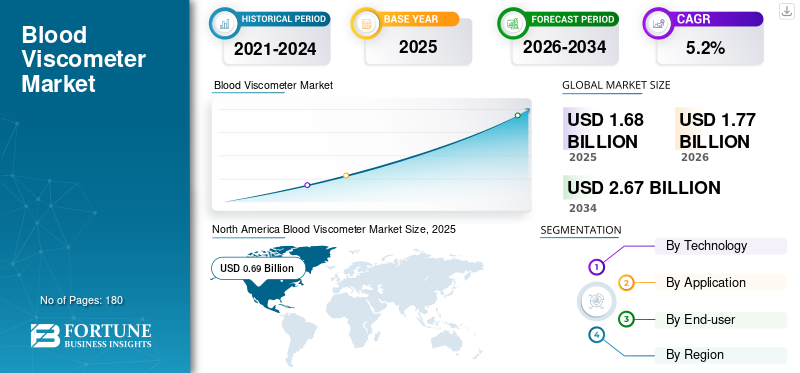
The global blood viscometer market size was valued at USD 1.68 billion in 2025. The market is projected to grow from USD 1.77 billion in 2026 to USD 2.67 billion by 2034, exhibiting a CAGR of 5.2% during the forecast period. North America dominated the blood viscometer market with a market share of 41.07% in 2025.
Blood viscometers are devices used to measure the thickness and flow properties of blood in diseases such as diabetes, cardiovascular disorders, stroke, and inflammatory conditions. The market growth is attributed to the increasing use of these viscometers in hospitals, diagnostic laboratories, and research centers due to the higher incidence of cardiovascular diseases, diabetes cases, and an aging population worldwide.
Furthermore, RheoSense, Inc., AMETEK.Inc., and A&D Company, Limited held the majority of the market share in 2025 due to their strong global presence and high precision instruments.
Download Free sample to learn more about this report.
BLOOD VISCOMETER MARKET KEY TAKEAWAYS
 Market Size & Forecast
- 2025 Market Size: USD 1.68 billion
- 2026 Market Size: USD 1.77 billion
- 2034 Forecast Market Size: USD 2.67 billion
- CAGR: 5.2% from 2026–2034
 Market Share
- North America dominated the blood viscometer market with a 41.07% share in 2025.
- The capillary viscometer segment held the largest share of the market in 2025.
- The clinical diagnostics & patient monitoring segment is estimated to account for 72.0% of the market in 2026.
 Key Regional Highlights
North America
North America generated USD 0.69 billion in revenue in 2025, supported by its well-established network of clinical laboratories and strong adoption of diagnostic technologies.
Europe
Europe is projected to grow at a CAGR of 5.2% through 2034, driven by expanding blood rheology research and increasing product innovation across healthcare institutions.
Asia Pacific
Asia Pacific is expected to reach USD 0.38 billion by 2026, fueled by government investments in hospital modernization and laboratory automation.
U.S.
The market is projected to reach USD 0.62 billion in 2026.
Japan
The market is expected to generate USD 0.10 billion in 2026.
Read More

BLOOD VISCOMETER MARKET TRENDS
Shift toward Automated and Digital Systems to Emerge as a Key Trend
Currently, there is a growing shift from manual viscometers to automated, digital systems. Modern devices deliver faster results, greater precision, and integration with laboratory information systems. As a result, companies are focusing on compact, user-friendly designs. Moreover, the use of microfluidic technology, requiring smaller blood samples and providing quick results, is increasing.
- For instance, in February 2026, Anton Paar launched ViscoQC, an automated rotational viscometer engineered for streamlined routine viscosity testing via intuitive guided controls.
Download Free sample to learn more about this report.
MARKET DYNAMICS
MARKET DRIVERS
Rising Burden of Cardiovascular and Metabolic Diseases to Fuel the Market Expansion
Over the past few years, there have been increasing cases of heart diseases, diabetes, and blood-related disorders and blood viscosity is closely linked with hypertension, stroke risk, and vascular complications. As a result, physicians are increasingly using viscosity testing as part of patient monitoring in high-risk groups, thereby driving the product demand. Such a scenario is anticipated to drive the global blood viscometer market growth.
- For instance, in September 2025, the World Health Organization (WHO) reported that approximately 1.4 billion adults aged 30-79 globally had hypertension as of 2024.
MARKET RESTRAINTS
High Cost of Advanced Devices to Restrict Market Growth
Despite significant adoption, fully automated digital systems are expensive and may not be affordable for small laboratories or healthcare centers in developing regions. In addition to the device cost, maintenance and calibration expenses add to the overall burden. Further, some hospitals still rely on conventional laboratory tests rather than specialized viscosity testing due to budget constraints. Moreover, the lack of skilled professionals to operate advanced rheology equipment is also expected to limit adoption, hindering the market growth.
- For instance, in February 2025, LabX noted that new viscometers and rheometers typically cost between USD 2,000 and USD 50,000, depending on type, precision, and included features.
MARKET OPPORTUNITIES
Growth in Research and Development to Offer Significant Opportunities
In recent years, blood viscosity has been increasingly studied to understand inflammation, cancer progression, and microcirculation disorders. As a result, pharmaceutical companies and research institutes are investing in hemorheology studies to improve drug development.
This is expected to offer lucrative opportunities for key players to collaborate with research institutions and pharmaceutical companies to develop microfluidic viscometers for advanced blood flow studies, thereby supporting market expansion.
MARKET CHALLENGES
Limited Clinical Standardization to Challenge Market Expansion
Despite the significant importance of blood viscosity in many diseases, it is not yet considered a standard test in all hospitals. Furthermore, different laboratories use different measurement methods, leading to variations in results. This lack of uniform standards is anticipated to limit widespread clinical adoption.
Moreover, regulatory approval processes for new devices are lengthy and complex, pushing manufacturers to invest in clinical validation studies to demonstrate the benefits of routine viscosity testing. This is expected further to increase time and cost, challenging market expansion.
Segmentation Analysis
By Technology
Widespread Usage of Capillary Viscometers across Clinical Laboratories to Boost the Segment’s Growth
Based on technology, the market is segmented into rotational viscometer, capillary viscometer, vibrational/oscillatory viscometer, and others.
To know how our report can help streamline your business, Speak to Analyst
The capillary viscometer segment accounted for the largest global blood viscometer market share in 2025. Capillary viscometers are simple, reliable, and cost-effective, which is driving their adoption across clinical laboratories and hospitals for routine testing and research applications, thereby contributing to the segment’s expansion.
Additionally, the rotational viscometer segment is projected to grow at a CAGR of 4.7% during the forecast period.
By Application
Increasing Hospital Admissions to Drive Clinical Diagnostics & Patient Monitoring Segment Growth
By application, the market is segmented into clinical diagnostics & patient monitoring and research.
The clinical diagnostics & patient monitoring segment accounted for the largest market share in 2025. The segment's growth is driven by increasing hospital admissions for chronic diseases, which are driving the demand for blood viscosity testing to help doctors assess cardiovascular risk, monitor diabetes patients, and evaluate inflammatory diseases. The segment is estimated to hold a 72.0% share in 2026.
Additionally, the research segment is anticipated to grow at a CAGR of 4.9% over the forecast period.
By End-user
Rising Number of Hospitals Worldwide to Drive the Hospitals & Diagnostic Laboratories Segment’s Growth
On the basis of end-user, the market is segmented into hospitals & diagnostic laboratories, pharmaceutical & biotechnology companies, academic & research institutes, and others.
In 2025, the hospitals & diagnostic laboratories segment dominated the market in terms of end user. The segment growth is attributed to higher testing volume in these settings, which are equipped with better resources and skilled staff to operate viscometers. Moreover, the increasing number of hospitals is also anticipated to support this demand. Furthermore, the segment is set to hold a 50.1% share in 2026.
- For instance, according to the American Hospital Association, the U.S. has around 6,100 registered hospitals as of 2026.
In addition, the academic & research institutes segment is projected to grow at a CAGR of 5.0% over the forecast period.
Blood Viscometer Market Regional Outlook
Based on geography, the market is classified into North America, Europe, Asia Pacific, Latin America, and the Middle East & Africa.
North America
North America accounted for the largest share of revenues in 2024, valued at USD 0.65 billion, and also held the largest share in 2025, reaching a value of USD 0.69 billion. The growth is attributed to the well-established network of clinical laboratories, which is expected to favor the adoption of viscometers in the region.
North America Blood Viscometer Market Size, 2025 (USD Billion)
To get more information on the regional analysis of this market, Download Free sample
- For instance, according to data from Laboratory of Florida LLC., in February 2026, over 200,000 clinical laboratories provided testing services in the U.S.
U.S. Blood Viscometer Market
In 2026, the U.S. is projected to reach USD 0.62 billion, accounting for approximately 35.0% of the global market.
Europe
The Europe market is projected to record a 5.2% growth rate during the projection period, the second-highest globally, reaching USD 0.50 billion by 2026. European research institutions are actively studying blood rheology in stroke and vascular diseases, which is influencing key players to expand their product offerings in the region.
U.K. Blood Viscometer Market
The U.K. market is expected to reach USD 0.11 billion by 2026, accounting for roughly 5.9% of global revenues.
Germany Blood Viscometer Market
The Germany market is projected to reach USD 0.12 billion by 2026, accounting for approximately 6.5% of global revenue.
Asia Pacific
By 2026, the Asia Pacific market is expected to reach USD 0.38 billion, ranking third globally. Governments in the region are investing in hospital upgrades and laboratory automation, which is expected to fuel product demand, driving market growth.
Japan Blood Viscometer Market
The Japan market is projected to generate USD 0.10 billion in revenue by 2026, accounting for approximately 5.8% of the global market.
China Blood Viscometer Market
The China market is expected to reach nearly USD 0.13 billion by 2026, accounting for 7.5% of global revenues.
India Blood Viscometer Market
The India market is projected to reach USD 0.04 billion by 2026, accounting for around 2.4% of global market revenue.
Latin America and Middle East & Africa
Both Latin America and the Middle East & Africa markets are expected to showcase moderate growth, with the Latin America market predicted to reach USD 0.10 billion by 2026. The growth of these regions is expected to be driven by rising healthcare investments and expanding private hospital networks, as well as increasing demand for viscometers.
GCC Blood Viscometer Market
By 2026, the GCC market is expected to reach USD 0.04 billion, accounting for 2.3% of total market revenues.
COMPETITIVE LANDSCAPE
Key Industry Players
Strong Brand Reputation and Diversified Portfolios to Strengthen the Market Position of Key Players
In 2025, RheoSense, Inc., AMETEK.Inc., and A&D Company, Limited held the majority of the global blood viscometer market share. The share is mainly due to their strong brand reputation, strong international presence, and high-precision instruments.
Moreover, other prominent players are collaborating with research institutions, focusing on product innovations, and expanding their geographical presence to capture a significant portion of the market.
LIST OF KEY BLOOD VISCOMETER COMPANIES PROFILED
- Benson Viscometers – Clinical Viscometers (U.K.)
- RheoSense, Inc. (U.S.)
- proRheo GmbH (Germany)
- A&D Company, Limited (Japan)
- AMETEK.Inc. (U.S.)
- TA Instruments (U.S.)
- Cole-Parmer Instrument Company, LLC. (U.S.)
- IKA (Germany)
- LAMY RHEOLOGY (France)
- Hydramotion Ltd. (U.K.)
KEY INDUSTRY DEVELOPMENTS
- November 2025: Benson Viscometers – Clinical Viscometers attended MEDICA 2025 in Düsseldorf, showcasing their clinical viscometers, including BV1 semi-automated clinical viscometer and BV200 automated clinical viscometer.
- September 2025: Benson Viscometers – Clinical Viscometers announced its participation in the IBMS Congress 2025 to showcase its clinical viscometers, improving its brand presence.
- July 2025: Biorheologics Co. Ltd. received a U.S. patent for a compact blood viscosity measurement kit that uses a disposable U-shaped capillary viscometer.
- January 2023: RheoSense, Inc. unveiled the m-VROC II, a next-generation high-precision viscometer that measures viscosity using 15 microliters of sample with 2% accuracy and 0.5% repeatability.
- June 2021: PERL researchers at TotalEnergies Lacq facility developed a low-cost, portable viscometer prototype for hospitals to measure blood viscosity using webcam-based flow detection in syringes.
REPORT COVERAGE
The report presents a comprehensive analysis of all market segments, covering key drivers, trends, opportunities, restraints, and challenges shaping the market. It also includes insights into technological developments, recent industry activities, market share evaluation, and detailed company profiles of key players.
Request for Customization to gain extensive market insights.
Report Scope & Segmentation
| ATTRIBUTE | DETAILS |
| Study Period | 2021-2034 |
| Base Year | 2025 |
| Estimated Year | 2026 |
| Forecast Period | 2026-2034 |
| Historical Period | 2021-2024 |
| Growth Rate | CAGR of 5.2% from 2026-2034 |
| Unit | Value (USD Billion) |
| Segmentation | By Technology, Application, End-user, and Region |
| By Technology |
|
| By Application |
|
| By End-user |
|
| By Geography |
|
Frequently Asked Questions
Fortune Business Insights says that the global market value stood at USD 1.68 billion in 2025 and is projected to reach USD 2.67 billion by 2034.
In 2025, the North America market value stood at USD 0.69 billion.
The market is expected to grow at a CAGR of 5.2% over the forecast period of 2026-2034.
The capillary viscometer segment led the market by technology in 2025.
The key factor driving the market is the rising burden of cardiovascular and metabolic diseases.
RheoSense, Inc., AMETEK.Inc., and A&D Company, Limited are among the prominent players in the market.
North America dominated the market in 2025.



- 2021-2034
- 2025
- 2021-2024
- 180
Get 30-60 hrs Free Customization
Expand Regional and Country Coverage, Segments Analysis, Company Profiles, Competitive Benchmarking, and End-user Insights.













.webp)






Related Reports
-
US +1 833 909 2966 ( Toll Free )
-
Get In Touch With Us