Books Market Size, Share & Industry Analysis, By Genre (Fiction, Non-fiction, Educational, and Others), By Format (Hard Copy, E-books, and Audiobooks), By Distribution Channel (Supermarkets/Hypermarkets, Specialty Stores, Online, and Others), and Regional Forecast, 2026-2034
 Download Free Sample
(Offer valid till 30th Sep 2026)

Books Market Size and Future Outlook
 Listen to Audio Version
The global books market size was valued at USD 142.95 billion in 2025. The market is projected to grow from USD 150.06 billion in 2026 to USD 224.01 billion by 2034, exhibiting a CAGR of 5.14% during the forecast period. North America dominated the global books market with a market share of 35.42% in 2025.
Books are available in different formats, including e-books, hard copies, and audiobooks, which are mainly designed to inform and educate consumers. The increasing literacy rate, along with the rising penetration of digital formats of books, is fueling the demand. Moreover, the growing importance of education and increasing support by the governments of different regions is further expected to boost the market.
Leading players, such as Penguin Random House, Elsevier, Pearson PLC, and others, have been constantly adopting AI-based technologies to broaden their product offerings. They are also expanding into direct sales via author channels or subscription platforms, which contributes to the growth.
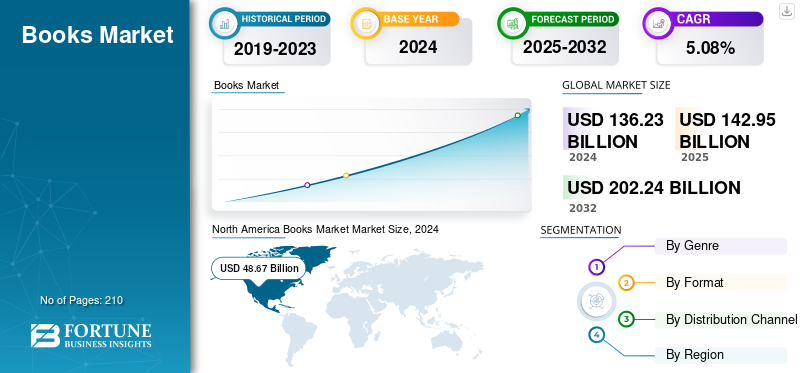
Download Free sample to learn more about this report.
BOOKS MARKET KEY TAKEAWAYS
 Market Size & Forecast
- 2025 Market Size: USD 142.95 billion
- 2026 Market Size: USD 150.06 billion
- 2034 Forecast Market Size: USD 224.01 billion
- CAGR: 5.14% from 2026–2034
 Market Share
- North America dominated the books market with a 35.42% share in 2025.
- The fiction segment accounted for 46.54% of the market in 2026.
- The hard book segment held a 54.33% market share in 2026.
 Key Regional Highlights
North America
North America generated USD 50.63 billion in 2025 and is projected to reach USD 52.69 billion in 2026, holding a 35.42% market share.
Europe
Europe was valued at USD 42.10 billion in 2025 and remained the second-largest regional market.
Asia Pacific
Asia Pacific reached USD 34.14 billion in 2025 and is projected to grow to USD 36.54 billion in 2026, with a CAGR of 7.04%.
U.S.
The market is projected to reach USD 34.53 billion in 2026, supported by high literacy rates and AI-driven book retail services.
Japan
The market is projected to reach USD 11.89 billion in 2026, driven by strong reading habits and a mature publishing industry.
Read More

Market Dynamics
Market Drivers
Rising Preference of Consumers toward E-books to Foster Market Growth
The rapid penetration of smartphones and the internet has made e-books easily accessible to a wide range of consumers, fostering the e-book market. Moreover, e-books are more affordable than hard-printed books, which reduces their production and distribution costs. This pricing advantage attracts cost-conscious customers, expanding the buyer base and driving market growth during the forecast period. For instance, according to the Pew Research Centre, in 2022, approximately 75% of adults in the U.S. report having read a book in any format within the past year.
Market Restraints
Limited Digital Adoption in Undeveloped Regions to Restrict Market Growth
Many underdeveloped nations have inadequate digital infrastructure, with limited coverage of high-speed internet, restricting access to digital content, including audiobooks and e-books. In these regions, affordability barriers are also high, which makes it expensive for low-income groups within the region. Furthermore, limited financial resources and an underdeveloped technological infrastructure hinder investments in digital ecosystems.
Market Opportunities
Increasing Government Initiatives to Promote Education to Propel Market Growth
In recent times, governments of different regions have been adopting initiatives to promote education among all age groups of students. These initiatives encourage skill-based talent and experimental learning, contributing to the increased demand for various formats of books. Additionally, governments are promoting digital learning tools by integrating QR codes and e-learning platforms, along with facilitating educational reforms and measures, thus fostering market growth. For instance, according to the New Education Policy 2024 of India, students will have the option to take their 10th and 12th board exams twice a year to alleviate academic stress, starting from the 2025-26 academic session.
Books Market Trends
Growing Social Media Influence in terms of Book Portals to Support Market Expansion
In recent times, authors and publishers have leveraged social media to directly connect with readers, promote new titles, and build loyal communities. These facilities also enable engagement with new and fresh content, which influences the purchase decisions of consumers. Furthermore, platforms such as Instagram and Facebook are widely used for advertising, promotional campaigns, and direct sales links, increasing impulse buying among consumers.
Download Free sample to learn more about this report.
Segmentation Analysis
By Genre
Increased Demand for Fiction Movies and TV Series to Foster Fiction Segment Growth
Based on genre, the market is divided into fiction, non-fiction, educational, and others.
The fiction segment dominates the market with a share of 46.54% in 2026. Fiction, particularly genres such as fantasy, romance, and thrillers, offers an immersive storytelling experience, fostering a strong emotional connection with the readers. Furthermore, several fiction books are adapted as films, TV series, and streaming content, which enhances their visibility.
The fiction segment is expected to grow at the fastest CAGR during the forecast period.
To know how our report can help streamline your business, Speak to Analyst
By Format
High Usage of Hard Book Copies in Educational Institutions to Boost Its Segment Growth
Based on format, the market is divided into hard copy, e-books, and audiobooks.
The hard book segment held the majority of the books market share in 2026, accounting for 54.33%. Millennials and Gen Z consumer groups often favor hardcovers, especially for special editions, gifts, or collector’s items. Moreover, hard copy books are mainly preferred for their long-lasting quality, making them more suitable for libraries and educational institutions.
The e-books segment is expected to grow at the fastest CAGR of 6.73% during the forecast period.
By Distribution Channel
Availability of Limited-Edition Books in Specialty Stores to Propel Segment Growth
Based on distribution channel, the market is segmented into supermarkets/hypermarkets, specialty stores, online, and others.
The specialty stores segment is expected to lead the market with a share of 27.79% in 2026. Specialty bookstores offer carefully curated collections focused on specific genres, local literature, and rare editions, attracting readers looking for a unique collection. These stores also include expert recommendations, author consultations, and community events, fostering segment growth.
The online segment is expected to grow at a CAGR of 8.08% during the forecast period.
Books Market Regional Outlook
By region, the global books market analysis is segmented into North America, Europe, Asia Pacific, South America, and the Middle East & Africa.
North America
North America Books Market Market Size, 2025 (USD Billion)
To get more information on the regional analysis of this market, Download Free sample
The North America region captured 35.42% of the global market in 2025, generating USD 50.63 Billion in revenue, and is projected to reach USD 52.69 Billion in 2026. Supported by widespread internet penetration and advanced digital infrastructure. In the U.S., there is a high literacy rate and a large number of avid readers who actively purchase books across formats.
The U.S. market is valued at USD 34.53 billion by 2026. Additionally, American publishers and online retailers invest heavily in AI-driven personalization and subscription services.
Asia Pacific and Europe
In 2025, Asia Pacific generated USD 34.14 billion, contributing 23.88% to global market revenue, and is projected to grow to USD 36.54 billion in 2026. Asia Pacific’s anticipated growth rate is 7.04% and will achieve the third position in the global market. The Japan market is valued at USD 11.89 billion by 2026, the China market is valued at USD 11.17 billion by 2026, and the India market is valued at USD 10.47 billion by 2026.
Europe has a large local publishing industry, producing a wide variety of titles and fostering a competitive market for books within the region. It is estimated to reach USD 42.10 billion in 2025 and secure the second position. The UK market is valued at USD 6.54 billion by 2026, while the German market is valued at USD 8.9 billion by 2026.
South America and the Middle East & Africa
South America and the Middle East & Africa are also expected to accumulate a substantial share. Middle East & Africa recorded a market size of USD 7.28 billion in 2025, capturing 5.09% of the global market share, and is projected to reach USD 7.51 billion in 2026. Increasing subscription-based reading models and consumer preference for sustainable practices are driving the market in MEA and South America.
The South America market was valued at USD 8.81 billion in 2025, capturing 6.16% of global revenue, and is estimated to reach USD 9.03 billion in 2026.
Competitive Landscape
Key Market Players
Increasing Partnerships of Authors with Publishers and Educational Institutions to Boost Market Growth
The increasing collaboration between authors and independent publishers allows them to develop textbooks and learning materials aligned with updated curricula. Moreover, partnerships facilitate wider dissemination of books through schools, colleges, universities, and online educational platforms, reaching a wider scale of audience. Additionally, partnerships help publishers identify emerging educational needs and niche subjects, creating new market segments and propelling books market growth.
List of Key Book Companies Profiled in the Report:
- Disney (U.S.)
- Penguin Random House (U.S.)
- Hachette Book Group (U.S.)
- Pearson (U.K.)
- HarperCollins Publishers (U.S.)
- Scholastic Inc. (U.S.)
- Simon & Schuster, Inc. (U.S.)
- McGraw-Hill (U.S.)
- Macmillan (U.S.)
- IDW Publishing (U.S.)
Key Industry Developments
- November 2024– Macmillan launched Folio 1.0 Digital Library, powered by Glassboxx technology. This state-of-the-art digital library offers seamless, scalable access to Macmillan’s extensive collection of eBooks and audiobooks globally.
- October 2024– Amulet Books, a children's novel book publisher, launched a Diary of a Wimpy Kid 3-Book Collection, Special Disney+ Cover Editions, featuring three bestselling books with unique covers inspired by the 3D animated Disney+ movies.
- October 2024 – Penguin Random House India has launched a new range of branded merchandise, including canvas tote bags and notebooks, featuring distinctive designs inspired by Penguin's iconic branding and literary themes.
- May 2024 – Scholastic launched a curated online hub of books and free resources designed to support children's emotional well-being through literacy. The resources include book lists, print, audio, and video materials.
- March 2023– Peppa Pig launched on Disney+ in 19 new markets across Europe, with availability in 25 additional languages. The streaming rollout covers regions including the Balkans, Baltics, Benelux, the U.K., France, Spain, Sweden, Turkey, and more.
REPORT COVERAGE
The market research report provides a comprehensive analysis, focusing on key elements such as major companies, regional and market segmentation, regional analysis, competition landscape, supply chain analysis, and competitive dynamics. Additionally, it offers insights into market trends and highlights significant developments within the book industry. Beyond these aspects, it also examines various factors that have contributed to market growth in recent years.
Request for Customization to gain extensive market insights.
Report Scope & Segmentation
| ATTRIBUTE | DETAILS |
|
Study Period |
2021-2034 |
|
Base Year |
2025 |
|
Estimated Year |
2026 |
|
Forecast Period |
2026-2034 |
|
Historical Period |
2021-2024 |
|
Growth Rate |
CAGR of 1.18% from 2026 – 2034 |
|
Unit |
Value (USD Million) |
| Segmentation |
By Genre
By Format
By Distribution Channel
|
|
By Region North America (By Genre, Format, Distribution Channel, and Country)
Europe (By Genre, Format, Distribution Channel, and Country)
Asia Pacific (By Genre, Format, Distribution Channel, and Country)
South America (By Genre, Format, Distribution Channel, and Country)
Middle East & Africa (By Genre, Format, Distribution Channel, and Country)
|
Frequently Asked Questions
Fortune Business Insights says that the global market size stood at USD 150.06 billion in 2026 and is anticipated to reach USD 224.01 billion by 2034.
Fortune Business Insights says that the global market value stood at USD 142.95 billion in 2025.
The global market will exhibit a CAGR of 5.14% during the forecast period.
By genre, the fiction segment is predicted to dominate the market during the forecast period.
The rising preference of consumers toward e-books is a key factor that drives growth.
Penguin Random House, Elsevier, and Pearson PLC are among the leading global players.
North America dominated the global market in 2025 by holding the largest share.



- 2021-2034
- 2025
- 2021-2024
- 210
-
(Offer valid till 30th Sep 2026)
Get 30-60 hrs Free Customization
Expand Regional and Country Coverage, Segments Analysis, Company Profiles, Competitive Benchmarking, and End-user Insights.



















Related Reports
-
US +1 833 909 2966 ( Toll Free )
-
Get In Touch With Us