Bottle Opener Market Size, Share & Industry Analysis, By Product Type (Manual, Electric, Wall-Mounted, and Others), By Material Type (Stainless Steel, Aluminum, Plastic, and Others), By End User (Household, Commercial, Hospitality & Foodservice, and others), By Distribution Channel (Online and Offline), and Regional Forecast, 2026-2034
 Download Free Sample
(Offer valid till 30th Sep 2026)

Bottle Opener Market Size and Future Outlook
 Listen to Audio Version
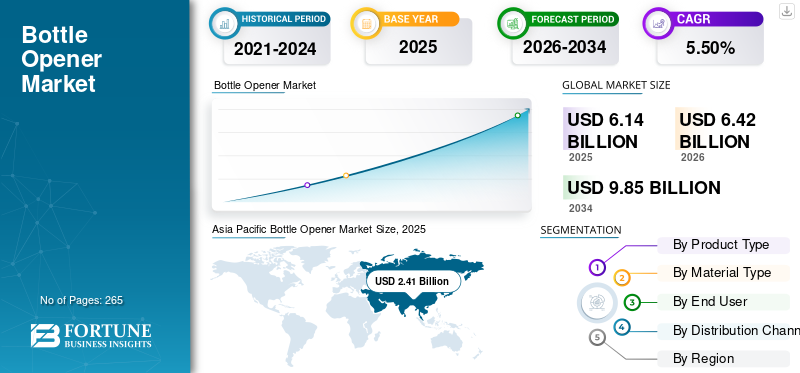
The global bottle opener market size was valued at USD 6.14 billion in 2025 and is projected to grow from USD 6.42 billion in 2026 to USD 9.85 billion by 2034, exhibiting a CAGR of 5.50% during the forecast period. Asia Pacific dominated the bottle opener market with a market share of 39.25% in 2025.
The bottle opener market is experiencing stable growth driven by increased consumption of bottled beverages globally, improvements in hospitality industry infrastructure, and high demand for luxury kitchen and bar appliances. The use of bottle openers is widespread in homes, bars and restaurants, hotels, and recreational activities owing to their ease of use, portability, and multiple functions. The increasing consumption of craft beer and the popularity of home entertainment systems are fueling the trend toward custom-designed, wall-mounted, electric bottle openers. According to the Brewers Association, in 2024, the U.S. craft beer industry brewed more than 23 billion barrels, indicating high demand for bottle openers. Moreover, the use of glass bottles in carbonated beverages and alcoholic drinks will ensure continuous demand for the product.
Leading players in the market include OXO, Cuisinart, Kuhn Rikon, BarCraft, and Victorinox. These companies are focused on product innovation and the expansion of their premium barware product range, with a strong emphasis on electric and stainless steel bottle opener variants to improve convenience and durability. Moreover, collaborations with hospitality chains, online platforms, and retail distributors are helping widen global penetration.
Download Free sample to learn more about this report.
Bottle Opener Market Key Takeaways
 Global Market Size & Forecast
- 2025 Market Size: USD 6.14 billion
- 2026 Market Size: USD 6.42 billion
- 2034 Forecast Market Size: USD 9.85 billion
- CAGR: 5.50% from 2026–2034
 Market Share
- Asia Pacific dominated the bottle opener market with a market share of 39.25% in 2025.
- The aluminum segment is anticipated to rise at the second-fastest CAGR of 5.42% over the forecast period.
- The hospitality & foodservice segment is anticipated to rise at the fastest CAGR of 6.61% over the forecast period.
 Key Regional Highlights
Asia Pacific
The region led the global market with a value of USD 2.41 billion in 2025 and is projected to expand at a 6.68% CAGR, supported by rising bottled beverage consumption and a growing hospitality industry.
North America
The market reached USD 1.46 billion in 2025 and is expected to grow at a 4.10% CAGR, driven by strong demand from restaurants, pubs, breweries, and high alcohol bottle consumption.
Europe
The region accounted for USD 1.68 billion in 2025, representing 27.38% of the global market, supported by strong beverage consumption and expanding hospitality and tourism sectors.
U.S.
The market was valued at USD 1.06 billion in 2025, benefiting from rising home entertainment trends and increasing demand for premium kitchen and bar accessories.
Japan
The market reached USD 0.60 billion in 2025, driven by strong ready-to-drink beverage consumption and growing demand for compact, multifunctional, and premium-quality bottle openers.
Read More

BOTTLE OPENER MARKET TRENDS
Rising Home Entertainment and Craft Beverage Culture are Driving Demand for Premium Bottle Openers
The market has been significantly impacted by the trend of craft beer culture, the rising popularity of home entertainment, and the overall increase in the consumption of a variety of beverages that use corkscrew openers. With more people setting up home bars, there is greater interest in attractive corkscrew openers that can perform multiple functions, including electric models. Companies have responded to the demand by manufacturing beverage-opening tools that are attractive and ergonomically designed, with innovative features such as magnetic caps and rechargeable capabilities. The increased popularity of events, outdoor activities, and gifts has only hastened this product adoption process.
MARKET DYNAMICS
MARKET DRIVERS
Download Free sample to learn more about this report.
Increasing Bottled Beverage Consumption Accelerating Market Growth
The growing consumption of bottled beverages globally is a significant factor driving the growth of the industry. Increased consumer demand for beers, sodas, energy drinks, and similar drinks has led to greater adoption of capped glass bottles in household, restaurant, bar, and hospitality settings. The burgeoning consumption of beverages has, in turn, created a need for efficient, convenient ways to open bottles. In addition, the process of urbanization, lifestyle changes, and social gatherings have also led to a growing demand for beverages, further supplementing the expansion of the market.
MARKET RESTRAINTS
Growing Adoption of Twist-Off Caps and Cans to Limit Market Demand
The use of twist caps on bottle tops, pull tabs on cans, and innovative beverage packaging styles is the key constraint affecting the bottle opener market growth. The beverage industry is increasingly adopting packaging methods that eliminate the need for any extra tools to open products. This is particularly the case for soft drinks, ready-to-drink beverages, and canned beverages. Hence, less use of bottle openers has been observed, as one can conveniently consume beverages from their containers without having to open them.
MARKET OPPORTUNITIES
Expansion of Personalized and Premium Bar Accessories are Creating New Growth Opportunities
Consumer preference for custom lifestyle products and luxurious bar tools and accessories for home bars provides substantial growth opportunities in the market. Rising demand for customized, stylish, and multifunctional kitchen tools is leading companies in this market to introduce more premium products. The development of a gifting culture and corporate promotional activities, as well as the availability of online platforms for customization, provide additional support for the demand for unique bottle opener products. Moreover, growing consumer interest in advanced, technology-based household kitchen gadgets and luxury home entertainment spaces is fueling demand for electric and designer bottle openers.
MARKET CHALLENGES
Intense Price Competition and Product Commoditization to Challenge Profit Margins
The industry faces several challenges due to competitive pricing and the availability of cheap generic goods. Since bottle openers are very simple tools with little technology involved, there are many regional and unorganized producers offering cheaper substitutes, leading to price competition with branded products. This high level of market commodification poses a problem for manufacturers, as their margins and brand reputations suffer greatly. Thus, counterfeiting and low-quality goods being offered via internet marketplaces only increase the competition faced.
Segmentation Analysis
By Product Type
Affordability and Widespread Everyday Usage Led to Dominance of Manual Segment
By product type, the market is segmented into manual, electric, wall-mounted, and others.
The manual segment dominated the market owing to its affordability, reliability, and widespread applicability at home, in bars and restaurants, and at outdoor events. They are also preferred for their portability, ease of use, and lack of need for electricity or charging. The easy availability of these products at grocery stores, kitchenware stores, and online channels has contributed to high market penetration. In addition, an increasing trend toward commercial bar equipment and the consumption of bottled beverages is expected to drive demand for manual bottle openers.
To know how our report can help streamline your business, Speak to Analyst
The electric segment is anticipated to rise at the fastest CAGR of 7.00% over the forecast period.
By Material Type
Superior Durability and Premium Consumer Preference Led to Dominance of Stainless Steel Segment
Based on material type, the market is divided into stainless steel, aluminum, plastic, and others.
The stainless steel segment dominated the market due to its durability, anti-corrosive nature, and longevity. Consumers, as well as pub owners, restaurateurs, hoteliers, and others, prefer stainless steel as it is more durable than other materials such as plastic or aluminum. Another reason is that stainless steel enables companies to produce high-end, ergonomic products. There is an increasing customer preference for reusable, aesthetically pleasing kitchenware, which is boosting demand for stainless steel products.
The aluminum segment is anticipated to rise at the second-fastest CAGR of 5.42% over the forecast period.
By End User
Rising Residential Beverage Consumption and Home Bar Trends Led to Dominance of Household Segment
Based on end user, the market is divided into household, commercial, hospitality & foodservice, and others.
The household segment captured the dominant bottle opener market share, owing to the extensive use of bottle openers in everyday domestic operations. The rising popularity of packaged carbonated beverages, beer, flavored drinks, and ready-to-consume beverages among consumers has been a major driver of demand for these products. Moreover, the growing trend of entertaining at home, setting up one's own bar, and using kitchen gadgets and equipment has been instrumental in boosting the sales of manual and high-end bottle openers in households.
The hospitality & foodservice segment is anticipated to rise at the fastest CAGR of 6.61% over the forecast period.
By Distribution Channel
Strong Retail Presence and Immediate Product Accessibility Led to Dominance of Offline Segment
Based on distribution channel, the market is segmented into offline and online.
The offline segment held the dominant share of revenue in 2025, driven by supermarkets, hypermarkets, specialist cookware shops, and bulk retailing organizations. People often purchase bottle openers in physical stores as they can assess the quality, robustness, size, and usability of the products before making the purchase. Bulk purchases are common among commercial customers, such as hotels and pubs, which depend more on physical sales channels. Also, the widespread availability of cheap manual bottle openers through traditional offline sales channels has contributed significantly to sales.
The online segment is projected to grow at the fastest CAGR of 6.89% during the forecast period.
Bottle Opener Market Regional Outlook
By geography, the market is categorized into Europe, North America, Asia Pacific, South America, and the Middle East & Africa.
North America
Asia Pacific Bottle Opener Market Size, 2025 (USD Billion)
To get more information on the regional analysis of this market, Download Free sample
North America is projected to grow at a CAGR of 4.10% in the coming years, holding the second-highest market share among all regions. The region reached a valuation of USD 1.46 billion in 2025, driven by high alcohol bottle consumption. Moreover, the presence of restaurants, pubs, breweries, and other such facilities makes people look for reliable bottle openers.
U.S. Bottle Opener Market
With North America’s strong contribution and the U.S. dominance in the region, the U.S. market reached USD 1.06 billion in 2025, accounting for roughly 17.29% of global market sales. A rise in the home entertainment sector is driving sales of premium kitchen and bar products, which in turn is driving market growth.
Europe
Europe held the third-largest share in 2025, valued at USD 1.68 billion, accounting for 27.38% of the global market. Europe’s market growth is driven by high consumption of bottled beer, wine, and soft drinks in Germany, the U.K., France, and Italy. The thriving hospitality, tourism, and brewery sectors in the region are continually driving demand for high-quality, multifunctional bottle openers. Moreover, the growing consumer demand for attractive kitchenware, eco-friendly metal products, and custom bar equipment is driving market growth.
U.K. Bottle Opener Market
The U.K. market reached USD 0.28 billion in 2025, representing roughly 4.61% of global market revenues.
Germany Bottle Opener Market
Germany’s market reached USD 0.37 billion in 2025, equivalent to around 6.04% of global market sales.
Asia Pacific
The Asia Pacific market dominated the global market, reaching USD 2.41 billion in 2025 and growing at a CAGR of 6.68% over the forecast period. The factors driving the market include a growing population, rising consumption of bottled beverages, and expanding foodservice and hospitality industries across India, China, Japan, and Southeast Asia. Furthermore, increasing demand for affordable kitchen, bar, and beverage packaging accessories, along with rising e-commerce penetration, fuels regional market expansion.
Japan Bottle Opener Market
The Japanese market was valued at USD 0.60 billion in 2025, accounting for roughly 9.78% of global market revenues. The market is driven by a country’s strong culture of ready-to-drink beverage and bottled beer consumption, coupled with the presence of izakayas, bars, and restaurants. Also, increasing consumer preference for compact, multifunctional, and premium-quality kitchen accessories further strengthens market growth.
China Bottle Opener Market
China’s market was valued at USD 1.029 billion in revenues in 2025, representing roughly 16.57% of global market sales.
India Bottle Opener Market
The Indian market was valued at USD 0.29 billion in 2025, accounting for roughly 4.67% of global market revenues.
South America and the Middle East & Africa
The South America and Middle East & Africa regions are expected to witness moderate growth in this market during the forecast period. The South American market reached USD 0.39 billion in 2025. Increasing consumption of bottled alcoholic beverages, particularly beer, across Brazil and Argentina, along with a growing culture of home entertainment, drives regional market growth. Growth in tourism, nightlife culture, and the expansion of hospitality establishments are further supporting demand for affordable, durable bottle opener products.
UAE Bottle Opener Market
The UAE market reached USD 0.05 billion in 2025.
South Africa Bottle Opener Market
The South African market reached USD 0.04 billion in 2025, representing roughly 0.59% of global market revenues.
COMPETITIVE LANDSCAPE
Key Industry Players
Pricing Competitiveness Intensifies Market Competition through Margin Pressure and Product Differentiation Challenges
Pricing competitiveness adds to competition in the bottle opener business, as many local manufacturers produce low-cost products that serve the same purpose as those from bigger manufacturing brands. Since bottle openers are very simple tools with little technical edge, consumers tend to consider price rather than brand name when making purchasing decisions. Therefore, there is great pressure on larger manufacturers to either cut prices or add more features to their products to stay competitive. Consequently, big companies have been using quality material, ergonomic design, branding, and other factors to command premium prices.
LIST OF KEY BOTTLE OPENER COMPANIES PROFILED IN REPORT
- Cuisinart (U.S.)
- OXO (U.S.)
- Kuhn Rikon (Switzerland)
- Victorinox (Switzerland)
- BarCraft (U.K.)
- Chef Craft (U.S.)
- True Brands (U.S.)
- Rabbit Wine (U.S.)
- Le Creuset (France)
- ZWILLING J.A. Henckels (Germany)
KEY INDUSTRY DEVELOPMENTS
- April 2026: Heineken and LÕK planned global market availability of their special-edition bottle opener-integrated sports accessory collection across selected international retail and padel club channels, supporting geographical expansion and experiential product marketing initiatives.
- December 2025: Heineken partnered with LÕK to introduce the world’s first padel racket with an integrated bottle opener, combining sports accessories with beverage-opening functionality as part of Heineken’s expanding global padel partnerships strategy.
- December 2025: Récolte launched a new USB rechargeable electric automatic wine opener products in Japan, expanding its premium beverage accessory portfolio with convenient and compact bottle-opening solutions for household and gifting applications.
- October 2025: SUWADA and JAPAN CRAFT SAKE COMPANY received the 2025 Good Design Award for their jointly developed “Sake Bottle Opener,” strengthening product innovation and premium positioning within the specialty bottle opener segment.
- April 2025: SUWADA in collaboration with JAPAN CRAFT SAKE COMPANY launched the “Sake Bottle Opener” through the Makuake platform in Japan. The product was specifically designed to simplify opening tightly sealed sake bottles and beer caps, highlighting innovation in ergonomic and premium bottle opener designs.
REPORT COVERAGE
The global bottle opener market analysis includes a comprehensive study of the market & forecast by all the market segments included in the report. This qualitative and quantitative report includes details on the market dynamics and trends that are expected to drive the market over the forecast period. It provides information on key aspects, including technological advancements and product launches. Additionally, it details partnerships, mergers & acquisitions, and key industry developments. The global research report combines the market outlook with a detailed competitive landscape, including market share and profiles of key players.
Request for Customization to gain extensive market insights.
Report Scope & Segmentation
| ATTRIBUTE | DETAILS |
| Study Period | 2021-2034 |
| Base Year | 2025 |
| Estimated Year | 2026 |
| Forecast Period | 2026-2034 |
| Historical Period | 2021-2024 |
| Growth Rate | CAGR of 5.50% from 2026 to 2034 |
| Unit | Value (USD Billion) |
| Segmentation | By Product Type, Material Type, End User, Distribution Channel, and Region |
| By Product Type |
|
| By Material Type |
|
| By End User |
|
| By Distribution Channel |
|
| By Region |
|
Frequently Asked Questions
According to Fortune Business Insights, the global market value stood at USD 6.14 billion in 2025 and is projected to reach USD 9.85 billion by 2034.
In 2025, the North America’s market value stood at USD 1.46 billion.
The market is expected to grow at a CAGR of 5.50% over the forecast period.
By product type, the manual segment led the market.
The process of urbanization, lifestyle changes, and social gatherings, coupled with the growing consumption of beverages, are key factors driving market growth.
OXO, Cuisinart, Kuhn Rikon, BarCraft, and Victorinox are the major players in the global market.
Asia Pacific held the largest market share.



- 2021-2034
- 2025
- 2021-2024
- 265
-
(Offer valid till 30th Sep 2026)
Get 30-60 hrs Free Customization
Expand Regional and Country Coverage, Segments Analysis, Company Profiles, Competitive Benchmarking, and End-user Insights.

















-
US +1 833 909 2966 ( Toll Free )
-
Get In Touch With Us