Clothes Pegs Market Size, Share & Industry Analysis, By Material Type (Plastic, Wooden, Stainless Steel/Metal, and Others), By Application (Residential and Commercial), By Distribution Channel (Supermarkets & Hypermarkets, Convenience Stores, E-Commerce, and Others), and Regional Forecast, 2026-2034
 Download Free Sample
(Offer valid till 15th Oct 2026)

Clothes Pegs Market Size and Future Outlook
 Listen to Audio Version
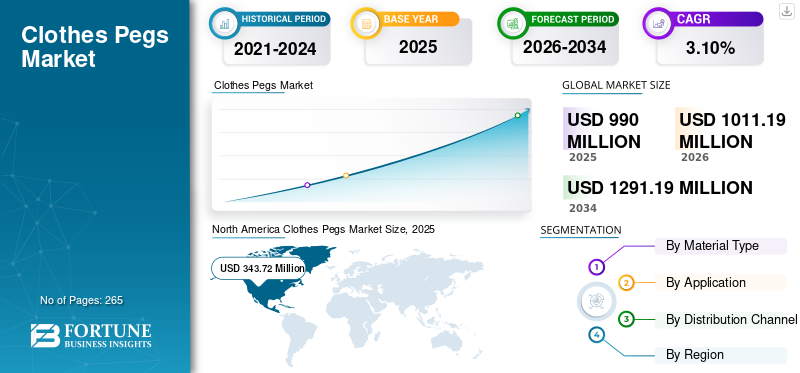
The global clothes pegs market size was valued at USD 990.00 million in 2025. The market is projected to grow from USD 1,011.19 million in 2026 to USD 1,291.19 million by 2034, exhibiting a CAGR of 3.10% during the forecast period. North America dominated the clothes pegs market with a market share of 34.72% in 2025.
The global market is still in a growing stage and is a crucial segment of household care products. The market growth is primarily fueled by everyday laundry routines across households and commercial premises. The high demand is further driven by the continuous expansion of urban households, increasing housing construction, and the frequent replacement of items due to wear and tear. The majority of sales are of plastic clothespins since they are the cheapest, most durable, and least affected by moisture; however, wooden ones still have their share of the market among environmentally aware and eco-conscious consumers. Due to the large populations and the habit of drying laundry outdoors, the Asia Pacific region accounts for a major portion of the market. It is evident that the market continues to be highly fragmented, with a majority of the local manufacturers, fierce price competition, and limited product differentiation being the characteristics of the sector.
Some of the key players in the market include Brabantia, Minky Homecare, Lakeland, Pincinox, and Addis Housewares. Product differentiation via material innovation and durability is the primary growth strategy adopted by market players. Moreover, players emphasize upon sustainability by introducing recyclable materials to align with environmentally aware consumers.
Download Free sample to learn more about this report.
Clothes Pegs Market Key Takeaways
 Global Market Size & Forecast
- 2025 Market Size: USD 990.00 million
- 2026 Market Size: USD 1,011.19 million
- 2034 Forecast Market Size: USD 1,291.19 million
- CAGR: 3.10% from 2026–2034
 Market Share
- North America dominated the clothes pegs market with a 34.72% share in 2025.
- Plastic clothes pegs segment led due to durability, affordability, and moisture resistance.
- Residential application segment dominated due to high household usage and replacement demand.
 Key Regional Highlights
North America
North America reached USD 343.72 million in 2025, supported by premium household product demand.
Asia Pacific
Asia Pacific recorded USD 284.51 million in 2025, driven by large household consumption in China and India.
Europe
Europe accounted for USD 267.26 million in 2025, supported by demand for sustainable household products.
U.S.
The U.S. market reached USD 300.23 million in 2025, representing strong regional dominance.
Japan
Japan reached USD 23.46 million in 2025, supported by compact living and air-drying laundry preferences.
Read More

CLOTHES PEGS MARKET TRENDS
Shift Toward Sturdy and Sustainable Clothespins Led by Eco-Conscious Households
Awareness of environmental concerns is on the rise along with the growing focus on energy-efficient washing habits are pushing consumers to the usage of reusable, durable clothespins made of recycled plastic or wood coming from sustainable and eco-friendly sources. Therefore, the market players have channelized their focus to superior-quality materials, more robust spring mechanisms, and green brand marketing. The change contributes to an increase in the durability of a product, less frequent replacement, and the ability of a brand to stand out in a highly price-sensitive and fragmented market.
Download Free sample to learn more about this report.
MARKET DYNAMICS
MARKET DRIVERS
Expansion of Urban Households and Housing Construction Increasing Everyday Laundry Accessory Demand
The swiftly expanding urban population and residential housing construction rates are constantly going up, which is directly reflecting an increase in the number of households that need laundry accessories such as clothes hangers. For instance, as per data released by the World Bank, over 50% of the global population resides in urban centers, indicating the continued expansion of urban households. Each time an apartment, independent house, or a rental unit is developed, the demand for cheap, basic household items also goes up. Urban households, especially in Asia Pacific and emerging economies, are often dependent on air-drying their clothes in a space saving way through balconies and communal drying areas, thus ensuring regular use of clothespins and hence enabling strong clothes pegs market growth rate over time.
MARKET RESTRAINTS
Rising Penetration of Electric Dryers Reducing Dependence on Clothespins
Many households are now using electric tumble dryers instead of traditional air-drying, mainly in the developed countries. Thus, there is less need for traditional air-drying accessories such as clothes hangers. Besides that, the rise in disposable incomes, small, sized dryers, and preference for saving time have been encouraging urban households to use less clotheslines, thus directly limiting the replacement demand and constraining the long term volume growth of clothespins in dryer, penetrated markets.
MARKET OPPORTUNITIES
Growing Adoption of Energy-Efficient and Low-Carbon Laundry Practices Creating New Demand Avenues
Due to rising cost of electricity and increasing environmental awareness, more and more families are turning to air-drying their clothes as a cheaper, energy-saving alternative. This change in behavior is boosting the relevance of products such as clotheslines and clothespins, especially in apartments in big cities and developing countries. While sustainability campaigns may reduce the usage of appliances, the clothes pegs suppliers still have the scope for increasing the demand through sturdy, eco-friendly, and value-added clothespin designs.
MARKET CHALLENGES
High Price Sensitivity and Product Commoditization Limiting Margin Expansion
The global market faces intense competition since there is minimal product differentiation presence of numerous unorganized and domestic manufacturers. Most buyers consider clothespins as minimal effort, utility items, so their buying decisions mainly revolve around the price. Such an indistinguishable product offering inhibits brand loyalty and also restricts producers ability to pause the increasing costs of raw materials and logistics to the consumers, thereby resulting in a continuous pressure on profit margins.
Segmentation Analysis
By Material Type
Cost Efficiency and Mass Household Adoption to Drive Growth of Plastic Clothes Pegs
Based on the material type, the market is divided into plastic, wooden, stainless steel/metal, and others.
The plastic segment dominated the market growth due to their optimal balance between durability, economical, and moisture resistance, making them suitable for routine household usage. Moreover, there are other features of plastic hangers such as wide color variety, lightweight nature, and availability in bulk packs further strengthens their dominance. Furthermore, their mass production and wide distribution through supermarkets & hypermarkets and convenience stores, reinforces their higher sales volume compared to metal and wooden alternatives.
The stainless steel/metal segment is anticipated to grow at the second-fastest CAGR of 4.25% over the forecast period.
To know how our report can help streamline your business, Speak to Analyst
By Application
High Household Penetration and Frequent Replacement Demand to Propel Residential Segment
Based on application, the market is divided into residential and commercial.
In 2025, the residential segment dominated the global market. This dominance of the segment was due to widespread application for everyday laundry drying across both urban and rural settings. Huge number of residences compared to commercial establishments creates higher cumulative product demand. Moreover, frequent replacement due to exposure to sunlight, wear and tear, and breakage during daily use reinforces recurring purchases, thereby sustaining segment dominance.
The commercial segment is projected to grow at the second-fastest CAGR of 3.78% over the forecast period.
By Distribution Channel
High Footfall and One-Stop Shopping Advantage to Lead Growth of Supermarkets & Hypermarkets
Based on distribution channel, the market is segmented into supermarkets & hypermarkets, convenience stores, e-commerce, and others.
The supermarkets & hypermarkets segment dominated the global market. This high clothes pegs market share was contributed due to the ability of these establishments to offer extensive product assortments under one roof, competitive pricing driven by economies of scale, and frequent in-store promotions. Moreover, their widespread physical presence ensures high consumer footfall sustaining the segment’s dominance.
In addition, the e-commerce segment is projected to grow at the fastest CAGR of 4.25% during the study period.
Clothes Pegs Market Regional Outlook
By region, the market is categorized into Europe, North America, Asia Pacific, South America, and the Middle East & Africa.
North America
North America Clothes Pegs Market Size, 2025 (USD Million)
To get more information on the regional analysis of this market, Download Free sample
North America is projected to record a growth rate of 2.59% in the coming years, which is the highest among all regions, and reached a valuation of USD 343.72 million by 2025. Higher disposable incomes and lifestyle-oriented purchasing behavior encourage consumers to opt for premium, weather-resistant, and aesthetically designed clothes hangers supplementing regional market growth.
U.S. Clothes Pegs Market
Based on North America’s strong contribution and the U.S. dominance within the region, the U.S. market can be analytically recorded at around USD 300.23 million in 2025, accounting for roughly 29.29% of global product sales.
Asia Pacific
Asia Pacific reached USD 284.51 million in 2025 and secure the position of the second-largest region in the market. In the region, India and China are both reached USD 88.26 million and USD 93.26 million, respectively in 2025.
Japan Clothes Pegs Market
The Japan market size in 2025 valued at around USD 23.46 million, accounting for roughly 2.37% of global revenues. Compact living spaces and a strong cultural preference for air-drying laundry, sustains steady demand for durable and space-efficient clothes hangers driving the country’s market growth.
China Clothes Pegs Market
China’s market size in 2025 was recorded at around USD 93.26 million revenues, representing roughly 9.42% of global products sales.
India Clothes Pegs Market
The India market in 2025 valued at around USD 88.26 million, accounting for roughly 8.92% of global revenues.
Europe
Europe held the third-dominant share in 2025, valuing at USD 267.26 million with a market share of 27.00% in the global market. The region’s growth is led by strong consumer preference for sustainable, long-lasting household products, supported by high awareness of eco-friendly hangers such as wood and recycled plastics.
U.K. Clothes Pegs Market
The U.K. market in 2025 reached around USD 31.48 million, representing roughly 3.18% of global revenues.
Germany Clothes Pegs Market
Germany’s market reached approximately USD 47.16 million in 2025, equivalent to around 4.76% of global revenues.
South America and Middle East & Africa
South America and the Middle East & Africa regions are expected to witness moderate growth in this market space during the forecast period. The South America market reached a valuation of USD 57.99 million in 2025. Favorable climatic conditions that encourage outdoor clothes drying, supporting consistent demand for clothes hangers in the region. Moreover, widespread use of cost-effective household essentials and growing urban households contribute to steady market expansion across the region. In the Middle East & Africa, the UAE reached a value of USD 9.58 million in 2025.
South Africa Clothes Pegs Market
The South Africa market reached around USD 6.92 million in 2025, representing roughly 0.70% of global market revenues.
COMPETITIVE LANDSCAPE
Key Market Players
Product Innovation and Cost Optimization Intensify Competitive Positioning
Industry players are striving for a competitive edge by focusing on product innovation, such as launching durable, weather-resistant, and environmentally-friendly clothes hangers to cater to changing consumer preferences. Meanwhile, producers are also witnessing ways to reduce their costs of production through more efficient use of materials and large-scale manufacturing in order to stay competitive in terms of price.
The big focus on branding and attractive packaging helps increase the product's visibility not only in supermarkets and hypermarkets but also on e-commerce platforms. Besides that, players are also enlarging their distribution networks and reinforcing their partnerships with retailers in order to have better market reach. Thus, firms that have a well-balanced strategy of product innovation, affordability, and extensive distribution channels seem to be a step ahead competitively in the industry landscape.
LIST OF KEY CLOTHES PEGS COMPANIES PROFILED
- Minky Homecare (Vale Mill (Rochdale) Limited) (U.K.)
- Lakeland (U.K.)
- Pincinox (France)
- Brabantia (Netherlands)
- Addis Housewares (U.K.)
- Rongxin Clothespins Factory (China)
- Caraselle (U.K.)
- Foshan Pegly Technology Co., Ltd. (China)
- Guangzhou Qinfeng Plastic Hardware Co., Ltd. (China)
- EE-LIAN ENTERPRISE (M) SDN. BHD. (Malaysia)
KEY INDUSTRY DEVELOPMENTS
- February 2025: Addis Housewares unveiled 18-pack and 50-pack variants bulk and mixed-color clothes peg packs to increase choice and value for money in core laundry segments. This helped in driving higher sales through broad-use, durable designs suitable for both indoor and outdoor drying.
- September 2024: Lakeland widened its clothes peg range by launching soft grip and recycled plastic peg varieties alongside traditional wooden pegs, catering to eco-conscious consumers and enhancing its laundry accessory assortment in both physical and online stores.
- July 2024: Minky Homecare relaunched its sureGRIP clothes pegs with new soft-pad jaw technology and vibrant color options to better protect delicate garments while increasing consumer appeal in the U.K. household goods market.
- March 2024: Brabantia extended its Smart Pegs laundry accessory lineup by enhancing product design features such as strong grip, rust-free materials, and improved grip geometry to appeal to high quality-conscious consumers seeking long-lasting pegs with a 2-year warranty, reinforcing its reputation for durable laundry solutions.
REPORT COVERAGE
Request for Customization to gain extensive market insights.
Report Scope & Segmentation
| ATTRIBUTE | DETAILS |
| Study Period | 2021-2034 |
| Base Year | 2025 |
| Estimated Year | 2026 |
| Forecast Period | 2026-2034 |
| Historical Period | 2021-2024 |
| Growth Rate | CAGR of 3.10% from 2026-2034 |
| Unit | Value (USD Million) |
| Segmentation | By Material Type, Application, Distribution Channel, and Region |
| By Material Type |
|
| By Application |
|
| By Distribution Channel |
|
| By Region |
|
Frequently Asked Questions
According to Fortune Business Insights, the global market value stood at USD 990.00 million in 2025 and is projected to reach USD 1,291.19 million by 2034.
In 2025, the market value stood at USD 343.72 million.
The market is expected to grow to a CAGR of 3.10% during the forecast period.
By material type, the plastic segment is expected to lead the market.
continuous expansion of urban households, increasing housing construction, and the frequent replacement of items due to wear & tear are driving market expansion.
Brabantia, Minky Homecare, Lakeland, Pincinox, and Addis Housewares are the major players in the global market.
North America dominated the market in 2025.



- 2021-2034
- 2025
- 2021-2024
- 265
-
(Offer valid till 15th Oct 2026)
Get 30-60 hrs Free Customization
Expand Regional and Country Coverage, Segments Analysis, Company Profiles, Competitive Benchmarking, and End-user Insights.

















-
US +1 833 909 2966 ( Toll Free )
-
Get In Touch With Us