Brewing Enzymes Market Size, Share & Industry Analysis, By Type (Amylases, Glucoamylase, Proteases, Xylanases, Cellulases, and Others), By Source (Microbial-Derived, Plant-Derived, and Animal-Derived), By Form (Dry and Liquid), By Beverage Type (Lager, Ale, Specialty Beer, Wine, Juice/Fruit Beverages, Spirits/Distilling, and Others), and Regional Forecast, 2026-2034
 Download Free Sample
(Offer valid till 30th Sep 2026)

Brewing Enzymes Market Size and Future Outlook
 Listen to Audio Version
The global brewing enzymes market size was valued at USD 446.64 million in 2025. The market is projected to grow from USD 467.38 million in 2026 to USD 690.44 million by 2034, exhibiting a CAGR of 5.00% during the forecast period. Europe dominated the brewing enzymes market with a market share of 33.31% in 2025.
Brewing enzymes are special proteins used in beer making. They help break down starch and protein, control thickness, facilitate filtration, and improve the overall brewing process. Breweries are able to prepare higher quantities of beer from the same ingredients, waste less, make their products more consistent, and speed up production. Enzymes also let brewers use different raw materials and adjust their recipes more easily. Owing to these benefits, such enzymes are now a key tool for making brewing more efficient and helping breweries create new products.
Leading companies operating in the market include Novozymes A/S, AB Enzymes, and Kerry Group, along with several other prominent participants. Strategies such as introducing new products and engaging in mergers and acquisitions are playing a crucial role in driving sales growth and strengthening overall market expansion.
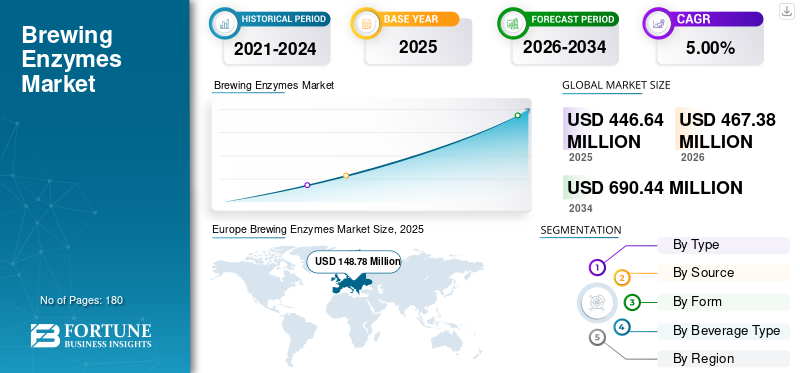
Download Free sample to learn more about this report.
BREWING ENZYMES MARKET KEY TAKEAWAYS
 Global Market Size & Forecast
- 2025 Market Size: USD 446.64 million
- 2026 Market Size: USD 467.38 million
- 2034 Forecast Market Size: USD 690.44 million
- CAGR: 5.00% from 2026–2034
 Market Share
- Europe dominated the market with a 33.31% share in 2025.
- Amylases held the largest share in 2025.
- Microbial-derived enzymes held the largest source share in 2025.
 Key Regional Highlights
Europe
Europe dominated the market with a 33.31% share in 2025.
Asia Pacific
Asia Pacific is expected to see steady growth driven by expanding brewing activity.
North America
North America is supported by demand for efficient and consistent brewing processes.
U.S.
The market is supported by established commercial brewing and enzyme adoption.
Japan
The market is driven by demand for brewing efficiency and consistent beverage quality.
Read More

BREWING ENZYMES MARKET TRENDS
Transition Toward Specialized, Performance-Based Brewing Inputs Driving Changes in Enzyme Usage
A major market trend is the increasing adoption of specialized enzymes designed for specific applications. Breweries are now seeking targeted solutions to address specific challenges, such as improving starch conversion, speeding up filtration, controlling haze, increasing extract yield, or producing low-alcohol beers. This shows a broader move in the brewing industry toward greater precision, efficiency, and recipe flexibility. Many breweries use enzymes as tools that can standardize processes and make results more predictable. There is also growing interest in using enzymes to make brewing more sustainable by reducing waste, using raw materials more efficiently, and saving resources.
MARKET DYNAMICS
MARKET DRIVERS
Download Free sample to learn more about this report.
Increasing Need for Brewing Efficiency and Yield Improvement Drives Market Demand
The brewing enzymes market growth is mainly as breweries face greater pressure to boost production efficiency while maintaining consistent craft beer quality. These enzymes break down starches into fermentable sugars, proteins, and cell walls more efficiently. This leads to better extract recovery, smoother fermentation, and fewer processing losses. Due to these benefits, enzymes are especially valuable in large-scale breweries, where even small efficiency gains can yield real cost savings. Enzymes also allow brewers to use a wider variety of raw materials, such as adjuncts and unmalted grains, without major changes to the brewing process. As breweries continue to focus on productivity, consistency, and cost-cutting, the use of enzymes is becoming increasingly critical in commercial brewing.
MARKET RESTRAINTS
Concerns Over Process Complexity and Impact on Traditional Brewing Practices Limit Enzyme Adoption
A major challenge in the market is that some brewers are reluctant to change their tried-and-true brewing methods. Beer production depends on careful recipe balance, processing, and the final taste and quality. Another limitation is the perception that enzyme use may reduce the traditional character of brewing, where conventional malt-based methods are strongly valued.
MARKET OPPORTUNITIES
Growing Demand for Product Innovation and Flexible Brewing Creates New Opportunities
Enzymes let breweries make beers with different alcohol levels, ingredients, and qualities without needing to buy expensive new equipment. This is especially important for making low-alcohol and alcohol-free beers, and maintaining the right flavor, mouthfeel, and balance. Enzymes also help breweries use different grains or local ingredients more easily, which make it cost effective and support new regional products. Besides helping with new products, enzymes can also help breweries reduce waste, improve yields, and run more efficiently. As breweries search for ways to boost profits and innovate, enzyme suppliers can show that their products are more than just processing aids, they are tools that improve performance.
Segmentation Analysis
By Type
Essential Role in Starch Conversion and Brewing Efficiency Makes Amylases the Leading Segment in Market
The market is segmented by type into amylases, glucoamylase, proteases, xylanases, cellulases, and others.
The amylases segment held the largest brewing enzymes market share in 2025. It makes up the largest share of the market as they do the key job in beer production such as breaking down starch into sugars during mashing. As converting starch is central to extract yield and increase efficiency, and fermentation, amylases are used in many types of brewing operations. As they directly improve productivity, yield, and reliability, amylases are the most commercially important enzymes in brewing.
Glucoamylase holds the second-largest market share, and is expected to grow at a CAGR of 5.25% during the forecast period. Glucoamylase is the second most widely used enzyme as it helps turn dextrins and partly broken starch chains into simpler sugars, mainly glucose. Glucoamylase becomes even more important in recipes that need careful control over fermentability, such as low-carb beers, high-gravity brews, and some reduced- or modified-alcohol styles.
To know how our report can help streamline your business, Speak to Analyst
By Source
Commercial Scalability and Functional Consistency Make Microbial-Derived Enzymes the Leading Source Segment
Based on source, the market is segmented into microbial-derived, plant-derived, and animal-derived.
Microbial-derived segment accounted for the largest market share in 2025. Microbial-derived brewing enzymes lead the market as they combine scalability, consistent production, strong performance, and cost savings. Enzymes made from bacteria and fungi are produced in controlled fermentation systems. This helps suppliers deliver consistent activity, reliable quality, and large quantities. Microbial enzymes are also more flexible and can perform well under various brewing conditions, including changes in pH, temperature, or ingredients.
Plant-derived enzymes make up the second-largest share of the market and are expected to grow at a CAGR of 4.18% during the forecast period. These enzymes are especially important in breweries where malt enzymes already play a key role in breaking down starch and protein. Plant-derived enzymes work well in standard brewing, especially with traditional malt-based recipes that rely on natural grain enzymes.
By Form
Ease of Dosing and Better Process Integration Make Liquid Enzymes the Leading Form Segment in Market
The market is segmented by form into dry and liquid.
The liquid segment led the global market in 2025. Liquid brewing enzymes lead the market as they are easier to handle, can be added to brewing processes more quickly, and allow for more precise dosing in large-scale production. Commercial breweries value efficiency and consistency. Liquid enzymes work well in automated systems as they can be added straight into mashing, fermentation, or later stages without extra steps. Liquid formulations are also popular in industrial settings where continuous production, fast mixing, and precise application matter.
Dry is another major segment that has a CAGR of 4.40% during the forecast period. These enzymes are especially helpful when breweries or distributors need products that are easy to store, can withstand different conditions, and hold up well for extended inventory periods. Still, dry enzymes are less popular than liquid ones as they need to be prepared or dissolved before use, which takes extra time and is less convenient for busy breweries.
By Beverage Type
High-Volume Commercial Production and Greater Need for Process Consistency Make Lager the Leading Segment
The market is segmented by beverage type into lager, ale, specialty beer, wine, juice/fruit beverages, spirits/distilling, and others.
The lager segment led the global market in 2025. It holds the largest share of the market as it is the most widely produced and consumed type of beer in large commercial breweries. As lager dominates mainstream beer production, there is steady demand for beer and therefore enzymes that help with starch conversion, extract efficiency, filtration, and consistent product quality. Large commercial lager producers also often use adjuncts and advanced brewing systems, making enzymes even more important for supporting the brewing process. Its large production scale and need for efficiency and consistency explain why it leads the market.
The juice/fruit beverages segment accounted for the second largest market share in 2025 and are expected to register a CAGR of 4.79% during the forecast period. The use of such enzymes during the production helps to enhance juice extraction from raw material while supporting an increase in processing efficiency and generating a visually attractive clear fruit beverage.
Brewing Enzymes Market Regional Outlook
By region, the market is categorized into Europe, North America, Asia Pacific, South America, and the Middle East & Africa.
Europe
Europe Brewing Enzymes Market Size, 2025 (USD Million)
To get more information on the regional analysis of this market, Download Free sample
The European market reached a valuation of USD 148.78 million in 2025 and is the leading region in the world. Europe is an important market due to its long brewing tradition, wide range of beer styles, and strong industrial base. Breweries in Europe work hard to maintain high-quality, use raw materials efficiently, and make production more sustainable. These efforts encourage the use of enzymes.
Europe has both traditional beer makers and large international breweries. This mix creates a steady demand for enzymes that enhance efficiency, clarity, stability, and process control. European brewers are also seeking ways to cut waste and use energy more efficiently. This makes enzymes even more valuable in today’s breweries.
Germany Brewing Enzymes Market
The market in Germany in 2025 reached around USD 29.95 million, representing roughly 6.71% of global market revenues. Germany is an important market as it combines a strong brewing tradition with a growing need for efficiency and the ability to adapt to new beer categories. Although traditional beer styles still dominate the market, breweries are adapting to changing consumer demand, particularly the growing popularity of non-alcoholic beer.
U.K. Brewing Enzymes Market
The U.K. market reached approximately USD 19.03 million in 2025, equivalent to around 4.26% of global market sales.
Asia Pacific
The Asia Pacific market was valued at USD 125.89 million in 2025. Asia Pacific is a promising and rapidly growing market. This is due to its high beer production, changing consumer tastes, and more modern brewery operations. Breweries in the region want solutions that boost efficiency, accommodate ingredient differences, and enable more beer styles. Enzymes help producers get the most from their ingredients and maintain steady processes, even when brewing conditions vary. As breweries grow and upgrade their technology, the need for such enzymes is expected to continue to increase.
India Brewing Enzymes Market
The India market in 2025 was valued at around USD 8.63 million, accounting for roughly 1.93% of global market revenues.
China Brewing Enzymes Market
China’s market in 2025 was valued at around USD 55.59 million, representing roughly 12.45% of global market share. China is a key market due to its large beer production and the shift from volume-focused to premium offerings. As the market shifts from mass production to more premium, unique products, enzymes help breweries control costs while improving their processes.
Japan Brewing Enzymes Market
The Japan market in 2025 reached a valuation of around USD 12.38 million, accounting for roughly 2.77% of global market revenues.
North America
The North America market reached a valuation of USD 88.47 million in 2025. North America is a strong market due to its large commercial breweries and a well-developed craft brewing scene. There is strong demand in the region for process aids that help with mash efficiency, fermentation control, filtration, and consistent product quality. Breweries here face ongoing pressure to innovate while keeping costs down, making enzyme-based process optimization even more important. The rise of low-calorie, low-alcohol, and alcohol-free beers also drives demand, as enzymes enable these products to be produced with greater precision. Overall, the market benefits from advanced brewing facilities and a strong focus on improving production efficiency.
U.S. Brewing Enzymes Market
In 2025, the U.S. market reached USD 54.21 million and is a leading market. It brings together a large commercial beer industry and a culture of brewing innovation. Large breweries use enzymes to boost throughput, improve extract efficiency, and ensure consistency. Smaller and craft brewers use them more selectively to support recipe control and address process challenges. The increasing demand for alcoholic beverages and no alcohol beer segment in the U.S. is also increasing demand for enzymes. Enzymes help manage fermentability and product balance in these more technical recipes. Owing to its size, innovation in the U.S. is a strong and diverse market.
South America and Middle East & Africa
Over the forecast period, South America is expected to experience significant growth in this market and in 2025 recorded USD 47.94 million. South America presents a promising market growth, driven largely by high-volume beer production and the need for cost-efficient brewing systems. Breweries in the region are increasingly focused on improving raw material efficiency, reducing production losses, and maintaining uniform quality across large-scale output. As the region continues to develop its brewing and production expansion capabilities premium offerings, enzyme demand is expected to grow steadily over time. The Middle East & Africa region reached a valuation of USD 35.55 million in 2025. The regions are slowly becoming growing markets, but development differs widely from country to country. In Africa, demand for enzymes is growing as breweries want to improve efficiency when using local crops and less common raw materials. These factors make enzymes useful for improving conversion, managing diverse grain qualities, and maintaining steady product output.
Turkey Brewing Enzymes Market
Turkey market is set to grow at a CAGR of 3.02% during the forecast period. The demand is driven more by specialized, premium, and non-alcoholic drinks than by traditional beer production. Growth in this market is linked to the rise of alcohol-free malt drinks and the increasing popularity of sophisticated non-alcoholic options.
COMPETITIVE LANDSCAPE
Key Industry Players
Growing Need for Brewery Efficiency and Performance Optimization Intensifies Competition Among Enzyme Suppliers
The brewing enzymes market is moderately concentrated. With a few global biosolutions and specialty ingredient companies leading the competition. They focus on application performance, technical support, and brewery-specific process optimization rather than just competing on price.
Major players such as Novonesis, IFF, Kerry, and AB Enzymes focus their product portfolios on improving yield, mash separation, filtration efficiency, raw material flexibility, and supporting low- and no-alcohol beer production.
LIST OF KEY BREWING ENZYMES COMPANIES PROFILED
- Novozymes A/S (Denmark)
- AB Enzymes (Germany)
- Kerry Group (Ireland)
- dsm-firmenich (Netherlands)
- Amano Enzyme Inc. (Japan)
- Advanced Enzyme Technologies (India)
- Enzyme Development Corporation (U.S.)
- Biocatalysts Ltd (U.K.)
- Aum Enzymes (India)
- Specialty Enzymes & Probiotics (U.S.)
KEY INDUSTRY DEVELOPMENTS
- December 2025: Novonesis has introduced Termamyl Prime, a bio-solution designed to help brewers work more efficiently and boost their profits. Novonesis is developing solutions that support higher brewing gravity. This creates new opportunities for customers to increase capacity, improve profits, and use less energy.
- September 2024: International Flavors & Fragrances (IFF) has launched DIAZYME NOLO, a new enzyme solution that helps improve the production of no- and low-alcohol (NOLO) drinks.
- April 2023: IFF announced a new enzymatic solution that helps breweries keep their beer clear, using a simpler, smarter process. With BCLEAR, breweries can stabilize their beer more efficiently and reliably than with other enzymatic solutions, while also saving on costs.
- July 2022: Biocatalysts Ltd has completed the acquisition of Breatec, WeissBioTech, and Biosun from its parent company, BRAIN Biotech AG. These companies will now form the Bioproducts division under the Biocatalysts brand. With the added expertise and knowledge from Breatec, WeissBioTech, and Biosun, the company is working to develop the baking, beverage, and grain-processing product lines.
- February 2022: Kerry, a global leader in taste and nutrition, announced two major biotechnology acquisitions that grew its expertise, technology portfolio, and manufacturing capabilities. The company acquired c-LEcta, a leading biotechnology innovator, and has also completed the purchase of Enmex, a Mexico-based enzyme manufacturer.
REPORT COVERAGE
The global industry research provides an in-depth study of market size & forecast by all the market segments included in the report. The brewing enzymes market demand includes details on the market dynamics and market trends expected to drive the market during the forecast period. It offers information on the market expansion, technological advancements, new product launches, key industry developments, and details on partnerships, mergers & acquisitions. The market forecast also encompasses detailed competitive landscape with information on the market segmentation, market share and profiles of key operating players.
Request for Customization to gain extensive market insights.
Report Scope & Segmentation
| ATTRIBUTE | DETAILS |
| Study Period | 2021-2034 |
| Base Year | 2025 |
| Estimated Year | 2026 |
| Forecast Period | 2026-2034 |
| Historical Period | 2021-2024 |
| Growth Rate | CAGR of 5.00% from 2026-2034 |
| Unit | Value (USD Million) |
| Segmentation | By Type, Source, Form, Beverage Type, and Region |
| By Type |
|
| By Source |
|
| By Form |
|
| By Beverage Type |
|
| By Region |
|
Frequently Asked Questions
Fortune Business Insights says that the global market value stood at USD 446.64 million in 2025 and is projected to reach USD 690.44 million by 2034.
In 2025, the Europes market value stood at USD 148.78 million.
The market is expected to exhibit a CAGR of 5.00% during the forecast period.
By type, amylases segment led the global market in 2025.
The rising need for brewing efficiency and yield improvement drives demand for the market.
Novozymes A/S, AB Enzymes, and Kerry Group are a few of the players in the market.
Europe held the largest market share in 2025.
Shift toward targeted, performance-based brewing inputs shapes the evolution of enzyme usage.



- 2021-2034
- 2025
- 2021-2024
- 180
-
(Offer valid till 30th Sep 2026)
Get 30-60 hrs Free Customization
Expand Regional and Country Coverage, Segments Analysis, Company Profiles, Competitive Benchmarking, and End-user Insights.




















-
US +1 833 909 2966 ( Toll Free )
-
Get In Touch With Us