Bricklaying Robot Market Size, Share & Industry Analysis, By Robot Type (Fully Automated Bricklaying Robots, Semi-Automated Bricklaying Robots, and Robotic Masonry Assist Systems), By Application (Residential Construction, Commercial Construction, Industrial Construction, and Infrastructure Construction), By End User (Construction Contractors & Builders, Real Estate Developers, Infrastructure Development Companies, and Industrial Facility Owners), By Revenue Model (Direct Robot Sales and Robot-as-a-Service), and Regional Forecast, 2026 – 2034
 Download Free Sample
Bricklaying Robot Market Size and Future Outlook
 Listen to Audio Version
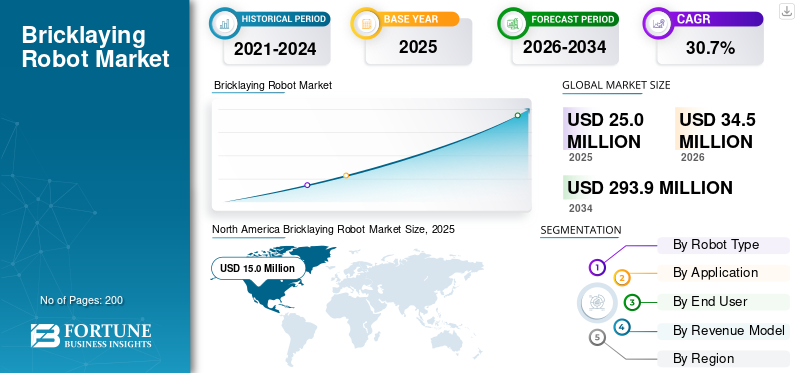
The bricklaying robot market size was valued at USD 25.0 million in 2025. The market is projected to grow from USD 34.5 million in 2026 to USD 293.9 million by 2034, exhibiting a CAGR of 30.7% during the forecast period. North America dominated the bricklaying robot market with a market share of 60.% in 2025.
Bricklaying robots are emerging as advanced construction automation systems, providing improved masonry productivity, reduced dependency on manual labor, enhanced construction speed, better wall alignment, improved site safety, and the ability to enhance productivity across repetitive masonry activities. The market is steadily expanding as bricklaying robot technology and broader robotics technology gain popularity in residential construction, commercial buildings, industrial facilities, and infrastructure projects. This is becoming increasingly important as the construction industry faces rising labor pressure and tighter project schedules. Key drivers include the growing shortage of skilled bricklayers, increasing requirement for faster project completion, rising adoption of construction robotics, and the need to improve productivity throughout labor-intensive masonry activities.
Growing focus on reducing construction delays, improving build accuracy, limiting material consumption, and lowering worker fatigue continues to boost the adoption of bricklaying robots across the construction sector. It helps to improve masonry efficiency when compared with conventional manual bricklaying methods. These systems are designed to modernize bricklaying processes with robotic arms, automated material handling, digital layout systems, and controlled brick or block placement to support wall construction with higher consistency and less manual effort, thereby making them appropriate for jobs requiring repeatable, accurate, and faster masonry work. While bricklaying robots might possess restrictions in terms of high equipment cost, site adaptability, operator training, material compatibility, and suitability for complex building designs, they considerably reduce labor dependency, improve placement accuracy, support safer working conditions, and raise productivity when compared with traditional masonry methods.
Major companies in the market include FBR Limited, Wienerberger AG, Monumental, Construction Robotics, LLC, and GreenBuild. They are progressively adopting automated bricklaying systems, robotic masonry assists platforms, mobile construction robots, and service-based deployment models to improve construction efficiency and strengthen their competitiveness in the market. In the long run, rising requirements for faster housing construction, increasing labor shortages, higher adoption of digital construction technologies, and growing acceptance of Robot-as-a-Service models will boost growth in the wider construction robotics market.
Download Free sample to learn more about this report.
Bricklaying Robot Market Key Takeaways
 Global Market Size & Forecast
- 2025 Market Size: USD 25.0 million
- 2026 Market Size: USD 34.5 million
- 2034 Forecast Market Size: USD 293.9 million
- CAGR: 30.7% from 2026–2034
 Market Share
- North America dominated the bricklaying robot market with a 60.0% share in 2025.
- The robotic masonry assist systems segment is projected to grow at the highest CAGR of 33.9% during the forecast period.
- The infrastructure construction segment is expected to register the highest CAGR of 33.6% during the forecast period.
 Key Regional Highlights
North America
North America led the market with a valuation of USD 15.0 million in 2025 and is expected to maintain its leading position.
Europe
Europe is projected to witness strong growth, driven by labor shortages, rising construction costs, and increasing adoption of automated construction technologies.
Asia Pacific
Asia Pacific accounted for USD 4.0 million in 2025, supported by growing investment in construction automation.
U.S.
The market is expected to reach approximately USD 15.8 million in 2026.
Japan
The market is estimated at USD 1.3 million in 2026, accounting for approximately 2.6% of global sales.
Read More

Bricklaying Robot Market Trends
Growing Adoption of Robotic Masonry Systems to Address Labor Shortages is a Key Market Trend
The market is facing growing demand for robotic masonry systems as construction companies, contractors, and builders face shortages of skilled bricklayers, rising labor costs, and pressure to complete projects faster. Bricklaying robots help automate repetitive wall-building tasks, reduce the physical burden on workers, improve accuracy, and support more predictable work schedules. These systems are becoming popular in residential construction, commercial buildings, and repeatable masonry projects where wall layouts can be digitally planned and executed using robotic systems.
- For instance, in April 2026, Wienerberger featured the development of its mobile masonry robot with KM Robotics and academic partners, noting that the project was aimed at enabling brick buildings to be erected more quickly, safely, and efficiently while supporting teams on-site.
MARKET DYNAMICS
MARKET DRIVERS
Download Free sample to learn more about this report.
Surging Need to Improve Construction Productivity is Driving Market Growth
The increasing need to complete construction projects faster and with greater consistency is one of the major factors driving the bricklaying robot market growth. Residential, commercial, and infrastructure projects commonly undergo delays due to limited labor availability, rework, weather disruptions, and manual productivity constraints. Bricklaying robots can support builders by improving the speed and repeatability of wall construction while reducing the physical burden on workers. This is especially useful in projects where layouts are standardized, wall construction is repetitive, and project durations are closely monitored.
The demand is particularly strong in residential construction, where housing shortages, rising labor costs, and the need for faster project completion are encouraging builders to explore automation. Robotic bricklaying systems also support commercial and industrial construction projects where consistent masonry output and better workforce utilization are important. Companies such as FBR, Monumental, Construction Robotics, Construction Automation Limited, and GreenBuild are developing or commercializing systems that support automated or assisted masonry work, showing a clear shift toward greater jobsite automation.
- For instance, in March 2026, Wienerberger advanced the commercialization of the WLTR masonry robot through GreenBuild to support scalable robotic bricklaying services across European construction projects.
MARKET RESTRAINTS
High Initial Cost and Site-Level Complexity are Limiting Faster Market Penetration
High equipment cost remains one of the key restraints for the market. Advanced robotic bricklaying systems require robotic arms, vision systems, motion control, sensors, software, safety systems, and integration with digital plans, which can make the initial investment difficult for small and mid-sized contractors. In addition, construction sites are less controlled than factories. Uneven terrain, changing site conditions, weather exposure, material variation, and limited space can affect robotic deployment.
Contractors may also need trained operators, maintenance support, and workflow adjustments before they can fully benefit from robotic masonry systems. This can slow down adoption in price-sensitive regions and in projects where labor is still comparatively affordable. As a result, early adoption is expected to remain concentrated among larger contractors, technology-driven builders, and service providers that can justify the investment through repeated project use.
MARKET OPPORTUNITIES
High Upfront Ownership Cost is Increasing Demand for Robot-as-a-Service Models, Creating New Growth Opportunities
The expansion of Robot-as-a-Service models is creating strong growth opportunities for the market. Instead of purchasing expensive robotic systems, contractors can access bricklaying robots through project-based services, leasing, rental, or service contracts. This helps reduce the cost burden of ownership and allows builders to use automation only when project conditions support it.
Robot-as-a-Service is especially attractive for residential developers, commercial builders, and infrastructure contractors who want to improve productivity without committing to full equipment ownership. It also enables robotics companies to build recurring revenue streams while offering technical support, maintenance, and operator expertise as part of the service package. As robotic bricklaying systems become more reliable and easier to deploy, the service-based model is expected to play an important role in improving adoption within different construction markets.
- For instance, in February 2025, FBR Limited expanded its Wall as a Service model with Hadrian robotic construction technology to deliver block walls as an installed service, supporting contractors and builders who want robotic wall construction without high upfront robot ownership costs.
Segmentation Analysis
By Robot Type
Semi-Automated Bricklaying Robots Segment Led Market Due to Their Practical Integration among Existing Construction Workflows
Based on robot type, the market is divided into fully automated bricklaying robots, semi-automated bricklaying robots, and robotic masonry assist systems.
Semi-automated bricklaying robots held the largest bricklaying robot market share in 2025. The segment growth is driven by their practical use across active construction sites where contractors still require human supervision, coordination with human workers, finishing work, quality checks, and on-site adjustments. These robots support masonry crews by improving brick placement speed, reducing repetitive manual work, and improving construction consistency while avoiding fully replacing skilled workers. Compared with fully automated systems, semi-automated bricklaying robots are easier to deploy across residential, commercial, and small-to-mid-scale construction projects as they require relatively lower site readiness and can be adapted to existing construction methods. Rising labor shortages, increasing project delays, and growing pressure to improve masonry productivity continue to strengthen the adoption of semi-automated bricklaying robots globally.
- For instance, in April 2026, Wienerberger enhanced the WLTR masonry robot with real-site optimization, digital tool connectivity, and robot-ready block systems to support scalable semi-automated bricklaying operations.
Robotic masonry assist systems are expected to witness the highest growth rate, with a CAGR of 33.9% in the coming years. The segment growth is driven by increasing demand for equipment that reduces heavy lifting, improves worker safety, and supports masons in repetitive brick handling and placement tasks.
To know how our report can help streamline your business, Speak to Analyst
By Application
Residential Construction Led Market Owing to Rising Demand for Quicker Housing Development
By application, the market is segmented into residential construction, commercial construction, industrial construction, and infrastructure construction.
Residential construction held the largest market share in 2025, propelled by rising housing demand, skilled labor shortages, and the growing need to complete residential projects within shorter timelines. Bricklaying robots are highly suitable for housing projects as residential construction commonly involves repetitive wall-building activities, standardized layouts, and predictable masonry requirements. Builders and contractors are increasingly evaluating robotic masonry systems to improve bricklaying speed, decrease dependency on manual labor, and achieve better consistency across housing developments. Compared with industrial and infrastructure projects, residential construction offers stronger early adoption potential as robotic systems can be deployed across repeatable wall structures and larger housing projects in which productivity gains are easier to realize.
- For instance, in March 2025, FBR Limited completed a U.S. home using the Hadrian X robotic system for PulteGroup to support faster, precise, and lower-waste residential construction.
Infrastructure construction is expected to witness the highest growth rate, with a CAGR of 33.6% in the coming years. The segment growth is attributed to increasing investments in public infrastructure, transport facilities, institutional buildings, and large-scale construction projects where automation can improve productivity, safety, and project execution.
By End User
Construction Contractors & Builders Segment Led Market Owing to Their Direct Involvement in On-Site Masonry Operations
By end user, the market is segmented into construction contractors & builders, real estate developers, infrastructure development companies, and industrial facility owners.
Construction contractors & builders held the largest market share in 2025, driven by their direct involvement in masonry operations, labor planning, project execution, and site productivity management. These users are the primary adopters of bricklaying robots as they face the immediate impact of skilled labor shortages, rising wages, project delays, and repetitive manual work on construction sites. Bricklaying robots help contractors improve wall construction speed, reduce physical strain on workers, and maintain better consistency in masonry output. Compared with real estate developers and industrial facility owners, contractors and builders are more directly responsible for deploying equipment, managing crews, and ensuring timely project completion, which strengthens their adoption of robotic bricklaying systems.
- For instance, in February 2025, FBR Limited partnered with PulteGroup to complete a robotic-built demonstration home in Florida, supporting homebuilders with automated wall construction technology for improved construction efficiency, quality, and safety.
Infrastructure development companies are expected to witness the highest growth rate, with a CAGR of 34.1% in the coming years. The segment growth is driven by rising adoption of automation in large-scale projects, growing demand for faster construction methods, and increasing need to reduce labor dependency in complex construction environments.
By Revenue Model
Direct Robot Sales Segment Led Market Owing to Early Adoption by Large Contractors and Technology-Focused Construction Firms
By revenue model, the market is segmented into direct robot sales and robot-as-a-service.
Direct robot sales held the largest market share in 2025, driven by early adoption among large contractors, construction technology firms, and specialized service providers that prefer equipment ownership for repeated project use. Direct ownership allows companies to control robot deployment, scheduling, maintenance, operator training, and long-term utilization across multiple construction sites. This model is more attractive for firms with frequent masonry requirements, larger project pipelines, and the financial capacity to invest in advanced robotic systems. Compared with service-based models, direct robot sales currently account for a larger share, as early market adoption is concentrated among companies that are actively investing in automation as a long-term productivity strategy.
- For instance, in January 2024, FBR Limited and CRH Ventures executed a U.S. demonstration program agreement for Hadrian X robots to support the future supply of Wall as a Service, enabling builders to access robotic wall construction without building in-house robotics capability.
Robot-as-a-Service is expected to witness the highest growth rate, with a CAGR of 35.8% in the coming years. The segment growth is driven by high upfront ownership costs, growing preference for flexible deployment models, and increasing demand from contractors that want robotic wall construction without purchasing the equipment outright.
Bricklaying Robot Market Regional Outlook
By geography, the market is categorized into North America, Europe, Asia Pacific, South America, and the Middle East & Africa.
North America
North America Bricklaying Robot Market Size, 2025 (USD Million)
To get more information on the regional analysis of this market, Download Free sample
North America led the market with USD 15.0 million in 2025 and will continue to dominate in the coming years. Market growth in the region is supported by high construction labor costs, skilled mason shortages, strong adoption of construction automation, and increasing demand for productivity-enhancing robotic masonry systems across the U.S., Canada, and Mexico. Regional demand is strongly influenced by rising pressure on contractors to reduce project delays, improve wall construction speed, and manage repetitive masonry work with limited skilled labor availability. The region benefits from early adoption of advanced construction technologies, active deployment of robotic wall-building systems, growing contractor interest in automation, and increasing use of robotic solutions across residential, commercial, and infrastructure construction projects.
U.S. Bricklaying Robot Market
The U.S. is expected to dominate the market with an estimated revenue of about USD 15.8 million in 2026, driven by the country’s large residential construction base, high labor cost environment, persistent skilled workforce shortages, and growing adoption of automated construction technologies. Demand for bricklaying robots remains particularly strong across homebuilders, commercial contractors, construction technology firms, and infrastructure developers requiring faster wall construction, improved masonry consistency, reduced manual labor dependency, and better jobsite productivity. The country continues to witness increasing interest from robotics developers, builders, contractors, and construction service providers seeking to commercialize robotic wall construction and improve project execution efficiency.
Europe
The European market is expected to witness strong growth during the forecast period, caused by increasing construction labor shortages, high masonry labor costs, increasing focus on worker safety, and growing demand for automated construction methods in Germany, the U.K., France, Italy, and the rest of Europe. Regional demand is closely associated with housing construction needs, digital construction adoption, masonry productivity improvement, robotic site assistance, and the transition from manual bricklaying toward semi-automated and service-based robotic masonry solutions. Europe remains one of the most important markets for bricklaying robots as contractors, builders, and building material companies steadily prioritize automation, precision, jobsite efficiency, and scalable construction practices.
U.K. Bricklaying Robot Market
The U.K. market in 2026 is estimated at around USD 1.4 million, representing roughly 3.7% of global revenues.
Germany Bricklaying Robot Market
Germany’s market is projected to reach USD 1.6 million in 2026, equivalent to around 4.5% of global sales.
Asia Pacific
Asia Pacific market accounted for USD 4.0 million in 2025. Regional growth is strongly supported by rapid urbanization, large-scale housing demand, infrastructure expansion, rising construction technology adoption, and growing interest in robotic automation across China, India, Japan, South Korea, and the rest of Asia Pacific. The region continues to witness rising demand for fully automated bricklaying robots, semi-automated bricklaying robots, robotic masonry assist systems, digital construction tools, and Robot-as-a-Service models that improve construction productivity, reduce labor dependency, enhance wall-building accuracy, and support faster project delivery.
China Bricklaying Robot Market
China’s market is projected to remain dominant in the Asia Pacific region, with 2026 revenues estimated at around USD 2.1 million, representing roughly 6.2% of global sales.
Japan Bricklaying Robot Market
The Japanese market in 2026 is estimated at around USD 1.3 million, accounting for roughly 2.6% of global sales.
India Bricklaying Robot Market
The Indian market in 2026 is estimated at around USD 0.6 million, accounting for roughly 1.6% of global sales.
Middle East & Africa
The Middle East & Africa market is driven by increasing adoption of advanced construction technologies, expanding real estate and infrastructure development, and rising demand for productivity-enhancing robotic masonry solutions across GCC countries, South Africa, North Africa, Israel, and other regional markets. Demand is closely linked to large commercial developments, smart city projects, housing construction, industrial facilities, and infrastructure programs where contractors are looking for faster project execution and better labor efficiency. GCC countries lead regional adoption due to large-scale construction pipelines, premium real estate projects, stronger purchasing capacity, and growing interest in automation-led construction methods that can improve wall-building speed, precision, and workforce productivity.
GCC Bricklaying Robot Market
The GCC market is projected to reach around USD 0.7 million in 2026, representing roughly 2.0% of global sales.
South America
The South America market is driven by rising demand for construction productivity improvement, growing urban development, and increasing interest in automation across Brazil, Argentina, Chile, Colombia, Peru, and other regional economies. Demand for bricklaying robots is primarily associated with residential construction, commercial buildings, infrastructure projects, and large contractors seeking to reduce manual masonry dependency and improve project delivery efficiency. Although adoption is expected to remain gradual, the region offers long-term opportunities as robotic systems become more affordable, easier to deploy, and better aligned with local construction practices.
Brazil Bricklaying Robot Market
The Brazilian market is projected to reach around USD 0.7 million in 2026, representing roughly 2.1% of global sales.
COMPETITIVE LANDSCAPE
Key Industry Players
Key Industry Players Focus on Automation, Jobsite Productivity, and Service-Based Deployment to Strengthen Market Positions
The global bricklaying robot market is still at an early stage but is developing quickly as companies move from concept validation and pilot projects toward commercial deployment. Competition is controlled by robot accuracy, mobility, wall-building speed, software integration, artificial intelligence, ease of deployment, and the ability to work in real jobsite conditions. Companies are focusing on fully automated wall-building systems, semi-automated masonry robots, and robotic assist systems that reduce physical strain and improve productivity.
Key players in the market include FBR Limited, Monumental, Wienerberger AG, Construction Robotics, and GreenBuild. Several players are developing different approaches to masonry automation, ranging from fully automated bricklaying systems to robotic assistance and digitally enabled masonry workflows. As the market expands, partnerships with contractors, building material companies, developers, and construction service providers are expected to become important competitive strategies.
LIST OF KEY BRICKLAYING ROBOT COMPANIES PROFILED
- FBR Limited (Australia)
- Wienerberger AG (Austria)
- Monumental (Netherlands)
- Construction Robotics, LLC (U.S.)
- GreenBuild (Europe)
- Construction Automation Limited (U.K.)
- KM Robotics (Czech Republic)
- Craftsmac Labs (India)
- ROB Technologies AG (Switzerland)
- Ziqi Technology (China)
KEY INDUSTRY DEVELOPMENTS
- April 2026: Wienerberger advanced the commercialization of the WLTR masonry robot through GreenBuild and KM Robotics, strengthening the use of robotic bricklaying technology for scalable construction-site applications across Europe.
- March 2026: GreenBuild showcased the WLTR masonry robot at CONSTRUMA 2026 in Budapest to demonstrate automated bricklaying with Porotherm Robot Ready bricks, supporting wider market visibility for robotic masonry in everyday construction.
- March 2025: FBR Limited completed a demonstration home for DiVosta Homes, a PulteGroup subsidiary, using the Hadrian X robotic system in Florida, supporting automated wall construction adoption among large U.S. homebuilders.
- February 2024: Monumental raised USD 25 million in funding led by Plural and Hummingbird to scale its AI-powered autonomous construction robots across Europe and expand robotic capabilities for wall-building applications.
- January 2024: FBR Limited and CRH Ventures executed a U.S. demonstration program agreement to construct up to ten houses with the Hadrian X robot, supporting the future supply of Wall as a Service in the U.S.
REPORT COVERAGE
The global bricklaying robot market analysis includes a comprehensive study of the market size & forecast by all the market segments included in the report. It includes details on the market activities and market patterns expected to drive the market over the forecast period. It provides information on primary aspects, including an overview of construction automation, robotics technology advancements, skilled labor shortages, Robot-as-a-Service adoption, jobsite productivity improvement, and robotic masonry deployment across construction sites. Additionally, it details product launches, partnerships, commercialization activities, service-based deployment models, as well as key industry developments and regional adoption trends. The global market research report also provides an in-depth competitive landscape with information on the market share and profiles of key operating players.
Request for Customization to gain extensive market insights.
Report Scope & Segmentation
| ATTRIBUTE | DETAILS |
| Study Period | 2021-2034 |
| Base Year | 2025 |
| Estimated Year | 2026 |
| Forecast Period | 2026-2034 |
| Historical Period | 2021-2024 |
| Growth Rate | CAGR of 30.7% from 2026 to 2034 |
| Unit | Value (USD Million) |
| Segmentation | By Robot Type, By Application, By End User, By Revenue Model, and By Region |
| By Robot Type |
|
| By Application |
|
| By End User |
|
| By Revenue Model |
|
| By Region |
|
Frequently Asked Questions
According to Fortune Business Insights, the global market size was valued at USD 25.0 million in 2025 and is projected to reach USD 293.9 million by 2034.
In 2025, the market in North America reached USD 15.0 million.
The market is expected to exhibit a CAGR of 30.7% during the forecast period of 2026-2034.
By robot type, the semi-automated bricklaying robots segment led the market.
The surging need to improve construction productivity is driving the market.
FBR Limited, Wienerberger AG, Monumental, Construction Robotics, and GreenBuild are among the key players considered in the market.
North America dominated the market in 2025.


- 2021-2034
- 2025
- 2021-2024
- 200
Get 30-60 hrs Free Customization
Expand Regional and Country Coverage, Segments Analysis, Company Profiles, Competitive Benchmarking, and End-user Insights.















Related Reports
-
US +1 833 909 2966 ( Toll Free )
-
Get In Touch With Us