Cardiovascular Health Supplements Market Size, Share & Industry Analysis, By Product Composition (Single-ingredient and Multi-ingredient/Combination Supplements), By Ingredient (Omega-3 Fatty Acids, Vitamins, Minerals, Coenzyme Q10, and Plant Sterols & Stanols), By Health Benefit (Cholesterol & Triglyceride Management, Blood Pressure Support, and Circulation & Vascular Support), By Dosage Form (Tablets, Capsules, Softgels, and Gummies & Chewables), By Distribution Channel (Retail Pharmacies & Drug Stores, Supermarkets & Hypermarkets, and Online Retail), and Regional Forecast, 2026-2034
 Download Free Sample
Cardiovascular Health Supplements Market Size and Future Outlook
 Listen to Audio Version
The global cardiovascular health supplements market size was valued at USD 12.31 billion in 2025. The market is projected to grow from USD 13.00 billion in 2026 to USD 21.55 billion by 2034, exhibiting a CAGR of 6.52% during the forecast period. North America dominated the cardiovascular health supplements market with a market share of 41.02% in 2025.
The global market for cardiovascular health supplements is supported by the rising awareness of preventive heart care and growing consumer focus on maintaining overall heart wellness. The high burden of cardiovascular diseases is encouraging consumers, particularly aging and health-conscious populations, to include nutritional supplements in their daily wellness routines. Manufacturers are also focusing on ingredients that are scientifically supported, combination formulations, clean-label products, and convenient dosage formats to strengthen consumer acceptance.
Critical partnerships among key players are driving new product launches to further the strengthen the overall market growth. Furthermore, major players, such as Nestlé S.A., Pharmavite, Amway Corporation, and Herbalife Ltd., are actively participating in strategic collaborations and acquisitions to expand their offerings, facilitate interchangeability, enhance market access, and fortify their market presence.
For instance, in February 2026, GNC entered into a partnership with High Level Science to introduce the Heart + Body + Mind supplement through nearly 1,000 GNC stores and its online platform. The products are also third-party tested and manufactured in cGMP-certified facilities. This partnership highlights the increasing focus of supplement companies on clinically positioned formulations, ingredient transparency, product quality, and wider omnichannel availability.
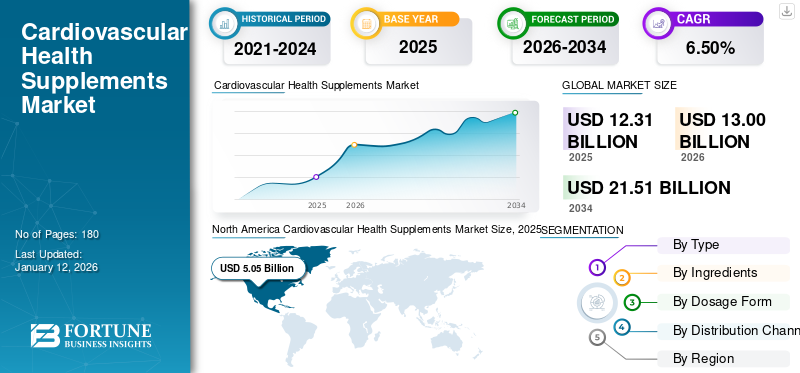
Download Free sample to learn more about this report.
CARDIOVASCULAR HEALTH SUPPLEMENTS MARKET TRENDS
Growing Adoption of Plant-based and Algae-derived Omega-3 Products to Transform Product Portfolios
Growing preference for vegetarian, vegan, fish-free, and sustainably sourced supplements is encouraging manufacturers to expand their plant-based omega-3 product portfolios. Conventional botanical oils such as flaxseed primarily provide alpha-linolenic acid. In contrast, algal oils can directly supply DHA and, in certain formulations, EPA, making them suitable alternatives to fish-derived omega-3 products. This allows companies to serve consumers who avoid fish due to dietary preferences, allergies, taste, odor, or sustainability concerns. Algae-derived products can also reduce dependence on wild-caught marine resources while supporting clean-label and environmentally responsible brand positioning. As formulation technologies improve, manufacturers are introducing higher-potency algae oils, blended plant-based fatty acids, and softgels with reduced aftertaste. Therefore, the shift toward plant-based and algae-derived omega-3 is expected to diversify cardiovascular supplement portfolios and attract a broader consumer base.
- For instance, in May 2024, MegaFood launched Plant-Based Omega 3-6-9, formulated with farm-traceable Ahiflower oil and fish-free algae oil. The product comprises ingredients such as omega-3 fatty acids and is positioned to support heart, brain, vision, and joint health. It also uses organic lemon oil to reduce aftertaste and was developed to minimize dependence on marine ecosystems. The launch highlights the increasing focus of supplement companies on combining plant-based sourcing, sustainability, and consumer-friendly formulations.
MARKET DYNAMICS
MARKET DRIVERS
Download Free sample to learn more about this report.
Rising Burden of Cardiovascular Diseases to Increase Demand for Preventive Heart Health Supplements
The increasing prevalence of cardiovascular diseases is a key factor driving the global market demand. Major risk factors such as unhealthy diets, physical inactivity, obesity, high blood pressure, elevated blood glucose, and raised blood lipid levels are also becoming more common across aging and urban populations. As awareness of these risks increases, consumers are more likely to include cardiovascular health supplement ingredients in their daily wellness routines. This is encouraging manufacturers to introduce targeted and multi-ingredient formulations for cholesterol management, vascular support, circulation, and general cardiovascular wellness. Therefore, the expanding population affected by cardiovascular conditions and associated risk factors is expected to support sustained consumer demand.
- For instance, in June 2025, Healthy Extracts launched STAT10, a CoQ10-based multi-ingredient nutritional formulation developed for consumers using statins. The product comprises CoQ10, omega-3 fatty acids, berberine, citrus bergamot, resveratrol, and vitamin C and is positioned to support heart health and nutrients that may be affected by statin use. The launch highlights the growing focus of supplement manufacturers on developing condition-specific products for large populations managing cholesterol and cardiovascular risks.
|
Rank |
Market Driver |
Expected Impact on Market Growth |
Negative CAGR Contribution (2026-2034) |
Impact: 2026-2028 |
Impact: 2029-2031 |
Impact: 2032-2034 |
|
1 |
Rising Burden of Cardiovascular Diseases and Growth of the Aging Population |
High |
2.40% |
High |
High |
High |
|
2 |
Growing Awareness of Preventive Healthcare and Self-managed Heart Wellness |
High |
1.95% |
Medium |
High |
High |
|
3 |
Innovation in Clinically Supported Multi-ingredient and Personalised Formulations |
High |
1.70% |
High |
High |
Medium |
|
4 |
Expansion of E-commerce, Pharmacy Networks, and Omnichannel Distribution |
Medium-High |
1.35% |
Medium |
High |
High |
|
5 |
Increasing Demand for Plant-based, Clean-label, and Convenient Supplement Formats |
Medium |
1.05% |
Medium |
Medium |
High |
|
6 |
Others |
Low |
0.40% |
Low |
Low |
Low |
|
Total Positive Growth Contribution |
8.85% |
MARKET RESTRAINTS
Increasing Presence of Counterfeit Products to Hamper Market Growth
The growing availability of counterfeit and unauthorized supplements through unverified platforms may restrict the global cardiovascular health supplements market growth. Such products may contain incorrect ingredient quantities, undeclared substances, low-quality raw materials, or misleading labels that imitate established brands. Reports of fraudulent supplements can also reduce confidence in genuine products and make consumers more hesitant to purchase unfamiliar brands. Legitimate manufacturers may consequently face the burden of spending high costs on product authentication, traceability, quality testing, and consumer education. Therefore, increasing circulation of counterfeit products is expected to weaken consumer trust and restrain the market growth.
- For instance, in May 2026, Europol supported an international operation against a criminal network involved in producing and distributing counterfeit medicines and dietary supplements across several European countries. The network was associated with approximately USD 240 million in illicit transactions and promoted unauthorized supplements through misleading advertisements and fake endorsements. Such instances raise safety concerns, damage the credibility of legitimate brands, and discourage consumers from purchasing health supplements through less-regulated channels.
|
Rank |
Market Restraint |
Expected Impact on Market Growth |
Estimated Reduction in Market Size (USD Billion) |
Impact: 2026-2028 |
Impact: 2029-2031 |
Impact: 2032-2034 |
|
1 |
Regulatory Variability, Restricted Health Claims, and Inconsistent Clinical Evidence |
High |
0.85% |
High |
High |
Medium |
|
2 |
Counterfeit, Adulterated, and Misleadingly Marketed Products |
Medium-High |
0.65% |
High |
Medium |
Medium |
|
3 |
High Cost of Premium and Clinically Validated Cardiovascular Formulations |
Medium |
0.55% |
Medium |
Medium |
Low |
|
4 |
Others |
Low |
0.28% |
Low |
Low |
Low |
|
Total Market Reduction |
2.33% |
MARKET OPPORTUNITIES
Expansion of Personalized Nutrition and Condition-specific Heart Health Formulations to Create New Growth Avenues
The increasing shift from general wellness supplements toward personalized and condition-specific formulations is expected to create significant growth opportunities in the market. Consumers have different nutritional requirements depending on their age, lifestyle, dietary habits, health background, medication use, and cardiovascular risk factors. This is encouraging manufacturers to develop targeted products for cholesterol and triglyceride management, blood pressure support, vascular circulation, heart energy, and general cardiovascular wellness. Therefore, the expansion of data-driven personalized nutrition is expected to help manufacturers differentiate their products and reach consumers with specific heart health requirements. This represents a market opportunity rather than evidence that supplements can replace medical treatment.
- For instance, in March 2026, Herbalife acquired certain assets of Bioniq to expand its personalized nutritional supplement capabilities. Bioniq develops individualized formulations using consumers’ health history, questionnaires, blood test information, and a proprietary biomarker database. The development highlights the growing investment by established nutrition companies in scalable, technology-enabled and condition-relevant supplement solutions.
MARKET CHALLENGES
Building Consumer Trust Amid Misleading Marketing Claims to Pose Challenge to Product Adoption
The increasing presence of misleadingly labeled products is creating a major credibility challenge for the market. Products with little or no declared active ingredients may fail to provide the expected benefits, causing consumers to question the effectiveness of the wider supplement category. Exaggerated cardiovascular claims can further create unrealistic expectations and increase regulatory scrutiny. Consequently, legitimate manufacturers must invest in third-party testing, authentication seals, supply-chain monitoring, legal action, and consumer education, which raises operating costs. Therefore, maintaining trust while separating scientifically supported products from poor-quality alternatives is expected to remain a significant market growth challenge.
- For instance, in May 2025, Kaneka Nutrients announced market protection measures against counterfeit ubiquinol products after identifying an increasing number of products making misleading ingredient claims. Laboratory testing conducted with accredited third-party laboratories found that multiple products purchased through Amazon contained zero or negligible quantities of ubiquinol despite making substantially higher label claims.
|
SWOT Analysis |
|
|
Strengths |
|
|
Weaknesses |
|
|
Opportunities |
|
|
Threats |
|
Segmentation Analysis
By Product Composition
Multi-ingredient/Combination Supplements Dominated Owing to Their Ability to Address Multiple Cardiovascular Needs in Single Formulation
Based on product composition, the market is categorized into single-ingredient supplements and multi-ingredient / combination supplements.
Multi-ingredient/combination supplements segment dominated the market as they cater to several interconnected factors, including cholesterol levels, blood pressure, circulation, oxidative stress, and cellular energy, which influence cardiovascular wellness. Products combining omega-3 fatty acids, CoQ10, magnesium, phytosterols, vitamins, and botanical ingredients allow consumers to address several of these factors through a single daily formulation. This reduces the need to purchase and manage multiple standalone supplements, improving convenience and supporting regular consumption.
- For instance, in June 2025, Nature’s Bounty introduced Advanced Vital Heart, a triple-action cardiovascular supplement containing clinically studied CoQ10, magnesium, and phytosterols. The product was designed to support cholesterol management, blood pressure already within the normal range, and healthy circulation. The launch highlights the growing focus of supplement companies on multi-ingredient products that address several cardiovascular wellness requirements through one formulation.
The single-ingredient supplements are expected to grow at a CAGR of 5.97% over the forecast period.
To know how our report can help streamline your business, Speak to Analyst
By Ingredient
Omega-3 Fatty Acids Held the Leading Share With Their Strong Consumer Recognition and Broad Cardiovascular Health Positioning
Based on ingredient, the market is segmented into omega-3 fatty acids, vitamins, minerals, coenzyme q10, plant sterols & stanols, herbal, botanical & fermented ingredients, amino acids, soluble fibers, and others.
In 2025, the omega-3 fatty acids segment held the largest cardiovascular health supplements market share as they are commonly positioned to support healthy triglyceride levels, cardiovascular function, blood flow, and general wellness, allowing to cater to broader target population than many specialized ingredients. Omega-3 products are also widely available in different strengths, price ranges, and in combinations with CoQ10, vitamins, and antioxidants. Their long-standing presence further supports repeat purchases and high brand familiarity. Therefore, broad consumer acceptance and extensive commercial availability enabled omega-3 fatty acids to account for the largest market share.
- For instance, in May 2024, Doctor’s Best launched Vegan Omega-3 with Elantria, an algae-derived, high-potency EPA and DHA supplement. The product was introduced as a sustainable alternative to fish oil and was positioned to support cardiovascular, eye, and brain health. This launch demonstrates the continued expansion of omega-3 portfolios to attract consumers seeking plant-based and fish-free heart health supplements.
The plant sterols & stanols segment is projected to grow at a CAGR of 6.95% during the forecast period.
By Health Benefit
High Consumer Awareness for Preventive Cardiovascular Care Boosted Cholesterol and Triglyceride Management Dominance
Based on health benefit, the market is segmented into cholesterol & triglyceride management, blood pressure support, circulation & vascular support, heart function, rhythm & energy support, general cardiovascular wellness, and others.
By health benefit, the cholesterol and triglyceride management segment captured the highest share. Consumers can obtain measurable cholesterol and triglyceride results through routine blood tests, which creates a clear and identifiable need for nutritional support alongside diet and lifestyle changes. This encourages demand for omega-3 fatty acids, phytosterols, soluble fibres, berberine, and plant-derived formulations positioned for lipid management. The segment also benefits from strong demand among middle-aged and older consumers who are increasingly focused on preventive cardiovascular care. It also provides manufacturers with a specific benefit that consumers can easily understand and track. Therefore, the large addressable population and clear preventive-health positioning supported the segment’s dominant share.
- For instance, in May 2024, Valbiotis launched ValbiotisPRO Cholestérol in France for individuals with mild-to-moderate hypercholesterolemia. The product contains Lipidrive, a patented natural supplements. The development highlights increasing commercial investment in scientifically positioned supplements specifically targeting cholesterol management.
The others segment is projected to grow at a CAGR of 6.98% during the forecast period.
By Dosage Form
Softgels Dominated Owing to Their Suitability for Oil-based Ingredients and Convenient Daily Consumption
Based on dosage form, the market is segmented into tablets, capsules, softgels, gummies & chewables, powders, liquids, and others.
In 2025, the softgels segment dominated the market as several major cardiovascular supplement ingredients such as fish oil, krill oil, algae oil, and lipid-based CoQ10 formulations are well suited for encapsulation in soft gelatin shells. Softgels can contain liquid or oil-based formulations in a pre-measured dose, helping manufacturers maintain product consistency and simplify daily consumption. Their smooth outer shell also makes them easier to swallow for many adults compared with large compressed tablets. Encapsulation can reduce consumers’ direct exposure to the taste and smell of marine oils, which improves the overall product experience. As a result, the strong connection between softgels and high-volume oil-based cardiovascular products supported the segment’s leadership.
- For instance, in December 2025, Rouzel Pharma launched EDO-3 Softgel Capsules containing omega-3 fatty acids, including EPA and DHA. The company positioned the formulation for cardiovascular, cognitive, joint, and general wellness support and highlighted the softgel format’s convenience and ease of swallowing. The launch reflects the continued preference for softgel delivery in oil-based omega-3 supplement formulations.
The gummies & chewables segment is projected to grow at a CAGR of 8.65% over the forecast period.
By Distribution Channel
Retail Pharmacies and Drug Stores are the Most Favored Channel Owing to High Consumer Trust and Immediate Product Accessibility
Based on distribution channel, the market is segmented into retail pharmacies & drug stores, supermarkets & hypermarkets, specialty health & nutrition stores, online retail, direct selling, and others.
In 2025, retail pharmacies and drug stores dominated the market as they provide consumers with convenient access to cardiovascular supplements alongside prescription medicines and other preventive-health products. The availability of pharmacists and trained store personnel can also help consumers compare brands, strengths, dosage forms, and potential medicines. Large pharmacy chains offer extensive physical networks, established consumer trust, promotional programs, and strong shelf visibility for recognized supplement brands. Therefore, frequent consumer visits, trusted healthcare positioning, and broad product availability supported the channel’s dominant market share.
- For instance, in December 2024, Nature’s Bounty launched its Plant-Based Omega-3 supplement across major retailers, including CVS and Walgreens. The algae-derived product was supplied as a once-daily softgel containing EPA and DHA and was positioned to support heart, joint, and skin health. Its availability through leading pharmacy chains demonstrates the importance of retail pharmacies and drug stores in providing mass-market access to cardiovascular health supplements.
The online retail segment is projected to grow at a CAGR of 8.62% from 2026 to 2034.
Cardiovascular Health Supplements Market Regional Outlook
|
Region |
Current Position |
Growth Outlook |
Investment Attractiveness |
Key Opportunity Drivers |
|
North America |
Largest regional market |
Moderate to High |
Very high |
High dietary-supplement use, established pharmacy and mass-retail networks, strong online penetration, high consumer awareness of heart health, premium-product adoption, and broad availability of omega-3, CoQ10, plant sterol, vitamin, and botanical products. |
|
Europe |
Second-largest market |
Moderate |
High |
Aging population, prevalence of supplement consumption, demand for scientifically supported ingredients, strong pharmacy distribution, plant-based product adoption, and regulated health-claim environment. |
|
Asia Pacific |
Fastest-growing region |
Very High |
Very high |
Large population base, growing middle-income consumer group, increasing preventive-health expenditure, established herbal traditions, rapid e-commerce expansion, rising omega-3 and CoQ10 use, and growing local manufacturing capabilities. |
|
Latin America |
Emerging market |
High |
Moderate to High |
Expanding pharmacy chains, increasing online access, growing awareness of preventive nutrition, rising demand for vitamins, minerals and omega-3 products, and development of local and multinational supplement brands. |
|
Middle East & Africa |
Developing market |
Moderate |
Moderate |
Growing urban population, increasing lifestyle-related health concerns, expansion of modern retail and pharmacies, rising premium-wellness demand in GCC countries, and improving digital-commerce access. |
By geography, the market is categorized into Europe, North America, Asia Pacific, Latin America, and the Middle East & Africa.
North America
North America Cardiovascular Health Supplements Market Size, 2025 (USD Billion)
To get more information on the regional analysis of this market, Download Free sample
North America held the dominant share in 2024 at USD 4.77 billion and maintained its leading position in 2025 at USD 5.05 billion. The market in North America is growing due to the high prevalence of cardiovascular conditions, widespread awareness of cholesterol and blood pressure management, and strong consumer acceptance of dietary supplements.
U.S. Cardiovascular Health Supplements Market
Given North America's substantial contribution and the U.S. dominance in the region, the U.S. market is estimated at around USD 3.66 billion in 2026, accounting for roughly 28.17% of the global market.
Europe
Europe is projected to grow at 5.45% over the coming years, the second-highest among all regions, and reach a valuation of USD 2.23 billion by 2026. Market growth in Europe is supported by an aging population, a significant cardiovascular disease burden, and increasing public focus on preventive healthcare.
U.K. Cardiovascular Health Supplements Market
The U.K. market is estimated at USD 0.78 billion in 2026, accounting for roughly 6.00% of the global market.
Germany Cardiovascular Health Supplements Market
Germany's market is projected to reach approximately USD 0.58 billion in 2026, equivalent to around 4.43% of the global market.
Asia Pacific
Asia Pacific is estimated to reach USD 2.88 billion in 2026 and secure the position of the third-largest region in the market. Asia Pacific is expected to experience fastest growth owing to its large population base, rapid demographic aging, and rising prevalence of cardiovascular risk factors such as hypertension, diabetes, unhealthy diets, and physical inactivity.
Japan Cardiovascular Health Supplements Market
The Japanese market in 2026 is estimated at around USD 1.06 billion, accounting for approximately 8.19% of the global market.
China Cardiovascular Health Supplements Market
China's market is projected to be among the largest worldwide, with 2026 revenues estimated at around USD 0.54 billion, accounting for approximately 4.14% of global sales.
India Cardiovascular Health Supplements Market
The Indian market in 2026 is estimated at around USD 0.31 billion, accounting for roughly 2.42% of global revenue.
Latin America and the Middle East & Africa
The Latin America and Middle East & Africa regions are expected to witness moderate growth in this market during the forecast period. The market in Latin America is estimated to reach a valuation of USD 0.45 billion. Growth in the region is driven by increasing clinical trial participation, improving healthcare digitization, and the need to reach diverse patient populations across large geographies. In the Middle East & Africa, the GCC is set to reach USD 0.66 billion in 2026.
South Africa Cardiovascular Health Supplements Market
The South African market is projected to reach approximately USD 0.46 billion by 2026, accounting for roughly 3.57% of global revenue.
COMPETITIVE LANDSCAPE
Key Industry Players
Product Innovation and Omnichannel Expansion by Key Companies to Intensify Market Competition
The global cardiovascular health supplements market is moderately fragmented, with competition led by companies offering broad portfolios of multi-ingredient cardiovascular formulations. Major players such as Nestlé Health Science, Pharmavite LLC, Amway Corp., Herbalife Ltd., GNC Holdings, Inc., Jamieson Wellness Inc., and Nordic Naturals, Inc., are strengthening their market positions through new product launches, improved ingredient-delivery technologies, retail expansion, partnerships, and wider adoption of direct-to-consumer channels.
- For instance, in May 2026, Jamieson Wellness Inc. announced that its international campaigns for heart health, coupled with new product launches and expanded market distribution, has contributed to growth across its key international markets. Furthermore, the company also reported acceleration of digital commerce and continued demand for key products in the U.S., demonstrating the need for combining product innovation with broader online and retail accessibility.
Other notable participants in the market include Nordic Naturals and NOW Health Group. These companies are focusing on concentrated omega-3 formulations, enhanced-bioavailability CoQ10, algae-derived ingredients, practitioner-recommended products, ingredient testing, and convenient dosage formats. The market remains strongly innovation-driven, with established players holding a stronger near-term position owing to their recognized brands, extensive pharmacy and retail networks, manufacturing scale, and international distribution.
|
Market Concentration – Global Cardiovascular Health Supplements Market |
|
|
|
|
LIST OF KEY CARDIOVASCULAR HEALTH SUPPLEMENTS COMPANIES PROFILED
- Nestlé S.A. (Switzerland)
- Herbalife Ltd. (U.S.)
- GNC Holdings, LLC (U.S.)
- Reckitt Benckiser Group plc (U.K.)
- Amway Corporation (U.S.)
- Pharmavite (U.S.)
- Kirin Holdings Company, Limited (Japan)
- Health and Happiness (H&H) International Holdings Limited (Hong Kong)
- Jamieson Wellness Inc. (Canada)
- Nordic Naturals, Inc. (U.S.)
- NOW Health Group, Inc. (U.S.)
- Life Extension Foundation Buyers Club, Inc. (U.S.)
- Metagenics, LLC (U.S.)
- Natural Factors Nutritional Products Ltd. (Canada)
- Carlson Laboratories, Inc. (U.S.)
KEY INDUSTRY DEVELOPMENTS
- July 2026: Great HealthWorks entered into its first U.S. retail partnership with GNC to expand the availability of OmegaXL products. The launch included OmegaXL + Krill, which combines marine lipid ingredients and sources of EPA and DHA. Although the products are mainly positioned for mobility and performance support, the partnership denotes wider expansion of omega-3 products into physical retail channels.
- July 2026: Viactiv launched CoQ10 CARDIO Complete Soft Chews as part of its expansion into women’s proactive wellness. The convenient tropical fruit-flavored product is positioned to support cardiovascular wellness, cellular energy, and muscle function. The launch reflects the increasing use of chewable formats to attract consumers who prefer alternatives to conventional tablets and capsules.
- July 2026: BioAdaptives announced the planned commercial launch of XcellaraHeart from August 2026 onwards. The cardiovascular wellness formulation combines the company’s Xcellara base with Tanshinone IIA, a compound derived from Danshen. The development demonstrates the increasing commercial interest in condition-specific formulations combining proprietary supplement platforms with traditional botanical ingredients.
- May 2026: Life Extension launched AmpliQ CoQ10, developed in collaboration with Akay Bioactives. The formulation uses fenugreek-derived FenuMat technology to improve CoQ10 stability and bioavailability. The development demonstrates the growing investment in advanced delivery technologies that can differentiate cardiovascular supplements and improve consumer acceptance.
- April 2026: Symrise introduced Hibicyan, a standardized hibiscus extract developed to support blood flow and microvascular circulation. The ingredient is available in powder and liquid formats for use in dietary supplements and functional products. This launch highlights the growing opportunity for botanical and plant-based ingredients in vascular-health formulations.
- April 2026: GNC launched MitoQ Pure and MitoQ NAD+ Dual Action through its The Drop innovation platform. MitoQ Pure contains a mitochondria-targeted antioxidant positioned to support cellular energy, oxidative balance, performance, and cardiovascular health. The launch indicates the growing convergence of healthy-aging, mitochondrial-support, and heart health supplement categories.
REPORT COVERAGE
|
Key Strategic Questions Answered by the Report |
|
1. What are the current and future revenue opportunities in the global market through 2034? 2. Which product-composition segment; single-ingredient or multi-ingredient/combination supplements will provide the strongest growth and investment potential? 3. Which ingredients including omega-3 fatty acids, vitamins, minerals, Coenzyme Q10, plant sterols and stanols, botanical ingredients, amino acids, and soluble fibers will generate the highest demand? 4. Which health-benefit segments including cholesterol and triglyceride management, blood pressure support, circulation and vascular support, heart function and energy support, and general cardiovascular wellness will record the strongest growth? 5. How are consumer preferences shifting across tablets, capsules, softgels, gummies, powders, liquids, and emerging dosage formats? 6. Which geographic markets offer the strongest expansion opportunities, and how do demand drivers differ across North America, Europe, Asia Pacific, Latin America, and the Middle East & Africa? 7. How are scientific research, clinical substantiation, new ingredients, personalized nutrition, and AI-supported product development influencing market competition? |
The global cardiovascular health supplements report provides market size and forecast by all the segments included in the report. The market outlook also details the market dynamics and trends expected to influence market growth during the forecast period. It offers information on the prevalence of cardiovascular diseases and related risk factors across key regions and countries, along with major industry developments, new product launches, ingredient innovations, partnerships, collaborations, mergers, and acquisitions. The report also provides a comprehensive global market analysis. It covers a detailed competitive landscape with information on the estimated market share, product portfolios, business strategies, and profiles of key players.
Request for Customization to gain extensive market insights.
Report Scope & Segmentation
| ATTRIBUTE | DETAILS |
| Study Period | 2021-2034 |
| Base Year | 2025 |
| Estimated Year | 2026 |
| Forecast Period | 2026-2034 |
| Historical Period | 2021-2024 |
| Growth Rate | CAGR of 6.52% from 2026 to 2034 |
| Unit | Value (USD Billion) |
| Segmentation | By Product Composition, Ingredient, Health Benefit, Dosage Form, Distribution Channel, and Region |
| By Product Composition |
|
| By Ingredient |
|
| By Health Benefit |
|
| By Dosage Form |
|
| By Distribution Channel |
|
| By Region |
|
Research Methodology
1. Bottom Up Approaches
Approach 1: Revenues and Market Share of Major Players
- Collection of cardiovascular supplement revenues from annual reports, investor presentations, earnings releases, and official disclosures of companies such as Nestlé Health Science, Haleon, Pharmavite, Amway, H&H Group, Kirin Holdings/Blackmores, GNC, Nordic Naturals, and others.
- Separation of revenues related to omega-3, vitamins, minerals, Coenzyme Q10, plant sterols, botanicals, amino acids, soluble fibers, and cardiovascular-positioned combination products from broader nutrition revenues.
- Estimation of undisclosed revenues using brand sales, product portfolio, geographic presence, pricing, distribution coverage, and sales volumes.
- Geographic allocation of revenues based on regional disclosures, product availability, local pricing, retailer presence, e-commerce coverage, and direct-selling operations.
- Summation of company revenues and an allowance for private-label, regional, practitioner, and online-first brands to estimate the global market.
Approach 2: Product-Level Sales Analysis
- Identification of major cardiovascular health supplement products across multinational, specialist, regional, and private-label brands.
- Collection of product-level inputs such as ingredient composition, pack size, dosage form, manufacturer price, recommended usage, country availability, and primary health claim.
- Estimation of product revenue using annual units sold multiplied by manufacturer or brand-owner net revenue per unit.
- Product volumes were estimated using company shipments, pharmacy and retail availability, online sales indicators, distributor inputs, import-export data, and consumer purchase frequency.
- Products were mapped across Product Composition, Ingredient, Health Benefit, Dosage Form, and Distribution Channel segments.
Approach 3: Consumer Adoption and Consumption Model
- Estimation of the addressable population using adult population, supplement-use prevalence, cardiovascular-health awareness, income levels, retail access, and e-commerce penetration.
- Calculation of cardiovascular supplement users by applying the share of consumers purchasing products specifically positioned for heart health.
- Estimation of annual consumption using average dosage, months of use, adherence, repeat purchases, and pack duration.
- Country-level market value was calculated by multiplying consumers, annual units per consumer, and manufacturer net revenue per unit.
- Consumer-based estimates were reconciled with company revenues and product-level sales.
2. Top Down Approaches
Approach 1: Parent Market Analysis
- Analysis of parent markets such as dietary supplements, vitamins and minerals, omega-3 supplements, herbal supplements, healthy-aging nutrition, and preventive wellness.
- Estimation of the proportion attributable to products marketed for cholesterol management, blood pressure support, circulation, heart function, and general cardiovascular wellness.
- Application of country-level factors such as supplement adoption, aging population, cardiovascular burden, disposable income, pharmacy penetration, e-commerce adoption, and regulatory environment.
- Exclusion of prescription drugs, OTC medicines, functional foods and beverages, medical nutrition, raw ingredients, and general supplements without cardiovascular positioning.
- The resulting market estimate was validated against company revenues, product sales, consumer adoption, and channel data.
3. List of Key Sources
- Annual reports, SEC filings, investor presentations, earnings releases, and official company announcements.
- Company product catalogs, product labels, pricing pages, retailer listings, and launch announcements.
- FDA, FTC, NIH Office of Dietary Supplements, CDC, European Commission, EFSA, FSSAI, ANVISA, SAMR, and other regulatory bodies.
- WHO, World Bank, OECD, Eurostat, national statistical agencies, and customs databases.
- UN Comtrade, pharmacy chains, supermarkets, specialty stores, brand websites, and e-commerce platforms.
- Published clinical studies, permitted health-claim databases, ingredient-safety assessments, and product-quality reports.
4. Primary Interviews
Supply Side Interviews: 60%
- Key respondents: Key Respondents: Supplement manufacturers, brand owners, ingredient suppliers, distributors, pharmacies, retailers, direct-selling companies, and online-marketplace participants.
- Interviews validated company revenues, product volumes, manufacturer pricing, ingredient mix, geographic sales, channel shares, margins, and competitive positioning.
- Discussions also covered product development, sourcing, clinical substantiation, regulatory barriers, and future demand.
Demand Side Interviews: 40%
- Key Respondents: Consumers, pharmacists, nutritionists, dietitians, physicians, cardiologists, retail buyers, and wellness-program managers.
- Interviews validated ingredient preferences, dosage-form preferences, purchase frequency, willingness to pay, brand loyalty, and channel selection.
- Demand-side feedback was used to validate Product Composition, Ingredient, Health Benefit, Dosage Form, Distribution Channel, and regional splits.
Frequently Asked Questions
According to Fortune Business Insights, the global market value stood at USD 12.31 billion in 2025 and is projected to reach USD 21.55 billion by 2034.
In 2025, the market value stood at USD 5.05 billion.
The market is expected to grow at a CAGR of 6.52% over the forecast period of 2026-2034.
The multi-ingredient / combination supplements segment is expected to lead the market.
Rising burden of cardiovascular diseases is expected to increase demand for preventive heart health supplements and drive overall market growth.
Nestlé S.A., Pharmavite, Amway Corporation, and Herbalife Ltd. are among the major players in the global market.
North America dominated the market in 2025.



- 2021-2034
- 2025
- 2021-2024
- 190
Get 30-60 hrs Free Customization
Expand Regional and Country Coverage, Segments Analysis, Company Profiles, Competitive Benchmarking, and End-user Insights.













.webp)






Related Reports
-
US +1 833 909 2966 ( Toll Free )
-
Get In Touch With Us