Carnauba Wax Market Size, Share & Industry Analysis, By Type (Type 1, Type 2, and Type 3), By Form (Powder, Pellets, and Flakes), By Application (Food & Beverages, Pharmaceuticals, Cosmetics & Personal Care, and Others), and Regional Forecast, 2026-2034
 Download Free Sample
(Offer valid till 31st Oct 2026)

KEY MARKET INSIGHTS
 Listen to Audio Version
The global carnauba wax market size was valued at USD 282.01 million in 2025 and is projected to grow from USD 293.09 million in 2026 to USD 409.99 million by 2034, exhibiting a CAGR of 4.28% during the forecast period. Asia Pacific dominated the Carnauba Wax Market with a market share of 38.09% in 2025.
Carnauba wax, commonly known as palm/brazil wax, is a plant-derived natural wax harvested from the Brazilian carnauba palm leaves. This wax comprises 10-15% free fatty alcohols and 80-85% esters and has a high melting point. Moreover, it is easily soluble in methanol and chloroform, but insoluble in water. With respect to extraction, this wax is mainly derived during the dry season by scraping, boiling, and solidifying the dried leaves. Likewise, other waxes, this carnauba, is also utilized in a variety of industries, including automotive, shoe polishes, printing inks, and textiles. Primarily, it is used in the beauty care sector due to its aesthetic appeal. Moreover, food-grade wax is utilized in the confectionery and bakery market for coating purposes. Based on the consumption, North America and Asia Pacific are the top consumers in the global marketplace.
The rising consumer preferences for natural and organic products and the expanding pharmaceutical sector are key factors that bolster market expansion. Some of the major players include Brasil Ceras, TER INGREDIENTS GMBH & CO KG, and Kahl GmbH & CO. KG.
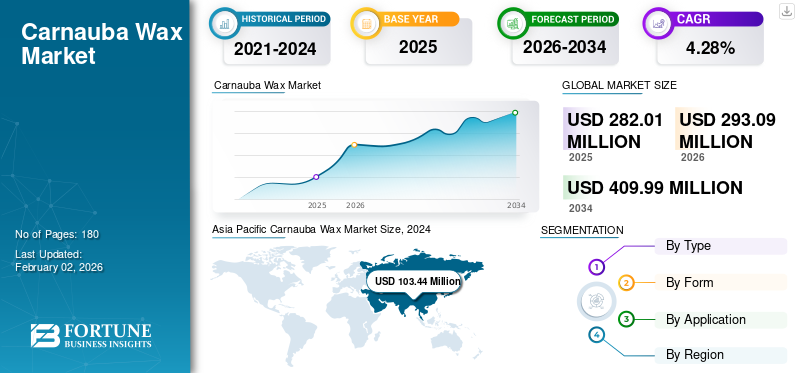
Download Free sample to learn more about this report.
Carnauba Wax Market Key Takeaways
 Market Size & Forecast
- 2025 Market Size: USD 282.01 million
- 2026 Market Size: USD 293.09 million
- 2034 Forecast Market Size: USD 409.99 million
- CAGR: 4.28% from 2026-2034
 Market Share
- Asia Pacific dominated the carnauba wax market with a 38.09% share in 2025.
- The cosmetics & personal care segment accounted for a 40.91% share in 2026.
- The powder category segment held the largest share of 53.34% in 2026.
 Key Regional Highlights
Asia Pacific
Asia Pacific accounted for USD 107.40 million in 2025 and is projected to reach USD 111.58 million in 2026.
North America
North America reached USD 73.68 million in 2025 and is expected to grow to USD 76.86 million in 2026.
Europe
Europe generated USD 65.58 million in 2025 and is projected to reach USD 68.19 million in 2026.
U.S.
The market is projected to reach USD 61.62 million by 2026.
Japan
The market is projected to reach USD 13.96 million by 2026.
Read More

MARKET DYNAMICS
MARKET DRIVERS
Expanding Automotive Industry Drives the Usage of Carnauba Wax
The growing automotive sector is a pivotal driver of carnauba wax usage. In today’s era, more than half of the population has a strong earning level and are utilizing it for their car care maintenance. To enhance the visual appeal, carnauba wax is used as a polish, providing protection from environmental contaminants and creating a glossy shine. Moreover, the rising demand for luxury or premium cars is another strong factor that favors product usage. This wax, when used on luxury vehicles, provides a superior gloss and can be easily applied.
The augmented trend of DIY car care supports the high utilization of wax. In addition, compared to synthetic waxes, it is a well-known, eco-friendly wax that appeals to a range of sustainable followers. By recognizing these advantages, companies are focusing on launching new carnauba-based waxes that can fulfill the market demand.
MARKET RESTRAINTS
Growing Incidence of Health Disorders and Environmental Challenges Hinder Market Growth
Surging prevalence of chronic health ailments is hindering market growth. Although carnauba is considered non-toxic and safe, it still creates health ailments in individuals with particular allergies/sensitivities. When utilized in lipsticks or lip balms, it can cause skin rashes, redness, and lip inflammation. Moreover, carnauba can lead to digestive discomfort, especially in sensitive consumers. Additionally, it causes eye irritation and dryness, as this wax can sometimes block glands near the lashes. Along with this, facial flushing and nasal congestion are other primary health challenges caused by carnauba ingestion.
Environmental challenges are another hurdle in the global industry. Globally, the production areas face numerous difficulties, such as the spread of invasive species, continuous drought, and a high deforestation rate, which disrupts the overall supply chain and restricts the global carnauba wax market growth.
MARKET OPPORTUNITIES
Adoption of Advanced Technologies Builds Growth Chances
The utilization of modern technologies in the global industry creates several growth opportunities. To strengthen efficiency, companies can use encapsulation techniques, where carnauba is combined with essential oils to create fruit coatings. Moreover, nanotechnology is another emerging technology that is known to improve the barrier properties of films for food packaging. Additionally, enterprises should utilize high-pressure processing to develop high-performance nanoemulsions, particularly for coatings. In addition, functional coatings are gaining huge popularity, where wax is enriched with plant extracts to add antimicrobial/antioxidant properties to the wax produce. Additionally, solvent extraction is also employed, particularly after the separation of crude wax. This technique helps remove impurities and improve the quality of the wax.
CARNAUBA WAX MARKET TRENDS
Augmented Inclination Toward Clean Beauty Products is a Current Trend
The global industry is witnessing a growing and remarkable trend of clean beauty cosmetic products. In today’s era, many individuals are gravitating toward personal care items made with natural and sustainable ingredients. This demand necessitates beauty care item manufacturers to replace artificial components with plant-centric ones, such as carnauba. This ingredient can be widely used in the cosmetics industry owing to its hypoallergenic and emollient properties. Moreover, it offers a shiny finish and high gloss, especially in makeup items such as mascara and lipsticks. Additionally, it provides a stable and firm consistency to face creams and lipsticks, and is blended with other waxes to attain the desired texture. Additionally, it creates a protective barrier on the skin, which helps retain moisture.
Download Free sample to learn more about this report.
Segmentation Analysis
By Type
Type 1 Dominated Market Due to Its Mechanical Durability and Thermal Stability
Based on type, the market is segmented into Type 1, Type 2, and Type 3.
The type 1 segment is expected to lead the market, contributing 53.41 in 2026. Type 1 is considered the purest form of wax in comparison to other types, as it is extracted from the young leaves of the carnauba palm, which have minimal contamination. Moreover, it has a higher melting point (82–86 °C), which offers mechanical durability and thermal stability. Additionally, this type of wax possesses superior protective and film-forming properties, and it has regulatory acceptance, even in sensitive industries.
The type 3 segment is expected to surge at a CAGR of 3.94% over the forecast period.
By Form
Powder Segment Led Market Owing to Its Superior Dispersibility
Based on form, the market is segmented into powder, pellets, and flakes.
The powder category segment is expected to lead the market, contributing 53.34% in 2026. The powdered form of wax has a high surface area-to-volume ratio, which helps it disperse evenly and easily into resins, emulsions, and oils. Moreover, powders have lower heat transfer resistance (melt uniformly and quickly) than flakes and pellets. Additionally, it is easy to handle, store, transport, and mix with various dry components (starches, pigment fillers). As a result, the aforementioned factors propel the global carnauba wax market share.
The flakes segment is predicted to increase at a CAGR of 4.02% over the forecast period.
By Application
To know how our report can help streamline your business, Speak to Analyst
Cosmetics & Personal Care Dominated Market Due to High Usage of Natural Ingredients
Depending on the application, the market is distributed into food & beverages, pharmaceuticals, cosmetics & personal care, and others.
The cosmetics & personal care segment is expected to lead the market, contributing 40.91% in 2026. In today’s era, most consumers are inclined toward safe and hypoallergenic ingredients, which can be used in the preparation of cosmetics. To fulfil this demand, personal care producers are utilizing carnauba wax due to its non-greasy and lightweight profile. Moreover, it improves water resistance and boosts pigment dispersion. Thus, such benefits drive the segment’s potential.
The food & beverages segment is set to increase at a high CAGR of 4.34% over the projected period.
Carnauba Wax Market Regional Outlook
By geography, the market is segregated into Middle East & Africa, Europe, South America, Asia Pacific, and North America,
Asia Pacific
Asia Pacific Carnauba Wax Market Size, 2025 (USD Million) To get more information on the regional analysis of this market, Download Free sample
The Asia Pacific market accounted for USD 107.4 million in 2025, representing 38.09% of the global industry, and is expected to reach USD 111.58 million in 2026. In this region, countries such as China, South Korea, India, and Japan have the largest and fastest-growing beauty care sector, which extensively utilizes carnauba wax. Moreover, the expanding confectionery and processed food industry in Asia Pacific fuels the need for wax as it is used as an anti-sticking and coating agent. Additionally, the rapid growth in industrial polishes makes carnauba an essential material. Furthermore, the growing nutraceutical sector incorporates the use of carnauba due to its moisture resistance and gloss-enhancing properties. Besides this, the rising awareness of health & wellness, along with improved disposable income, further fuels the region’s potential. The Japan market is projected to reach USD 13.96 billion by 2026, the China market is projected to reach USD 38.67 billion by 2026, and the India market is projected to reach USD 20.13 billion by 2026.
North America
North America is anticipated to record a growth rate of 4.56%, which is the second-highest among all regions. The growing pharmaceuticals sector and strong product innovation are key factors propelling the market’s momentum. Among all the American countries, the U.S. leads in the region, followed by Mexico and Canada. The increasing inclination toward sustainable ingredients and robust technological advancements augments the nation’s potential. The U.S. market is projected to reach USD 61.62 billion by 2026. North America maintained a strong presence in the global market, reaching USD 73.68 million in 2025, accounting for 26.13% share, and is expected to reach USD 76.86 million in 2026.
Europe
In 2025, Europe generated USD 65.58 million, contributing 23.26% to global market revenue, and is projected to grow to USD 68.19 million in 2026. The surging demand for functional cosmetics and the increasing use of wax in food products create opportunities in the regional market. The UK market is projected to reach USD 9.75 billion by 2026, and the Germany market is projected to reach USD 18.18 billion by 2026.
South America and Middle East & Africa
South America and the Middle East & Africa are set to register notable growth in the coming years. The awareness of carnauba due to the growing government support and evolving automotive industry is likely to propel its growth rate. In 2025, Middle East & Africa represented USD 13.56 million, accounting for 4.81% of the worldwide market, and is projected to grow to USD 14.06 million in 2026.
Latin America
Latin America contributed 7.72% to the global market in 2025, with a valuation of USD 21.78 million, and is projected to reach USD 22.39 million in 2026.
COMPETITIVE LANDSCAPE
Key Industry Players
Top Companies Emphasize New Launches to Cater to Rising Consumer Needs
Brasil Ceras, TER INGREDIENTS GMBH & CO. KG, and Kahl GmbH & CO. KG are some of the prominent participants in the market. All companies in the global space are aiming for product launches that can be utilized for various purposes. Through such launches, enterprises can fulfil the growing consumer demands, ultimately enhancing their market positions.
List of Key Carnauba Wax Companies Profiled
- Foncepi Comercial Exportadora Ltda. (Brazil)
- Brasil Ceras (Brazil)
- Kahl GmbH & Co. KG (Germany)
- Frank B. Ross Co., Inc. (U.S.)
- TER INGREDIENTS GMBH & CO. KG (Germany)
- Pontes Industria de Cera Ltda. (Brazil)
- Strahl & Pitsch, Inc. (U.S.)
- Norevo GmbH (Germany)
- Koster Keunen (Holland) B.V. (Netherlands)
- Poth Hille & Co Ltd (U.K.)
KEY INDUSTRY DEVELOPMENTS
- May 2024: Turtle Wax Inc., an American producer of automotive appearance products, entered into a collaboration with Mister Cartoon, a Netflix star, to introduce new car care items. The products launched comprise carnauba wax, along with synthetic sealants and other components.
- November 2023: Gehring-Montgomery, a part of the German chemical distributor TER Group, acquired Strohmeyer & Arpe's Wax Division, a U.S.-based company. Through this acquisition, Gehring expanded its portfolio of carnauba wax and improved its position in the U.S.
- January 2023: Turtle Wax Inc., a car care company based in Chicago, announced its collaboration with Bosch Car Services, a network of German automobile workshops. This alliance helps enhance the field of car care across the Indian market.
- October 2022: Proje, a U.S.-based manufacturer of premium car care products, released a new wax spray composed of carnauba wax. The firm unveiled this end product at the SEMA Automotive Aftermarket Expo, a trade association, and it is primarily formulated to enhance the vehicle’s finish.
REPORT COVERAGE
The global carnauba wax market report includes quantitative and qualitative insights into the market. It also offers a detailed market analysis of sizing and growth rate for all possible market segments. Various key insights presented in the market research report are an overview of related markets, competitive landscape, recent industry developments such as mergers & acquisitions, the regulatory scenario in critical countries, and global market trends.
Request for Customization to gain extensive market insights.
Report Scope & Segmentation
|
ATTRIBUTE |
DETAILS |
|
Study Period |
2021-2034 |
|
Base Year |
2025 |
|
Estimated Year |
2026 |
|
Forecast Period |
2026-2034 |
|
Historical Period |
2021-2024 |
|
Unit |
Value (USD Million) |
|
Growth Rate |
CAGR of 4.28% from 2026 to 2034 |
|
Segmentation |
By Type · Type 1 · Type 2 · Type 3 |
|
By Form · Powder · Pellets · Flakes |
|
|
By Application · Food & Beverages · Pharmaceuticals · Cosmetics & Personal Care · Others |
|
|
By Region · North America (By Type, Form, Application, and Country) o U.S. (Type) o Canada (Type) o Mexico (Type) · Europe (By Type, Form, Application, and Country) o Germany (Type) o France (Type) o Italy (Type) o Spain (Type) o U.K. (Type) o Rest of Europe (Type) · Asia Pacific (By Type, Form, Application, and Country) o China (Type) o India (Type) o Japan (Type) o Australia (Type) o Rest of Asia Pacific (Type) · South America (By Type, Form, Application, and Country) o Brazil (Type) o Argentina (Type) o Rest of South America (Type) · Middle East & Africa (By Type, Form, Application, and Country) o UAE (Type) o South Africa (Type) o Rest of Middle East & Africa (Type) |
Frequently Asked Questions
Fortune Business Insights says that the global market size was valued at USD 282.01 million in 2025 and projected to reach USD 409.99 million by 2034.
The market is expected to grow at a CAGR of 4.28% during the forecast period (2026-2034).
By form, the powder segment led the market.
The expanding automotive industry drives market growth.
Brasil Ceras, TER INGREDIENTS GMBH & CO, KG, and Kahl GmbH & CO. KG are a few of the top players in the market.
Asia Pacific dominated the Carnauba Wax Market with a market share of 38.09% in 2025.
Adoption of advanced technologies builds growth chances.



- 2021-2034
- 2025
- 2021-2024
- 180
-
(Offer valid till 31st Oct 2026)
Get 30-60 hrs Free Customization
Expand Regional and Country Coverage, Segments Analysis, Company Profiles, Competitive Benchmarking, and End-user Insights.




















Related Reports
-
US +1 833 909 2966 ( Toll Free )
-
Get In Touch With Us