Cationic Surfactants Market Size, Share & Industry Analysis, By Application (Home Care, Personal Care, Industrial & Institutional Cleaning, Textile, and Others), and Regional Forecast, 2026-2034
 Download Free Sample
KEY MARKET INSIGHTS
 Listen to Audio Version
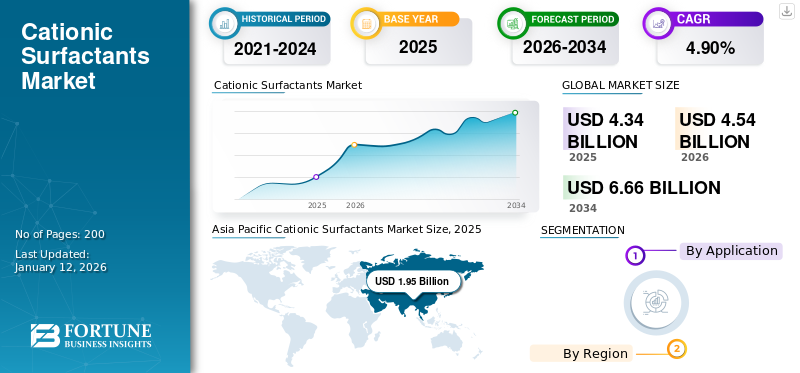
The global cationic surfactants market size was valued at USD 4.34 billion in 2025. The market is projected to grow from USD 4.54 billion in 2026 to USD 6.66 billion by 2034, exhibiting a CAGR of 4.90% during the forecast period. Asia Pacific dominated the cationic surfactants market with a market share of 45% in 2025.
Cationic surfactants are surface-active agents with a positive charge on their hydrophilic heads. This positive charge gives them unique properties, including antistatic effects, which make them useful in fabric softeners, and antimicrobial properties, which are beneficial in disinfectants and sanitizers. They are also used in hair conditioners to neutralize the negatively charged hair surface and reduce frizz. Key players operating in the market include Stepan Company, Clariant AG, Croda International Plc, Nouryon, and ABITEC.
Download Free sample to learn more about this report.
CATIONIC SURFACTANTS MARKET Key Takeaways
 Global Market Size & Forecast
- 2025 Market Size: USD 4.34 billion
- 2026 Market Size: USD 4.54 billion
- 2034 Forecast Market Size: USD 6.66 billion
- CAGR: 4.90% from 2026–2034
 Market Share
- Asia Pacific dominated the cationic surfactants market with a 45.00% share in 2025.
- The home care segment dominated the market in 2024 and held the largest cationic surfactants market share.
- The industrial & institutional cleaning segment is expected to experience considerable growth in the coming years.
 Key Regional Highlights
Asia Pacific
The Asia Pacific market was valued at USD 1.95 billion in 2025, capturing 45.00% of global revenue, and is estimated to reach USD 2.04 billion in 2026.
North America
North America contributed 24.00% to the global market in 2025, with a valuation of USD 1.04 billion, and is projected to reach USD 1.09 billion in 2026.
Europe
Europe accounted for USD 0.78 billion in 2025, representing 18.00% of the global market share, and is projected to reach USD 0.81 billion in 2026.
U.S.
The country leads the North American market with strong demand for premium and specialty cationic surfactants across home care and personal care applications.
Japan
Growing demand for high-performance and environmentally friendly surfactants is supporting market expansion, driven by innovation in personal care and industrial cleaning applications.
Read More

CATIONIC SURFACTANTS MARKET TRENDS
Shift toward Sustainable and Bio-based Surfactants is a Prominent Trend
As environmental awareness grows among consumers and regulators, there is a strong movement to reduce the ecological footprint of chemical products. Traditional cationic surfactants, while effective, often raise concerns due to their poor biodegradability and potential toxicity to aquatic life. In response, manufacturers are investing in research and development to create eco-friendly formulations using renewable raw materials, such as plant-based oils and natural fatty amines. These bio-based surfactants meet stricter environmental standards and align with the values of environmentally conscious consumers.
Download Free sample to learn more about this report.
MARKET DYNAMICS
MARKET DRIVERS
Growth in Personal Care and Cosmetic Industry to Boost Market Growth
The growing personal care and cosmetic industry is a significant driver of the cationic surfactants market growth. These surfactants are key ingredients in products such as hair conditioners, skin creams, and lotions due to their excellent emulsifying, conditioning, and antimicrobial properties. As consumer preferences shift toward more premium, multifunctional, and specialized personal care products, manufacturers are increasingly using cationic surfactants to enhance both product performance and user experience. Furthermore, rising disposable incomes, urbanization, and increased awareness of grooming, particularly in emerging economies, are boosting the demand for these products. This consistent growth in the personal care sector directly drives the need for high-quality surfactant solutions.
MARKET RESTRAINTS
Environmental and Regulatory Concerns to Limit Market Expansion
Despite their usefulness, many conventional cationic surfactants pose environmental risks due to their low biodegradability and toxicity to aquatic life. Regulatory agencies, such as the U.S. Environmental Protection Agency (EPA) and the European Chemicals Agency (ECHA), have established strict regulations regarding the use and discharge of these substances. Complying with these regulations increases production complexity and costs, as manufacturers may need to reformulate their products or invest in cleaner alternatives. These environmental and legal constraints limit the use of certain cationic surfactants and restrict market growth.
MARKET OPPORTUNITIES
Rising Demand for Eco-Friendly Formulations to Positively Impact Market Growth
There is a growing opportunity for innovation in the development of eco-friendly and biodegradable cationic surfactants. As environmental awareness increases and regulations tighten, industries are seeking greener alternatives that maintain high performance. Companies that can produce sustainable surfactants from renewable sources, such as plant oils and natural amines, have the potential to capture new market segments. This trend is especially strong in the personal care, cleaning, and textile industries, where consumers are increasingly choosing environmentally responsible products. Investing in sustainable product lines could create significant new revenue streams and enhance brand equity.
MARKET CHALLENGES
Raw Material Price Volatility is Likely to Hamper Market Growth
One of the main challenges the market is facing is the volatility in raw material prices, especially those derived from petrochemicals and natural fats. These materials can experience price fluctuations due to geopolitical tensions, supply chain disruptions, and variations in market demand. Such unpredictability can lead to inconsistent production costs, ultimately affecting manufacturers' profit margins. To address this issue, companies have two primary options: they can either absorb the cost fluctuations, which reduces profitability, or pass those costs on to customers, which may harm their competitiveness. Effectively managing this challenge requires efficient procurement strategies, as well as the possibility of diversifying supply sources or shifting to more stable bio-based inputs.
Segmentation Analysis
By Application
Excellent Barrier Properties of Cationic Surfactants Boosted Home Care Segment Growth
The market is segmented by application into home care, personal care, industrial & institutional cleaning, textile, and others.
The home care segment dominated the market in 2024 and held the largest cationic surfactants market share. Cationic surfactants are positively charged surfactants that are commonly used in home care applications, particularly for their conditioning, antimicrobial, and anti-static properties. They are often found in fabric softeners, rinse aids, and disinfectants, enhancing the softness and functionality of these products. They are a key ingredient in fabric softeners, helping to reduce static cling, improve fabric softness, and add a smooth texture to clothing.
The personal care segment is anticipated to experience significant market growth during the forecast period. They are used in personal care products such as hair conditioners and fabric softeners to provide conditioning benefits, reduce static, and improve texture. They are particularly effective in hair care, where their positive charge allows them to adhere to the negatively charged hair surface, smoothing the cuticle and improving manageability.
The industrial & institutional cleaning segment is expected to experience considerable growth in the coming years. In industrial and institutional cleaning due to their ability to adhere to negatively charged surfaces, enhance cleaning efficiency, and act as disinfectants. They are often used in products, including fabric softeners, antistatic agents, and disinfectants, and can also be used as emulsifiers and particle dispersants.
Cationic Surfactants Market Regional Outlook
By region, the market is categorized into North America, Europe, Asia Pacific, Latin America, and Middle East & Africa.
Asia Pacific
Asia Pacific Cationic Surfactants Market Size, 2025 (USD Billion)
To get more information on the regional analysis of this market, Download Free sample
The Asia Pacific market was valued at USD 1.95 billion in 2025, capturing 45.00% of global revenue, and is estimated to reach USD 2.04 billion in 2026. Countries such as China and India hold a significant position in the global market primarily due to their well-established manufacturing frameworks, which consist of extensive supply chains and advanced technology. These nations benefit from comparatively lower labor costs, which not only make production more economical but also attract foreign investment. This demographic shift is accompanied by rapid urbanization, resulting in a higher demand for personal care products and industrial applications.
North America
North America contributed 24.00% to the global market in 2025, with a valuation of USD 1.04 billion, and is projected to reach USD 1.09 billion in 2026. North America is experiencing a significant shift toward eco-friendly and sustainable surfactants, fueled by a growing awareness among consumers about environmental impact and the implementation of regulations that promote green chemistry practices. The U.S. market is leading the market, particularly in the niche of premium and specialty surfactants.
Europe
Europe accounted for USD 0.78 billion in 2025, representing 18.00% of the global market share, and is projected to reach USD 0.81 billion in 2026. Europe is a front-runner in adopting biodegradable, bio-based surfactants due to stringent environmental policies. Over 50% of new hair care and skin care launches in Europe use eco-friendly cationic surfactants, reflecting consumer demand and regulatory pressure.
Latin America
In 2025, the Latin America market stood at USD 0.35 billion, representing 8.00% of global demand, and is projected to grow to USD 0.36 billion in 2026. Latin America is an emerging market with expanding personal care and agriculture sectors. Although smaller in volume, the market is growing steadily due to rising disposable incomes and urbanization.
Middle East & Africa
The market in Middle East & Africa reached USD 0.22 billion in 2025, representing 5.00% of total market revenue, and is projected to reach USD 0.23 billion in 2026. The Middle East & Africa region is experiencing significant growth in the use of cationic surfactants, particularly in the industrial cleaning, oil and gas, and agricultural sectors. Key demand drivers include investments in research and development, infrastructure, and an increasing awareness of hygiene.
COMPETITIVE LANDSCAPE
Key Industry Players
Continuous Expansion and Acquisitions by Key Companies Resulted in Their Dominant Positions in Market
The cationic surfactants market is moderately consolidated, with the top players commanding a large portion. However, many regional producers cater to local demand. Some of the key players include Stepan Company, Clariant AG, Croda International Plc, Nouryon, and ABITEC. The players are emphasizing green chemistry and natural raw materials. Leading companies have introduced new cationic surfactants derived from natural oils such as palm kernel, coconut, and castor oils with improved biodegradability and reduced toxicity.
LIST OF KEY CATIONIC SURFACTANT COMPANIES PROFILED
- Stepan Company (U.S.)
- Clariant AG (Switzerland)
- Croda International Plc (U.K.)
- Nouryon (Netherlands)
- ABITEC (U.S.)
- PCC Group (Poland)
- Lion Specialty Chemicals Co., Ltd. (Japan)
- Ashland Global Holdings Inc. (U.S.)
- Kao Corporation (Japan)
- Evonik Industries AG (Germany)
KEY INDUSTRY DEVELOPMENTS
- September 2022: Stepan Company completed the acquisition of the surfactant business and associated assets of PerformanX Specialty Chemicals, LLC. The acquisition includes intellectual property, commercial relationships, and inventory.
REPORT COVERAGE
Request for Customization to gain extensive market insights.
Report Scope & Segmentation
|
ATTRIBUTE |
DETAILS |
|
Study Period |
2021-2034 |
|
Base Year |
2025 |
|
Estimated Year |
2026 |
|
Forecast Period |
2026-2034 |
|
Historical Period |
2021-2024 |
|
Growth Rate |
CAGR of 4.90% from 2026-2034 |
|
Unit |
Value (USD Billion) and Volume (Kiloton) |
|
Segmentation |
By Application
|
|
By Region
|
Frequently Asked Questions
Fortune Business Insights says that the global market value stood at USD 4.54 billion in 2026 and is projected to reach USD 6.66 billion by 2034.
In 2026, the market value stood at USD 2.04 billion.
The market is expected to exhibit a CAGR of 4.90% during the forecast period of 2026-2034
The home care segment led the market by application.
Growth in the personal care and cosmetic industry to boost market growth.
Stepan Company, Clariant AG, Croda International Plc, Nouryon, and ABITEC are the top players in the market.
Asia Pacific dominated the cationic surfactants market with a market share of 45% in 2025.
The global shift toward sustainable and bio-based surfactants and increasing demand from home care, industrial & institutional cleaning, and textile industries is expected to favor product adoption.



- 2021-2034
- 2025
- 2021-2024
- 200
Get 30-60 hrs Free Customization
Expand Regional and Country Coverage, Segments Analysis, Company Profiles, Competitive Benchmarking, and End-user Insights.


















Related Reports
-
US +1 833 909 2966 ( Toll Free )
-
Get In Touch With Us