Cement Additives Market Size, Share & Industry Analysis, By Type (Grinding Aids, Performance & Strength Enhancers, and Others), By Application (Portland Cement, Blended Cement, and Others), and Regional Forecast, 2026-2034
 Download Free Sample
Cement Additives Market Size and Future Outlook
 Listen to Audio Version
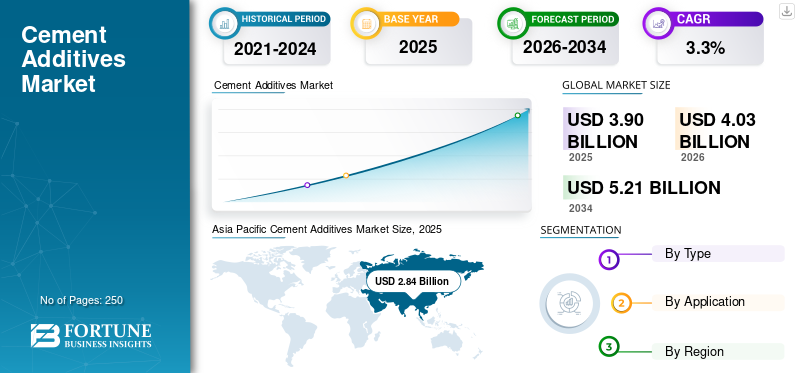
The global cement additives market size was valued at USD 3.90 billion in 2025 and is projected to grow from USD 4.03 billion in 2026 to USD 5.21 billion by 2034, exhibiting a CAGR of 3.3% during the forecast period. Asia Pacific dominated the cement additives market with a market share of 72.82% in 2025.
Cement additives refer to chemical and mineral-based substances incorporated during cement manufacturing or blending to improve processing efficiency, enhance cement performance, and optimize end-use properties. These additives include grinding aids, performance enhancers, strength improvers, set modifiers, and other formulation-support materials that help improve mill productivity, reduce energy consumption, and tailor cement characteristics. Demand for cement additives is primarily driven by rising cement production in developing economies and by growing infrastructure and urban construction activities. The increasing focus on reducing the clinker factor and carbon emissions, and the need for higher-efficiency cement formulations that meet evolving construction standards, are assisting market growth. The product’s ability to improve compressive strength and durability, along with efficient production economics, makes it an important component in modern cement manufacturing.
The market is led by global construction chemicals companies and cement performance solution providers that maintain strong positions through specialized formulation expertise, technical service capabilities, and long-term relationships with cement producers. Major players such as Sika AG, Chryso, Master Builders Solutions, GCP Applied Technologies, and WACKER Chemie AG sustain competitiveness through broad additive portfolios, continuous product development, and regionally diversified supply networks. Market participants are increasingly focusing on performance-driven, sustainability-oriented solutions that support lower clinker-to-cement ratios, improved grinding efficiency, and enhanced final cement properties.
Download Free sample to learn more about this report.
Cement Additives Market Key Takeaways
 Market Size & Forecast
- 2025 Market Size: USD 3.90 billion
- 2026 Market Size: USD 4.03 billion
- 2034 Forecast Market Size: USD 5.21 billion
- CAGR: 3.3% from 2026–2034
 Market Share
- Asia Pacific dominated the cement additives market with a 72.82% share in 2025.
- Grinding Aids segment held the largest market share in 2025.
- Blended Cement segment accounted for the largest market share in 2025.
 Key Regional Highlights
North America
North America market valued at USD 0.23 billion in 2025.
Asia Pacific
Asia Pacific held 72.82% share in 2025, valued at USD 2.84 billion.
Europe
Europe market valued at USD 0.39 billion in 2025.
U.S.
Market is expected to reach USD 0.21 billion in 2026.
Germany
Market is expected to reach USD 0.08 billion in 2026.
Read More

CEMENT ADDITIVES MARKET TRENDS
Growth in Sustainable Construction and Green Building Initiatives to Accelerate Product Adoption
The growing emphasis on sustainable construction and green building practices is a major trend driving the adoption of cement additives. As the construction sector faces increasing pressure to reduce environmental impact, cement producers are using additives to improve energy efficiency, lower clinker factor, and enhance the performance of blended cement formulations. These solutions support the development of more resource-efficient cement products that align with green building certifications and low-carbon construction goals. At the same time, rising awareness among builders, developers, and regulators regarding environmentally responsible materials is encouraging wider acceptance of performance-enhancing additives. Hence, the shift toward sustainable, greener construction systems is steadily increasing demand for high-performance cement additives.
- Green building programs in Europe aim to achieve a decarbonized building stock by 2050, driven by the EU Green Deal and the Renovation Wave initiative, which aims to double renovation rates by 2030.
MARKET DYNAMICS
MARKET DRIVERS
Download Free sample to learn more about this report.
Rapid Urbanization and Infrastructure Development Globally to Drive Market Growth
Rapid urbanization and large-scale infrastructure projects across emerging and developed economies are driving sustained cement demand, in turn supporting market growth. Expanding investments in residential buildings, commercial complexes, transportation networks, industrial facilities, and public infrastructure are increasing cement consumption volumes and encouraging producers to improve grinding efficiency and cement performance. Cement additives play an important role in helping manufacturers enhance productivity, reduce production costs, and tailor cement properties for diverse construction requirements. In addition, rising demand for high-performance cement in complex and large-scale projects is further strengthening additive adoption. Therefore, continued urban expansion and infrastructure modernization are anticipated to drive the global cement additives market growth during the forecast period.
MARKET RESTRAINTS
Environmental Regulations on Cement Manufacturing Emissions May Limit Market Growth
Stringent environmental regulations on cement manufacturing emissions may act as a restraint for the market by increasing compliance pressure across the cement value chain. Cement production remains one of the more carbon-intensive industrial processes, and tightening rules related to carbon dioxide emissions, particulate matter, and energy consumption are compelling manufacturers to invest heavily in cleaner technologies and process upgrades. In such an environment, purchasing decisions for additives may become more selective, particularly when producers prioritize broader, capital-intensive emission-control measures. In addition, regulatory scrutiny over chemical usage and formulation safety in certain regions may create additional complexity for additive suppliers. Therefore, regulatory pressure on cement manufacturing operations may limit market expansion in cost-sensitive and highly regulated environments.
MARKET OPPORTUNITIES
Growth in Green Cement and Low-Carbon Construction Materials to Create Lucrative Opportunities
The growing shift toward green cement and low-carbon construction materials is creating lucrative opportunities for the market. Cement producers are increasingly developing blended cements and lower-carbon formulations that reduce clinker usage while maintaining strength, durability, and workability standards. This transition is increasing the need for advanced additives that meet the requirements for high-performance concrete with supplementary cementitious materials and alternative raw materials. Additives that improve grinding efficiency, optimize hydration behavior, and enhance final cement properties are increasingly valuable for developing sustainable cement solutions. As decarbonization becomes a strategic priority across the construction and building materials sectors, the role of cement additives is expected to expand further. Thus, the rise of green cement is likely to unlock strong long-term growth opportunities for market participants.
Segmentation Analysis
By Type
Grinding Aids Dominated Market Due to Their Strong Role in Improving Mill Efficiency and Lowering Production Cost
Based on type, the market is segmented into grinding aids, performance & strength enhancers, and others.
The grinding aids segment held the largest market share in 2025. The strong demand is mainly due to their critical role in improving milling efficiency, reducing agglomeration in cement mills, and lowering specific energy consumption in cement production. These additives are widely used across cement plants as they help increase throughput, improve powder flow characteristics, and support more cost-efficient manufacturing. Their relevance remains particularly high in the Asia Pacific, where large-scale cement production and cost competitiveness are central to producer strategy. Continued focus on plant productivity, energy optimization, and operational efficiency is expected to sustain demand for grinding aids through 2034.
Demand for performance & strength enhancers is mainly driven by increasing demand for high-performance cement to extend the lifespan of structures, reducing repair costs, and allowing for lighter, more efficient designs. These additives are becoming more important as manufacturers seek to differentiate cement grades and support higher-performance construction requirements in infrastructure and commercial projects. The segment is projected to grow at a CAGR of 3.6% during 2026–2034, supported by rising demand for enhanced cement functionality and improved construction performance.
The “others” segment includes specialty additives used for targeted formulation adjustments, including set control, workability support, and niche performance improvement requirements. Although smaller in market size, these additives remain relevant in specific cement chemistries and application environments where customized processing and performance characteristics are needed. Their use is gradually increasing as specialized construction requirements expand, and evolving cement formulation practices are expected to drive growth at a CAGR of 4.0% during 2026–2034.
By Application
To know how our report can help streamline your business, Speak to Analyst
Blended Cement Led Market Due to Increasing Adoption of Sustainable and Cost-Effective Cement Formulations
Based on application, the market is segmented into Portland cement, blended cement, and others.
The blended cement segment accounted for the largest global cement additives market share in 2025, driven by the increasing adoption of sustainable and cost-effective cement formulations across the construction industry. The rising use of blended cement across residential, commercial, and infrastructure construction is further strengthening segment demand, as builders and developers increasingly prefer cement products that offer both performance and environmental benefits. Growing decarbonization initiatives, stricter sustainability targets, and continued infrastructure investments are expected to sustain the demand for additives used in blended cement production over the forecast period.
The Portland cement segment is expected to maintain steady demand in the global cement additives market, supported by high-volume consumption in cost-sensitive construction markets, where it remains a preferred cement type due to its established performance, broad availability, and compatibility with standard construction practices. Cement additives are extensively used in Portland cement production to improve grinding efficiency, reduce production costs, ensure consistent quality, and enhance final cement performance. Therefore, ongoing urbanization, infrastructure expansion, and housing development across emerging economies are set to drive the segment’s growth at a CAGR of 3.0% during 2026–2034.
The “others” segment covers additive use in niche or specialized cement applications that do not fall under standard Portland or blended cement categories. Specific construction needs, regional formulation preferences, and targeted performance requirements support these applications. While relatively small in terms of value contribution, the segment continues to benefit from gradual diversification in cement product offerings and specialty usage areas. As a result, the segment is projected to grow at a CAGR of 3.3% during 2026–2034.
Cement Additives Market Regional Outlook
By geography, the market is segmented into North America, Europe, Asia Pacific, Latin America, and the Middle East & Africa.
Asia Pacific
Asia Pacific Cement Additives Market Size, 2025 (USD Billion)
To get more information on the regional analysis of this market, Download Free sample
Asia Pacific dominated the global market in 2025, reaching USD 2.84 billion, and is expected to maintain its leadership in 2026 with USD 2.94 billion. The region accounts for the largest share due to its high cement production base, large-scale infrastructure activity, and continued urban construction across major economies such as China and India. Strong investment in residential development, transport infrastructure, industrial construction, and public works continues to support cement consumption across the region. At the same time, growing focus on improving mill productivity, optimizing cement performance, and supporting blended cement formulations is reinforcing additive usage across cement plants.
China Cement Additives Market
China is expected to reach approximately USD 1.88 billion in 2026, representing around 46.6% of global demand, supported by its dominant cement manufacturing base and broad construction materials ecosystem. The country’s large installed production capacity, ongoing infrastructure maintenance and expansion, and increasing focus on production efficiency continue to sustain additive demand.
To know how our report can help streamline your business, Speak to Analyst
India Cement Additives Market
India is expected to reach USD 0.33 billion in 2026, making it one of the most significant contributors to market growth. Demand is supported by the country’s expanding residential construction pipeline, large infrastructure development programs, and rising cement capacity additions by domestic producers.
North America
North America reached USD 0.23 billion in 2025, supported by steady construction activity and the region’s continued focus on quality-enhanced and performance-oriented cement formulations. Demand for cement additives is driven by the need for increased production efficiency, cost optimization, and improved cement performance across commercial, residential, and infrastructure applications.
U.S. Cement Additives Market
The U.S. market is expected to reach USD 0.21 billion in 2026, accounting for roughly 5.2% of global revenues. Market growth is driven by ongoing building renovation, highway and bridge upgrades, commercial construction, and continued usage of performance-based construction materials. Cement additives are increasingly used to improve cement grinding efficiency and support stable quality in a market where consistency, operational economics, and application performance remain important purchasing factors.
Europe
Europe reached USD 0.39 billion in 2025, and it is anticipated to grow at a CAGR of 2.8% through 2034. The region represents a mature but technically advanced market, where demand is strongly influenced by efficiency improvement, product quality optimization, and sustainability priorities in cement manufacturing. The market is also benefiting from the region’s growing emphasis on low-clinker cement, energy-efficient grinding processes, and lower-carbon construction materials.
Germany Cement Additives Market
Germany is expected to reach USD 0.08 billion in 2026, representing around 2.1% of global revenues, supported by its well-established cement production base and strong focus on industrial efficiency and sustainable construction materials. Demand for additives in the country is shaped by the need to optimize cement processing, improve performance properties, and support lower-emission cement formulations aligned with evolving environmental targets.
U.K. Cement Additives Market
The U.K. market in 2026 is expected to reach USD 0.03 billion, accounting for roughly 0.7% of global revenues. The country’s demand for cement additives is supported by infrastructure rehabilitation, urban construction activity, and growing attention to sustainable building materials. Additive use is particularly relevant in improving cement quality and enabling more efficient production in a market increasingly shaped by cost discipline and environmental compliance considerations.
Latin America
Latin America reached USD 0.21 billion in 2025, reflecting a relatively stable market environment supported by ongoing residential construction, public infrastructure requirements, and selective industrial development. Demand for cement additives across the region remains tied to the need for better grinding economics, improved quality, and enhanced performance in conventional cement applications.
Brazil Cement Additives Market
Brazil is expected to reach USD 0.11 billion in 2026, representing around 2.7% of global revenues. The country remains the leading contributor within Latin America due to its large construction base and relatively broader cement consumption profile. Additive demand is supported by housing activity, infrastructure works, and the need for efficient cement production in a market where plant productivity and performance consistency remain commercially important.
Middle East & Africa
The Middle East & Africa region reached USD 0.22 billion in 2025. Demand is primarily supported by infrastructure investment, urban expansion, commercial construction, and large-scale development projects across selected Middle Eastern and African markets. Cement additives are gaining relevance as producers seek better milling efficiency, improved cement characteristics, and greater flexibility in formulation design.
COMPETITIVE LANDSCAPE
Key Industry Players
Portfolio Expansion and Sustainability-Focused Innovation are Reshaping Competitive Dynamics in Market
The cement additives market is led by global construction chemical manufacturers and admixture specialists, including Saint-Gobain Construction Chemicals, Sika AG, MAPEI S.p.A., Master Builders Solutions, and other regionally strong additive suppliers. Players are increasingly competing on formulation capability, performance enhancement, grinding efficiency, support for clinker reduction, and technical service for low-carbon cement systems. Recent developments indicate a clear strategic direction, including acquisitions to broaden cement additive portfolios, regional capacity additions to improve supply responsiveness, and targeted investments to support sustainable cement and concrete production.
As the market shifts toward lower-clinker formulations and higher-performance construction materials, competitive advantage is increasingly moving toward companies that can combine scale, application expertise, and sustainability-oriented innovation. Furthermore, continued expansion in production capabilities and technology-led additive solutions is likely to reshape competitive positioning over the long term.
LIST OF KEY CEMENT ADDITIVE COMPANIES PROFILED
- Chryso (France)
- GCP Applied Technologies Inc (U.S.)
- Master Builders Solutions (Germany)
- MBT Tech (Turkey)
- MUHU (China) Construction Materials Co., Ltd. (China)
- SIKA (Switzerland)
- Shandong Tiancheng Hongsha Construction Materials Co., Ltd (China)
- Tianjin Chengyi International Trading Co., Ltd. (China)
- Ultra Tech Cement (India)
- Wacker Chemie AG (Germany)
KEY INDUSTRY DEVELOPMENTS
- September 2025: MBT Construction Chemicals, part of the Master Builders Solutions Group, inaugurated a new manufacturing plant in Taloja, Navi Mumbai, India, with the capacity to support growing regional demand. The facility strengthens the local supply of construction chemical solutions in one of the world’s fastest-growing cement and concrete markets.
- December 2024: Master Builders Solutions finalized its acquisition of a 51% stake in MBT Tech, a Turkey-based construction chemical supplier, following the joint venture agreement announced in August 2024. The move broadened Master Builders Solutions’ manufacturing and market presence in a strategically important regional construction hub.
- September 2024: MAPEI opened a new 32,000-square-foot admixtures plant in Denver, Colorado, equipped with advanced mixing, batching, warehousing, laboratory, and quality-control capabilities. The investment expands MAPEI’s regional production capacity and local service responsiveness for additive technologies, supporting faster supply to western U.S. construction markets.
- May 2023: Sika successfully closed its acquisition of MBCC Group, substantially enlarging its position in construction chemicals and admixture systems worldwide. The combination strengthened Sika’s scale, innovation capacity, and regional coverage across cement and concrete additives, while improving its ability to serve customers with broader performance and sustainability-focused solutions.
- January 2022: Master Builders Solutions launched its MasterEase and Master X-Seed admixtures range in Europe to support the production of new low-clinker CEM II/C-M and CEM VI Portland-composite The launch aligned the company with the market’s move toward lower-CO2 cement formulations.
REPORT COVERAGE
The global cement additives market analysis provides an in-depth study of market size & forecast across all market segments included in the report. It includes details on the market dynamics and market trends expected to drive the market over the forecast period. It offers information on technological advancements, new product launches, key industry developments, and partnerships, mergers & acquisitions. The market research report also encompasses a detailed competitive landscape, including market share and profiles of key operating players.
Request for Customization to gain extensive market insights.
Report Scope & Segmentation
| ATTRIBUTE | DETAILS |
| Study Period | 2021-2034 |
| Base Year | 2025 |
| Estimated Year | 2026 |
| Forecast Period | 2026-2034 |
| Historical Period | 2021-2024 |
| Growth Rate | CAGR of 3.3% from 2026 to 2034 |
| Unit | Value (USD Billion) Volume (Kiloton) |
| Segmentation | By Type, Application, and Region |
| By Type |
|
| By Application |
|
| By Region |
|
Frequently Asked Questions
Fortune Business Insights says that the global market size was valued at USD 3.90 billion in 2025 and is projected to reach USD 5.21 billion by 2034.
In 2025, the market value of Asia Pacific stood at USD 2.84 billion.
Recording a CAGR of 3.3%, the market is slated to exhibit steady growth during the forecast period of 2026-2034.
The blended cement application segment led in 2025.
Rapid urbanization and infrastructure development globally boost market growth.
Sika AG, Chryso, Master Builders Solutions, GCP Applied Technologies, and WACKER Chemie AG are some of the prominent players in the market.
Asia Pacific held the highest market share in 2025.
Growth in sustainable construction and green building initiatives is expected to favor product adoption.



- 2021-2034
- 2025
- 2021-2024
- 250
Get 30-60 hrs Free Customization
Expand Regional and Country Coverage, Segments Analysis, Company Profiles, Competitive Benchmarking, and End-user Insights.


















Related Reports
-
US +1 833 909 2966 ( Toll Free )
-
Get In Touch With Us