Cloud-Native AI Platfoarms Market Size, Share & Industry Analysis, By Component (Platform and Services), By Platform Type (End-to-End AI Platforms, AI Development Platforms, AI Operations Platforms, AI Inference Platforms, AI Governance Platforms, and Others), By Deployment (Public Cloud, Private Cloud, and Hybrid Cloud), By Enterprise Type (Large Enterprises and Small and Medium Enterprises (SMEs)), By End-user (BFSI, IT & Telecommunications, Healthcare, Retail & E-commerce, Manufacturing, Government, Automotive, and Others), and Regional Forecast, 2026–2034
 Download Free Sample
CLOUD-NATIVE AI PLATFORMS MARKET SIZE AND FUTURE OUTLOOK
 Listen to Audio Version
The global cloud-native AI platforms market size was valued at USD 7.38 billion in 2025. The market is projected to grow from USD 8.73 billion in 2026 to USD 47.11 billion by 2034, exhibiting a CAGR of 23.5% during the forecast period. North America dominated the cloud native AI platforms market with a market share of 44.04% in 2025.
Cloud-native AI platforms are integrated environments that enable organizations to develop, train, deploy, operate, monitor, and govern AI models and applications across public cloud, private cloud, hybrid and multi cloud, Kubernetes, and edge infrastructure. Unlike standalone AI development tools or traditional on-premises machine learning systems, these platforms combine scalable computing, model access, data integration, container orchestration, MLOps, LLMOps, inference management, security, observability, and governance within a unified architecture. They support predictive AI, generative AI, and agentic AI workloads while allowing enterprises to scale resources dynamically and manage the complete AI lifecycle across distributed environments.
The rapid expansion of enterprise AI applications, foundation-model usage, agentic applications, GPU-intensive workloads, and cloud-based data environments is driving demand for cloud-native AI platforms. Organizations are investing in these platforms to accelerate model development, reduce infrastructure complexity, automate deployment, optimize inference performance, and maintain consistent security and governance across AI workloads. As enterprises move AI initiatives from isolated pilots to production-level applications, cloud-native platforms are becoming essential for managing fluctuating computing requirements, connecting models with enterprise data, and monitoring application performance. They also help control deployment risks, and support AI operations across multiple business units and geographies.
Key players such as Amazon Web Services (AWS), Microsoft, Google, and IBM are strengthening their portfolios through integrated model development environments, foundation-model catalogues, generative AI services, agent orchestration, automated MLOps, optimized inference, and responsible AI capabilities. These vendors focus on delivering end-to-end platforms that support data preparation, model training, fine-tuning, deployment, monitoring, security, and governance across public, private, hybrid, and multicloud environments. Their continued investments in AI infrastructure, Kubernetes integration, industry-specific solutions, sovereign AI, and enterprise-grade agentic AI are accelerating platform innovation and expanding market adoption.
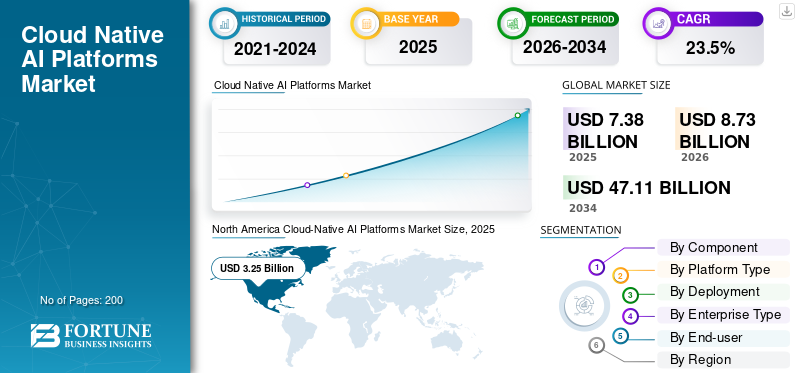
Download Free sample to learn more about this report.
Cloud Native AI Platforms Market KEY TAKEAWAYS
 Global Market Size & Forecast
- 2025 Market Size: USD 7.38 billion
- 2026 Market Size: USD 8.73 billion
- 2034 Forecast Market Size: USD 47.11 billion
- CAGR: 23.5% from 2026–2034
 Market Share
- North America dominated the market with a 44.04% share in 2025.
- BFSI held the majority market share at 19.8% in 2025.
- The services segment is expected to witness the second-highest CAGR of 29.1% during the forecast period.
 Key Regional Highlights
Asia Pacific
Asia Pacific reached USD 1.77 billion in 2025 and is expected to grow at the highest CAGR of 26.0%, driven by cloud modernization, sovereign AI initiatives, and rising enterprise AI deployments.
North America
North America held the dominant position with a market size of USD 3.25 billion in 2025, supported by high cloud adoption, extensive data center capacity, and strong AI investment.
Europe
Europe reached USD 1.95 billion in 2025 and is projected to grow at a CAGR of 22.9%, supported by demand for secure, transparent, sovereign, and regulatory-compliant AI platforms.
U.S.
The U.S. market was estimated at around USD 2.89 billion in 2025, accounting for roughly 39.2% of global sales, driven by strong enterprise AI adoption and investment in cloud-native technologies.
Japan
The Japan market was valued at around USD 0.27 billion in 2025, accounting for roughly 3.7% of global revenues.
Read More

IMPACT OF GENERATIVE AI
Enterprise Generative AI Deployment Driving Cloud-Native Platform Expansion
Generative AI is having a strong positive impact on the cloud-native AI platforms market growth by increasing enterprise demand for scalable infrastructure. These infrastructures can support foundation-model development, fine-tuning, retrieval-augmented generation, real-time inference, model monitoring, security, and governance. As organizations integrate generative AI into customer service, software development, knowledge search, content creation, and intelligent automation, they require cloud-native platforms that can manage GPU resources, containerized models, fluctuating workloads, enterprise data connections, and continuous application updates.
- The Cloud Native Computing Foundation’s 2025 Annual Cloud Native Survey, published in January 2026, found that 66% of organizations hosting generative AI models use Kubernetes to manage some or all of their inference workloads. Further, demonstrating the growing convergence of generative AI and cloud-native infrastructure.
This adoption is encouraging cloud providers and software vendors to expand their platforms with model catalogues, vector databases, LLMOps, guardrails, optimized inference services, and generative AI development tools.
CLOUD-NATIVE AI PLATFORMS MARKET TRENDS
Growing Deployment of Autonomous AI Agents is Emerging as a Key Platform Trend
Enterprises are rapidly moving beyond prompt-based generative AI assistants toward autonomous agents that can understand objectives, plan multi-step tasks, access enterprise data, use business applications, coordinate with other agents, and execute workflows with limited human intervention. This transition is increasing demand for such AI platforms that provide scalable computing, agent orchestration, persistent memory, secure tool connectivity, identity and access controls, execution monitoring, evaluation, and governance across the agent lifecycle.
- In April 2026, Google Cloud launched the Gemini Enterprise Agent Platform, combining Vertex AI capabilities with agent integration, DevOps, orchestration, security, Agent Identity, Agent Registry, Agent Gateway, and Agent Observability.
The launch demonstrates how leading providers are evolving from standalone model-development platforms into comprehensive operating environments for deploying and managing production-scale multi-agent systems.
MARKET DYNAMICS
MARKET DRIVERS
Download Free sample to learn more about this report.
Expanding Enterprise AI Deployment is Accelerating Demand for Cloud-Native Platforms
The accelerating enterprise adoption of generative AI is a major driver of the market, as organizations integrate AI into customer service, software development, knowledge management, marketing, data analytics, content generation, and internal workflow automation. As enterprises progress from small-scale experiments to production deployments, they require platforms capable of supporting large and fluctuating workloads, secure access to enterprise data, rapid model development, automated deployment, real-time inference, performance monitoring, and centralized governance.
Cloud-native platforms address these requirements through scalable computing resources, containerized architectures, APIs, MLOps capabilities, and integrated security controls, enabling businesses to deploy and update AI applications more efficiently.
- Stanford University’s 2025 AI Index reported that 78% of surveyed organizations used AI in 2024, up from 55% in 2023, while generative AI usage in at least one business function increased from 33% to 71%. Further, demonstrating the rapid expansion of enterprise demand for production-ready AI infrastructure.
|
Rank |
Market Drivers |
Overall Impact Rank |
Estimated Gross Market Growth Contribution (USD Billion) |
Impact 2026-2028 |
Impact 2029-2031 |
Impact 2032-2034 |
|
1 |
Expanding enterprise AI deployment accelerating demand for cloud-native platforms. |
High |
12.60 |
High |
High |
High |
|
2 |
Growing demand for scalable GPU infrastructure and optimized AI inference. |
High |
9.10 |
High |
High |
High |
|
3 |
Increasing adoption of end-to-end AI lifecycle and MLOps platforms. |
Medium-High |
7.45 |
Medium |
High |
High |
|
4 |
Expansion of hybrid, multicloud, Kubernetes, and distributed AI environments. |
Medium-High |
6.30 |
Medium |
High |
High |
|
5 |
Development of industry-specific, sovereign, and regionally compliant AI platforms. |
Medium |
5.20 |
Medium |
Medium |
High |
|
6 |
Others, including AI governance, managed AI services, edge AI deployment, open-model ecosystems, etc. |
Low |
3.95 |
Low |
Medium |
Medium |
|
Total Positive Growth Contribution |
44.60 |
MARKET RESTRAINTS
Rising Data Security, Privacy, and Regulatory Risks is Limiting Enterprise Adoption
Data security, privacy, and regulatory compliance concerns are significant restraints on the adoption of such AI platforms, particularly among organizations handling financial records, health information, government data, intellectual property, and other sensitive datasets. Developing and operating AI models in cloud-native environments often requires data to move across storage systems, APIs, containers, model-training pipelines, and multiple cloud regions. This expands the potential attack surface and increases the risk of unauthorized access, data leakage, insecure configurations, compromised model endpoints, and exposure through unapproved AI tools.
Enterprises must also ensure that data collection, processing, retention, and cross-border transfers comply with regulations such as the GDPR, sector-specific privacy requirements, and national data-residency rules. Meeting these obligations can require additional security controls, encryption, access management, continuous monitoring, audit trails, and localized infrastructure, increasing implementation costs and delaying deployments.
- IBM’s 2025 Cost of a Data Breach Report found that 97% of organizations experiencing an AI-related security breach lacked proper AI access controls. This demonstrates how insufficient governance and security preparedness can expose enterprise AI systems and discourage organizations from rapidly adopting cloud-native AI platforms.
|
Rank |
Market Restraints |
Overall Impact Rank |
Estimated Reduction in Market Size (USD Billion) |
Impact 2026-2028 |
Impact 2029-2031 |
Impact 2032-2034 |
|
1 |
Rising data security, privacy, and regulatory risks limiting enterprise adoption. |
High |
2.20 |
High |
High |
Medium |
|
2 |
High GPU computing, cloud infrastructure, and production inference costs. |
Medium-High |
1.75 |
High |
Medium |
Medium |
|
3 |
Complexity of integrating AI platforms with legacy systems and fragmented enterprise data. |
Medium |
1.35 |
Medium |
Medium |
Low |
|
4 |
Others, including cloud-native AI skills shortages, vendor lock-in, interoperability limitations, and poor data quality. |
Low |
0.92 |
Low |
Low |
Low |
|
Total Negative Growth Impact |
6.22 |
MARKET OPPORTUNITIES
Industry-Specific AI Platforms Creating New Vertical Growth Opportunities
The development of industry-specific AI platforms presents a significant opportunity for cloud-native AI platform providers, as organizations increasingly require solutions tailored to their sector-specific data, terminology, workflows, security standards, and regulatory obligations. Vendors can combine scalable cloud infrastructure, domain-trained models, industry datasets, APIs, governance controls, and preconfigured workflows to help customers deploy AI applications faster and reduce the cost and technical complexity of building them independently
This approach can support specialized use cases such as clinical research in healthcare, risk assessment in banking, digital twins in manufacturing, personalized content in retail, and network optimization in telecommunications.
- In August 2025, Google Cloud introduced AI Industry Bundles offering purpose-built infrastructure, AI models, and deployment guidance for industries including manufacturing, life sciences, retail, media, gaming, and financial services, demonstrating the growing commercial shift toward ready-to-use, sector-focused cloud AI environments.
Segmentation Analysis
By End-user
BFSI Segment Dominated the Market Due to its High-Volume of Real-Time AI Workloads and Strict Governance Requirements
Based on the end-user, the market is segmented into BFSI, IT & telecommunications, healthcare, retail & e-commerce, manufacturing, government, automotive, and others.
The BFSI segment held the majority market share of 19.8% in 2025. The segment dominated as banks, insurers, and payment companies operate large volumes of real-time, data-intensive AI workloads across fraud detection, credit scoring, anti-money laundering, claims processing, and customer service. These organizations also require highly secure, scalable, and continuously available platforms that can integrate with core transaction systems while meeting strict audit, data governance, and regulatory requirements.
The automotive segment is expected to witness the highest CAGR of 28.1% during the forecast period.
To know how our report can help streamline your business, Speak to Analyst
By Component
Platform Segment Dominated the Market Due to Growing Demand for Integrated AI Development and Lifecycle Management
Based on the component, the market is segmented into platform and services.
The platform segment held the majority share of the market in 2025, as it forms the core technology layer for developing, training, deploying, orchestrating, monitoring, and governing AI models and applications. Enterprises depend on these platforms for scalable computing, model hosting, data integration, APIs, security controls, and lifecycle management. Their continuous use across multiple AI workloads, combined with subscription and consumption-based pricing, generates substantial recurring revenue and strengthens the segment’s market position.
The services segment is expected to witness the second-highest CAGR of 29.1% during the forecast period.
By Platform Type
End-to-End AI Platforms Segment Led the Market Due to Unified Management of the Complete AI Lifecycle
Based on platform type, the market is categorized into end-to-end AI platforms, AI development platforms, AI operations platforms, AI inference platforms, AI governance platforms, and others.
The end-to-end AI platforms segment held the majority market share of 26.6% in 2025. The segment dominated as enterprises increasingly prefer a unified environment that supports the complete AI lifecycle, from data preparation and model development to deployment, inference, monitoring, and governance. These platforms reduce tool fragmentation, integration complexity, and operational handoffs across data science, engineering, security, and compliance teams. Their ability to support multiple models and enterprise-wide AI workloads through a single scalable architecture drives broader adoption, higher platform usage, and stronger recurring revenue.
The AI inference platforms segment is expected to witness the highest CAGR of 29.1% during the forecast period.
By Deployment
Public Cloud Segment Dominated the Market Due to On-Demand Scalability and Easy Access to Advanced AI Infrastructure
Based on deployment, the market is categorized into public cloud, private cloud, and hybrid cloud.
The public cloud segment held the majority market share at 62.7% in 2025. The segment dominates as it provides immediate access to scalable computing, GPUs, storage, foundation models, and managed AI tools without requiring large upfront infrastructure investments. Its pay-as-you-use model allows enterprises to rapidly test, deploy, and scale AI workloads according to changing demand. Public cloud platforms also offer broad global availability, frequent technology upgrades, and integrated data, security, and MLOps capabilities, supporting faster enterprise adoption.
The hybrid cloud segment is expected to witness the second-highest CAGR of 29.3% during the forecast period.
By Enterprise Type
Large Enterprises Lead Market Due to Extensive AI Workloads and Higher Technology Spending
Based on enterprise type, the market is categorized into large enterprises and Small & Medium Enterprises (SMEs).
The large enterprises segment held the majority share of the market in 2025. The segment dominated as such enterprises manage extensive data environments, multiple business units, and a broad range of AI applications across customer service, analytics, cybersecurity, operations, and product development. Their larger technology budgets allow them to invest in scalable computing, advanced model development, enterprise integration, security, and governance capabilities.
The Small & Medium Enterprises (SMEs) segment is expected to witness the second-highest CAGR of 29.5% during the forecast period.
Cloud-Native AI Platforms Market Regional Outlook
By region, the market is categorized into North America, South America, Europe, the Middle East & Africa, and Asia Pacific.
North America
North America Cloud-Native AI Platforms Market Size, 2025 (USD Billion)
To get more information on the regional analysis of this market, Download Free sample
North America held the dominant position in the cloud-native AI platforms market share at USD 3.25 billion in 2025. This growth is due to the strong presence of hyperscale cloud providers, AI chip manufacturers, foundation-model developers, and enterprise software companies across the region. High cloud adoption, extensive data center capacity, strong venture funding, and early deployment of generative and agentic AI encourage enterprises to invest in scalable AI development, inference, and governance platforms.
- Stanford University’s 2026 AI Index reported that U.S. private AI investment reached USD 285.9 billion in 2025, more than 23 times that of China, highlighting the region’s substantial funding capacity and rapidly expanding commercial AI ecosystem.
U.S. Cloud-Native AI Platforms Market
Given North America’s strong contribution and the U.S. dominance in the region, the U.S. market was estimated at around USD 2.89 billion in 2025, accounting for roughly 39.2% of sales.
Europe
Europe is projected to grow at 22.9% over the coming years and reached a valuation of USD 1.95 billion in 2025. This growth is driven by enterprises increasingly requiring cloud-based AI platforms that combine scalable computing with strong data residency, model transparency, security, and regulatory compliance. Adoption is expanding across manufacturing, financial services, healthcare, automotive, and the public sector, where organizations are deploying domain-specific and sovereign AI solutions.
- In February 2025, the European Commission launched the InvestAI initiative to mobilize approximately USD 207.28 billion for AI investment, including around USD 20.73 billion for AI gigafactories. Further, strengthening regional computing capacity and supporting enterprise AI platform deployment.
U.K. Cloud-Native AI Platforms Market
The U.K. market in 2025 was valued at around USD 0.34 billion, representing roughly 4.6% of global revenues.
Germany Cloud-Native AI Platforms Market
Germany’s market value reached approximately USD 0.32 billion in 2025, equivalent to around 4.3% of global sales.
Asia Pacific
Asia Pacific region reached USD 1.77 billion in 2025 and is expected to grow at the highest CAGR of 26.0% during the forecast period. The growth is driven by China, India, Japan, South Korea, and Southeast Asia, which are rapidly converting large-scale cloud modernization programs into production AI deployments. Growth is being reinforced by new regional cloud capacity, government-backed sovereign AI initiatives, local-language models, and strong demand from manufacturing, telecommunications, financial services, and digital commerce. The region also has considerable expansion potential outside its mature technology hubs, allowing platform adoption to rise from a comparatively lower base.
- The Asian Development Bank reported that Asia Pacific’s AI spending reached USD 73 billion in 2024, alongside USD 203 billion in cloud spending, indicating that the region is simultaneously scaling the two core foundations required for cloud-native AI platform adoption.
Japan Cloud-Native AI Platforms Market
The Japan market in 2025 was valued at around USD 0.27 billion, accounting for roughly 3.7% of global revenues.
China Cloud-Native AI Platforms Market
China’s market is projected to be one of the largest worldwide, with 2025 revenues estimated at around USD 0.65 billion, representing roughly 8.8% of global sales.
India Cloud-Native AI Platforms Market
The Indian market in 2025 was estimated at around USD 0.24 billion, accounting for roughly 3.3% of the global market share.
South America and Middle East & Africa
The Middle East & Africa region is expected to grow at the second-highest CAGR of 25.0% during the forecast period, as governments and large enterprises accelerate investment in cloud infrastructure, sovereign AI, smart cities, and digital public services. Gulf countries are building regional data centers and national AI ecosystems, while banks, telecom operators, energy companies, and public agencies are expanding production-level AI deployments. Adoption is also rising from a relatively low base, creating substantial room for cloud-native AI platform growth across the region.
South America is expected to grow at a slow and steady CAGR of 23.7% during the forecast period. Cloud-native AI adoption remains concentrated among large banks, telecom operators, retailers, and public-sector organizations in countries such as Brazil, Argentina, Chile, and Colombia. Market expansion is supported by gradual cloud migration and digital transformation, but limited AI budgets, uneven data center availability, skills shortages, and economic uncertainty slow large-scale deployment.
GCC Cloud-Native AI Platforms Market
The GCC market reached around USD 0.11 billion in 2025, representing roughly 1.5% of global revenues.
COMPETITIVE LANDSCAPE
Key Industry Players
Key Players Focus on Advancing Innovation and Strategic Expansion in the Market
Key players in the cloud-native AI platforms market are expanding their offerings to address rising demand for scalable AI development, generative AI deployment, agent orchestration, model inference, and enterprise-wide AI governance. Leading companies, including AWS, Microsoft, Google, and IBM, are strengthening their platforms with foundation-model access, MLOps and LLMOps capabilities, automated model deployment, GPU resource optimization, vector databases, observability, security controls, and responsible AI tools. Vendors are also developing end-to-end platforms that support public, private, hybrid, and multicloud environments, enabling enterprises to build, deploy, monitor, and govern AI applications across distributed infrastructure.
LIST OF KEY CLOUD-NATIVE AI PLATFORMS COMPANIES PROFILED
- Amazon Web Services, Inc. (U.S.)
- Microsoft Corporation (U.S.)
- Google LLC (U.S.)
- IBM (U.S.)
- Oracle Corporation (U.S.)
- NVIDIA Corporation (U.S.)
- Databricks, Inc. (U.S.)
- Snowflake, Inc. (U.S.)
- Palantir Technologies Inc. (U.S.)
- SAS Institute Inc. (U.S.)
- Red Hat, Inc. (U.S.)
- Cloudera, Inc. (U.S.)
- Dataiku, Inc. (U.S.)
- DataRobot, Inc. (U.S.)
- ai, Inc. (U.S.)
KEY INDUSTRY DEVELOPMENTS
- March 2026: Microsoft expanded Foundry and Azure AI infrastructure with NVIDIA technologies to support production AI development, deployment, inference, monitoring, and observability. The update strengthened Microsoft’s end-to-end cloud-native AI platform capabilities.
- October 2025: Google Cloud expanded its AI platform stack with A4X Max instances, Vertex AI Training, GKE Inference Gateway, and Kubernetes resource-allocation tools. These upgrades improved model training, distributed computing, and production inference.
- October 2025: Oracle launched the Oracle AI Data Platform, integrating cloud infrastructure, enterprise data, generative AI services, vector search, and governance. The platform supports AI development from data preparation through production deployment.
- August 2025: Cloudera extended AI Inference Service and AI Studios to private data centers. The development allows enterprises to deploy and scale AI models while retaining sensitive data within controlled infrastructure.
- June 2025: Databricks partnered with Google Cloud to integrate Gemini models into the Databricks Data Intelligence Platform. The collaboration enables enterprises to build AI applications directly on governed business data.
- March 2025: AWS launched Amazon SageMaker Unified Studio as a single environment integrating data discovery, analytics, model development, generative AI application creation, and governance. The platform combines capabilities from SageMaker AI, Amazon Bedrock, Redshift, Glue, Athena, EMR, and Amazon Q Developer. This release allows enterprise teams to securely access data, collaborate on projects, build models, and manage AI assets through one cloud-native development environment.
REPORT COVERAGE
The report provides a comprehensive analysis of the industry, focusing on key market players and the overall competitive landscape. It offers valuable insights into current market trends, technological advancements, and significant industry developments. The report further examines key growth drivers, restraints, opportunities, and challenges influencing market expansion.
Request for Customization to gain extensive market insights.
Report Scope & Segmentation
| ATTRIBUTE | DETAILS |
| Study Period | 2021-2034 |
| Base Year | 2025 |
| Estimated Year | 2026 |
| Forecast Period | 2026-2034 |
| Historical Period | 2021-2024 |
| Growth Rate | CAGR of 23.5% from 2026-2034 |
| Unit | Value (USD Billion) |
| Segmentation | By Component, Platform Type, Deployment, Enterprise Type, End-user, and Region |
| By Component |
|
| By Platform Type |
|
| By Deployment |
|
| By Enterprise Type |
|
| By End-user |
|
| By Region |
|
Frequently Asked Questions
According to Fortune Business Insights, the global market value stood at USD 7.38 billion in 2025 and is projected to reach USD 47.11 billion by 2034.
In 2025, the market value stood at USD 3.25 billion.
The market is expected to grow at a CAGR of 23.5% over the forecast period.
By end-user, the BFSI segment is expected to lead the market.
Expanding enterprise AI deployment is accelerating demand for cloud-native platforms.
Amazon Web Services, Microsoft, Google, and IBM are the major players in the global market.
North America dominated the market in 2025.



- 2021-2034
- 2025
- 2021-2024
- 200
Get 30-60 hrs Free Customization
Expand Regional and Country Coverage, Segments Analysis, Company Profiles, Competitive Benchmarking, and End-user Insights.




















Related Reports
-
US +1 833 909 2966 ( Toll Free )
-
Get In Touch With Us