 Download Free Sample



Get a Quote
Receive a tailored pricing based on your needs.
- Choose license type
- Multiple user options
- Custom scope & coverage
- Fast turnaround
"Smart Strategies, Giving Speed to your Growth Trajectory"
 Listen to Audio Version
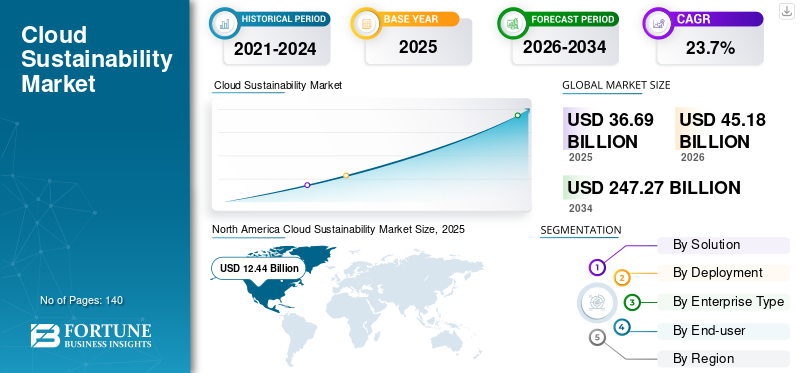
The global cloud sustainability market size was valued at USD 36.69 billion in 2025. The market is projected to grow from USD 45.18 billion in 2026 to USD 247.27 billion by 2034, exhibiting a CAGR of 23.7% during the forecast period. North America dominated the cloud sustainability market with a market share of 33.90% in 2025.
The global cloud sustainability market encompasses solutions and services, including carbon footprint management, sustainable cloud optimization, and green cloud infrastructure, delivered across public, private, and hybrid cloud environments to help enterprises mitigate the environmental impact of their cloud operations. It is used by large enterprises and small & medium enterprises (SMEs) across various sectors, including IT & telecom, BFSI, healthcare, retail, manufacturing, and government, to measure, manage, and minimize cloud-related energy use and emissions.
The market is driven by increasing climate reporting requirements, energy cost pressures, the growing use of AI and ML for environmental operations, and stronger enterprise demand for sustainable cloud infrastructure. Key companies operating in the market include Amazon Web Services, Inc., Microsoft Azure, Google LLC, IBM Corporation, Oracle Corporation, SAP SE, Salesforce, Inc., Dell Technologies Inc., Equinix, Inc., and Nutanix, Inc.
Download Free sample to learn more about this report.
 Market Size & Forecast
 Market Share
 Key Regional Highlights
North America
North America led the market with a value of USD 12.44 billion in 2025, supported by strong cloud adoption, advanced digital infrastructure, and growing net-zero commitments.
Europe
Europe accounted for the second-largest market share, driven by stringent environmental regulations and increasing investments in sustainable cloud operations.
Asia Pacific
Asia Pacific is anticipated to record the highest CAGR during the forecast period due to rapid digital transformation, expanding data center infrastructure, and rising sustainability initiatives.
U.S.
The country remains a major contributor to market growth, supported by hyperscale cloud investments, renewable energy adoption, and increasing focus on ESG compliance.
Japan
Growing cloud migration initiatives, energy-efficiency programs, and corporate sustainability goals are accelerating demand for cloud sustainability solutions across the country.
Read More

Growing Enterprise Focus on Net-Zero and ESG Targets Accelerates Adoption of Cloud Sustainability Practices
The surging enterprise commitment to net-zero and ESG goals is a key factor accelerating the adoption of cloud sustainability solutions. For instance,
Organizations across sectors are increasingly prioritizing carbon neutrality and environmental accountability, prompting greater investments in tools that measure and optimize cloud-related emissions. This shift is further reinforced by internal sustainability mandates and stakeholder expectations, which require companies to demonstrate measurable progress toward climate targets. As a result, enterprises are leveraging cloud sustainability platforms to align their digital operations with long-term ESG strategies and regulatory compliance requirements.
High Implementation Complexity and Limited Standardization Constrain Market Expansion
A key restraint in the cloud sustainability market is the high complexity involved in integrating carbon measurement and optimization tools across diverse cloud environments. Many organizations struggle with inconsistent data sources, fragmented systems, and differing methodologies for calculating cloud-related emissions. This challenge is further amplified by the lack of globally accepted standards for cloud carbon accounting, which creates uncertainty and slows adoption. As a result, enterprises delay or limit investments in cloud sustainability solutions due to perceived technical and operational burdens.
Rising Demand for Sustainability-Focused Cloud Services Among SMEs Creates Market Opportunities
A significant opportunity in the cloud sustainability market lies in expanding tailored solutions for small and medium-sized enterprises (SMEs). While large enterprises have been early adopters of ESG-driven cloud initiatives, many SMEs are only beginning to formalize their sustainability strategies and lack in-house expertise or tools. For instance,
Vendors can capitalize on this gap by offering simplified, cost-effective, and pre-configured cloud sustainability packages that bundle carbon tracking, optimization, and reporting capabilities. This segment represents a sizable untapped customer base, creating scope for scalable, subscription-based offerings that drive both market growth and broader adoption of sustainable cloud practices.
Growing Adoption of Carbon-Aware Cloud Management and Real-Time Emissions Monitoring Fuels New Market Trends
The increasing integration of carbon-aware workload management and real-time emissions monitoring within cloud platforms drives the cloud sustainability market growth. For instance,
Cloud providers and enterprises are embedding dashboards and analytics that quantify energy consumption and associated carbon output at the workload, application, and business-unit level. This capability enables IT teams to shift workloads across regions, time periods, or infrastructure types based on the relative carbon intensity of power sources, rather than solely on cost. As a result, organizations are moving from static sustainability reporting to continuous, data-driven optimization of their cloud environments.
Green Cloud Infrastructure Dominates Owing to Growing Demand for Sustainable Data Centers
Based on the solution, the market is divided into carbon footprint management, sustainable cloud optimization, and green cloud infrastructure.
Green cloud infrastructure holds the largest share, as organizations prioritize green data centers, renewable-powered facilities, and optimized hardware as the foundational step to reducing the environmental impact of cloud operations. Moreover, major cloud providers have already made substantial capital expenditures (capex) investments in green infrastructure, resulting in large, recurring revenue streams from existing enterprise workloads.
Carbon Footprint Management is expected to grow at the maximum CAGR of 25.3% as enterprises increasingly seek granular visibility into Scope 2 and cloud-related Scope 3 emissions to meet regulatory disclosure and ESG reporting requirements. The growing need for automated tracking, benchmarking, and audit-ready sustainability data is driving the accelerated adoption of advanced carbon accounting and analytics platforms.
Public Cloud Dominates the Market Growth Owing to Mature Energy-Efficient Infrastructure
Based on the deployment, the market is separated into public cloud, private cloud, and hybrid cloud.
Public cloud leads the market as hyperscale providers offer mature, globally distributed, and energy-optimized infrastructure that enables rapid, low-cost access to sustainable computing resources. Enterprises also perceive public cloud as an effective way to consolidate workloads from inefficient on-premise environments, thereby improving both cost and carbon performance.
The hybrid cloud is projected to grow at the highest CAGR of 25.2% as organizations adopt mixed environments to balance regulatory, data residency, and latency needs while still leveraging the capabilities of green public clouds. This model allows enterprises to progressively modernize legacy on-premise systems and integrate sustainability controls across both private and public environments, driving faster incremental adoption.
Large Enterprises Dominate the Market Development Owing to Higher IT Spending and ESG Priorities
Based on the enterprise type, the market is divided into large enterprises and small & medium enterprises (SMEs).
Large enterprises hold the maximum share due to their higher IT spending capacity, complex global operations, and stronger pressure from regulators, investors, and customers to demonstrate ESG progress. These organizations are early adopters of sustainability-focused cloud transformation programs and typically engage in long-term, high-value contracts with cloud providers.
SMEs are expected to record the highest CAGR of 25.3% as cloud-native, subscription-based sustainability tools become more affordable and easier to deploy, eliminating the need for extensive in-house expertise. Growing awareness of regulatory expectations and supply-chain sustainability requirements is prompting SMEs to adopt lightweight solutions for emissions tracking and green cloud optimization.
To know how our report can help streamline your business, Speak to Analyst
IT and Telecom Segment Dominates the Market Owing to High Cloud Usage and Early Sustainability Adoption
The end-user market is segmented into IT & telecom, BFSI, healthcare, retail, manufacturing, and other sectors.
IT & Telecom holds the highest share because this sector operates large-scale data centers and network infrastructure, making it both a major consumer of cloud resources and an early adopter of efficiency and decarbonization initiatives. Service providers are increasingly embedding sustainability as a differentiator in their cloud and connectivity offerings, further expanding demand within this segment.
Manufacturing is expected to post the highest CAGR of 27.2% as smart factories, IoT, and digital twin adoption increase reliance on energy-efficient cloud infrastructure. Rising pressure to decarbonize operations and supply chains further accelerates the adoption of sustainable cloud.
By region, the market is categorized into North America, South America, Europe, Middle East & Africa, and Asia Pacific.
North America Cloud Sustainability Market Size, 2025 (USD Billion) To get more information on the regional analysis of this market, Download Free sample
North America dominates the cloud sustainability market owing to its high cloud adoption rate, presence of hyperscale data centers, and strong concentration of leading cloud providers and technology vendors. Enterprises in the region are early adopters of ESG frameworks and net-zero commitments, which drives substantial investment in green cloud infrastructure and carbon management tools. In addition, U.S. supportive regulatory discussions, access to renewable energy sources, and mature digital ecosystems further reinforce North America’s leading position in the market.
Download Free sample to learn more about this report.
Europe holds the second-largest cloud sustainability market share due to its stringent environmental regulations, including EU-wide climate targets and disclosure requirements that compel organizations to decarbonize their IT operations. Enterprises in key markets, including Germany, the U.K., and the Nordics, are proactively implementing sustainable cloud strategies to comply with regulatory, investor, and societal expectations. The region’s strong policy focus on energy efficiency and renewable integration supports steady demand for cloud sustainability solutions.
To know how our report can help streamline your business, Speak to Analyst
The Asia Pacific region is expected to grow at the highest CAGR, driven by rapid cloud adoption, accelerating digital transformation, and large-scale data center expansion across countries such as China, India, Japan, and Southeast Asia. Governments and enterprises are increasingly prioritizing energy efficiency and emissions reduction as power demand from digital infrastructure continues to rise. As organizations in the region transition from traditional IT to cloud-first models, they are adopting sustainability-focused solutions to manage costs and comply with emerging environmental regulations.
Middle East & Africa, and South America are expected to grow at a significant rate as cloud infrastructure investments accelerate and regional data centers increasingly integrate renewable energy and efficiency measures. Governments and large enterprises in these regions are beginning to adopt formal ESG agendas, which include decarbonizing their IT operations and enhancing transparency regarding emissions. Rising digitalization, coupled with greenfield cloud deployments that can be designed with sustainability principles from the outset, creates substantial headroom for future market expansion.
Key Players Launch New Products Using Technological Advancements to Strengthen Market Position
Players launch new products to enhance their market positioning by leveraging technological advancements, addressing diverse consumer needs, and staying ahead of competitors. They prioritize portfolio enhancement and strategic collaborations, as well as acquisitions and partnerships, to strengthen their offerings. Such strategic launches enable the technology companies to maintain and expand their market share in a rapidly evolving landscape.
Request for Customization to gain extensive market insights.
| ATTRIBUTE | DETAILS |
| Study Period | 2021-2034 |
| Base Year | 2025 |
| Estimated Year | 2026 |
| Forecast Period | 2026-2034 |
| Historical Period | 2021-2024 |
| Growth Rate | CAGR of 23.7% from 2026-2034 |
| Unit | Value (USD Billion) |
| Segmentation | By Solution, By Deployment, By Enterprise Type, By End-user, and By Region |
| By Solution |
|
| By Deployment |
|
| By Enterprise Type |
|
| By End-user |
|
| By Region |
|
Fortune Business Insights says that the global market value stood at USD 36.69 billion in 2025 and is projected to reach USD 247.27 billion by 2034.
In 2025, the market value stood at USD 12.44 billion.
The market is expected to exhibit a CAGR of 23.7% during the forecast period of 2026-2034.
The green cloud infrastructure led the market in terms of solution.
The growing enterprise focus on net-zero and ESG targets accelerates the adoption of cloud sustainability solutions.
Amazon Web Services, Inc., Microsoft Corporation, and Google LLC are some of the prominent players in the market.
North America dominated the market in 2025.
Key factors include rising ESG commitments, stricter climate reporting standards, cost pressures from energy consumption, and the growing use of artificial intelligence and machine learning to automate carbon tracking and deliver more environmentally responsible cloud operations.

Get 30-60 hrs Free Customization
Expand Regional and Country Coverage, Segments Analysis, Company Profiles, Competitive Benchmarking, and End-user Insights.




















Related Reports
Get In Touch With Us
US +1 833 909 2966 ( Toll Free )
Receive a tailored pricing based on your needs.
Discuss your questions with our industry experts.
Have questions? Get quick answers before you purchase.

