Cocoa Nibs Market Size, Share & Industry Analysis, By Type (Raw Cocoa Nibs, Roasted Cocoa Nibs, and Flavored Cocoa Nibs), By Variety (Forastero Nibs, Criollo Nibs, Trinitario Nibs, and Others), By Distribution Channel (Chocolate & Confectionery Manufacturing, Bakery & Pastry, Beverages, Breakfast Cereals & Snacks, Dietary Supplements & Functional Foods, Cosmetics & Personal Care, and Others), By Distribution Channel (Online and Offline), and Regional Forecast, 2026-2034
 Download Free Sample
(Offer valid till 15th Oct 2026)

KEY MARKET INSIGHTS
 Listen to Audio Version
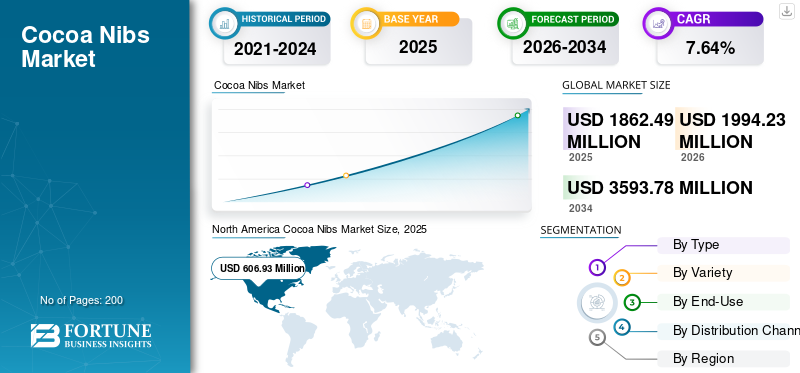
The global cocoa nibs market size was valued at USD 1,862.49 million in 2025. The market is projected to grow from USD 1,994.23 million in 2026 to USD 3,593.78 million by 2034, exhibiting a CAGR of 7.64% during the forecast period. North America dominated the global cocoa nibs market with a market share of 32.59% in 2025.
Cocoa nibs are small, crushed pieces of fermented and dried cocoa beans from the Theobroma cacao tree. They serve as the purest form of chocolate products before further processing into cocoa liquor, butter, or powder. The global cocoa nibs industry is expanding rapidly, driven by surging demand for cocoa nibs such as clean‑label, functional foods, premium chocolate, plant-based snacks, and superfood ingredients. Cocoa nibs have become a preferred ingredient across the food, nutraceutical, cosmetic, and beverage industry due to their high polyphenol content, antioxidants fiber, and essential minerals, low sugar profile, and alignment with wellness-centered consumer trends.
The global market is dominated by leading companies, including Barry Callebaut AG, Cargill Incorporated, Olam Food Ingredients (OFI), Navitas Organics, and Sunfood Superfoods.
Download Free sample to learn more about this report.
Cocoa Nibs Market Key Takeaways
 Global Market Size & Forecast
- 2025 Market Size: USD 1,862.49 million
- 2026 Market Size: USD 1,994.23 million
- 2034 Forecast Market Size: USD 3,593.78 million
- CAGR: 7.64% (2026–2034)
 Market Share
- North America dominated the market with a 32.59% share in 2025.
- The roasted cocoa nibs segment held the largest market share, valued at USD 925.73 million in 2025.
- The Forastero nibs segment dominated the market, reaching USD 1,318.19 million in 2025.
 Key Regional Highlights
Asia Pacific
Asia Pacific generated USD 464.97 million in 2025 and is expected to register the fastest growth during the forecast period.
North America
North America generated USD 606.93 million in 2025, maintaining its leading market position.
Europe
Europe accounted for USD 532.61 million in 2025, holding the second-largest regional market.
U.S.
U.S. market is projected to witness steady growth during the forecast period.
Japan
Japan is likely to witness sustained growth during the forecast period.
Read More

MARKET DYNAMICS
Market Drivers
Expanding Premium Chocolate & Specialty Cocoa Applications to Drive Market Growth
Specialty chocolate makers and artisanal brands are increasingly incorporating single-origin cocoa nibs, roasted nibs, and flavored nibs to create high-value products. Specialty cocoa applications extend to cosmetics, pharmaceuticals, and beverages, diversifying confectionery use. Fine-flavor beans enable single-origin premium chocolates, with high-end makers prioritizing scarce varieties for complex profiles. Major brands are also foraying into the chocolate business, further fueling global cocoa nibs market demand.
- For instance, in June 2025, Manam Chocolate, an Indian craft chocolate brand from Hyderabad, opened its first Delhi flagship store at Eldeco Center in Saket, featuring a live chocolateries, bakery, patisserie, and beverage bar for immersive experiences with Indian-origin cacao. The 3,200 sq ft space includes themed retail sections such as Snacking (barks, nibs, clusters, trail mixes), Indulgence (bonbons, truffles), and Tablets (over 40 flavors such as 67% West Godavari dark, Mango-Ginger, Pedda Rasalu Mango).
Market Restraints
High Capital Investment and Operational Costs to Impede Market Growth
Higher costs for specialty and organic cocoa nibs significantly narrow the addressable consumer base and compress margins for manufacturers, thereby constraining overall cocoa nib market growth. This cost gap stems from higher organic cocoa bean prices, premiums for specialty/fine-flavor origins, and added certification and segregation costs along the supply chain.
- According to Fairtrade pricing structures for cocoa, the organic differential applied to cocoa beans is approximately USD 300 per metric ton above the base minimum price, on top of a Fairtrade premium of about USD 240 per metric ton. This additional cost is passed downstream into organic cocoa nibs and other organic cocoa derivatives.
Market Opportunities
Strong Growth of Functional & Nutraceutical Applications to Unlock New Opportunities
Cocoa nibs are increasingly used in dietary supplements, reflecting deeper integration of cocoa polyphenols into wellness formulations and clean-label nutraceuticals. Cocoa nibs are rich in polyphenols, a class of bioactive compounds that includes flavanols and procyanidins, which have been scientifically linked to multiple health benefits. Such benefits include antioxidant activity, cardiovascular support, anti‑inflammatory effects, and metabolic regulation, further driving cocoa nibs market growth.
- Multiple studies and market reports highlight consumer awareness of the health benefits associated with cocoa polyphenols, encouraging manufacturers to market flavanol‑rich cocoa ingredients in supplements and functional products. There is a clear trend toward using cocoa polyphenols in products aimed at promoting cardiovascular health, cognitive support, and metabolic wellness.
Cocoa Nibs Market Trends
Growing Consumer Preferences For Transparency & Ethical Cocoa Sourcing to Shape Industry
Traceability, fair-trade certification, and carbon-neutral cocoa initiatives are becoming major differentiators for global suppliers. Heightened awareness of cocoa farming challenges, including exploitation and deforestation, fuels preference for transparent and ethically sourced products.
- Moreover, certifications such as Fairtrade and Rainforest Alliance ensure minimum prices, premiums for community projects, and labor rights, with Fairtrade producing over 618,633 MT in 2023. Production grew 11% annually from 2019-2022, though challenges such as cost crises reduced some sales.
Download Free sample to learn more about this report.
SEGMENTATION ANALYSIS
By Type
Superior Flavor Profile And Broad Industrial Compatibility to Lead Roasted Cocoa Nibs Segment’s High Market Proportion
The global cocoa nibs market segmentation is divided into raw cocoa nibs, roasted cocoa nibs, and flavored cocoa nibs.
Roasted cocoa nibs form the largest type segment at approximately USD 925.73 million in 2025, supported by their superior flavor profile and broad industrial compatibility, chocolate, confectionery, bakery, cereal, and dessert manufacturers prefer roasted nibs because roasting enhances aroma, reduces acidity, and delivers more consistent flavor, enabling them to position products as both indulgent and premium while keeping processability high.
The flavored cocoa nibs segment in the global market is expected to grow significantly in the forecast period, with a CAGR of 8.72% in 2026.
To know how our report can help streamline your business, Speak to Analyst
By Variety
Low-Cost and Robust Agronomic Characteristics to Lead Forastero Nibs Segment Growth
On the basis of variety, the market is segmented into forastero, criollo, trinitario, and others.
Forastero nibs dominate with an estimated market value of USD 1,318.19 million in 2025, supported by their high availability, robust agronomic characteristics, and lower cost compared with fine-flavor varieties. These nibs are the backbone of large-scale industrial chocolate and cocoa ingredient production, where secure supply, consistent quality, and cost efficiency are critical, especially for mainstream confectionery, bakery, and beverage applications.
The criollo nibs segment is expected to grow significantly at a CAGR of 8.57% during the forecast period.
By End-Use
Premiumization and Authentic Cocoa Positioning to Fuel Chocolate and Confectionery Segment Market Leadership
Based on end-use, the market is segmented into chocolate and confectionery, bakery and pastry, beverages, breakfast cereals and snacks, dietary supplements, cosmetics and personal care, and others.
Chocolate and confectionery remain the largest demand center, with cocoa nib usage valued at around USD 687.53 million in 2025, driven by the premiumization of chocolate, growth in dark and high-cocoa-content products, and the increasing tendency to use nibs as visible inclusions or toppings that communicate “real cocoa” and authenticity on-pack.
The dietary supplements & functional foods segment is anticipated to grow at a CAGR of 9.00% during the global cocoa nibs market forecast period.
By Distribution Channel
Shelf Visibility and Established Procurement Networks Fuel Offline Segment Market Leadership
On the basis of size, the market is segmented into offline and online.
The offline segment holds a dominant share of 69.60% in 2025 in the global cocoa nibs market share. Offline distribution, which includes supermarkets, hypermarkets, specialty health and organic stores, bulk ingredient retailers, and B2B channels, accounts for approximately USD 1,296.25 million in 2025. This channel is driven by the continued importance of physical retail for mainstream consumers, the desire to see and compare premium ingredients on-shelf, and the reliance of large food and beverages manufacturers, bakeries, and chocolatiers on established wholesale and distributor relationships for volume procurement. Shelf presence in major grocery chains and specialty natural-food outlets remains a critical factor in building brand recognition and driving trials for both conventional and organic products.
The online segment is anticipated to grow at a CAGR of 8.18% during the forecast period.
Cocoa Nibs Market Regional Outlook
Regionally, the report covers the global market analysis across North America, Europe, Asia Pacific, South America, and the Middle East & Africa.
North America
North America Cocoa Nibs Market Size, 2025 (USD Million) To get more information on the regional analysis of this market, Download Free sample
North America is the largest regional market, with a value of about USD 606.93 million in 2025. It is driven by a well-established functional food and snack ecosystem, strong adoption of plant-based diets, high consumer awareness of superfoods and antioxidants, and deep penetration of cocoa nibs through both brick-and-mortar and e-commerce channels. The region’s robust premium chocolate sector and the popularity of protein bars, granola, and health snacks underpin steady B2B and retail demand.
Europe
Europe, with an estimated market of USD 532.61 million in 2025, is characterized by a sophisticated chocolate and bakery culture and a strong regulatory and consumer focus on sustainability, traceable supply chains, and ethical sourcing. This has amplified demand for organic, fair-trade, and single-origin nibs, especially in Western European markets where consumers are willing to pay more for certified and story-rich ingredients.
Asia Pacific
Asia Pacific, valued at around USD 464.97 million, is the fastest-growing region, supported by rising disposable incomes, rapid urbanization, and an expanding middle class that is consuming more premium chocolates, snacks, and Western-style bakery products. The growth of modern retail and e-commerce in China, India, Southeast Asia, Japan, and South Korea is making cocoa nibs more accessible, while local manufacturers are increasingly incorporating nibs into snack bars, cereals, and beverages to tap into health and indulgence simultaneously.
South America
South America, with a 2025 market size of roughly USD 154.83 million, benefits from its proximity to cocoa production, emerging bean-to-bar movements, and increasing domestic consumption of higher-quality chocolate and bakery products, while also serving as a processing and export base for various cocoa derivatives.
Middle East & Africa
The Middle East & Africa region, estimated at USD 103.14 million in 2025, remains smaller but is expanding, driven by high-income consumer segments, luxury hospitality, and tourism that support demand for premium desserts and wellness offerings, and growing awareness of cocoa nibs in specialty retail and online channels. Here, nibs often occupy a premium niche within broader chocolate and health-food categories.
COMPETITIVE LANDSCAPE
Key Industry Players
Focus on Sustainability and Supply Chain Efficiency to Support Global Market Growth
The competitive landscape of the global market is shaped by a mix of large integrated cocoa processors, specialized superfood brands, ingredient suppliers, and artisanal or origin-focused companies that compete on quality, sustainability, flavor differentiation, and supply chain efficiency. Large multinational companies dominate the upstream portion of the value chain due to their vertically integrated structures, extensive sourcing networks in West Africa and Latin America, and long-term relationships with farmers and cooperatives; these firms leverage scale advantages to stabilize supply, manage volatility, and invest in sustainability programs that strengthen their brand reputation and secure long-term access to high-quality cocoa beans.
Key Players in the Cocoa Nibs Market
|
Rank |
Company Name |
|
1 |
Barry Callebaut AG |
|
2 |
Cargill Incorporated |
|
3 |
Olam Food Ingredients (OFI) |
|
4 |
Navitas Organics |
|
5 |
Sunfood Superfoods |
List of Key Cocoa Nibs Companies Profiled
- Barry Callebaut AG (Switzerland)
- Cargill Incorporated (U.S.)
- Olam Food Ingredients (OFI) (U.K.)
- Navitas Organics (U.S.)
- Sunfood Superfoods (U.S.)
- The Raw Chocolate Company (U.K.)
- CocoaSupply (U.S.)
- United Cocoa Processor (U.S.)
- Urban Platter (India)
- Blommer Chocolate Company (U.S.)
KEY INDUSTRY DEVELOPMENTS
- July 2024: Lindt & Sprüngli completed a USD 105.2 million expansion of its Cocoa Center in Olten, Switzerland. The project doubled production capacity since 2017 and supports cocoa mass supply to multiple European sites. Cocoa nibs play a key role in the process, roasted via proprietary methods before milling into mass.
- January 2024: PRONATEC AG, a Swiss processor of organic cocoa products, announced the acquisition of a second ball mill for cocoa mass production and the addition of roasted, cleaned cocoa nibs to its range.
- June 2022: Switzerland’s first fully organic cocoa-processing plant, PRONATEC Swiss Cocoa Production, which produces organic cocoa mass, cocoa butter, and cocoa powder, completed its test phase and would produce organic and fair-trade certified semi-finished cocoa products. The facility is positioned as the world’s first exclusively organic cocoa-processing plant for semi-finished cocoa products.
- December 2021: Montano’s Chocolate Co Ltd (MCCL), a family-owned Trinidad and Tobago company, launched its Chocolate Factory in Arouca to enhance production of the Machel Montano 60% dark chocolate bar, cocoa powder, cocoa butter, and cocoa nibs.
- February 2020: Cadbury launched two new products in its Darkmilk chocolate range in early 2020: Darkmilk with Crunchy Cocoa Pieces (also called cocoa nibs) and Darkmilk Giant Buttons. Darkmilk with Crunchy Cocoa Pieces features rich, creamy 40% cocoa Darkmilk chocolate combined with crunchy cocoa nibs for added texture and intense cocoa flavor, available in an 85g tablet format.
REPORT COVERAGE
The global cocoa nibs industry report analyzes the market in depth and highlights crucial aspects such as global market trends, market dynamics, prominent companies, investment in research and development, and end-use. Besides this, the report also provides insights into the global cocoa nibs market analysis and highlights significant industry developments.
Request for Customization to gain extensive market insights.
Report Scope & Segmentation
|
ATTRIBUTE |
DETAILS |
|
Study Period |
2021-2034 |
|
Base Year |
2025 |
|
Estimated Year |
2026 |
|
Forecast Period |
2026-2034 |
|
Historical Period |
2021-2024 |
|
Growth Rate |
CAGR of 7.64% from 2026 to 2034 |
|
Unit |
Value (USD Million) |
|
Segmentation |
By Type
|
|
By Variety · Forastero Nibs · Criollo Nibs · Trinitario Nibs · Others |
|
|
By End-Use
|
|
|
By Distribution Channel · Online · Offline |
|
|
By Region · North America (By Type, Variety, End-Use, Distribution Channel, and Country) • U.S. (By Distribution Channel) • Canada (By Distribution Channel) • Mexico (By Distribution Channel) · Europe (By Type, Variety, End-Use, Distribution Channel, and Country) • Germany (By Distribution Channel) • Spain (By Distribution Channel) • Italy (By Distribution Channel) • France (By Distribution Channel) • U.K. (By Distribution Channel) • Rest of Europe (By Distribution Channel) · Asia Pacific (By Type, Variety, End-Use, Distribution Channel, and Country) • China (By Distribution Channel) • Japan (By Distribution Channel) • India (By Distribution Channel) • Australia (By Distribution Channel) • Rest of Asia Pacific (By Distribution Channel) · South America (By Type, Variety, End-Use, Distribution Channel, and Country) • Brazil (By Distribution Channel) • Argentina (By Distribution Channel) • Rest of South America (By Distribution Channel) · Middle East & Africa (By Type, Variety, End-Use, Distribution Channel, and Country) • South Africa (By Distribution Channel) • Saudi Arabia (By Distribution Channel) • Rest of the Middle East & Africa (By Distribution Channel) |
Frequently Asked Questions
Fortune Business Insights says that the global market was USD 1,862.49 million in 2025 and is anticipated to reach USD 3,593.78 million by 2034.
At a CAGR of 7.64%, the global market will exhibit steady growth over the forecast period.
By distribution channel, the offline segment leads the market.
North America held the largest market share in 2025.
The expanding premium chocolate & specialty cocoa applications drive the global market growth.
Barry Callebaut AG, Cargill Incorporated, Olam Food Ingredients (OFI), Navitas Organics, and Sunfood Superfoods are the leading companies in the market.
The growing consumer shift toward transparency & ethical cocoa sourcing is shaping the industry.



- 2021-2034
- 2025
- 2021-2024
- 200
-
(Offer valid till 15th Oct 2026)
Get 30-60 hrs Free Customization
Expand Regional and Country Coverage, Segments Analysis, Company Profiles, Competitive Benchmarking, and End-user Insights.




















-
US +1 833 909 2966 ( Toll Free )
-
Get In Touch With Us