Commercial Aircraft Avionics Systems Market Size, Share & Industry Analysis, By Component (Embedded Software and Avionic Hardware), By System Type (Communication & Data Link Systems, Aircraft Data Management, and Others), By Aircraft Type, By Installation Type, By Technology, By Application (Aircraft Connectivity, Flight Management & Route Optimization, Air Traffic Communication & Surveillance Compliance, and Others), By Customer Type (Aircraft OEMs, Commercial Airlines, Cargo & Express Operators, Aircraft Lessors, and Avionics Retrofit Integrators), and Regional Forecast, 2026-2034
 Download Free Sample
Commercial Aircraft Avionics Systems Market Size and Future Outlook
 Listen to Audio Version
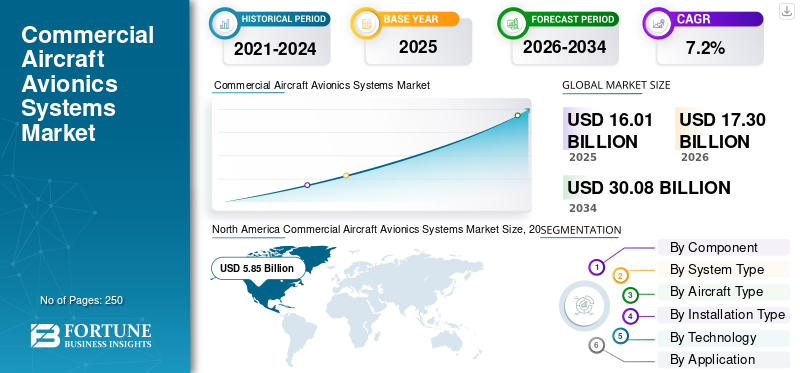
The global commercial aircraft avionics systems market size was valued at USD 16.01 billion in 2025. The market is projected to grow from USD 17.30 billion in 2026 to USD 30.08 billion by 2034, exhibiting a CAGR of 7.2% during the forecast period. North America dominated the commercial aircraft avionics systems market with a market share of 36.54% in 2025.
Commercial aircraft avionics represents a critical layer in modern aviation, enabling integrated, highly reliable, and safety‑certified connectivity between flight critical systems, cockpit displays, navigation, communication, and air‑traffic management. The global push for advanced avionics is accelerating, driven by the need for enhanced flight safety, fuel efficient operations, airspace modernization (e.g., NextGen and SESAR), and seamless integration with digital‑tower and satellite‑based navigation services across complex and congested air corridors.
Leading aerospace and electronics firms such as Collins Aerospace, Honeywell Aerospace, Thales Avionics, Safran, GE Aviation, and Rockwell Collins are advancing integrated avionics suites that support multi‑sensor navigation, digital cockpit ecosystems, and connected aircraft platforms. Key technical advances include open‑architecture and modular avionics software‑defined radios and satcom for in‑air connectivity, multi‑constellation GPS-based navigation solutions, and high‑bandwidth data buses enabling real‑time exchange of flight‑deck, maintenance, and operational data between aircraft and ground operations centers
Download Free sample to learn more about this report.
Commercial Aircraft Avionics Systems Market Key Takeaways
 Global Market Size & Forecast
- 2025 Market Size: USD 16.01 billion
- 2026 Market Size: USD 17.30 billion
- 2034 Forecast Market Size: USD 30.08 billion
- CAGR: 7.2% from 2026–2034
 Market Share
- North America dominated the commercial aircraft avionics systems market with a 36.54% share in 2025.
- The embedded software segment is projected to grow at the fastest CAGR of 7.9% during the forecast period.
- The aircraft data management, recording & health monitoring systems segment is expected to register the fastest CAGR of 8.3% during the forecast period.
 Key Regional Highlights
North America
North America was valued at USD 5.85 billion in 2025 and is projected to reach USD 6.25 billion in 2026.
Asia Pacific
Asia Pacific is projected to witness the fastest growth during the forecast period.
Europe
Europe is projected to record a CAGR of 7.9% during 2026–2034.
U.S.
The U.S. market was valued at approximately USD 5.27 billion in 2025.
Japan
The Japan market was valued at approximately USD 0.38 billion in 2025.
Read More

COMMERCIAL AIRCRAFT AVIONICS SYSTEMS MARKET TRENDS
Shift Toward Connected, Software-Defined, and Open-Architecture Avionics is Emerging as a Defining Market Trend
The industry is increasingly being shaped by the shift from hardware-heavy cockpit electronics toward connected, software-defined, and open-architecture avionics. Airlines and aircraft OEMs are prioritizing flight decks that can support faster software upgrades, secure data exchange, modular flight-management functions, advanced displays, aircraft-to-ground connectivity, and integration with electronic flight bags and airline operations systems. This is changing avionics from a static onboard equipment package into a digital aircraft operating layer.
- In April 2025, the FACE Consortium certified Thales’ FMS200 Flight Management System as conformant to the FACE 3.1 standard for portable components. Thales stated that the certification supports faster software evolution, easier integration, open standards compatibility, and modular avionics architecture.
This trend is expected to increase demand for next-generation FMS, electronic cockpit controls, avionics computing platforms, aircraft data networks, cyber-secure gateways, communication management units, and software-upgradable flight deck systems. As airlines move toward connected aircraft operations, demand is shifting from standalone avionics boxes toward integrated systems that support route optimization, real time data transfer, predictive maintenance, cockpit connectivity, and safer pilot decision-making.
MARKET DYNAMICS
MARKET DRIVERS
Download Free sample to learn more about this report.
Aircraft Production Recovery, Fleet Expansion, and Modernization of In-Service Fleets is Propelling Market Growth
The commercial aircraft avionics systems market growth is being driven by the recovery in aircraft deliveries, rising passenger traffic, and the large installed fleet requiring recurring avionics replacement and modernization. Avionics demand is not limited to new aircraft production; it is also supported by replacement of flight management systems, cockpit displays, communication units, surveillance systems, data loaders, recorders, sensors, and flight-control electronics across active fleets. As aircraft utilization rises, airlines have a stronger need to keep cockpit electronics, data-link systems, navigation equipment, and aircraft health-monitoring systems current.
- For instance, Airbus delivered 793 commercial aircraft in 2025 and ended the year with a record backlog of 8,754 aircraft, while Boeing delivered 600 commercial aircraft in 2025, including 447 737s and 88 787s.
The demand base is further strengthened by the global commercial fleet. IATA reported that the global commercial fleet comprised 35,550 aircraft, including 30,300 active aircraft, as of June 2025. Passenger demand also remained strong, with IATA reporting that full-year 2025 RPK demand increased by 5.3% compared with 2024. Therefore, growth in the market is expected to remain supported by linefit avionics for new aircraft, retrofit avionics for older aircraft, and replacement demand from high-utilization airline fleets. In addition, the market is driven by increasing adoption of Performance-Based Navigation (PBN) to enable more efficient flight paths, reduce fuel consumption. Modern commercial aircraft are equipped with multiple VHF communication systems to ensure reliable air-to-ground voice and data link connectivity with air traffic control centers.
MARKET RESTRAINTS
Certification Burden, Cybersecurity Compliance, and Supply Chain Pressure to Limit Market Expansion
A key restraint for the market is the high certification, cybersecurity, and validation burden associated with safety-critical cockpit systems. Avionics systems must operate reliably across thousands of flight cycles, multiple aircraft types, different regulatory environments, airline operating models, and mixed cockpit architectures. This creates long development timelines for flight management systems, data-link systems, surveillance electronics, flight-control computers, cockpit displays, and aircraft data systems. Any software or hardware change may require extensive testing, regulatory approval, airline integration, and fleet-level implementation planning.
For instance, EASA Part-IS requirements are increasing the cybersecurity compliance burden for aviation operators and aviation organizations. As a result, adoption may be slowed by certification cycles, cybersecurity audits, system-hardening requirements, software validation, supplier qualification, and the need to prove safe integration across both new-generation and legacy aircraft.
MARKET OPPORTUNITIES
Expansion of Aircraft Data Management, Health Monitoring, and Recorder Upgrades Presents Growth Opportunities for the Market
The market is expected to gain strong opportunities from aircraft data management, secure data loading, health monitoring, flight data analysis, and recorder modernization. Airlines are increasingly seeking systems that can capture, protect, transmit, and analyze aircraft operational data more efficiently. This creates opportunities for avionics suppliers providing flight data recorders, cockpit voice recorders, quick access recorders, secure data loaders, aircraft condition monitoring systems, onboard servers, wireless data-transfer systems, and predictive maintenance interfaces.
- In September 2025, Teledyne Controls received FAA Supplemental Type Certificate approval for installation of its eADL XS enhanced Airborne Data Loader on the Airbus A320 family, including A318, A319, A320, and A321 aircraft. Teledyne positioned the system as a secure, scalable data-loading solution for modern aviation operations.
These developments support demand for aircraft data systems, secure avionics storage, cockpit recording equipment, and operational data platforms across both linefit and retrofit channels.
MARKET CHALLENGES
Legacy Fleet Integration, Software Validation, and Fleet-Wide Update Complexity to Challenge Market
A major market challenge is integrating advanced avionics into large, mixed-age commercial fleets. Airlines often operate aircraft with different cockpit generations, software baselines, communication standards, data-loading processes, recorder configurations, FMS versions, and maintenance workflows. This makes fleet-wide avionics modernization difficult, especially when updates involve safety-critical functions such as flight controls, navigation, communication management, or aircraft data integrity.
- In November 2025, EASA issued an Emergency Airworthiness Directive for the Airbus A320 family after an issue was identified in one onboard computer following a software update.
As aircraft become more connected and digitally dependent, avionics suppliers and airlines must manage upgrade timing, regulatory approval, hardware compatibility, pilot training, cybersecurity assurance, and operational continuity at the same time.
Segmentation Analysis
By Component
Certified Cockpit Electronics and Line-Replaceable System Demand to Support Avionic Hardware Segment Dominance
Based on component, the market is divided into embedded software and avionic hardware.
The avionic hardware segment held a leading share in the market in 2025 as aircraft still require a sizable certified physical equipment layer. Further, including cockpit displays, flight control computers, communication radios, transponders, sensors, data loaders, recorders, navigation units, and avionics processing modules. Demand is strongly supported by the recovery in commercial aircraft deliveries and the continued expansion of airline fleets.
- For instance, in 2025, Airbus delivered 793 commercial aircraft, while Boeing delivered 600 commercial aircraft, directly supporting demand for linefit cockpit electronics, navigation systems, communication hardware, surveillance systems, and onboard avionics computers.
The embedded software segment is anticipated to rise with the fastest CAGR of 7.9% over the forecast period.
By System Type
Core Flight Planning, Navigation Accuracy, and Trajectory Management to Drive Flight Management, Navigation & Guidance Systems Segment Growth
By system type, the market is segmented into communication & data link systems, aircraft data management, recording & health monitoring systems, integrated modular avionics & core processing systems, surveillance, weather & safety systems, flight management, navigation & guidance systems, cockpit display & crew interface systems, flight control & autopilot electronics, and engine & aircraft system control electronics.
The flight management, navigation & guidance systems segment dominated the market in 2025 as these systems form the core operational layer of commercial aircraft avionics. FMS, GNSS/GPS, inertial navigation, air data systems, radio navigation, and landing guidance systems are essential for flight planning, route control, trajectory management, fuel efficiency, and safe aircraft operation. The segment also benefits from airline demand for more connected, interoperable, and advanced flight management systems.
- In 2026, Cathay Group selected Thales avionics solutions for its new Airbus A330neo, A321neo, and A320neo fleets, including Airbus’ new-generation Flight Management System based on Thales’ PureFlyt FMS, along with radio altimeter, HUD, and TCAS solutions.
The aircraft data management, recording & health monitoring systems segment is designed to register the fastest CAGR of 8.3% over the forecast period.
By Aircraft Type
Single-Aisle Fleet Expansion and High Delivery Volumes to Support Narrow-body Aircraft Segment Dominance
On the basis of aircraft type, the market is segmented into narrow-body aircraft, regional jets, wide-body aircraft, commercial turboprop aircraft, and freighter aircraft.
The narrow-body aircraft segment held the largest commercial aircraft avionics systems market share in 2025 as single-aisle aircraft account for the highest volume of commercial aircraft deliveries and fleet expansion. Airlines continue to prioritize narrow-body aircraft for domestic, regional, and short-to-medium-haul international routes, which makes this aircraft class the largest demand base for linefit avionics, replacement systems, cockpit upgrades, communication systems, and flight management technologies. The growth is further supported by low-cost carrier expansion and fleet renewal programs.
- For instance, Airbus delivered 607 A320 Family aircraft in 2025, while Boeing delivered 447 737 aircraft during the same year, confirming that narrow-body platforms remain the main production and delivery base for commercial avionics demand.
The freighter aircraft segment is projected to grow steadily with a CAGR of 6.4% over the forecast period.
To know how our report can help streamline your business, Speak to Analyst
By Installation Type
New Aircraft Production Backlogs and Certified Factory-Fit Avionics Integration to Strengthen Linefit/OEM Segment Growth
By installation type, the market is segmented into linefit / OEM installation, retrofit / modernization installation, and replacement / spares installation
The linefit / OEM installation segment dominated the market in 2025 as commercial avionics systems are usually selected, certified, and installed during aircraft production. Aircraft OEMs integrate cockpit displays, FMS, communication systems, flight control electronics, surveillance systems, and avionics computers as part of the certified aircraft configuration before delivery to airlines. The segment is supported by large OEM backlogs and the steady conversion of aircraft orders into deliveries.
The linefit / OEM installation segment is projected to grow with the fastest-growth rate of 8.2% over the forecast period.
By Technology
Shared Computing Architecture and Software-Defined Aircraft Systems to Support Integrated Modular Avionics Segment Dominance
By technology, the market is segmented into connected / software-defined avionics, integrated modular avionics, and federated avionics architecture.
The integrated modular avionics segment held a leading share in 2025 as commercial aircraft increasingly rely on shared computing architectures, modular processing, digital avionics networks, and common software-hosting platforms instead of isolated standalone avionics boxes. IMA helps reduce system duplication, improves data exchange between cockpit functions, and supports more scalable aircraft electronics architecture. The segment is also supported by the industry’s move toward open standards, portability, and easier software evolution.
- In April 2025, Thales’ FMS200 Flight Management System achieved FACE 3.1 conformance certification, supporting open architecture, faster software evolution, easier integration, and modular avionics compatibility.
The connected / software-defined avionics segment is witnessed to register the fastest CAGR of 8.2% over the forecast period.
By Application
Fuel Efficiency, Route Precision, and Operational Cost Reduction to Sustain Flight Management & Route Optimization Segment Leadership
On the basis of application, the market is divided into aircraft connectivity & operational data exchange, flight management & route optimization, aircraft health monitoring & predictive maintenance, air traffic communication & surveillance compliance, pilot situational awareness & safety warning, and flight control & aircraft stability management.
The flight management & route optimization segment dominated the application landscape in 2025 as airlines focus on fuel efficiency, optimized trajectories, lower pilot workload, and improved flight planning. FMS-based route optimization is central to reducing operational cost as it supports aircraft guidance, lateral and vertical trajectory calculation, flight performance management, and route efficiency. As airlines face higher fuel emissions and operational-efficiency pressure, demand for advanced FMS and route-optimization avionics is expected to remain strong.
- In June 2023, Amelia selected Universal Avionics to upgrade FMS avionics across 13 Embraer ERJ 135/145 jets, replacing UNS-1K units with dual SBAS-capable UNS-1Lw systems to meet NextGen airspace requirements. The STC from EASA enables precision navigation and, with an added LPV monitor, will allow LPV approaches down to roughly 200–250 ft, improving access to smaller airports and low-visibility safety.
The aircraft connectivity & operational data exchange segment is set to register the fastest CAGR of 9.7% over the forecast period.
By Customer Type
Factory-Level Avionics Selection and Large Commercial Aircraft Backlogs to Propel Aircraft OEMs Segment Growth
By customer type, the market is divided into aircraft OEMs, commercial airlines, cargo & express operators, aircraft lessors / fleet owners, and avionics retrofit integrators.
The aircraft OEMs segment held a leading share in the market in 2025 as OEMs control the largest linefit avionics procurement channel for new commercial aircraft. Airbus, Boeing, Embraer, ATR, and other aircraft manufacturers work with avionics suppliers to certify and install flight decks, navigation systems, communication systems, flight-control electronics, surveillance systems, and onboard computers before aircraft delivery.
- In May 2022, Airbus selected Thales’ PureFlyt-based Flight Management System to equip Airbus commercial airliners, particularly the A320, A330, and A350 families, with service entry planned for the end of 2026.
The commercial airlines segment is designed to register a steady CAGR of 7.3% over the forecast period.
Commercial Aircraft Avionics Systems Market Regional Outlook
By region, the market is segmented into North America, Europe, Asia Pacific, Latin America, and the Middle East & Africa.
North America
North America Commercial Aircraft Avionics Systems Market Size, 2025 (USD Billion)
To get more information on the regional analysis of this market, Download Free sample
North America dominated the market in 2025 with a valuation of USD 5.85 billion, growing to USD 6.25 billion in 2026. North America is expected to remain the largest regional market for commercial aircraft avionics systems. This leadership is primarily driven by the strong U.S. commercial aviation ecosystem and a large active airline fleet. The region also benefits from Boeing’s production base, strong avionics suppliers presence, and mature cargo operations. In addition, the region has a high replacement demand for cockpit electronics, flight management systems, communication systems, surveillance systems, data recorders, and aircraft data-management equipment. Market growth is supported by high aircraft utilization, fleet modernization, connected aircraft adoption, FAA safety requirements, and airline investment in more reliable flight deck, communication, and operational data systems.
- In July 2024, Honeywell was selected by United Airlines to provide a wide range of cockpit technologies for the airline’s new Boeing 737 MAX aircraft, including 3D weather radar, 25-hour flight data recorders, and advanced traffic avoidance systems. Further, supporting North American demand for modern commercial aircraft avionics.
U.S. Commercial Aircraft Avionics Systems Market
Based on North America’s strong contribution and the U.S. dominance within the region, the U.S. market was approximated at around USD 5.27 billion in 2025. The U.S. is expected to remain the largest country-level market. This position is supported by its large airline and cargo fleet, Boeing’s production ecosystem, major avionics suppliers, and the FAA-driven safety compliance requirements. The market continues to benefit from strong recurring demand for avionics replacement, cockpit modernization, data-recording systems, communication systems, and aircraft health-monitoring equipment. Growth is supported by the need to modernize both new and in-service aircraft with advanced flight deck systems, runway-safety software, secure data systems, connected cockpit functions, and certified onboard electronics.
- In June 2025, Honeywell announced that Southwest Airlines was activating its entire Boeing 737 fleet with SmartRunway and SmartLanding software through Honeywell’s existing EGPWS, with more than 700 aircraft activated. It further helps to improve pilot situational awareness during taxi, takeoff, and landing.
Europe
Europe is projected to record a moderate growth rate of 7.9% during 2026 to 2034. The region is expected to hold a strong share in the market. It is supported by Airbus production, the presence of leading avionics suppliers such as Thales and Safran, large airline groups, strong safety regulation, and sustained retrofit demand across mature commercial fleets. The region is moving toward more software-defined, cyber-secure, and integrated avionics architectures, particularly in flight management, cockpit display, aircraft data exchange, and operational efficiency systems. The growth is also supported by European airline investment in advanced navigation, communication, flight-optimization, and cockpit situational-awareness solutions.
- In August 2025, Honeywell was selected by LOT Polish Airlines to supply advanced navigation and communication avionics systems for the airline’s new Boeing 737 MAX aircraft, with deliveries beginning in 2026 for European and transcontinental routes.
U.K. Commercial Aircraft Avionics Systems Market
The U.K. market in 2025 was estimated at around USD 0.79 billion, representing roughly 4.9% of global revenues.
Germany Commercial Aircraft Avionics Systems Market
Germany market value reached approximately USD 0.88 billion in 2025, equivalent to around 5.5% of global sales.
Asia Pacific
Asia Pacific is projected to witness the fastest growth in the market. It is driven by rapid fleet expansion, rising passenger traffic, large narrow-body orders, airline modernization, and growing adoption of connected cockpit, FMS, communication, navigation, surveillance, and aircraft data systems. China, India, Japan, South Korea, Australia, and Southeast Asia are expected to generate strong demand as airlines expand domestic and regional networks while modernizing cockpit and operational systems.
- In February 2024, Collins Aerospace was selected by Air India to provide a full suite of avionics hardware for the airline’s expanding Boeing 737 MAX fleet, including communication, navigation, surveillance equipment, and air data sensors.
Japan Commercial Aircraft Avionics Systems Market
The Japan market in 2025 was estimated at around USD 0.38 billion, accounting for roughly 2.3% of global revenues.
China Commercial Aircraft Avionics Systems Market
China’s market is projected to be one of the largest worldwide, with 2025 revenues estimated at around USD 1.09 billion, representing roughly 6.8% of global sales.
India Commercial Aircraft Avionics Systems Market
The Indian market size in 2025 was estimated at around USD 0.63 billion, accounting for roughly 3.9% of global revenues.
Latin America and Middle East & Africa
Latin America represents a smaller but steadily developing market for commercial aircraft avionics systems. Regional demand is largely driven by Brazil, Mexico, and key airline groups investing in narrow-body and regional aircraft operations, fleet life extension, replacement avionics, and cockpit modernization. The market is more dependent on retrofit, replacement, and regional aircraft activity than large-scale OEM linefit demand. Middle East & Africa is expected to witness strong growth in the market, mainly driven by Gulf carrier fleet expansion, wide-body aircraft demand, long-haul network growth, cockpit communication needs, SATCOM/data-link adoption, and investment in digitally enabled airline operations
Brazil Commercial Aircraft Avionics Systems Market
The Brazil market in 2025 was estimated at around USD 0.21 billion, accounting for roughly 1.3% of global revenues.
Saudi Arabia Commercial Aircraft Avionics Systems Market
The Saudi Arabia market in 2025 was estimated at around USD 0.42 billion, accounting for roughly 2.6% of global revenues.
COMPETITIVE LANDSCAPE
Key Industry Players
Integrated Flight Decks, Connected FMS, and Aircraft Data Platforms Drive Competitive Leadership
The global commercial aircraft avionics systems market is characterized by competition among integrated avionics suppliers, flight deck system providers, FMS developers, aircraft data-management companies, communication and surveillance system manufacturers, flight-control electronics suppliers, and aircraft OEM-aligned avionics integrators. Competitive leadership is increasingly shaped by companies that can combine certified cockpit hardware, embedded avionics software, flight management, navigation, communication, surveillance, aircraft health monitoring, flight data recording, cybersecurity, and aircraft-to-ground data exchange into a reliable and upgradeable aircraft systems package.
LIST OF KEY COMMERCIAL AIRCRAFT AVIONICS SYSTEMS COMPANIES PROFILED
- Honeywell International Inc. (U.S.)
- Collins Aerospace / RTX Corporation (U.S.)
- Thales Group (France)
- Safran Electronics & Defense (France)
- Garmin Ltd. (Switzerland)
- GE Aerospace (U.S.)
- BAE Systems plc (U.K.)
- Acron Aviation (U.S.)
- Teledyne Technologies Incorporated / Teledyne Controls (U.S.)
- Elbit Systems Ltd. (Israel)
KEY INDUSTRY DEVELOPMENTS
- May 2026: Japan Airlines signed a 10-year agreement with GE Aerospace for avionics systems support of its Boeing 787 fleet, covering repair and stock support for 787 Common Core System and related avionics systems.
- April 2026: Acron Aviation’s ACSS announced an advanced ADS-B In retrofit solution for Boeing 757 and 767 aircraft, using SafeRoute+ ADS-B In technology hosted on the TCAS 3000SP platform to improve flight deck traffic awareness and precision spacing.
- April 2026: Innovative Aerosystems entered into an asset purchase and perpetual license agreement with Honeywell for select autopilot, navigation/communication, multifunction display, and transponder product lines, strengthening its integrated cockpit avionics platform.
- September 2025: Thales signed two strategic contracts with IndiGo, including an 11-year avionics maintenance support agreement covering the airline’s current Airbus A320 fleet and future A32X aircraft, along with a five-year fleet-wide Electronic Flight Bag rollout.
- September 2025: Collins Aerospace secured two 20-year FlightSense and Dispatch contracts with China Airlines for its Boeing wide-body fleets, supporting reliability, operational efficiency, and maintenance optimization across systems including avionics.
- July 2025: Safran completed the acquisition of Collins Aerospace’s flight-control and actuation activities, strengthening its position in mission-critical flight-control systems for commercial aircraft, military aircraft, and helicopters.
REPORT COVERAGE
The global market analysis provides an in-depth study of market size & forecast by all the market segmentation included in the report. It includes details on the market dynamics, and market trends, and regional analysis expected to drive the market in the forecast period. The market report includes porter’s five forces analysis which illustrates the potency of buyers suppliers in the market. The commercial aircraft avionics systems market forecast offers information on the technological advancements, new product launches, key trends, major industry developments, and details on partnerships, mergers & acquisitions. The market analysis also encompasses detailed competitive landscape with information on the market share and profiles of key players.
Request for Customization to gain extensive market insights.
Report Scope & Segmentation
| ATTRIBUTE | DETAILS |
| Study Period | 2021-2034 |
| Base Year | 2025 |
| Estimated Year | 2026 |
| Forecast Period | 2026-2034 |
| Historical Period | 2021-2024 |
| Growth Rate | CAGR of 7.2% from 2026-2034 |
| Unit | Value (USD Billion) |
| Segmentation | By Component, System Type, Aircraft Type, Installation Type, Technology, Application, Customer Type, and Region |
| By Component |
|
| By System Type |
|
| By Aircraft Type |
|
| By Installation Type |
|
| By Technology |
|
| By Application |
|
| By Customer Type |
|
| By Region |
|
Frequently Asked Questions
According to Fortune Business Insights, the global market value stood at USD 16.01 billion in 2025 and is projected to reach USD 30.08 billion by 2034.
In 2025, the market value stood at USD 5.85 billion.
The market is expected to exhibit a CAGR of 7.2% during the forecast period.
By aircraft type, the narrow-body aircraft segment is expected to lead the market.
Aircraft production recovery, fleet expansion, and modernization of in-service fleets is driving market expansion.
Honeywell International Inc., Collins Aerospace/RTX Corporation, Thales Group, and Safran Electronics & Defense are some of the major players in the global market.
North America dominated the market in 2025.



- 2021-2034
- 2025
- 2021-2024
- 250
Get 30-60 hrs Free Customization
Expand Regional and Country Coverage, Segments Analysis, Company Profiles, Competitive Benchmarking, and End-user Insights.




















Related Reports
-
US +1 833 909 2966 ( Toll Free )
-
Get In Touch With Us