Commercial Aircraft Engine Indicating Systems Aftermarket Growth, Size, Share, and Analysis, By Component (Engine Indicating Systems (Temperature Sensors, Speed Sensors, Pressure Sensors, Flow Measurement, & Others), Engine Oil Systems (Oil Tanks, Pumps, Coolers, Sensors, Filters, Deaerators, Monitors), & Others), By Offering (MRO Services and Refurbished Parts (USM & PMA)), By Aircraft Family (Airbus A220 (ex-CSeries), Airbus A320 Family (ceo/neo), Airbus A330 (ceo/neo), Airbus A350, ATR 42/72, Boeing 737 Family (Classic/NG/MAX), Sukhoi Superjet 100 & Others), & Regional Forecast 2025-2045
 Download Free Sample
Commercial Aircraft Engine Indicating Systems Aftermarket Size and Future Outlook
 Listen to Audio Version
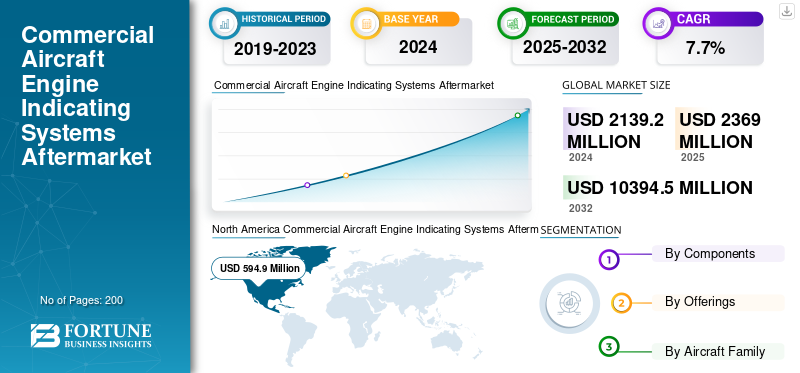
The global commercial aircraft engine indicating systems aftermarket size was valued at USD 2,139.2 million in 2024 and is projected to grow from USD 2,369.0 million in 2025 to USD 10,394.5 million by 2045, exhibiting a CAGR of 7.7% during the forecast period. North America dominated the global commercial aircraft engine indicating systems aftermarket with a market share of 27.8% in 2024.
For safe and effective engine operation, the aircraft's oil, starting, and indication systems are important. Oil systems cool and lubricate parts to stop wear, starting systems provide the initial power to start the engine, and indicator systems give real-time performance and safety data. The market for MRO and reconditioned parts for these systems extends engine lifecycles while guaranteeing dependability, economy, and adherence to aviation safety regulations. The need to extend aircraft lifecycles, increased air passenger traffic, and stringent aviation safety regulations necessitating routine maintenance and rapid replacement of critical engine subsystems driving the market for commercial aircraft engine indicating systems.
Key players like Honeywell International, Collins Aerospace, Safran, Parker Hannifin, Rolls-Royce, GE Aerospace, Lufthansa Technik, and MTU Aero Engines are providing cutting-edge MRO services, creating certified and refurbished parts to cut costs, and investing in digital diagnostics and predictive maintenance technology, driving the market growth.
Download Free sample to learn more about this report.
Commercial Aircraft Engine Indicating Systems Aftermarket Key Takeaways
 Market Size & Forecast
- 2024 Market Size: USD 2,139.2 million
- 2025 Market Size: USD 2,369.0 million
- 2045 Forecast Market Size: USD 10,394.5 million
- CAGR: 7.7% from 2025-2045
 Market Share
- North America dominated the market with a 27.8% share in 2024.
- The engine oil systems segment accounted for the largest market share.
- The MRO services segment dominated the market by service type.
 Key Regional Highlights
North America
North America reached USD 594.9 million in 2024, supported by a large active aircraft fleet and established MRO hubs.
Europe
Europe held the second-largest market share due to large Airbus fleets and growing adoption of reconditioned components.
Asia Pacific
Asia Pacific is expected to witness the fastest growth, driven by expanding aircraft fleets in China and India.
U.S.
Strong demand for engine maintenance services and extensive airline operations continue to support market growth.
Japan
Increasing aircraft fleet modernization and focus on aviation safety are driving aftermarket demand.
Read More

Market Dynamics
Market Driver
Rising Air Traffic and Aging Fleets Drive Demand for Commercial Aircraft Engine Indicating Systems
The growing global aviation traffic, raising flight cycles and operating hours, is placing more strain on engine subsystems and driving the commercial aircraft engine indicating systems aftermarket Additionally, the high cost of purchasing new aircraft and the delays in delivering new models have led airlines and operators to seek dependable maintenance and refurbishment solutions to prolong the service life of their current fleets. Thus, to guarantee operational safety and performance, stringent aviation safety rules also require regular reformation, repairs, and replacements of crucial equipment, including engine indications, lubrication units, and starters.
Additionally, airlines can improve maintenance budgets without sacrificing safety due to the growing use of affordable used parts rather than new replacements, which sustains demand for MRO and refurbishment services globally.
- For example, in July 2025, MTU Aero Engines announced a 41% increase in operational profit for the second quarter, reaching about USD 420 million, primarily driven by robust sales of commercial maintenance and replacement parts. Delays in the delivery of new aircraft result in a spike, which leads to older engines having to remain in service longer and raises the demand for MRO.
This contract highlights how important it is to maintain vital engine subsystems like starters, lubrication systems, and indication systems.
Market Restraints
High Maintenance Costs and Supply Chain Challenges Restrict Market Growth
The high costs of maintenance, repair, and overhaul services frequently put pressure on airlines with less profit margins, hindering the commercial aircraft engine indicating systems aftermarket. Supply chain interruptions due to the ongoing Russia-Ukraine conflict and increasing regional tensions also cause delays and longer turnaround times for MRO operations, especially to procure specialty parts like sensors, lubricants, and starter parts.
Further, strict regulatory approvals for reconditioned parts, long certification procedures are required to comply with safety and airworthiness norms, which slow down the market growth.
- For instance, in January 2025, Peter Barrett, CEO of the aircraft lessor SMBC Aviation Capital, stated that “almost every aircraft being delivered by Boeing and Airbus is delayed” due to supply chain challenges.
Market Opportunities
Rising Demand for Cost-Effective Lifecycle Extension Offers Significant Potential
The market for commercial aircraft engine indicating systems aftermarket is expected to grow significantly as airlines and operators seek to extend the lifespan of aging fleets while controlling costs. Resulting, demand for dependable and reasonably priced MRO services is increasing, especially in developing nations where reconditioned parts offer a more cost-effective option to costly OEM replacements, since worldwide aviation passenger volume is expected to quadruple by 2040.
Additionally, digital predictive maintenance tools have made it possible to identify early failures in engine subsystems. This presents a cost-effective potential for both new and current MRO players to offer value-added services that improve safety and save downtime.
- For Instance, in August 2024, the U.S. Navy selected StandardAero as the prime contractor for depot-level MRO services on the Rolls-Royce T56-A-427A engine, which powers E-2D Advanced Hawkeye aircraft. The contract is worth about USD 316 million and includes four option years in addition to the base year. For essential engine parts like starters and lubrication systems, this includes thorough maintenance and overhaul services.
Aircraft Engine Indicating Systems Aftermarket Market Trends
Digitalization & Predictive Maintenance in Engine Subsystems are Shaping the Market Trend
Integration of state of the art digital technologies and predictive maintenance techniques into commercial aircraft engine indicating systems to increase productivity and decrease unscheduled downtime. Additionally, airlines and MRO providers are using engine parameters to display oil flow, starter dependability, and signaling system performance using IoT sensors, AI-powered analytics, and real-time health monitoring technologies more and more. By allowing condition-based maintenance (CBM) in place of planned checks, this change increases safety and adherence to strict aviation standards and reduces operating expenses.
Moreover, operators are increasing the utilization of reconditioned parts supported by data-driven traceability, resulting in speeding up the adoption of USM & PMA.
Download Free sample to learn more about this report.
Impact of Russia-Ukraine Conflict
Russia-Ukraine War Disrupts Supply Chains but Boosts Demand for Independent MRO & Refurbished Parts
Sanctions restrict the sale of aerospace components and spare parts to Russia. The Russia-Ukraine conflict has caused disruptions in the worldwide supply chain for aircraft engine maintenance, repair, and overhaul (MRO) and reconditioned parts, particularly for indicating, oil, and starting systems. Due to shortages, many Russian airlines that were previously largely dependent on Western OEMs such as Safran, Honeywell, and Collins Aerospace for engine subsystems have been forced to turn to secondary markets and part cannibalization in order to maintain fleet operations.
Moreover, airlines in Europe, the Middle East, and Asia-Pacific have increased their demand for Western MRO providers in an effort to expand their suppliers and obtain reliable aftermarket service. In addition, it is anticipated that this geopolitical environment will pressure supply chains, increase prices for operators globally, and accelerate the expansion of independent MRO providers and reconditioned parts sellers.
- For Instance, in February 2024, Reuters reported that sanctions on Russia are significantly impacting the availability of titanium and other essential engine materials, which is having a significant impact on MRO operations and part refurbishing cycles for global aerospace providers.

SEGMENTATION ANALYSIS
By Component
Surging Demand for Engine Cooling, Lubrication, and Efficiency Fuels the Engine Oil Systems Segment’s Growth
Based on component, the market is divided into the engine indicating systems (temperature sensors, speed sensors, pressure sensors, flow measurement, system interface, and advanced sensors/monitors), engine oil systems (oil tanks, pumps, coolers, sensors, filters, deaerators, monitors), and starting systems (starters, ignition systems, control units).
The engine oil systems segment dominates the commercial aircraft engine indicating systems aftermarket due to the rising need for engine cooling, lubrication, and performance optimization, which necessitates frequent servicing and replacement of parts. Regular oil filter replacements, pump overhauls, and lubrication system refurbishments are in high demand as a result of airlines' pressuring aircraft to operate at higher utilization rates.
- For Instance, in June 2024, IATA reports that airlines will operate approximately 39 million flights in a given year, reflecting the scale of global operations.
- For Instance, in January 2025, ACI World passenger travel outlook indicates that global demand will continue to rise on track to reach 12 billion passengers by 2030, with strong growth waves from the Asia-Pacific and Middle East regions.
By Offering
High Frequency of Inspection, Overhaul, and Maintenance Cycle Fuels MRO Service Segment’s Growth
The offering segment divides the market into MRO Services and Refurbished Parts (USM and PMA) segments.
Airlines mostly depend on routine inspection, overhaul, and preventative maintenance to guarantee operational safety and compliance with stringent aviation rules, resulting in the MRO services segment dominating the commercial aircraft engine indicating systems aftermarket. Owing to their extreme sensitivity and direct influence on engine parameters, optimal fuel economy, and safety engine monitoring technologies, these subsystems require constant maintenance. The demand for MRO services has increased as operators place a higher value on longer service lives and less downtime than expensive replacements.
- For Instance, in June 2025, Boeing in its 2025 Commercial Market Outlook stated that the global commercial fleet is expected to nearly double, growing from about 27,400 aircraft in 2024 to over 49,600 by 2044.
Highlighting the demand for MRO services will surge as operators prioritize extended service life and reduced downtime over costly replacements.
By Aircraft Family
Boeing 737 Family Dominates the Market Due to Large Fleet Size and Regulatory-Driven System Upgrades
Based on aircraft family, the market is segmented into Airbus A220 (ex-CSeries), Airbus A320 Family (ceo/neo), Airbus A330 (ceo/neo), Airbus A350, Airbus A380, ATR 42/72, Boeing 737 Family (Classic/NG/MAX), Boeing 747, Boeing 767, Boeing 777, Boeing 787, Bombardier CRJ Series, COMAC C919, De Havilland Dash 8 (Q-Series), Embraer E-Jets (E1/E2), and Sukhoi Superjet 100.
Owing to its large global fleet size and high utilization rates, the Boeing 737 Family (Classic/NG/MAX) dominates commercial aircraft engine indicating systems aftermarket growth. Boeing 737s continue to be the most commonly used aircraft family in the world, with over 8,000+ aircraft in active service globally. This aircraft is mostly used on short- and medium-haul routes, where higher flight frequencies result in increased wear on vital engine subsystems. Resulting, 737 is on priority for maintenance by airlines and MRO providers due to its low cost, readily available refurbished components, and standardized service methods that expedite turnaround times.
Furthermore, a significant backlog of new deliveries and the continuous return of 737 MAX aircraft into service guarantee a steady demand for MRO and refurbished parts support, further driving the 737's market growth.
- For Instance, in July 2025, the Directorate General of Civil Aviation (DGCA) of India ordered all Indian airlines to examine the fuel switch locks on their fleet of Boeing 737 and 787 aircraft.
In order to guarantee passenger safety and operational dependability, this safety requirement emphasizes the significance of routinely servicing and rebuilding crucial engine subsystems, particularly those specific to the 737 series, further fueling the segment growth.
Commercial Aircraft Engine Indicating Systems Aftermarket Regional Outlook
Commercial Aircraft Engine Indicating Systems Aftermarket is studied across North America, Europe, Asia-Pacific, the Middle East & Africa, and Latin America
North America
North America holds the largest commercial aircraft engine indicating systems aftermarket share because of its sizable active fleet, dominated by Boeing aircraft, and has developed MRO hubs in the U.S. and Canada. Europe holds the second-largest share, due to its large fleets of Airbus aircraft, more stringent regulations, and growing use of reconditioned parts to lower lifespan costs. With China and India's rapidly rising fleets and the rebound in domestic air travel, the Asia Pacific region is anticipated to be the fastest-growing segment, resulting in increased demand for component-level MRO services.
North America Commercial Aircraft Engine Indicating Systems Aftermarket Size, 2024 (USD Million)
To get more information on the regional analysis of this market, Download Free sample
In contrast, the Latin American industry is expanding gradually due to fleet modernization initiatives and the increased usage of third-party MRO providers, while the Middle East and Africa market is expanding steadily due to investments in regional hubs like Dubai and Qatar.
- For example, in March 2025, the state government of Odisha authorized an incentive package worth over USD 9.6 million to build a large aircraft maintenance and repair facility at Bhubaneswar's Biju Patnaik International Airport.
Showcasing the fast-growing domestic aviation industry demand.
Competitive Landscape
Key Market Players
OEM Dominance Coupled with Independent MRO Growth and Refurbished Parts Demand is shaping the Market
The commercial aircraft engine indicating systems aftermarket is categorized by strong competition among OEMs such as Pratt & Whitney, GE Aerospace, and Rolls-Royce, controlling proprietary technologies and OEM-certified parts to maintain dominance. Particularly for aged fleets, independent MRO providers such as ST Engineering, Lufthansa Technik, and Air France–KLM Engineering & Maintenance are growing their capacity to provide affordable aftermarket services.
In the meantime, suppliers of reconditioned parts, such as AAR Corp. and AJW Group, are growing in popularity as a result of the growing need for reasonably priced replacement parts. Moreover, the environment is being shaped by strategic alliances, capacity increases, and digital MRO solutions, guaranteeing that both independent and OEM-backed companies continue to be important in fulfilling the demands of fleet maintenance around the world.
LIST OF KEY COMMERCIAL AIRCRAFT ENGINE INDICATING SYSTEMS AFTERMARKET PLAYERS
| SR. No | MRO Service & Refurbished Parts Company | MRO Service Providers | Refurbished Parts Suppliers | |
| 1 | Lufthansa Technik (Germany) | GE Aerospace (U.S.) | Moog Inc. (U.S.) | |
| 2 | ST Engineering (Singapore) | Rolls-Royce (U.K.) | Collins Aerospace (Intertrade) (U.S.) | |
| 3 | AAR Corp. (U.S.) | Pratt & Whitney (U.S.) | VSE Corporation (U.S.) | |
| 4 | AJW Group (U.K.) | Safran Aircraft Engines (France) | HEICO Corporation (U.S.) | |
| 5 | StandardAero (U.S.) | MTU Aero Engines (Germany) | GA Telesis (U.S.) | |
| 6 | AerSale (U.S.) | Delta TechOps (U.S.) | ||
KEY INDUSTRY DEVELOPMENTS
- For Instance, in July 2024, GE Aerospace announced that it would invest USD 1 billion over five years to upgrade and expand its global MRO and component-repair facilities, including capabilities that support engine subsystems like fuel, oil, ignition, and test cells, in order to increase capacity and decrease turnaround times.
- For Instance, in September 2023, an ST Engineer signed a multi-year contract with Lion Air Group for MRO of the LEAP-1B engine. Expanding its engine-component capability (covering fuel, oil, ignition, and related modules) to support Boeing 737 MAX operators in the region.
- For instance, in October 2023, Honeywell and Triumph Group signed a long-term agreement to manufacture and maintain boost pumps, electronic control units, and hydromechanical fuel controls for several platforms. This deal secures supply and maintenance capacity for critical fuel and engine subsystems.
- For instance, in August 2024, StandardAero was chosen as the main depot-level MRO contractor for the U.S. Navy’s Rolls-Royce T56-A-427A engine. The contract is valued at approximately USD 316 million and spans multiple years. It includes overhaul work on starters, pumps, and accessory systems.
REPORT COVERAGE
The research report delivers a detailed analysis of the market and emphases key aspects such as key players, offerings, objects, and end-users of the commercial aircraft engine indicating systems aftermarket. Moreover, the report deals with insights into commercial aircraft engine indicating systems aftermarket trends, competitive landscape, market competition, product pricing, regional analysis, market players, competition landscape, and the market status, and highlights key industry growth. In addition to the factors stated above, the report encompasses several direct and indirect influences that have subsidized the sizing of the market in recent years.
Request for Customization to gain extensive market insights.
Report Scope & Segmentation
| ATTRIBUTE | DETAILS |
| Study Period | 2019-2045 |
| Base Year | 2024 |
| Forecast Period | 2025-2045 |
| Historical Period | 2019-2023 |
| Growth Rate | CAGR of 7.7% from 2025 to 2045 |
| Unit | Value (USD Million) |
|
Segmentation
By Region |
Component, Offerings, and Aircraft Family |
|
By Component
|
|
|
By Offerings
|
|
|
By Aircraft Family
|
|
|
Frequently Asked Questions
According to the Fortune Business Insights study, the global market was valued at USD 2,139.2 million in 2024 and is anticipated to be USD 10,394.5 million by 2045.
The market will likely grow at a CAGR of 7.7% over the forecast period (2025-2045).
The top ten players in the industry are Lufthansa Technik, ST Engineering, AAR Corp., AJW Group, StandardAero, AerSale, GE Aerospace, Rolls-Royce, Pratt & Whitney, and Safran Aircraft Engines based on parameters such as Services Portfolio, Regional Presence, and Industry Experience.
North America dominated the global Commercial Aircraft Engine Indicating Systems Aftermarket in 2024, with USD 594.9 million, and is expected to continue leading the market, reaching an estimated USD 2,102.8 million by 2045.
Rising Air Traffic and Aging Fleets Drive Demand for Engine Indicating, Oil & Starting Systems MRO and Refurbished Parts
High maintenance costs and supply chain challenges restrict market growth.



- 2019-2045
- 2024
- 2019-2023
- 200
Get 30-60 hrs Free Customization
Expand Regional and Country Coverage, Segments Analysis, Company Profiles, Competitive Benchmarking, and End-user Insights.




















Related Reports
-
US +1 833 909 2966 ( Toll Free )
-
Get In Touch With Us